The magic of waking up slowly in nature
Why the morning rituals around the van often form the most beautiful moment of the trip.
Ardennen
By Laurens De Leeuw · 20 June 2026
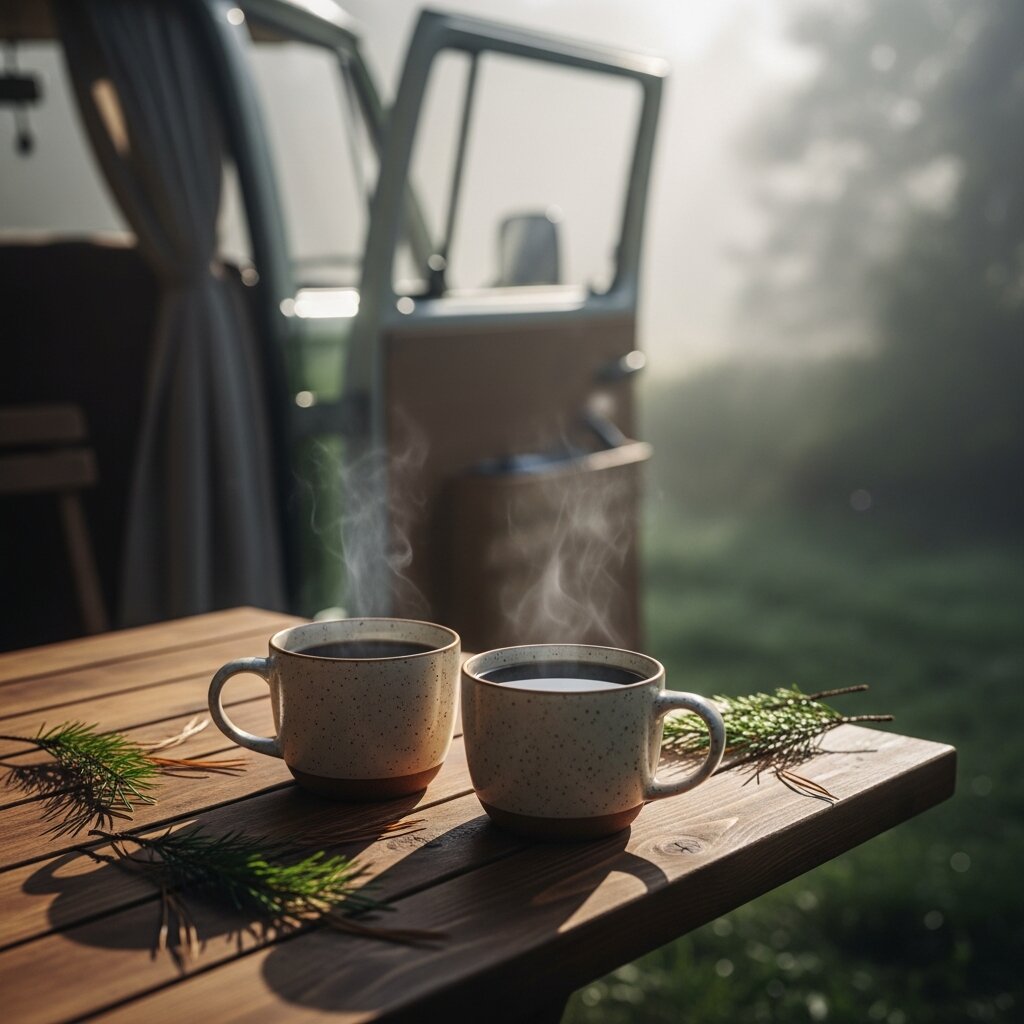
There are moments on the road that you almost automatically remember. A sunset over the High Fens. The first bend as you drive into the Semois valley. An evening at the edge of an Ardennes forest, with just enough light to see the mist hanging over the grass. Or that one view that makes you think afterwards: yes, that's what we do it for.
But the longer I've been on the road with the van, the more I notice that it's not always those big moments that stick.
Sometimes the most beautiful memory isn't in the spectacular view, but in the dimly lit fifteen minutes just after waking up. In the sound of a gas burner igniting. In the first cup of coffee, still far too hot, held between two cold hands. In the condensation on the windows. In the careful opening of the sliding door, as if you don't want to startle the day.
For me, that has become one of the greatest riches of traveling with the van: not arriving, not departing, but waking up.
Waking up slowly.
Not because you have to. Not because an alarm clock goes off. Not because the agenda says the day has begun. But because the world around the van slowly comes to life and you, with your duvet still half over your legs, are simply allowed to witness it.
I remember a morning in the Ardennes that was actually nothing special. And that's precisely why it stayed with me.
We were at a small, permitted overnight spot at the edge of a forest. No luxury campsite, no place with a swimming pool or entertainment, no perfectly laid out pitch with numbered sections. Just a quiet place where you were allowed to stay, with some gravel, a few trees, a narrow path to the forest, and otherwise mostly a lot of silence.
We had arrived late the evening before. It had rained. Not heavily, but that persistent fine rain that makes everything damp without you really knowing when it started. We had quickly eaten something in the van: soup from a pot, bread with it, a piece of cheese that should have actually been eaten a day earlier. Then we stood outside for a bit with our jackets zipped up, looked at the dark trees, and then went inside. The van felt small, warm, and safe.
During the night, I had heard the rain on the roof a few times. That's a sound you don't hear the same way at home. In a house, rain is something outside. In a van, rain is close. It taps above your head, runs down the window, collects somewhere at an edge, and then suddenly falls in thicker drops. Sometimes it sounds like you're lying right in the middle of the weather. And maybe you are.
When I woke up, it was still early.
Not early like on a workday, when early mostly means you'd rather stay in bed. But early like outdoors, when the day has already begun without making a sound. The van was cool. My nose felt cold, but under the duvet, it was wonderfully warm. I stayed lying down, with my eyes half-open, and listened.
That is often the first ritual of the morning: listening.
No radio. No phone notifications. No traffic passing through the street. Only small sounds. A bird somewhere behind the van. A drop falling from a branch. The light creaking of wood or metal as the van cools down or warms up a bit. Far away, perhaps a tractor, or maybe just the wind between the trees.
Inside the van itself, everything was still night. The curtains were closed. On the cabinet was a cup from the night before, with a brown coffee stain inside. My sweater lay over the passenger seat. A pair of wet socks hung in a place where they were supposedly drying, though I already knew at that moment that they were mostly just hanging there pretending.
That's vanlife too. Not just the view and the freedom, but also socks that don't dry, a towel that's always a bit in the way, and searching for a dry spot for your shoes.
I stayed lying down for a bit longer.
I used to find that difficult. Especially at the beginning of our van trips. Then I wanted to move forward. Get somewhere. See as much as possible. The day had to be utilized. If we were in the Ardennes, we had to hike. If we were at the coast, we had to go to the beach. If we were in France, we had to drive to the next village, the next market, the next view.
I thought freedom meant you could do a lot.
But on the road, I've learned that freedom sometimes means you don't have to do anything at all.
That sounds simple, but it requires practice. Especially if, like many people, you're used to cutting days into pieces: work, appointments, traffic, shopping, cooking, quickly arranging something, sleeping, and starting over. With the van, you easily bring that habit with you. You drive to quiet places, but remain busy inside yourself.
Until nature gently calls you to order one morning.
That morning in the Ardennes, it happened without big words. Simply by lying there. By feeling that nothing was urgent. The coffee could wait another five minutes. The route too. The hiking boots too. Even the day itself was in no hurry.
Eventually, the moment came when I did sit up. That's never elegant in a van. You almost always bump into something. An elbow against a cabinet, a knee against the table, your hair going in all directions. Anyone who says vanlife is always romantic has never tried to get dressed in a cool van without losing their balance.
I slid the curtain open a little.
The world outside was grey-blue and still. Mist hung between the trees, low to the ground. Not an impressive misty landscape that makes you immediately grab your camera, but a soft veil, as if the forest wasn't quite awake yet. The gravel in front of the van was dark from the rain. Thousands of small drops stood on the windshield. The trees barely moved.
I put water on.
For some people, coffee is just coffee. For me, coffee in the van is the start of the day. Not because I'm not human without caffeine, though some might dispute that, but because making it is a ritual that doesn't rush you anywhere.
Water in the kettle. Gas open. Click. Click again because the flame doesn't catch immediately. Then that small blue flame, the soft rustling, the first warmth spreading. While the water heats up, I look for the coffee, the filter, the cup. Everything has its place, except on days when you're sure you put it there and it turns out to be behind a bag of pasta.
A van teaches you patience, even if it's sometimes against your will.
As the water began to sing, I wiped a small patch of condensation from the window with my sleeve. Not clean, but enough to look outside. Condensation is a constant travel companion in the in-between seasons. You can complain about it, and I do occasionally, but somewhere I even find it beautiful. It's a sign that you really slept there. That your breath lingered in that small space all night. That the van isn't just a vehicle, but a home for a while.
I poured the water over the coffee and waited.
That waiting is also good. At home, we press buttons. On the road, we wait. For hot water. For sun. For dry clothes. For a shower to pass. For the moment you know whether you'll stay or leave. In that waiting, there is often more peace than in the coffee itself.
With the cup in my hands, I slid the door open.
There are few sounds that, for me, are as much a part of van travel as a sliding door opening in the morning. That heavy rolling, that brief hesitation, and then suddenly more air. The fresh morning came right in. Not cautiously, just straight to my face. Cold air, wet wood, forest floor, leaves. The smell of a place that doesn't try to impress, and precisely because of that, it does.
I remained sitting on the edge of the van, my feet still inside. The ground was wet, and I didn't feel like cold socks. Before me lay the small clearing. A few deep tire tracks in the gravel. A wooden fence. Trees that were still dripping. Nothing else.
No view that belonged on a postcard. No mountaintop, no lake, no dramatic sunbeams. Just Belgium at its best: a bit damp, a bit subdued, a little rough around the edges, but honest and beautiful.
I took a sip of coffee and burned my tongue. Like almost every morning. Apparently, that's a ritual too.
There I sat.
That moment, with the cup of coffee in my hands and the van behind me, is difficult to explain to someone who has never experienced it. It's not a spectacular bliss. You won't shout about it. It's quieter than that. It's more a kind of deep contentment. A feeling that, for just a moment, you are in your place.
Not because the place is yours. On the contrary. It is precisely not. You are a guest there. That realization makes it more beautiful. You don't have to own the place to enjoy it. You don't have to put a fence around it, build a terrace, or take a photo to prove you were there. You can just sit, look, drink coffee, and leave again soon without leaving a trace.
That last part has become increasingly important to me.
For me, vanlife is not about just parking anywhere because you can. It's about freedom with manners. About knowing when you're welcome and when not. About not making noise at an hour when the neighborhood is still asleep. About not leaving trash behind. About not setting up camp where it doesn't fit. About leaving a place cleaner than you found it, if possible.
The morning is a good time for that. Then you see what you leave behind. A cap under the van. A piece of paper that fell out of your jacket pocket. Crumbs on the ground. A wet spot you'd better not drive over again. In the silence of the morning, you quicker feel what respect means.
After coffee, the second part of the morning began: slowly transforming the van from night to day.
That sounds more practical than it is. In a small van, everything is a bit of a ceremony. The bed becomes a bench again. The duvet is fluffed up. The pillow disappears to the back. The table is unfolded. The sleeping bag or blanket needs to air out, but not too far outside, because everything is still damp. The windows are wiped dry. A wet jacket gets a better place. A cabinet that stayed closed at night suddenly falls open anyway.
Every action is small, but together they make the day.
I find that beautiful about a van. You live in a space that you constantly remake. In the evening, you turn it into a bedroom. In the morning, a kitchen. An hour later, perhaps a place to read. Then a vehicle again. You automatically become aware of what you need. Not much, actually. A warm place to sleep. Something to cook on. Water. A cup. A knife. A small board. A place for dry socks, though that last one remains a continuous challenge.
When the van had become a living space again, I made breakfast. Bread, cheese, an apple, and jam from a pot that was sticky at the edge. Nothing special. Yet such a breakfast outside always tastes better than at home. Perhaps because there's no rush. Perhaps because you have to make a little effort for it. Perhaps because the air is fresher and your hands are still cold.
I sat down again in the doorway and ate slowly.
Eating slowly, looking slowly, waking up slowly. These are things we sometimes forget at home. Not because we don't want to, but because the day often immediately sweeps us along. On the road with the van, you can briefly hold back that speed. Not always. Sometimes it rains too hard, sometimes you have to refill water, sometimes you've slept badly, sometimes you're in a parking lot where the first truck starts its engine at six o'clock. But if it works, if the place is quiet and the morning gives you time, then you shouldn't give it away too quickly.
The sun hesitantly broke through the trees. First, only the light changed. The grey softened. Then a thin golden edge appeared on a branch. A few drops began to glisten. The mist slowly lifted. The forest didn't seem to suddenly wake up, rather as if it was stretching.
I thought about how different mornings in nature are from home.
At home, I often wake up with thoughts. What needs to be done today? What emails are waiting? What have we forgotten? Where do we need to be on time? On the road, I wake up with senses. Is it cold? Is it windy? Does it smell like rain? Are there birds? Is the van still somewhat level? Is there coffee?
That's a different kind of beginning.
And perhaps that's why those mornings stick with you so much. They don't immediately put you in your head, but first in your body. You feel the cold floor. You put on a sweater. You hear water boiling. You warm your hands on a cup. You step outside and notice if the ground is hard, wet, sandy, or muddy. You're not concerned with all the things you need to be. You just are.
After breakfast, I did the dishes. That's another small ritual that I almost enjoy taking time for on the road. A little warm water, not too much, because you know what's left in the tank. A little soap. First the cup, then the knife, then the small board. Rinse, dry, put away. Secure everything for the drive. Don't leave anything lying around, because every loose spoon later becomes a percussion instrument as soon as you drive over a bad road.
Anyone who travels with a van quickly learns that order is not a luxury. Order is peace. And sometimes just less noise.
Then I put on my shoes and really stepped outside. I walked a few meters away from the van and turned around.
I often do that.
There's something special about seeing your own van standing in a landscape. Not because it's big or impressive. Usually, it's not. It might be dirty, parked a bit crooked, with mud on the wheel arches and a towel behind the window. But still. There stands your small home on wheels. Everything you need fits in it. Your bed, your coffee, your raincoat, your map, your supplies, your memories from previous days.
In the evening, the van is a shelter. In the morning, it's a starting point.
I looked at the drops running from the roof. At the open window. At the trail of wet leaves on the tires. And I felt gratitude. Not loud, not exaggerated. Just gratitude for the fact that this was possible. That we could wake up in a quiet place with few belongings. That the day was still wide open.
A little further on, the door of another van opened. Someone came out with a hat on and a face that was clearly still in the startup phase. We looked at each other and nodded. Nothing more was needed.
That's also something I appreciate about people on the road. The best encounters often begin without many words. A nod. A brief "good morning." Later, perhaps a chat about the route, about water points, about a nice hike or a place where you'd better not park. But in the morning, everyone understands that coffee comes first.
There's a lot of connection in that small recognition.
Everyone who travels with a van knows the same small inconveniences. A bed that isn't tidied yet. Condensation on the windows. A wet jacket that doesn't hang well anywhere. Coffee spilling at the wrong moment. The search for a level spot. The slight panic when you think you've lost the key, while it's just in your jacket pocket. The satisfaction when everything is finally secured and you can leave without rattling.
These aren't grand adventures, but they are the things that make up life on the road.
By the time the van was ready to leave, the morning had actually already well begun. Most items were stowed away. The trash bag was closed. The dishes were done. The windows were more or less clear. I checked around the van again to see if anything was left behind. No trash, no cap, no lost piece of paper. I picked up a small piece of plastic that wasn't ours, but that's not the point. If you see it and you can take it with you, then you take it with you.
Leaving a place clean is not a heroic act. It's just normal.
Still, I didn't leave yet.
I sat down one more time on the edge of the van, with the door open. The cup was empty, the coffee gone, the day ready. But I wasn't ready with the morning yet. And that's something I only learned after years of traveling: being ready to leave doesn't mean you have to leave immediately.
Sometimes you can stay a little longer.
Not to do anything else. Not to take another photo. Just not to break off the moment too abruptly. Nature has taken its time to wake up. Then you can do that too.
I sat there for another fifteen minutes. Maybe longer. The sun had now reached the clearing. The air became lighter. The birds sounded more active. There was some movement on the path. Someone walked by with a dog. We said hello. The dog looked at the van for a moment, decided there was probably no food to be had, and walked on.
Everything was ordinary. And precisely because of that, it was beautiful.
I think that on the road, we sometimes search too hard for exceptional moments. We want the most beautiful spot, the quietest parking, the best view, the most special route. I understand that. I still do it myself. But if I'm honest, the moments that touch me most often need little.
A safe place where you're allowed to stay. A quiet morning. Coffee. Fresh air. Time. A van that still smells of night. A day that is not yet filled.
It doesn't always have to be more than that.
Of course, there are also less pleasant mornings. Let's not be coy about that. Mornings when everything is damp. Mornings when you wake up because the wind is tugging at the van. Mornings when the coffee is gone and you wonder how you could have let that happen. Mornings in a parking lot along a busy road, because there was no better option yesterday. Mornings when you've slept badly because the van wasn't as level as you thought.
But even then, there's something about that life on the road that keeps attracting me.
Perhaps because you live closer to reality. Comfort is there, but not unlimited. Water doesn't just come out of the wall without you thinking about it. Warmth requires attention. You have to create space. You have to take your trash with you. You quicker feel what you use, what you need, and what is actually superfluous.
That makes the morning simpler, but also richer.
A cup of coffee isn't just coffee if you first put water on in a cold van. A dry sweater isn't a detail if the previous one still feels damp. A ray of sun on your face feels better when you've had a cool night. Small things regain their weight.
That is perhaps the true magic of slow travel: you start paying attention again to what is close at hand.
Not just to the destination, but to getting up. Not just to the route, but to the moment before you leave. Not just to what you've seen, but to how you were present somewhere.
That morning in the Ardennes, I eventually only left around noon. The plan, however, was different. We would drive early, do a hike somewhere, then shop in a village and perhaps travel a bit further. But the morning had slowed us down. Not in an annoying way. In a good way.
We drove away with a clean place left behind us and a peaceful day ahead of us.
In the mirror, I saw the clearing grow smaller. A moment later, it had disappeared behind the trees. Nothing of us remained, I hope. No trash, no noise, no trace that lingered longer than necessary. Only the memory of coffee, mist, and wet grass.
On the way, I thought about the question people often ask me: what is the most beautiful thing about traveling with a van?
Then I could answer with countries, regions, and routes. The Ardennes in autumn. The Gaume in summer. The coast out of season. The French back roads. The mountains, if we travel further. The small villages where you get bread from a baker who still has time for a chat.
But more and more often I think: the most beautiful thing is the morning.
Waking up without haste.
Opening your eyes in a small space that is your home for a while. Not immediately knowing what time it is. First listening. Then feeling how cool it is. Then putting water on. Making coffee. Opening the door. Looking. Not having to say anything. Letting the day in.
There, in that simple ritual, for me, lies everything that makes vanlife valuable.
Freedom, but not loud. Adventure, but not rushed. Nature, but with respect. Simplicity, but not poor. Time, but not empty.
Just waking up, somewhere in Belgium or beyond, with your van as a shelter and the world as your host.
And realizing that you don't have to go anywhere yet.
That is the magic.
Not the perfect photo. Not the longest route. Not the wildest story afterwards.
But the gentle beginning of a day.
The condensation on the window. The small flame under the kettle. The first sip of coffee. The feet on the ground. The view of your van from a few meters away. The round to check if everything is clean. Staying seated for a bit longer, even though you could leave.
Since I understand that, I travel slower.
And perhaps better too.
Because sometimes the most beautiful part of the journey doesn't begin when the engine starts.
Sometimes it begins in the silence before.