Full-time living in your van and a reference address with friends or family: how does that work in Belgium?
Anyone living full-time in a van will sooner or later encounter the question of where you are officially registered. What is a reference address, when is it possible, what is the difference with domicile, and what does it mean for the friend or family member helping you? An overview of the Belgian rules.
By Laurens De Leeuw · 21 June 2026
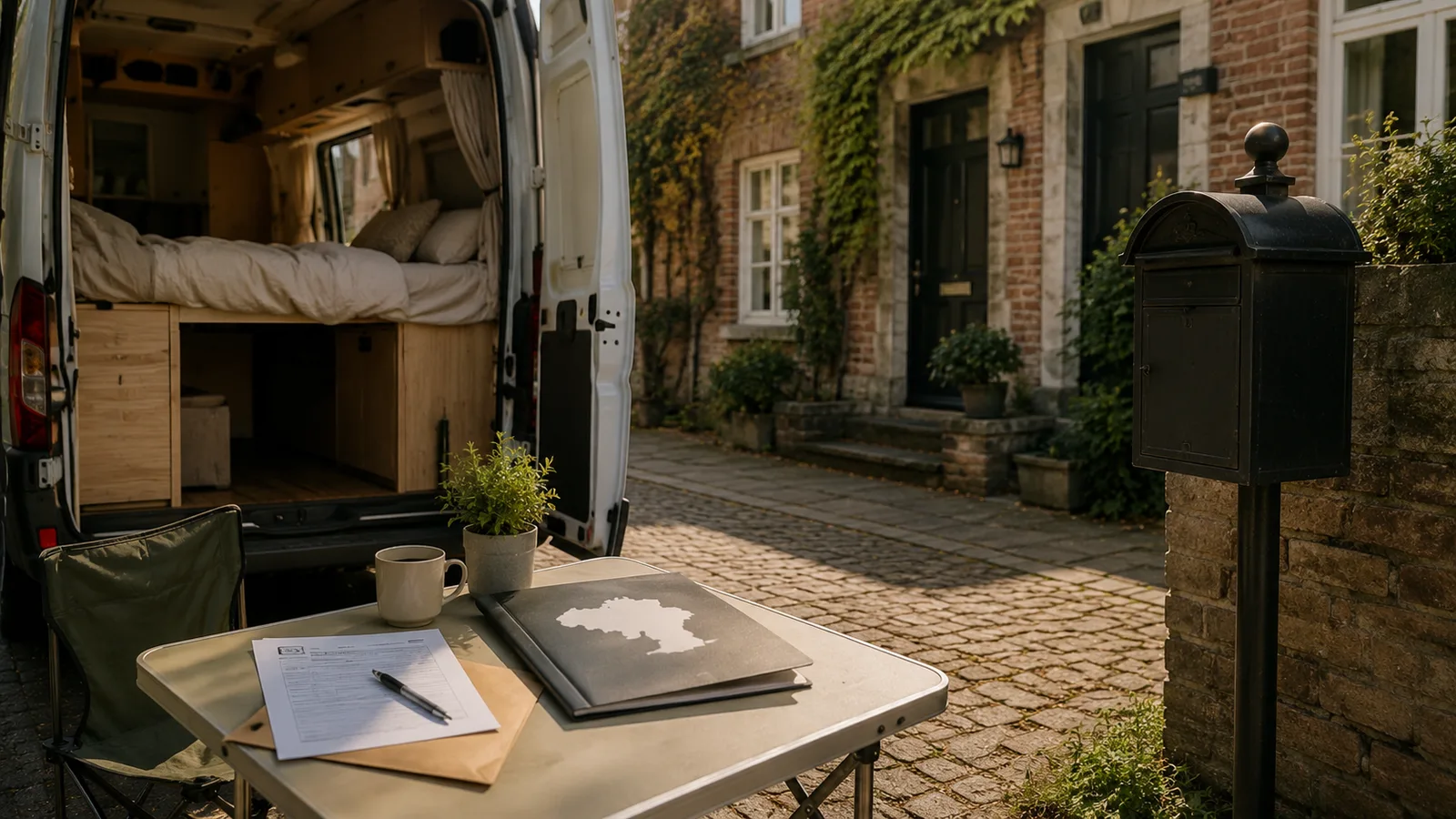
Anyone living full-time in a van will sooner or later arrive at the same question: where are you officially registered if you no longer have a permanent home? In Belgium, a reference address can sometimes be a solution, but it is not a free pass, nor is it a trick to be fictitiously domiciled somewhere.
For vanlifers, this is an important topic, as your official address affects your identity card, health insurance, taxes, driver's license, bank, insurance, benefits, elections, and official mail. Without correct registration, you can quickly run into administrative problems.
This article explains what a reference address is, when it is possible, what the difference is with domicile, what it means for the friend or family member helping you, and what you need to consider if you truly live in your van.
First the difference: domicile, main residence, and reference address
In Belgium, your main residence is the place where you usually live. That is not a free choice on paper, but a factual situation. The government therefore looks at where you actually spend most of the year, where you go after work, where your family lives, where your energy consumption is, and so on. Just saying you live somewhere is not enough. The municipality can check this, often through the neighborhood police officer.
A reference address is different. It is an administrative address for someone without a fixed place of residence. The address primarily serves to be reachable for official bodies and to receive mail. Vlaanderen.be gives examples of people who are homeless, live on a ship, or in a caravan. With a reference address, you can also maintain or open certain rights that require an official address.
The most important point: a reference address is not the place where you live. Vlaanderen.be explicitly states that the reference address may not be your place of residence or domicile and that you may not stay there permanently overnight.
Can you have a reference address as a full-time vanlifer?
In principle, yes, but only if your situation falls within the legal categories. According to the FPS Home Affairs, a reference address is strictly limited to certain groups, including people living in a mobile home, people who do not have a place of residence due to insufficient means of subsistence, certain detainees, and people who temporarily do not have a main residence for professional reasons.
For vanlifers, the mobile home category is particularly important. The FPS Home Affairs distinguishes between a truly movable home and a mobile home that has actually lost its mobile character, for example, because it is fixed in one place or attached to the ground. Those who travel with their mobile home may fall under the regulation. Those who remain in a fixed location are, in principle, registered at that fixed location and not via a reference address.
Practically, this means: if you truly live full-time in your van and move around for most of the year, a reference address with a friend or family member can be legally defensible. If your van is actually permanently in one fixed place, the municipality may decide that you have your main residence there or that another form of registration is required. The municipality assesses the concrete facts.
Reference address with a friend or family member
In practice, many people take a reference address with a parent, brother, sister, friend, or other trustworthy person. This is possible, but that person must have their main residence at that address and must give permission. Vlaanderen.be recommends making a written agreement clearly stating that it is a reference address, that you do not live there, and that the resident will deliver your mail.
The FPS Home Affairs emphasizes that a reference address cannot simply be a mailbox or poste restante. There must be someone who is effectively responsible for receiving and forwarding correspondence. If the person providing the reference address moves, a new application must be made.
For the friend or family member, this is often the biggest concern: will they be financially or fiscally affected? Official information states that a reference address with a private individual does not affect the benefits or taxes of that individual, as long as the person with the reference address does not actually reside there. The FPS Home Affairs also mentions that there is no actual cohabitation and that this has no impact on, for example, living wage or unemployment benefits.
This is an important caveat: you are not supposed to actually live there. If you regularly or permanently sleep there, it becomes a different situation. Then it is no longer a reference address, but possibly a main residence or cohabitation.
What if you are homeless or cannot afford housing?
There is a separate arrangement for people who are homeless or have no place of residence due to insufficient means of subsistence. In that case, a reference address with a private individual or with the OCMW (Public Centre for Social Welfare) may be possible. According to the POD Social Integration, the reference address is intended to maintain or open social rights, such as health insurance coverage, social benefits, unemployment, health insurance, or a valid identity card.
For a reference address via the OCMW, the OCMW must check whether you are entitled to social assistance, are homeless, and, in the OCMW context, have been officially removed from the population registers or that your existing registration no longer corresponds to reality. The POD Social Integration describes homelessness as the situation in which someone does not have their own housing, does not have the means to provide for it themselves and therefore has no place of residence, or temporarily stays with a private individual or in a shelter awaiting their own housing.
Anyone who wants a reference address with a natural person as a homeless person must, according to the POD Social Integration, first have written permission from that person. The OCMW must make a decision and cannot simply refuse because the municipality might decide differently about the registration later.
How does the application process work?
For a reference address with a private individual, you normally contact the resident and the municipality where you want to take the reference address. Vlaanderen.be mentions that it is best to draw up a written agreement and then contact the municipality for the necessary documents.
For a homeless procedure via the OCMW, you must go to the OCMW of the municipality where you usually reside. The POD Social Integration brochure explains that the OCMW must provide an acknowledgment of receipt, conduct a social investigation, and provide the information to the municipality if the conditions are met. The procedure generally takes 30 days at the OCMW, after which the municipality calculates approximately another 15 days for a reference address at the OCMW or 30 days for an address with a private individual.
After approval, there is follow-up. The POD Social Integration mentions mandatory quarterly follow-up for reference addresses at the OCMW and with private individuals.
Important for vanlifers: this is not permission to sleep anywhere
A reference address solves your administrative address, not your overnight stay question. It therefore does not give you the right to park, camp, or stay permanently anywhere. You must still take into account traffic rules, local police regulations, parking bans, nature rules, private property, and any rules of campsites or camping areas.
Even on private land, you need to be careful. Vlaanderen.be mentions with environmental permits that placing a movable facility such as a caravan, camper van, or tent without actually living in it may be exempt under certain conditions, but if a structure is inhabited, a permit is always required.
In other words: you cannot simply say that you are administratively registered with your parents and then permanently live in a van on a piece of land without looking at spatial planning, permits, and local rules.
What about your van itself?
If your vehicle has been converted into a camper van, mobility rules also play a role. Vlaanderen.be explains that a vehicle converted into a camper van and equipped with, among other things, sleeping facilities, cooking facilities, a table, chairs, and storage options may require a new individual approval certificate. According to that information, a camper van must have at least a table and chairs, sleeping facilities, cooking facilities, and storage options, and this equipment must be permanently fixed in the living area.
This is separate from your reference address but is relevant if you live full-time in a converted bus. Being administratively correctly registered is one thing. Keeping your vehicle correctly registered, insured, and inspected is another.
Practical example
Suppose: you sell your apartment, live full-time in your self-converted van, and travel around for most of the year. You want your official mail to be delivered to your parents. Then you can inquire with the municipality about a reference address with your parents as a natural person. Your parents must agree in writing, have their main residence at that address themselves, and be willing to forward your mail. You may not permanently live or sleep there, because then it is no longer a reference address.
Suppose, on the other hand, that you have lost your apartment, are temporarily sleeping in your van because you cannot afford housing, and you do not have a stable place of residence. Then the OCMW trajectory may become relevant. You then go to the OCMW of the municipality where you usually reside, ask for help regarding a reference address, and the OCMW investigates your situation.
Common misunderstandings
A reference address is not a domicile with your parents. It is an administrative address for someone without a fixed place of residence.
A reference address does not mean you can pretend to live somewhere when you don't. The main residence is determined by the facts.
A reference address with a friend or family member does not automatically make you cohabiting, as long as you do not actually reside there.
A reference address does not give you the right to stay overnight anywhere in Belgium with your van.
A fixed van, caravan, or bus in one fixed place can be viewed differently legally than a mobile home with which you actually travel around.
Conclusion
Full-time living in a van in Belgium is administratively more possible than many people think, but you have to approach it correctly. The keyword is honesty. If you truly live nomadically in a mobile home, a reference address with a friend or family member can be a solution. If you actually live with that friend or family, then a reference address is not appropriate, but a regular registration at your main residence. If you are homeless or have no housing due to insufficient means of subsistence, the path usually goes through the OCMW.
The best first step is always the same: explain your concrete situation to the population service of the municipality where you want to take the reference address. Ask what documents they need, ensure a clear written agreement with the person helping you, and avoid fictitious constructions.
Vanlife is about freedom, but your official administration must be solid enough not to lose that freedom along the way.
Sources
- Reference address — Vlaanderen.be
- The main residence — Belgium.be
- Change of address — Belgium.be
- FAQ reference address — FPS Home Affairs (IBZ)
- Brochure: The reference address (PDF) — POD Social Integration
- Instructions from 18/05/2020 — POD Social Integration
- Conditions OCMW registration at reference address — POD Social Integration
- Environmental permit: placing a movable facility — Vlaanderen.be
- Converting your vehicle into a camper van — Vlaanderen.be