Safe and discreet overnight stays: quick checklist to avoid causing nuisance
Vanlife in Belgium can work perfectly, as long as you have a good sense of where the line is between a quiet overnight stay and causing a nuisance. Because that is often the real difference. Not just "can I sleep here?", but especially: am I parked correctly, am I bothering anyone, am I leaving nothing behind, and am I not acting as if this parking lot is my campsite?
By Laurens De Leeuw · 25 June 2026
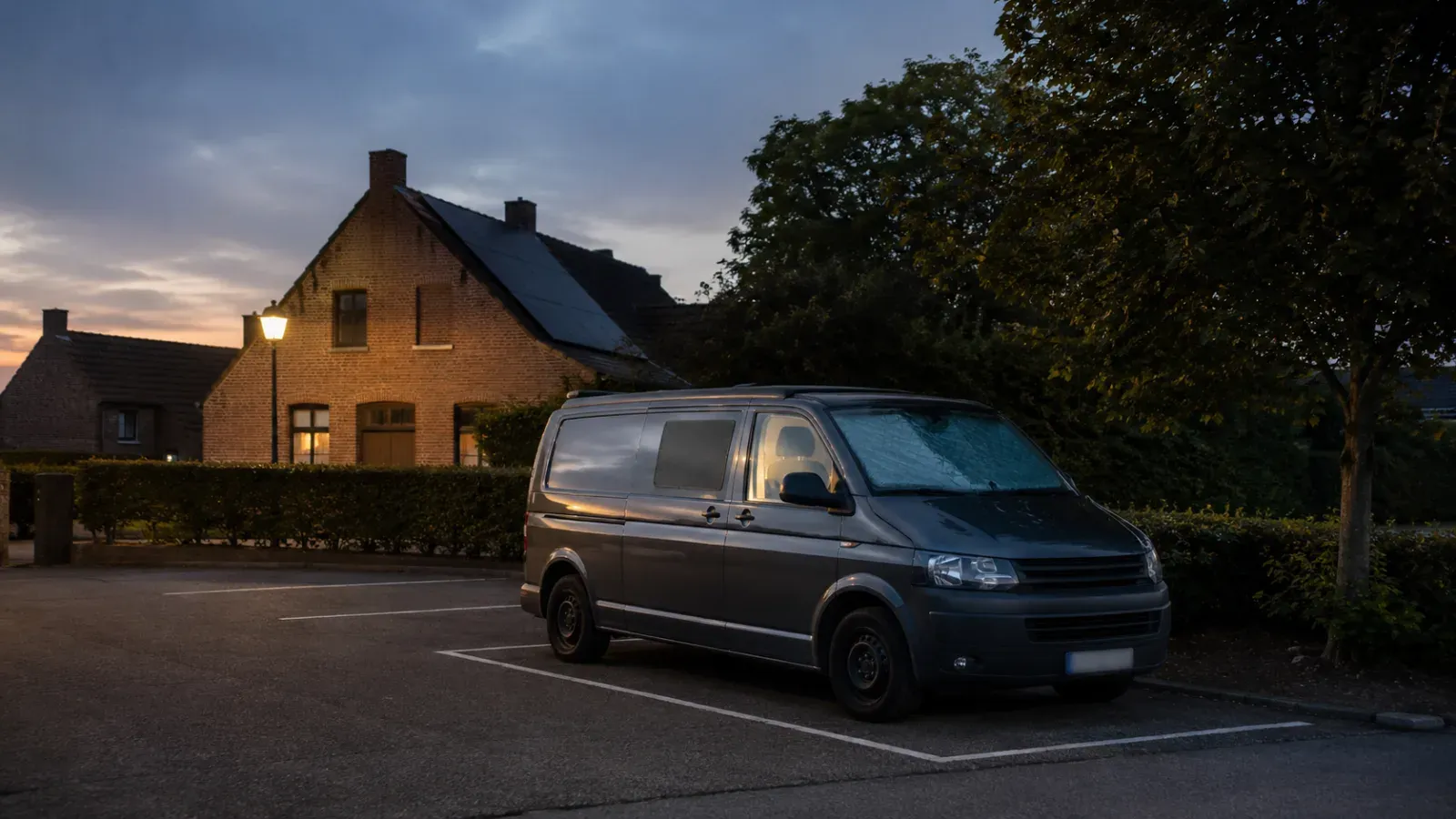
Vanlife in Belgium can work perfectly, as long as you have a good sense of where the line is between a quiet overnight stay and causing a nuisance.
Because that is often the real difference. Not just “can I sleep here?”, but especially: am I parked correctly, am I bothering anyone, am I leaving nothing behind, and am I not acting as if this parking lot is my campsite?
This article is a short practical checklist. No long theory, but the basics every vanlifer should know before staying somewhere overnight.
Sleeping in your vehicle is not automatically forbidden
In Belgium, there is no general prohibition against sleeping in a correctly parked vehicle. If you are tired and want to stop safely, resting in your car, van, or camper is usually wiser than continuing to drive.
But that doesn't mean you can just stay overnight anywhere.
You still need to consider:
- traffic signs
- parking rules
- local police regulations
- private property
- nature rules
- any camper bans
- nuisance to residents or other users
In other words: sleeping in your vehicle is possible, but the location and your behavior determine whether it is wise.
Parking is not the same as camping
This remains the most important rule.
Parking is: your vehicle is correctly in a spot or an allowed place. You stay inside, make no noise, and leave again.
Camping is: you turn the spot into a dwelling place.
Think of chairs outside, table outside, awning open, cooking next to your bus, leveling blocks, hanging laundry, music, discharging grey water, or staying for multiple days.
In many places, quiet parking may be tolerated, but camping is not. Especially in shopping car parks, sports halls, nature car parks, coastal car parks, and village squares, this distinction is important.
My own rule of thumb: if an outsider sees that you are “set up,” you have probably gone too far.
Always read the signs
An app, Facebook tip, or review is not official permission.
If there is a sign on site that says “no overnight stays,” “private parking,” “customers only,” “maximum 2 hours,” or “no motorhomes,” then you follow that sign.
Even without a sign, you need to think. An open car park can be private. A quiet spot can belong to a company. A nature car park may only be intended for day visitors.
In doubt? Find another spot or ask for permission.
Avoid GAS fines and complaints
Municipalities can take action against nuisance through GAS fines. Think of noise at night, litter, public urination, disruptive behavior, or other violations of local police regulations.
For vanlifers, complaints usually arise from simple things:
- music that is too loud
- generator or running engine
- loud conversations in the evening
- sliding doors that keep slamming shut
- dog that barks frequently
- waste or grey water
- cooking outside where it's not appropriate
- staying multiple nights in the same spot
- using the parking lot as if it were a campsite
You don't have to be perfectly invisible, but you do have to be respectful. If no one is bothered by you, the chance of problems is much smaller.
The simple checklist for a good overnight stay
Before you stay somewhere overnight, it's best to check this:
- Am I legally and correctly parked here?
- Are there prohibition signs or restrictions?
- Is this private property?
- Is this a nature reserve, forest, dune, or beach area?
- Am I bothering residents, customers, trucks, or other visitors?
- Am I not in front of a gate, loading zone, fire lane, or passage?
- Can I leave quickly if necessary?
- Am I only staying one night?
- Do I keep chairs, table, and awning inside?
- Is music off or very quiet?
- Am I not using a generator?
- Am I not letting my engine run?
- Am I not discharging water?
- Am I not leaving any waste behind?
- Does the place feel safe?
If you are in doubt about multiple questions, it is usually better to drive on.
Extra caution in nature and at the coast
Forests, dunes, beaches, and nature reserves are the places where you will most quickly encounter problems. Wild camping in a forest or nature reserve is not simply allowed in Flanders. Bivouac zones exist, but they are intended for hikers on foot or by bike, not for vans or campers.
At the coast, additional local rules often apply. Some car parks allow campers during the day but not at night. Other car parks are only for passenger cars or have a maximum parking time.
Nature is beautiful, but also vulnerable. Use official car parks for walking, but for the night, it is better to look for a place where overnight stays are clearly permitted.
Private property? Ask for permission
A shop car park, sports hall car park, restaurant car park, or company car park may be open, but still private. Publicly accessible does not mean you can freely camp there.
If you want to stay there, ask for permission if possible. Especially at a cafe, restaurant, farm, sports club, or small business, politely asking is often the best solution.
Ask briefly and clearly:
“May I quietly stay here for one night with my bus? I won't leave anything behind and will leave early tomorrow morning.”
Do you get a no? No discussion. Just thank them and drive on.
Keep it quiet
Noise is the quickest way to get complaints.
After evening, it's best to keep it very quiet. No speaker outside, no generator, no engine running, no loud conversations next to the bus.
Even small things sound louder at night: sliding door, cabinets, rear doors, dog leash, chairs, shoes, cooking utensils.
I've had those bus moments myself where you think “I'm not doing anything,” but in a quiet street, you really hear everything. Especially with a sliding door. Being quiet costs nothing.
Leave no trace
This is the basic principle.
No waste. No grey water. No toilet contents. No dog poop. No wet wipes. No cigarette butts. No mess next to a full bin.
Leave a place at least as clean as you found it. Preferably cleaner.
Vanlife only gets space if we show that we are not a nuisance. One bad experience can be enough for a new prohibition sign.
What if someone approaches you?
Stay friendly.
Whether it's the police, security, a resident, owner, or municipal employee: do not argue. Just say that you wanted to stay overnight quietly, do not want to cause a nuisance, and will leave if necessary.
If someone asks you to leave, then leave.
A friendly attitude often prevents a situation from escalating unnecessarily.
Good spots still exist
This article may sound strict, but it doesn't mean you can't park anywhere anymore.
Good spots certainly exist:
- official camper spots
- campsites
- car parks where overnight stays are clearly permitted
- private properties with permission
- festival or event camper parkings
- places with friends or family
- quiet car parks where you are parked correctly, briefly, and discreetly
The difference lies in respect and common sense.
Conclusion
Safe and discreet overnight stays are not just about legislation, but also about attitude.
Park correctly, read the signs, avoid nature and private property without permission, make no noise, do not display camping behavior, and leave nothing behind. This greatly reduces the chance of complaints, GAS fines, and inspections.
For me, this is actually the basis of Belgian vanlife: taking freedom without bothering others with it. If we do that well as a community, much more will remain possible.
Source: https://www.veiligverkeer.be/veilig-rijden/slaperigheid/wegcode-parkeren-slapen-auto/
Source: https://www.belgium.be/nl/justitie/veiligheid/gemeentelijke_administratieve_sanctie_gas
Source: https://www.vlaanderen.be/omgevingsvergunning/stedenbouwkundige-handelingen/opslag
Source: https://natuurenbos.vlaanderen.be/faq/mag-ik-kamperen-een-bos-natuurgebied
Source: https://www.wegcode.be/nl/regelgeving/2024005817~0mocswfbry