Starting a van conversion: what choices should you make first?
A van conversion usually doesn't start with a saw, a roll of insulation, or a beautiful Pinterest photo. It starts with choices. And honestly? That's often the part people skip because they want to build as quickly as possible.
By Laurens De Leeuw · 25 June 2026
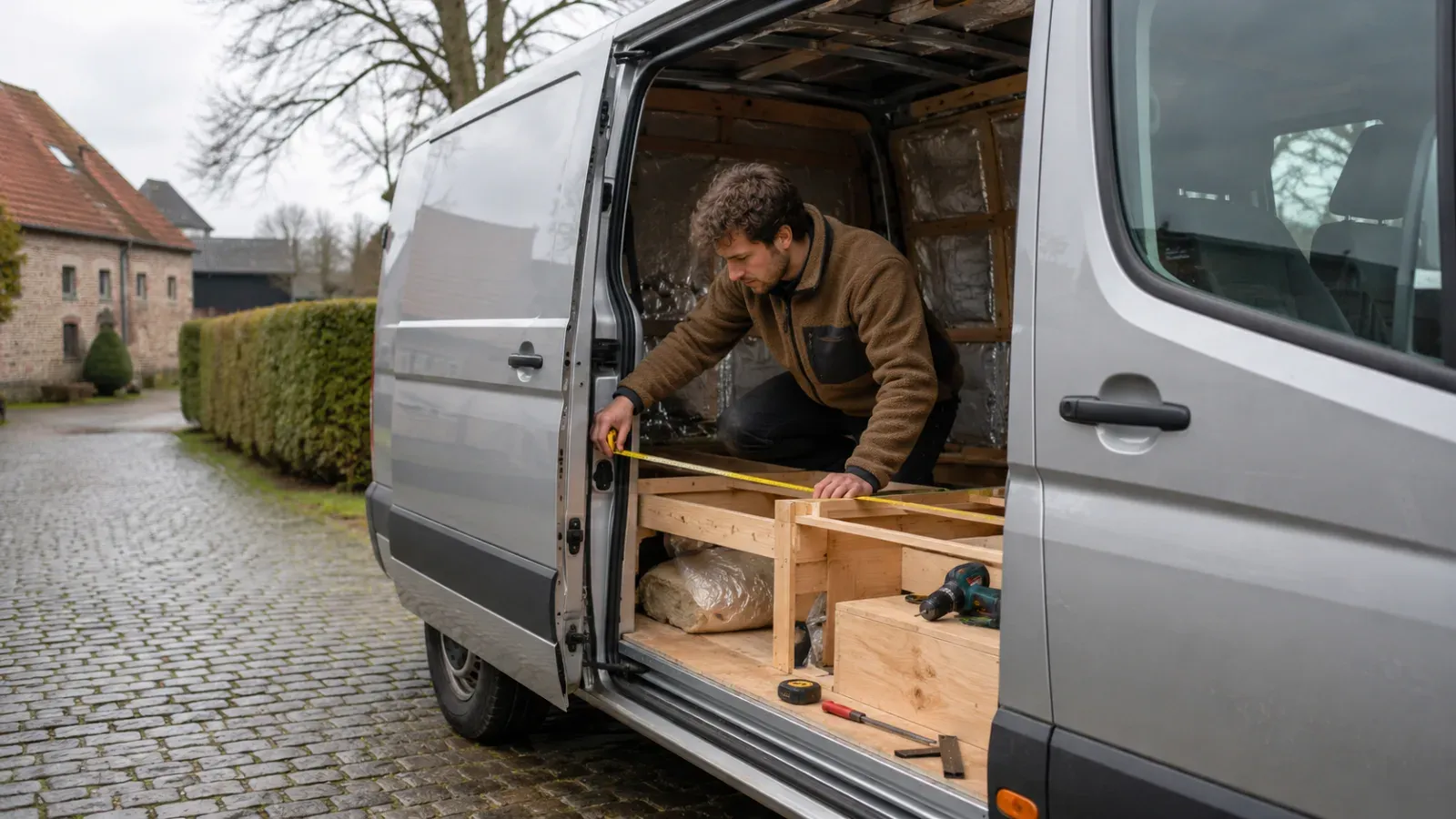
A van conversion usually doesn't start with a saw, a roll of insulation, or a beautiful Pinterest photo. It starts with choices. And honestly? That's often the part people skip because they want to build as quickly as possible.
Yet, you'll save yourself a lot of money, frustration, and double work if you first think carefully about what you actually need. A weekend van for short trips requires something completely different from a van where you'll be on the road for weeks, working, cooking, sleeping, and perhaps even traveling with a dog or children.
I would never start with “what looks nice?”, but with “how will I actually use this van?”. That sounds less exciting, but it makes almost every subsequent choice easier.
Don't start with building, start with your use case
The first question is simple: what should your van serve for?
Not “which floor do I want?” or “which type of wood is beautiful?”, but truly: how will you live in it?
Will you mainly go away for weekends in Belgium and neighboring countries? Then you might be fine with a bed, some storage space, a cooler, and a simple cooking set. If you're traveling longer, also in winter, then insulation, heating, electricity, ventilation, and water become much more important.
First, ask yourself these questions:
- Will I travel alone, with two, with children, or with a dog?
- Do I mainly want to live outside, or should the interior space also be comfortable in the rain?
- Will I work in it with a laptop and internet?
- Do I want to be able to go off-grid or mainly stay at campsites and camper spots?
- Do I need to be able to stand upright?
- Do I want to be able to park stealthily, as inconspicuously as possible?
- Will I travel in winter or only in good weather?
For Belgium, that rain factor is not unimportant. A van that works fantastically in Southern Spain can suddenly feel much less practical on a wet weekend on the Belgian coast. If everything is wet, your shoes are muddy, and you have to cook inside, you'll quickly notice if your layout really works.
First choose your type of vehicle
The base van determines almost everything: your budget, your layout, your comfort, your driving behavior, your consumption, and your possibilities for inspection or homologation.
A small commercial vehicle like a Caddy, Berlingo, or Kangoo is cheaper, more discreet, and easier to park. Ideal for short trips, stealth overnight stays, and minimalist setups. But you mainly live around your vehicle, not really in it. In bad weather, it quickly gets cramped.
A medium-sized van like a Transporter, Vivaro, or Transit Custom offers more space but remains reasonably suitable for daily use. This is a good middle ground for many people. You can fit a bed, cabinets, and a compact kitchen without immediately driving around in a large panel van.
A large van like a Ducato, Boxer, Jumper, Sprinter, or Crafter offers much more freedom. Standing upright, a fixed bed, a real kitchen, a garage under the bed, more water, more electricity, and possibly a small workspace become more realistic. Against this are higher purchase costs, more consumption, more difficult parking, and more weight to consider.
When purchasing, pay attention not only to length and height but also to rust, maintenance history, mileage, payload, engine, emission standard, insurance, and whether the vehicle is registered as a light commercial vehicle, passenger car, or camper van.
Think early about light commercial vehicle or camper van
In Belgium, this is an important choice. You can't just build out any commercial vehicle and then hope everything will be fine.
Anyone who wants to officially convert a vehicle into a camper van will have to deal with rules regarding homologation, basic equipment, and approval. A camper van must, among other things, have a living area with a table and chairs, sleeping accommodation, cooking facilities, and storage space. This equipment must be permanently fixed, although the table may be easily removable.
According to the official Flemish info, the agreement of the manufacturer of the base vehicle is also an important requirement if you want to obtain an approval certificate. For more recent vehicles with European homologation, the file may also have to go through an accredited technical service.
This doesn't mean you should panic as a beginner, but it does mean you should make this choice before making major structural modifications. Think about installing windows, a pop-top roof, extra seats, swivel seats, a pass-through, gas installation, or heavy fixed furniture.
Are you staying a light commercial vehicle? Then you also need to understand what that practically means. Do you want to officially become a camper van? Then you need to take the basic requirements into account from the design stage. If in doubt, contact the competent service, an accredited technical service, or your inspection center in good time. That is much cheaper than having to adjust everything afterwards.
Weight is not a detail
Many beginners underestimate weight. A few wooden panels, a heavy battery, water tanks, a refrigerator, a mattress, flooring, insulation, panels, tools, clothes, food, and two bicycles all seem manageable individually. Together, that quickly adds up.
With a regular B driving license, you can drive a vehicle up to a maximum of 3,500 kg MTM in Belgium, if the vehicle also meets the other conditions of category B. That is why many self-builders try to stay below that limit.
The problem is that a large van is sometimes quite heavy when empty. The more luxury you add, the less margin you have left for passengers, water, luggage, and materials. And when converting to a camper van, tare weight and useful payload also play a role. The official Flemish info even mentions formulas for useful payload for camper vans.
My practical advice: weigh your vehicle as early as possible. Not just at the end, but also during construction. Then you'll know if you still have a margin. Build light where possible, place heavy components low, and distribute the weight logically throughout the van.
Fixed bed or convertible bed?
This is one of the biggest layout choices.
A fixed bed is easy. You don't have to convert anything in the evening, your bed is always ready, and you get a lot of storage space under the bed. That's handy for chairs, a table, tools, water, cables, shoes, dog gear, or sports equipment.
The disadvantage is that a fixed bed takes up a lot of living space. In a smaller van, that can mean you're mainly building a mobile bedroom.
A convertible bed provides more space during the day. You can sit, eat, work, and move around. But you do have to move cushions, put away blankets, and make your bed again every evening and morning. That seems minor until you do it after a long day, in the rain, with cold hands.
For weekend trips, a convertible bed is often fine. For longer trips, I would lean more towards a fixed bed, especially if you're traveling with two or have a lot of stuff.
Do you want to cook inside or mainly outside?
Cooking seems simple, but it determines a lot of your layout.
If you mainly travel in good weather, a simple pull-out kitchen at the back or a loose cooking set may suffice. You cook outside, keep odors out of the van, and save interior space.
But in Belgium, cooking outside is not always realistic. Rain, wind, cold evenings, and busy parking lots sometimes make it difficult. Then a small indoor kitchen suddenly becomes very valuable.
Also think about your energy source. Cooking with gas is popular and relatively simple, but requires attention to safety, ventilation, and correct installation. Electric cooking, for example with induction, sounds clean and modern, but requires a lot of power. Then you need a heavier battery, a strong inverter, and good charging options.
Those just starting out should ideally not make it too complicated. A simple cooking solution that works safely is better than an expensive installation that drains your power or is technically beyond your knowledge level.
How much water do you really need?
Water takes up space and weighs a lot. One liter of water is approximately one kilogram. A 70-liter tank sounds nice, but you're also driving around with an extra 70 kilos when it's full.
For short trips, loose water bottles or jerry cans are often more practical than a large fixed tank. You see how much water you still have, you can easily fill and clean them, and in case of problems, you simply remove them.
Think about three things: drinking water, greywater, and washing up. A small sink is handy, but not mandatory for everyone. An outdoor shower seems great, but in practice, it's not often used by everyone. Especially in Belgium, where you can't just shower or discharge water visibly everywhere.
It's better to start with a simple water system that you understand. You can always upgrade later.
Power: start with your consumption, not with solar panels
Many people start with the question: how many solar panels should I install?
The better question is: what do I want to power?
Charging a phone requires little. Using a laptop daily already requires more. A compressor refrigerator runs all day long. A diesel heater uses power for the fan and startup. A water pump, lighting, fan, cameras, router, electric hob, or coffee machine make the story even bigger.
First, make a list of your consumers. Only then do you choose a battery, charge booster, solar panels, shore power, and possibly an inverter.
For many beginners, a good 12-volt system is more logical than immediately wanting to do everything on 230 volts. The more heavy 230-volt appliances you want to use, the more expensive and complex your electrical system becomes.
Never compromise on safety. Use correct cable thicknesses, fuses, decent connections, and if in doubt, have someone who really knows about it take a look. A poorly built electrical system is not a detail in a wooden van full of stuff.
Insulation and ventilation go hand in hand
Insulation gets a lot of attention, but ventilation is at least as important.
You exhale moisture, wet clothes dry inside, cooking creates steam, and in Belgium, the outside air is often humid. Without ventilation, you quickly get condensation on windows, cold bridges, and stale air.
Insulating without ventilating is therefore not a good plan. Think in advance about air intake and exhaust. A roof fan, window vents, or cleverly placed ventilation openings can make a big difference.
If you only go away in the summer, you don't need to build a winter-proof expedition van. If you also travel in autumn and winter, insulation, heating, and moisture management become much more important.
How important is stealth to you?
Not everyone wants to project the same image.
Some people want a nice camper look with windows, an awning, solar panels, and external connections. Others want their van to look like a regular commercial vehicle.
Stealth is useful if you want to park inconspicuously, but it has limitations. Fewer windows mean less light. No roof hatch or visible ventilation can quickly make it stuffy inside. No external features also mean that some practical solutions become more difficult.
So choose consciously. Are you building for comfort, for discretion, or for a mix of both?
For Vanlife Belgium, I find that balance important. We shouldn't pretend that everyone wants to disappear illegally for weeks in an anonymous van, but also not that everyone wants a classic camper. Many Belgian vanlifers are somewhere in between.
Think about your daily routine
A good van is not a showroom. It's a small system where everything needs a place.
Where do you put wet shoes? Where do you put your jacket? Can you reach your toothbrush without emptying your entire cabinet? Where is your power bank? Where does dirty laundry go? Where do you eat when it rains? Can you sit upright on your bed inside? Can you make coffee without moving three crates first?
These are the small things that determine whether your van feels good.
If I were on the road with Grephar, for example, I would immediately think about a fixed place for his leash, towel, water bowl, and muddy paws. That sounds trivial, but in a small van, every loose item quickly becomes clutter.
First create a test setup
Before you start building definitively, you can learn a lot with a temporary setup.
Put a mattress in the van, bring a few crates, cook outside once, sleep somewhere legally for a night, and see what you're missing. Preferably, don't do that only in perfect weather. A rainy evening teaches you more about your layout than ten hours of watching YouTube.
After such a test, you often immediately know what becomes important:
- You still want to be able to sit inside.
- Your bed is too narrow.
- You miss ventilation.
- You have too little space for wet items.
- Your cooking equipment is inconveniently placed.
- You need more light.
- You take way too much with you.
A temporary setup may feel less professional, but it's a smart way to avoid expensive mistakes.
The best building order
There isn't one perfect order, but this is a logical way to start:
1. Determine your use: weekend, long trips, full-time, working, dog, children, winter or summer.
2. Choose your vehicle based on space, budget, payload, and condition.
3. Check early whether you'll remain a light commercial vehicle or want to go towards a camper van.
4. Make a simple layout on paper and measure everything in your van.
5. Determine where heavy components will go, such as battery, water, and furniture.
6. Think about ventilation, windows, roof hatch, and any structural interventions.
7. Plan power and water based on your actual consumption.
8. First build the basics, test again, and only then finish.
9. Secure everything firmly, because in an emergency stop, loose fittings become dangerous.
10. Keep photos, invoices, and documentation, especially if you're going towards inspection or homologation later.
What I would especially recommend to beginners
Don't immediately build your dream van. First, build a van that works.
Your first idea is almost never your best idea. Only when you've been away a few times do you notice what you really use and what mainly looked good in photos.
A simple, safe, and well-thought-out conversion is better than an expensive van full of gadgets that you don't enjoy living in. Start with the choices that determine your travel behavior: vehicle, layout, bed, cooking, water, power, ventilation, weight, and legal direction. The rest comes after that.
Vanlife ultimately isn't about the perfect wood, the most expensive battery, or the prettiest cabinets. It's about freedom, convenience, and the desire to leave. And you mainly get that by choosing smartly before you start building.
Source: https://mobilit.belgium.be/nl/weg/rijden/rijbewijzen/belgisch-rijbewijs/personenwagen-categorie-b
Source: https://www.gocavlaanderen.be/detail-page/verbouwen
Source: https://www.gocavlaanderen.be/detail-page/een-voertuig-ver-kopen-stap-voor-stap