Smart storage in a small van without everything getting messy
In a small van, clutter doesn't build up slowly. It happens all at once. One jacket on the bed, two wet shoes by the sliding door, a cooking pot that doesn't fit anywhere, a lost power bank, and suddenly your cozy van feels like a junk heap on wheels.
By Laurens De Leeuw · 25 June 2026
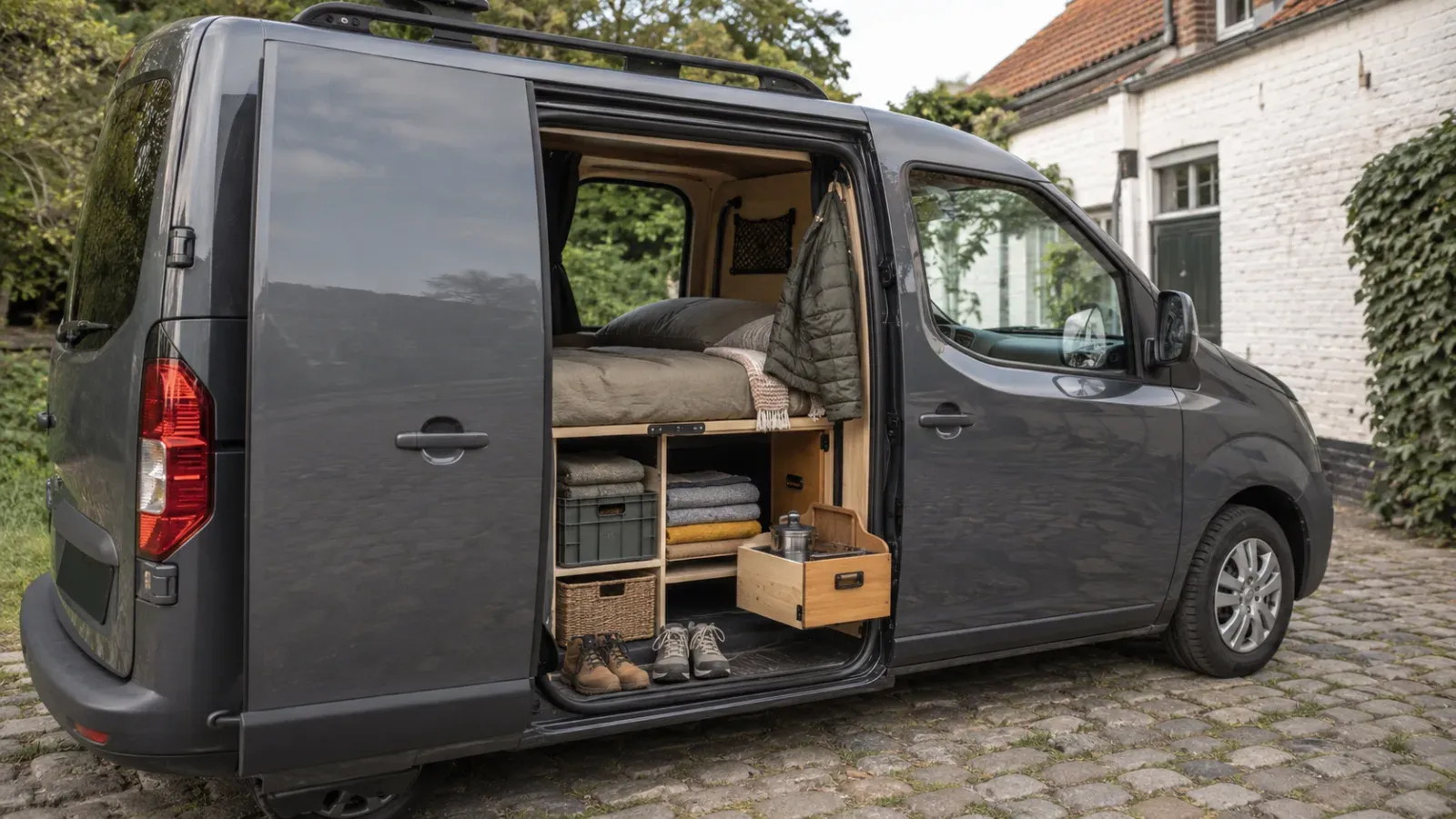
In a small van, clutter doesn't build up slowly. It happens all at once. One jacket on the bed, two wet shoes by the sliding door, a cooking pot that doesn't fit anywhere, a lost power bank, and suddenly your cozy van feels like a junk heap on wheels.
Smart storage, therefore, isn't just about building more cabinets. It's mainly about making choices. What needs to come along? What do you use every day? What can be tucked away deep? And how do you ensure everything stays put when you leave?
A small van can be surprisingly practical, but only if every item has a logical place. Not perfect like on Instagram, but simply livable. Especially in Belgium, where you often need to be able to rummage around inside without half your belongings getting wet or dirty.
Start with fewer items, not more storage space
The biggest mistake with a small van is thinking you primarily need more storage. Often, you first need fewer items.
Every extra bin, cabinet, or shelf seems like a solution, but it also takes up space and adds weight. If you bring too much, you'll constantly be reorganizing. Then you're not traveling, but constantly moving your own stuff around.
Therefore, start with an honest selection. Lay out everything you think you need, and then remove a third. Sounds strict, but in a small van, you quickly realize you use much less than you thought.
Ask yourself for each item: do I really use this on the road, or am I bringing it because it "might be useful someday"? One good knife is more useful than five kitchen gadgets. One warm fleece you wear often is better than three sweaters that just take up space. A compact cooking set that works is better than half a kitchen.
I notice myself that this almost always comes back in vanlife: the fewer loose items you have, the calmer your van feels. Not because minimalism sounds hip, but because you can simply leave faster and have to search less.
Work with zones instead of loose spots
A small van remains more organized if you think in zones.
This means that items stay together according to use. Cooking belongs with cooking. Sleeping belongs with sleeping. Tools belong with tools. Dog supplies, children's items, toiletries, electronics, and rain gear each get their own fixed zone.
A logical basic setup might look like this:
- Kitchen zone: cooking pot, pan, cutlery, spices, gas or cooking appliance, dishwashing supplies.
- Sleeping zone: blankets, pillows, sleepwear, possibly earplugs or a reading light.
- Daily zone: jacket, shoes, flashlight, power bank, keys, wallet.
- Technical zone: cables, fuses, tools, duct tape, tie-down straps.
- Dirty zone: wet shoes, muddy towels, trash, dog towel.
The goal is that you don't have to search everywhere. If you want to make coffee, everything for coffee should be in one place. If you want to brush your teeth in the evening, you shouldn't have to move three bins first.
Create a place for wet and dirty items
This is one of the most underestimated things in a small van.
In Belgium, you have rain, mud, wet grass, damp jackets, and shoes that never seem to dry completely. If you don't have a system for that, all that dirt ends up in your bed, on your floor, or among your clean clothes.
So, consciously provide a dirty zone. This can be simple: a low bin by the sliding door, a rubber mat, a fabric bag for laundry, a hook for a wet jacket, and a small towel for shoes or dog paws.
If you travel with a dog, this becomes even more important. For Grephar, I would always provide a fixed place for his leash, water bowl, towel, and possibly a blanket that can get dirty. Not because it looks nice, but because wet dog paws in a small van would otherwise be everywhere.
A small tip: place dirty items as close to the door as possible. You don't want to carry anything wet, muddy, or sandy through your entire van.
Use bins, but not just any bins
Bins are fantastic in a van, but only if they are well-chosen.
Too large bins become junk bins. You throw everything in and can't find anything. Too small bins, on the other hand, take up too much edge and wasted space. The best bins fit exactly in the space where they need to be and have a clear purpose.
So, first measure your cabinet, bench, or bed frame before buying bins. Look at height, width, and depth. Don't forget that you still need to be able to pull the bin out without having to rearrange half your van first.
Transparent bins are handy because you can see what's inside. Fabric bins are quieter and softer. Sturdy plastic bins are better for wet or dirty material. For clothing, soft bags often work better than hard bins, as they adapt somewhat to the space.
Use bins primarily to group items, not to hide clutter.
Keep daily items accessible
Not everything needs to be super accessible. But the things you use every day should be.
Think of:
- phone charger
- toiletry bag
- headlamp or flashlight
- jacket
- shoes
- water bottle
- coffee supplies
- small trash bag
- wet wipes or paper towels
- power bank
- dog supplies if you travel with a dog
These items do not belong under three pillows, behind a bed board, or deep in the garage. They should be at grabbing height or at least accessible in one movement.
Less frequently used items can be stored deeper. Think of spare cables, an extra gas cartridge, seasonal clothing, tools you almost never need, winter gear, or spare parts.
A good rule: the more often you use something, the easier it should be to access.
There's a lot of space under the bed, but use it smartly
In many vans, the space under the bed is the largest storage area. That's handy, but also dangerous. Not literally dangerous, but for your overview.
If everything disappears under the bed, it quickly becomes a deep cave where you only rummage with frustration. Especially with a fixed bed, it's smart to divide that space.
You can work with pull-out bins, low crates, drawers, or compartments. It's important not to throw everything in one heap. Large items like chairs, tables, cable reels, or tools can go at the back. Items you need more often should be placed closer to the door opening.
Heavy items are best placed low. Water, batteries, tools, and supplies do not belong high above your head. That's better for stability and also feels safer while driving.
Also pay attention to the total weight. A small van can reach its limit faster than you think. Water, wood, batteries, food, clothing, and tools all count. Smart storage is therefore not only a matter of space, but also of payload.
Don't build cabinets everywhere
Cabinets seem neat, but they are not always the best solution.
A cabinet takes up fixed space, even when it's half empty. Doors require space to open. Poorly built cabinets rattle. And if you build too many fixed cabinets, a small van becomes cramped.
Sometimes open compartments, soft bags, nets, or bins are more practical. Especially in a small van where everything needs to remain multifunctional.
A few sturdy fixed storage places are good. But try not to build every free corner shut. Air and freedom of movement are also valuable. A small van feels bigger when you can still turn, sit, and grab something without bumping your shoulders everywhere.
Use vertical space without making it cluttered
Walls, doors, and the backs of seats are useful places, but use them sparingly.
A hook for your jacket, a net for small items, a compartment for slippers, or a bag on the back of a seat can make a big difference. But if you hang every wall full, your van quickly looks chaotic.
Use vertical storage primarily for light and flat items. Think of a jacket, cap, flashlight, toiletry bag, small book, cable, or dog waste bags. It's better not to hang heavy things high on the wall.
Also consider movement while driving. Anything that hangs can swing, tap, or fall. In a small van, a constantly rattling hook can become quite annoying after an hour of driving.
Secure loose items for safe driving
A van is not a room that coincidentally moves. It's a vehicle.
Anything loose can slide, fall, or fly through the van during a hard brake. This applies to tools, cooking equipment, water bottles, laptops, power banks, pans, and even small bins.
Therefore, ensure items are secured while driving. Use anti-slip mats, tie-down straps, latches, sturdy bins, drawers with locks, or elastic nets. And actually test it: take a corner, brake normally, and listen to what moves.
If something rattles, slides, or falls, it's not properly stored yet.
Safe storage sounds less cozy than making beautiful cabinets, but it's much more important. Especially with self-builds, where you are responsible for how securely everything is attached.
Leave room for empty space
This sounds strange, but it's really important: plan for empty space.
Not every compartment needs to be full. Not every corner needs to be utilized. You always have temporary items on the road: groceries, wet towels, extra water, a jacket that needs to dry, a package, a bag of trash, or something you buy along the way.
If your van is already completely full when you leave, you have no margin on the road. Then everything immediately becomes cluttered as soon as something is added.
So, consciously provide an empty bin, a free corner, or a piece of floor that can be temporarily used. That's not wasted space. That's breathing room.
Work with an evening reset
Even the smartest storage doesn't help if you don't put things back.
Therefore, make it a habit to reset for five minutes every evening. Not cleaning, not perfecting, just putting things back.
Cooking items back in the kitchen bin. Clothes in the correct bag. Gather trash. Shoes in the dirty zone. Cables back with electronics. Clear the bed. That's all it needs to be.
In a house, clutter can spread. In a small van, it's immediately in your living space. A short reset makes the difference between cozy and chaotic.
Think in systems, not in perfect photos
The most beautiful van interiors are not always the most practical. Especially online, you often see perfectly tidy vans with empty countertops, pretty blankets, and exactly three coffee cups on a shelf.
But real vanlife is different. You have wet socks, crumbs, cables, groceries, dog hair, empty packaging, dirty shoes, and a jacket that needs to hang somewhere.
A good storage system takes that reality into account. It doesn't have to be perfect. It has to work when you're tired, when it's raining, when you want to leave quickly, or when you simply don't feel like styling everything neatly.
My practical basic layout for a small van
If I wanted to keep a small van as simply organized as possible, I would start with this system:
By the sliding door comes the dirty zone with shoes, jacket, towel, and possibly dog supplies. Under the bed, only large or less frequently used items go, preferably in easily accessible bins. Cooking equipment stays together in one kitchen block or cooking bin. Electronics get one fixed spot, with a small cable bag. Clothes go in soft bags instead of large hard cases. Tools get a closed bin low in the van. And there is always one empty bin left for temporary clutter.
That sounds simple, but that's what makes it strong. In a small van, you don't want a system that only works on the day you leave. You want something that also works on day three, with wet weather, little sleep, and a bag of groceries.
Smart storage is mainly about living calmly
A small van doesn't have to be messy. But you do have to be honest about what you bring and how you live.
Smart storage starts with fewer items, clear zones, and fixed places for daily things. Only then come bins, cabinets, drawers, and handy systems. Don't build everything shut, consider weight, and ensure everything is securely fastened while driving.
The best storage is almost unnoticeable. You grab what you need, put it back without thinking, and your van remains livable. That is ultimately the goal: less searching, less clutter, and more desire to just leave.
Source: https://www.anwb.nl/kamperen/caravan/rijden-met-de-caravan/gewicht-en-laadvermogen
Source: https://bearfoottheory.com/camper-van-organization-ideas/
Source: https://storevan.vlaanderen/bestelwageninrichting-op-maat/lading-vastzetten-in-bestelwagen/