Storage with a dog or children in the van
With a dog or children in the van, you do not just bring more things. You also need to think differently about where everything goes. An open toy box may be handy when you are parked, but it becomes dangerous during an emergency stop.
By Laurens De Leeuw · 12 August 2026
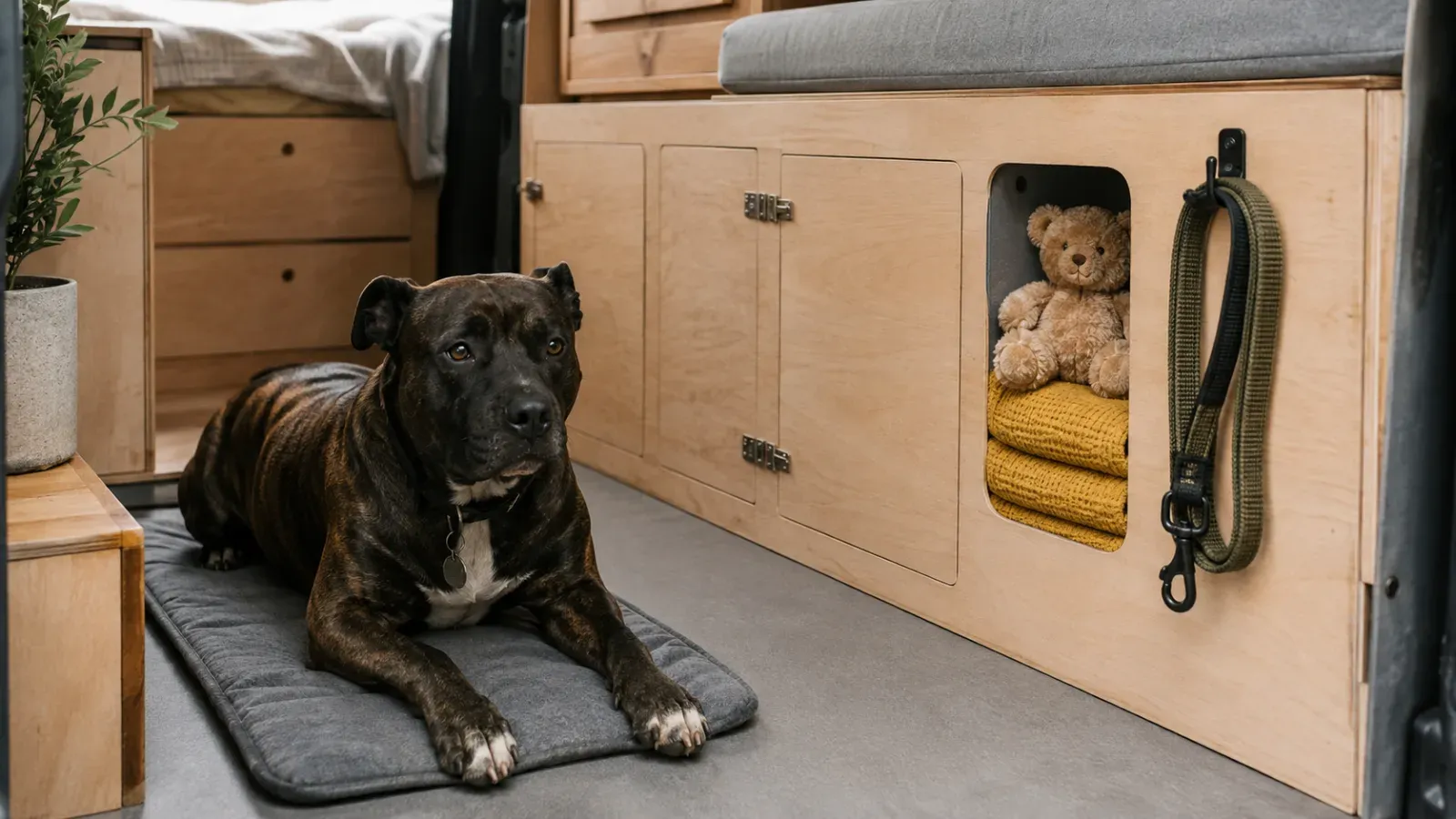
With a dog or children in the van, you do not just bring more things. You also need to think differently about where everything goes. An open toy box may be handy when you are parked, but it becomes dangerous during an emergency stop. Dog food needs to be easy to reach, but not so easy that the dog can open the bag itself. Cleaning products must be kept out of children’s reach, but storing heavy bottles high up in a cupboard is not wise while driving either.
Good storage is therefore not about fitting as much as possible into the van. The aim is a layout that remains predictable, safe and easy to tidy up, even when everyone is tired, wet or impatient.
Start with a place for the dog and children
Do not start by filling empty cupboards. First decide where everyone has a safe place while driving, resting and sleeping.
For children, the travel seat is straightforward: children under 1.35 metres tall must use an appropriate child restraint system in Belgium. The rules also apply in vans and motorhomes. The child seat must be placed on a designated seat and correctly secured.
A lounge bench, side-facing bench or bed does not automatically become an approved travel seat simply because there is enough room to sit on it. Check which seats in a converted van are officially intended for carrying passengers. Adding a belt or bench yourself does not automatically make that setup suitable or approved.
Keep enough clear space around the child seat. Luggage, organisers and toys must not obstruct the belt buckle, ISOFIX anchor points, any support leg or top tether. A rear-facing child seat must never be placed in front of an active front airbag.
For dogs, Belgium has no general rule requiring one specific method, such as a crate or dog seat belt. However, the driver must remain in control of the vehicle at all times. A dog must therefore not be able to reach the pedals, controls or driver.
Choose a solution that suits both the dog and the van:
- a properly secured transport crate;
- a separate area behind a suitable partition or sturdy grille;
- a harness and restraint system designed for use in a car.
Never attach a dog harness via the collar. The crate itself must also be secured. A loose crate can slide through the vehicle with the dog inside during a collision.
When a dog and children travel together, provide a separate travel place for each of them. The dog must not be able to interfere with the child seat, belt or child while driving.
Make a distinction between being parked and driving
Many storage systems work perfectly at a campsite, but not on the road. A water bowl on the floor, a toy basket beside the bed and an organiser on the seat are handy while the van is stationary. While driving, they can slide, tip over or fly through the interior.
Vias demonstrated in a test that a loose 2-kilogram thermos flask could cause an impact equivalent to almost 60 kilograms when braking sharply from 80 km/h. A metal water bottle, tablet, container of dog food or toy box is therefore not harmless.
So work with two clear situations.
When parked, a few everyday items may be left out and within reach. Before setting off, everything goes back into a closed cupboard, drawer or secured box. Only light, soft items that pose no danger may remain accessible to a child or dog.
Note the difference between a child lock and a lock for driving. A simple adhesive lock may prevent a toddler from opening a cupboard, but it is not necessarily strong enough to keep a full cupboard closed during an emergency stop. A cupboard containing dangerous items needs both:
- a sturdy closure that stays shut while driving;
- if necessary, additional protection against children or a curious dog.
A non-slip mat reduces sliding and rattling, but does not replace proper securing.
Create one compact dog station by the door
Most everyday dog items are used when getting in and out. Give them one fixed place close to the door, without blocking the passage.
That dog station can include:
- leash and harness;
- poo bags;
- a small towel;
- tick remover;
- collapsible water bowl;
- a few training treats;
- a small light for evening walks.
Do not leave the leash hanging loosely across a passage or lying on the floor. Put it in a fixed compartment that an adult can reach before the door is fully opened. This prevents the dog from already being outside while you are still looking for the leash.
Let a wet leash, towel or dog coat dry first. If you put everything straight into a closed plastic box, you will quickly get odours, mould and condensation. A removable, washable drip tray for muddy items is more practical. Do secure it while driving.
For a strong dog such as Grephar, such a storage compartment must also be able to withstand a real push from a nose or paw. An open fabric basket at dog height is unlikely to stay tidy for long.
Store dog food and water as proper supplies
A large bag of dog food takes up a lot of space, is difficult to secure and attracts moisture and pests. For a short trip, a smaller amount in a sturdy, well-sealed food container is usually more practical.
Keep the original label or at least note the brand, type, best-before date and batch number. This is useful if the food is recalled or the dog unexpectedly reacts badly to it.
Store dog food:
- dry and out of the sun;
- separately from cleaning products and fuels;
- out of the dog’s reach;
- in a container that cannot shift while driving.
Water weighs one kilogram per litre. A ten-litre drinking water supply is therefore no small storage detail. Store water low down, upright and securely fastened, preferably in a drip tray and never above electronics. Check regularly for leaking caps and damaged packaging.
Dierenwelzijn Vlaanderen advises providing enough fresh, cool drinking water and cooling while travelling. A water bowl may remain out while parked. While driving, only use a solution that can be safely and securely attached in the dog area. Otherwise, plan regular safe drinking breaks.
A storage system, fan or slightly open window never makes it safe to leave a dog alone in a parked van. The temperature can become dangerous in a short time.
Give children their own accessible storage area
Children should not need help for every little book, item of clothing or cuddly toy. A small personal compartment at their height gives them some independence and prevents belongings from ending up all over the van.
Keep the compartment deliberately small and fill it only with items they may take without supervision:
- a soft cuddly toy;
- an age-appropriate book;
- a few light toys;
- their own small clothing bag;
- a small craft set without sharp or loose dangerous parts.
It is better to have a few items that you rotate regularly than one large toy box. In a small space, ten times as many toys do not create ten times as much fun. They mainly mean less free floor space and more tidying up.
While driving, only safe, soft and light toys should remain accessible. A hard toy box, tablet, metal water bottle or heavy book should not be left loose beside or above the child seat. An organiser hanging from the seat back must also be properly secured and must not affect the seat, belt, airbag or child seat.
Check toys regularly for loose battery covers, broken parts and damage. Button batteries, loose magnets and other small parts belong in a locked adult-only area, not in a general drawer a child can access independently.
Adjust storage as the child grows. A cupboard that was out of reach for a baby may suddenly be easy for a crawling toddler to open. A child who could not reach the worktop yesterday may use a stool tomorrow.
Do not make one general box of ‘children’s things’
A large box containing toys, nappies, food, spare clothes, medicines and care products may seem simple. In practice, you have to search through everything each time, and clean and dirty items end up mixed together.
Modules organised by activity work better.
A large box containing toys, nappies, food, spare clothes and care products may seem handy. In practice, you have to search through everything each time, and clean and dirty items end up mixed together.
So work with separate modules:
- **On the road:** a soft cuddly toy, book and wipes. Store these safely by the travel seat.
- **Care:** nappies, clean wipes and a changing mat in one removable bag.
- **Clothing:** put complete outfits together in separate bags and store them in a dry cupboard or drawer.
- **Food:** keep the drinking cup, bib and daily snacks together in a clean kitchen box.
- **Night:** keep pyjamas, sleeping bag and night light by the sleeping area.
- **Spare supplies:** store extra nappies, clothing and unopened supplies further away, but still low down in the van.
Provide one small daily supply that is easy to reach. The rest can be stored deeper in the van. That way, you do not have to crawl under the bed at every stop to find clean trousers or a dog towel.
Dirty nappies, wet clothing and muddy dog items need a separate, sealable place. Do not store them with food, drinking water or clean clothing. Air out and clean that container regularly.
Create a proper adult-only area
Some items should never be within reach of a child or dog. Do not think only of bleach or medicines. Everyday items can also be dangerous:
- cleaning and laundry products;
- human and veterinary medicines;
- batteries and power banks;
- matches, lighters and fuels;
- knives, scissors and tools;
- glue, paint and maintenance products;
- nicotine products and e-liquids;
- insecticides and other pesticides;
- chocolate and other foods that can be dangerous for dogs.
Store hazardous products in their original packaging with the label intact. Never pour windscreen washer fluid, cleaning product or fuel into a water or soft drink bottle.
Store heavy liquids low down in a closed cupboard or drip tray. Simply storing them high up is not a good solution, as a heavy bottle can fall from an overhead cupboard in an accident. Light medicines may be stored higher up, but must also be locked away and stored according to the leaflet. A hot parked van is not a suitable storage place for some medicines.
Keep human and veterinary medicines separate. This reduces the chance of taking the wrong product in the dark or during a busy stop.
Do not use the gas bottle cupboard, the space around a heater or a technical compartment as convenient extra storage. Ventilation openings, shut-off valves, fuses and other technical components must remain accessible and clear.
Use height only for light items
Overhead cupboards seem ideal when you want to keep the floor clear. With children or a dog, it is tempting to put everything that should be out of reach up high. That is not always safe.
Store mainly light items overhead, such as clothing, towels, sleeping bags and empty bags. Water bottles, tins, tools, dog food and heavy toy boxes belong low down and as centrally as possible in the vehicle.
Also consider the total weight. A child seat, buggy, dog crate, dog, water, food and toys all count. Weigh a fully stocked supply box sometime. Small items can become surprisingly heavy together.
Do not simply drill or screw organisers in place near seat belts, airbags, wiring, gas lines or the vehicle structure. If you do not know what is behind a panel, it is better to have the attachment checked.
Keep the passage and exit clear at all times
A dog crate, shoe box or toy basket may sometimes fit exactly in front of a door. That may seem acceptable if you have another door, but in an emergency you do not want to move luggage first.
Always keep at least one usable exit and the route to it completely clear. Do not leave anything loose on the floor that someone could trip over when they need to go outside at night.
A few essential items may be kept ready by the exit:
- keys;
- torch;
- shoes;
- dog leash;
- a coat;
- possibly a small emergency bag.
Every item gets a fixed compartment. “Close to the door” does not mean “somewhere on the floor beside the door”.
Also think about what happens when you open the door. A loose dog may jump outside, and a young child may unexpectedly run into the road. A good layout allows you to secure the dog or take hold of the child first, and only then get out fully.
When dogs and children travel together
When both come along, keep their belongings as separate as possible. Dog treats do not need to be stored among children’s snacks, and a toy that is safe for a dog is not automatically suitable for a toddler.
For example, provide:
- one recognisable box for dog food and dog items;
- one clean box for children’s snacks and eating utensils;
- separate medicines;
- separate blankets and towels;
- a small dedicated sleeping and resting area for the dog.
Do not let the dog bed take up the entire passage. The dog should be able to rest without constantly being moved, but everyone must still be able to get in and out safely.
A crate can be a safe place for transport, but it is not a permanent living space. When parked, provide enough room to move, ventilation and a quiet place to lie outside the crate whenever this can be done safely.
A weekend requires fewer supplies than a long trip
For weekend use, removable modules usually work best. A dog box, children’s clothing bag and care module can be packed at home and only taken along when needed. Bring small quantities of food, nappies and care products.
On a longer trip, fixed zones are more practical. Provide a small accessible daily supply and store the reserve separately. As soon as you open the last spare pack, add the product to the shopping list.
Do not automatically bring extra equipment for every possible situation. A shop is usually never far away in Belgium or Western Europe. Exceptions include vehicle-specific parts, essential medicines and products that are difficult to replace for your child or dog.
Before leaving, check three questions
Look at every loose item and ask three simple questions:
1. Could this hit someone during an emergency stop?
2. Could it leak, break or tip over?
3. Could a child or dog open it, swallow it or chew it to pieces?
If the answer is yes even once, the item needs a different place or a better closure.
Then check the entire van:
- The child seat, belts and anchor points are clear.
- The dog and crate or harness are safely positioned.
- Heavy items are stored low down and secured.
- Cupboards, drawers and boxes are closed.
- The table, floor and worktop are clear.
- Nothing is near the pedals, airbags or controls.
- The passage and at least one exit are clear.
- Drinking water and hazardous liquids are upright and leak-free.
- Ventilation and technical access points are not blocked.
After a new layout, take an ordinary test drive and listen for rattling. Anything that audibly moves usually needs to be secured or padded better.
I would rather work with a few simple, fixed modules than dozens of small organisers. With a dog or children, a system is tested every day anyway. If everyone knows where the leash, cuddly toy, clean clothing and dirty towel belong, a small van stays much calmer and safer.
Source: https://www.veiligverkeer.be/veilig-rijden/gordel/regels-en-boetes-geen-gordel-dragen
Source: https://www.police.be/5998/fr/actualites/securite-la-place-de-votre-animal-de-compagnie
Source: https://www.kindengezin.be/nl/thema/veiligheid/veilige-en-gezonde-omgeving/schadelijke-stoffen