Storage crates, drawers or cabinets: what works best on the road?
When converting a van for the first time, most people mainly think about the bed, the kitchen and perhaps the electrical system. Storage space often comes later. Until you try packing for your first trip and realise that “there’ll be room for it somewhere” usually doesn’t work.
By Laurens De Leeuw · 8 August 2026
When converting a van for the first time, most people mainly think about the bed, the kitchen and perhaps the electrical system. Storage space often comes later. Until you try packing for your first trip and realise that “there’ll be room for it somewhere” usually doesn’t work.
Then the search begins.
Do you go for simple storage crates?
Do you build drawers under your bed?
Or do you make fixed cabinets like in a classic camper?
The honest answer is: there is no single perfect solution for everything.
Every option has strengths and weaknesses. What works best on the road depends on three things:
- how often you need access to your belongings
- how much space and weight capacity you have left
- how simple or complex you want your conversion to be
For me, that is also the heart of the answer: the best storage is not the one that looks the nicest, but the one that causes the least frustration on the road.
First things first: storing well is not the same as storing a lot
A van can hold a surprising amount of stuff. But more storage space does not automatically mean more convenience.
On the contrary. The more compartments, drawers and cabinets you build, the more likely you are to bring more along too. And then you end up with:
- extra weight
- more clutter
- things you never use
- a more difficult layout
- less clear passage space
- more chance of rattling
Good storage really does three things:
- it keeps belongings safely in place while driving
- it ensures you can quickly find what you need
- it makes it easier to keep the van tidy
That sounds simple, but this is exactly where many people go wrong. They build storage as if it were an apartment, while a van vibrates, tilts, brakes and shakes on the road.
What does the practical situation in Belgium add?
If you want to officially convert your vehicle into a motorhome, the living area must include storage facilities, among other things. Flanders also clearly states that this equipment must be permanently fixed and that doors and drawers of storage facilities must remain properly closed during sudden manoeuvres.
Apart from that, normal road safety principles still apply: your load must be securely fastened and must not endanger the vehicle’s stability. It is therefore best to place heavy items as low as possible and not leave them loose in the van.
That sounds logical, but it does have consequences for your choice between crates, drawers and cabinets.
The three main systems
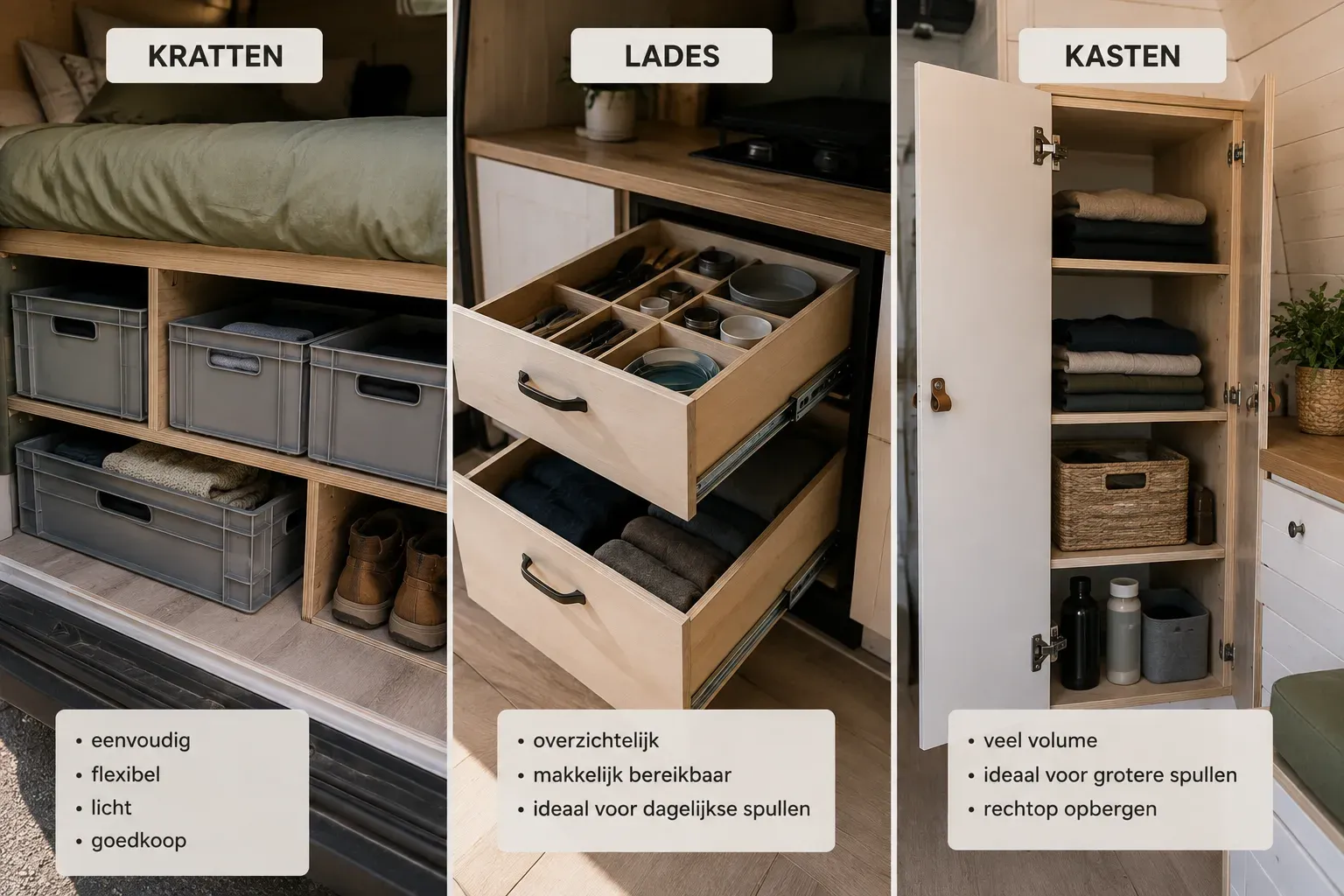
Broadly speaking, you will almost always end up with three types of storage:
- loose or semi-fixed storage crates
- built-in drawers
- fixed cabinets or cabinet compartments
Many good vans use a combination of all three, by the way. So it does not have to be an all-or-nothing story.
Let’s look at them one by one.
1. Storage crates
Storage crates are by far the simplest solution.
They can be plastic bins, sturdy fabric boxes or loose containers that you slide under a bed, bench or shelf.
Why storage crates are so popular
Because they are affordable, flexible and quick.
You do not need to build a complicated drawer system. You can simply create a logical compartment under your bed or bench and slide bins into it. If your layout changes later, you can just take those bins with you or replace them.
That makes crates especially interesting for:
- a first conversion
- a small budget
- a simple or modular van
- people who do not yet know exactly how they will travel
- weekend use
- vans that still partly serve as regular cargo space
The advantages of crates
- affordable
- lightweight
- quick to use
- easy to replace
- easy to remove
- handy for grouping items by category
- ideal for a modular build
- little hardware that can break
For example, if you have one bin for cooking, one for clothes and one for tools, you quickly know where everything is. That brings a surprising amount of calm.
The disadvantages of crates
They are less elegant to use.
You often have to:
- pull a bin all the way forward
- sometimes move other items first
- remove upper bins to reach lower ones
- put everything back properly to keep the space tidy
And that is the big downside on the road: if you need frequent access to the same things, crates can become tiring.
Example: a bin with everyday clothes at the back under the bed sounds smart, until you need one pair of dry socks in the dark when it is raining and first have to pull out two other bins.
Where crates work best
Crates are especially good for things you do not need all the time.
Think of:
- spare clothes
- extra food
- tools
- cables
- seasonal gear
- shoes
- dog supplies
- cleaning supplies
- outdoor gear
- spare parts
They also work well when you simply create deep open compartments under a fixed bed.
When crates work less well
They are less ideal for:
- everyday kitchen contents
- things you want to grab quickly with one hand
- small loose items
- places where you have little overview
- very heavy items that you have to lift or move every time
2. Drawers
Drawers often feel the most practical. And honestly: they often are.
A good drawer lets you pull open one compartment from outside or inside and immediately see what is there.
You do not have to dig through a deep bin. Everything is visible in front of you.
Why people love building drawers
Because they are very comfortable on the road.
Especially in a van, where space is limited, access is hugely important. If you pull open a drawer and immediately see your cooking gear, clothes or tools, it saves a lot of daily annoyance.
The advantages of drawers
- quick overview
- easy to organise by compartment
- belongings are directly accessible
- less digging and searching
- handy for everyday items
- a neat, finished feel
- ideal for a rear garage or kitchen module
For things you use often, drawers are often genuinely the nicest solution.
Think of:
- cutlery and cooking utensils
- dry food
- everyday clothes
- toiletries
- coffee and breakfast supplies
- small tools
- electronics
The disadvantages of drawers
Drawers also come at a cost, literally and figuratively.
They require:
- more work
- more material
- more weight
- quality hardware
- enough room to slide open
- good locking mechanisms
And this is where DIY builds can sometimes go wrong. A beautiful drawer in a photo is not automatically a good drawer on the road.
Poor drawers can:
- warp out of alignment
- jam
- rattle
- slide open while driving
- become too heavy due to overbuilt materials
You see that last one often. A first conversion then gets solid wooden drawers, heavy runners and thick fronts. Beautiful, but heavy.
Where drawers work best
Drawers are ideal for:
- everyday kitchen items
- clothes you use often
- storage accessible from the rear
- compact technical storage
- small items you want to keep neatly separated
A drawer under a bench or bed, for example, works very well for clothes, as long as it is accessible from a logical spot.
When drawers are less smart
Drawers make less sense:
- for very large, bulky items
- for equipment you rarely need
- if you want to build light and simple
- in areas where you do not have enough pull-out space
- if every kilo counts
For a large spare bin with cables or a storage compartment for dirty shoes, a drawer is often overkill.
3. Cabinets
Cabinets are the most classic solution.
They can be overhead cabinets, a vertical wardrobe, a kitchen cabinet, a technical cabinet or simply open compartments with doors.
Why cabinets are appealing
Because they can store a lot of volume and feel very familiar. You open a door and place things on a shelf, just like at home.
They are especially useful when you want to store belongings upright or by zone.
The advantages of cabinets
- good for larger items
- easy to combine with shelves
- handy for upright storage
- ideal for food, clothing or technical equipment
- can be lighter than heavy drawer constructions
- make good use of vertical space
- easy to adapt with small bins or baskets
A cabinet is also often simpler to build than a series of perfectly running drawers.
The disadvantages of cabinets
The big downside of cabinets is that you quickly lose access to depth.
You use what is at the front. You forget what is at the back. Or you first have to move three other things.
That is especially difficult in a small van. A deep cabinet without organisation quickly becomes a black hole where everything disappears.
Cabinets therefore usually need extra organisation such as:
- small bins
- baskets
- small crates
- dividers
- shelf separators
- doors with good closures
- raised edges so items do not slide around
Where cabinets work best
Cabinets are great for:
- food
- clothes on shelves
- technical equipment
- cleaning products
- overhead cabinets for lighter items
- a pantry
- larger items that you do not need to pull out in a drawer
When cabinets are less ideal
Less handy for:
- small loose items without further organisation
- very deep base cabinets
- things you often need quickly
- areas you cannot easily reach while cooking or sleeping
So: what works best on the road?
If you look purely at everyday use, then **drawers are often the most pleasant**.
But if you look at **simplicity, weight and flexibility**, then **crates** often win.
And if you look at **volume and upright storage**, then **cabinets** are strong again.
That is why the most honest answer is:
For most vans, a combination works best
For example:
- **crates** for spare and category-based items
- **drawers** for everyday items
- **cabinets** for larger or vertical storage
That usually gives the best balance between ease of use, simplicity and weight.
A practical layout that often works well
If I were creating a simple, logical layout, I would think about it roughly like this:
Crates for - spare clothes - shoes - dog supplies - cleaning supplies - tools - spare food - loose camping equipment
Drawers for - cooking utensils - cutlery - coffee and breakfast - everyday clothes - toiletries - electronics - small accessories
Cabinets for - supplies - overhead cabinets with light items - jackets - technical equipment - towels - larger kitchen items
Of course, that is not a fixed rule, but it does help to think by type of item instead of simply building compartments at random.
What works in a small van?
In a small van, you need to be extra critical.
You have little space, so every construction really has to prove its value.
For a small van, I would usually choose:
- simple open compartments under a bed or bench
- loose crates in those compartments
- perhaps one or two well-placed drawers for everyday items
- as few deep cabinets as possible that swallow up space
- limited overhead cabinets, only for light items
Why? Because small vans quickly become cramped and heavy if you build cabinetry everywhere.
Loose bins under a side bench or fixed bed are often much smarter than a complete set of heavy drawers and cabinets.
What works in a larger van?
In a larger van, you have a little more freedom.
There, it is more worthwhile to create a better mix of:
- a rear garage with drawers or sliding bins
- a kitchen cabinet with drawers
- overhead cabinets for light items
- a wardrobe or shelving unit
- a few loose bins for spare or outdoor items
Because you have more volume, you can also create zones more easily. That helps enormously to keep your layout calm and organised.
Think not only about storage, but also about access
This is something that is often forgotten.
A storage system is only good if you can live with it easily on a normal day.
Ask yourself about every compartment, drawer or cabinet:
- Can I reach it without first moving three other things?
- Can I reach it when it is raining?
- Can I reach it when the bed is unfolded?
- Can I reach it from both inside and outside?
- Do I have to bend down, kneel or half crawl into the van?
- Will I genuinely enjoy using this on the road?
It may sound trivial, but it makes the difference between a beautiful conversion and a practical one.
A drawer at the rear seems fantastic, until you realise you cannot open it when the bikes are in the way. A wardrobe seems logical, until it turns out the door hits the table. A crate under the bed is fine, until you can only reach it by first emptying the entire bed.
Everyday items should be the easiest to reach
A very simple rule:
> The more often you use something, the easier it should be to reach.
That means:
Very easy to reach - coffee - cooking supplies - cutlery - water bottles - everyday clothes - toiletries - towel - shoes - rubbish bag - chargers
Less easy to reach - spare clothes - extra food - tools - seasonal gear - spare parts - cleaning products
Many people build it the other way around. The nice drawer gets filled with beautiful but rarely used items, while the everyday clutter ends up in an awkward bin.
Think about weight too
Storage systems themselves also weigh something.
And that is often underestimated.
Crates Are usually light, especially plastic or fabric bins.
Drawers Are often the heaviest, especially with: - thick panels - heavy drawer runners - solid fronts - double constructions
Cabinets Can remain relatively light if you: - use thinner sheet material where possible - do not build excessively large doors - organise them smartly - do not duplicate everything
If you want to build light, crates and simple cabinets are often more interesting than a full interior packed with heavy drawers.
Make sure everything stays closed while driving
This is really important.
A cabinet or drawer that pops open on the road is not only annoying, but also dangerous.
That is why you need:
- reliable closures
- good locking mechanisms
- sturdy runners
- doors that do not swing open by themselves
- bins or edges so items cannot slide out
Especially for overhead cabinets and drawers with heavier contents, you want something that stays closed even during hard braking.
A simple magnetic catch is not always enough.
Open compartments: handy or messy?
Open compartments can look nice and be practical, but only in the right place.
They are good for:
- light items you want to grab quickly
- towels
- books
- a cap or jacket
- a rolled-up blanket
- items kept in baskets or small bins
They are less good for:
- small loose items
- heavy items
- anything that can fly around
- areas you want to keep tidy
Open compartments quickly look messy if you do not have a system for them. One bin or basket per compartment helps enormously.
Fabric bags and nets: underrated but useful
Not everything has to be wood.
Sometimes soft solutions work surprisingly well:
- hanging bags
- nets
- storage pockets on doors
- fabric baskets
- organisers on seat backs
They are often:
- lightweight
- affordable
- flexible
- ideal for small items
For heavy things or official fixed fittings, they are of course not always suitable as main storage, but as an addition they can do a lot.
For example, for:
- hats
- cables
- towels
- laundry bag
- toilet roll
- small everyday items
What works best for clothes?
For clothes, I usually see three good options:
Option 1: crates or fabric bins Good for anyone who wants to keep things simple.
Option 2: one or two drawers Very handy for everyday use.
Option 3: a shallow cabinet with shelves Good if you have more vertical space.
What often works less well is a deep cabinet without dividers. You simply end up with piles of clothes where you cannot find anything anymore.
Personally, I find a combination of shallow compartments, soft bags and perhaps one drawer often the most convenient for clothes.
What works best for a kitchen?
For a kitchen, drawers are usually hard to beat.
Why?
Because then you:
- have an immediate overview
- can neatly divide small items
- can quickly reach cutlery and cooking utensils
- do not have to dig as deeply
A base cabinet with one large door can work too, but it usually works better if you use bins or baskets inside it as well.
Otherwise, you get that cabinet problem again: fine at the front, chaos at the back.
What works best for a rear “garage”?
Under a fixed rear bed, the following often works very well:
- large crates for spare and outdoor items
- perhaps one sliding drawer or pull-out platform for frequently used items
- clearly separated zones
Examples:
- one bin for tools
- one bin for electricity and cables
- one bin for spare food
- one bin for outdoor gear
It does not have to look perfect there, but it does need to be logical.
The most common mistakes
1. Building too much fixed furniture Then you lose flexibility, add weight and reduce free space.
2. Deep cabinets without dividers That almost always becomes a clutter compartment.
3. Too many drawers for things you rarely use A nice solution, but often unnecessarily heavy.
4. Storing everyday items too far away Then using the van becomes tiring.
5. Not providing closures Then everything will rattle or pop open.
6. Building everything based on “home logic” A van is not an apartment. Different rules apply on the road.
7. Forgetting that items also need to be put back in their place A perfect system that you stop using after two days is not a good system.
My practical advice
If you are still unsure, I would keep it simple.
For a first or practical conversion, I would usually recommend this:
- first build logical open compartments
- use loose bins for spare and category-based items
- only add drawers where they genuinely offer a daily benefit
- use cabinets mainly where vertical storage is useful
- keep everything light
- test your system on a few trips before making everything permanent
You do not need to build a perfect camper interior straight away.
You often only learn on the road:
- what you constantly need access to
- which items are always in the way
- what would have been better in a crate
- which drawer you never actually use
- which cabinet is built too deep or too heavy
A simple, well-thought-out base almost always beats a hyper-complex furniture plan.
So: crates, drawers or cabinets?
If I had to summarise it very briefly:
Storage crates The best choice for simplicity, flexibility and low cost.
Drawers The best choice for everyday convenience and overview.
Cabinets The best choice for larger volumes and vertical storage.
What works best on the road? For most vanlifers: **a smart combination of all three**.
Not everything needs to be a drawer. Not everything has to go in a crate. And not every wall needs to become a cabinet.
Build around how you really use your van, not around what a camper photo looks like.
If you do that well, your van will not only be tidier, but above all much calmer to use. And you will feel that every day on the road.
Source: https://www.wegcode.be/nl/nieuws/uw-voertuig-laden-voor-vertrek~abekklzkxp
Source: https://www.wegcode.be/nl/regelgeving/2024008436~t0vfqfwzff