Organising clothes in your van: pack less, choose smarter
Clothes seem harmless when you start packing. A few T-shirts, two pairs of trousers, some underwear, a warm jumper, rain jacket, sleepwear and a few pairs of shoes. Yet clothing is one of the categories that can make a small van messy the fastest.
By Laurens De Leeuw · 8 August 2026
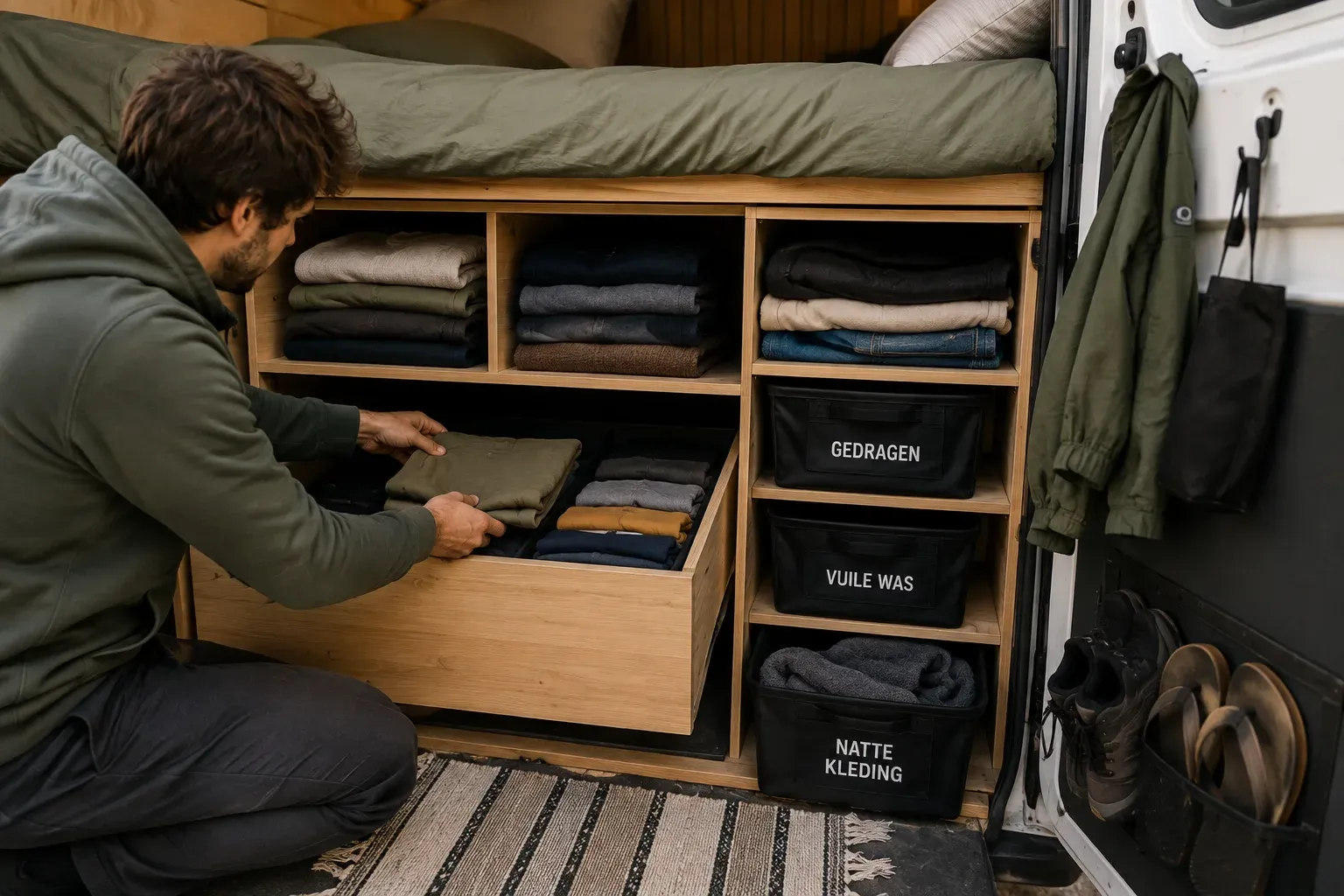
Clothes seem harmless when you start packing. A few T-shirts, two pairs of trousers, some underwear, a warm jumper, rain jacket, sleepwear and a few pairs of shoes. Yet clothing is one of the categories that can make a small van messy the fastest.
Clothes are soft, so they always seem to fit somewhere. That is exactly the problem. Before you know it, jumpers are on the bed, socks are in a kitchen drawer, wet jackets are against the wall and a bag of dirty laundry is in the walkway.
The solution is not to build a full wardrobe in your van. You will have more peace of mind by taking less, combining clothes more cleverly and using a clear system from the start for clean, worn, dirty and wet clothes.
You do not need a different outfit every day while travelling. Above all, you need clothes that are comfortable, go well together and remain useful when the weather changes.
Pack for the trip, not for every possible situation
Do not start by looking at your entire wardrobe. Start with the trip you are actually going to make.
Ask yourself these questions first:
- How long will you be away?
- What weather is expected?
- Can you do laundry along the way?
- Will you be hiking, cycling, working or mainly relaxing?
- Will you stay at campsites or more often without facilities?
- Are you travelling alone or with several people?
- Are you bringing a dog or children?
- How much dry storage space do you have?
- How much weight capacity does your van still have?
For a weekend in July, you do not need clothes for a snowstorm. For a winter trip, you do not need to bring half a summer wardrobe because there might be one sunny afternoon.
Always bring one sensible spare for a realistic problem. Think of dry trousers after a rainy walk, extra socks or a slightly warmer layer than the forecast seems to call for.
Being prepared is smart. Packing for every imaginable scenario is not.
Build a small core wardrobe
The easiest way to take fewer clothes is to choose items that combine well with each other.
That does not have to be fashionable or complicated. Simply choose a limited base where almost every top goes with every pair of trousers.
A practical vanlife wardrobe could include:
- a few T-shirts
- one long-sleeved shirt
- one warm jumper or fleece
- one lightweight pair of trousers
- one sturdier pair of trousers
- rain jacket
- underwear and socks
- sleepwear
- one smart but comfortable outfit if needed
Choose colours and styles that work easily together. That way, you do not need to bring separate trousers because one particular shirt does not go with anything else.
The goal is not to wear exactly the same thing every day. The goal is to have enough combinations with only a few items.
Dress in layers
Layers are much more practical on the road than one very thick jumper or coat.
A simple layering system consists of:
1. a base layer against your body
2. a warm mid-layer
3. a windproof or waterproof outer layer
On a chilly morning, you wear everything together. When it gets warmer, you take off one layer. In the rain, you add the outer layer without immediately needing a completely different outfit.
A useful base could be:
- T-shirt or thermal shirt
- fleece, woollen jumper or lightweight insulated jacket
- waterproof and windproof jacket
This system usually takes up less space than several heavy coats and thick jumpers for every temperature.
Just make sure the layers actually fit over each other. A compact rain jacket is of little use if it does not fit over your warm jumper.
How much clothing do you really need?
The numbers depend on your activities, the weather and how often you can do laundry. Still, a simple guideline helps.
| Clothing item | Weekend of 2 to 3 nights | About one week | Longer trip |
|---|---:|---:|---:|
| Underwear | 3 to 4 | 5 to 7 | For 5 to 7 days |
| Socks | 3 to 4 pairs | 5 to 7 pairs | For 5 to 7 days |
| T-shirts | 2 to 3 | 3 to 4 | 3 to 5 |
| Long-sleeved shirt | 1 | 1 to 2 | 1 to 2 |
| Trousers | 1 to 2 | 2 | 2 to 3 |
| Warm mid-layer | 1 | 1 to 2 | 1 to 2 |
| Rain jacket | 1 | 1 | 1 |
| Sleepwear | 1 set | 1 set | 1 to 2 sets |
| Shoes | Maximum 2 pairs | Maximum 2 to 3 pairs | Usually 2 to 3 pairs |
For a three-week trip, you therefore do not need three times as many clothes as for one week. Bring clothes for around five to seven days and plan a laundry stop along the way.
That gives you much more space than trying to bring a complete clean outfit for every day of the trip.
Underwear and socks deserve a little extra margin
You can easily wear trousers and jumpers again. With underwear and socks, you will want a little more spare.
Especially during hikes, warm weather or rain, socks can quickly become wet or dirty. Dry feet are more important than an extra fashionable jumper.
So it is better to bring one extra pair of socks than a third pair of trousers that will probably stay in the cupboard.
For longer trips, underwear and socks are also easier to wash along the way than heavy clothing items.
Choose clothes that dry quickly
At home, damp trousers can hang quietly on a drying rack for a day. In a small van, that is more difficult.
Quick-drying clothing is therefore very practical, especially for:
- underwear
- socks
- T-shirts
- hiking clothes
- towels
- sleepwear
Synthetic fabrics such as polyester and nylon generally dry faster than thick cotton. They are often light and compact, but can retain odours more quickly. Synthetic clothing can also shed microfibres when washed. So do not wash it more often than necessary.
Merino wool can be pleasant because it regulates temperature reasonably well and often feels fresh for longer. It is more expensive, needs slightly more careful care and is not automatically the best choice for every garment.
You do not need to replace your entire wardrobe with technical outdoor clothing. Choose strategically instead:
- quick-drying socks
- good underwear
- one practical base layer
- a warm but compact mid-layer
- a lightweight rain jacket
You will usually get more benefit from that than from suddenly buying everything new.
Cotton is comfortable, but dries slowly
Cotton feels pleasant and many people enjoy wearing it. So you do not need to avoid it completely.
Just keep in mind that a thick cotton jumper, jeans or heavy jogging bottoms can take a long time to dry. When such an item gets soaked, it remains a damp mass in your van for a long time.
A cotton T-shirt for a quiet day is not a problem. For a long walk in rain or cold weather, more practical materials are available.
So use cotton where it is comfortable and choose faster-drying fabrics where moisture is more likely.
Jeans take up a lot of space
Jeans are sturdy and familiar, but also heavy, bulky and slow to dry.
For a short city break, one pair of jeans is perfect. For active or wet trips, lighter hiking trousers or regular comfortable trousers are often more practical.
It is better to bring one pair of jeans than three nearly identical pairs.
A second, lighter pair of trousers usually gives you more options and dries faster when it gets wet.
Merino is useful, but not a miracle material
Merino wool gets a lot of praise in the travel and outdoor world. Rightly so, but sometimes a little excessively.
Advantages:
- feels pleasant
- regulates warmth reasonably well
- can often be worn several times
- takes up little space
- works well as a base layer or sock
Disadvantages:
- more expensive
- can wear out faster
- requires careful washing
- does not always dry as quickly as thin synthetic material
- not everyone finds wool pleasant against the skin
You do not need to buy a complete merino wardrobe to travel in an organised way. One good shirt or a pair of decent socks can already be useful.
Limit the number of shoes
Shoes may be the least efficient clothing items in a van.
They are:
- large
- relatively heavy
- difficult to compress
- often wet or dirty
- awkward to stack in a cupboard
For most trips, two pairs are enough:
- sturdy everyday or walking shoes
- lightweight slippers or slip-on shoes
A third pair only makes sense when you are planning a specific activity, such as cycling, mountain hiking or an occasion that requires different footwear.
Do not bring heavy boots because it might rain one evening. Do not bring smart shoes if you are not going anywhere you will actually wear them.
Give shoes a fixed place by the door
Shoes do not belong next to your pillow or under a pile of clean clothes.
Provide a spot close to the sliding door:
- a low plastic tub
- rubber mat
- pull-out compartment
- simple open shoe rack
- well-ventilated bag
This keeps mud and sand close to the entrance.
Do not immediately seal wet shoes in a completely airtight container. Let them drip and dry first where air can circulate.
With children or a dog, this dirty zone becomes even more important. Otherwise, every time someone gets in, moisture and dirt spread throughout the van.
Use four clothing zones
A clear system prevents everything from getting mixed up after two days.
Distinguish between four types of clothing.
1. Clean clothes
These stay in a cupboard, drawer, storage bag or packing cube.
2. Worn but still usable clothes
These are clothes you can wear again, but do not want to put back among the completely clean laundry.
Give them a separate place, for example:
- one hook
- open fabric bag
- small basket
- dedicated storage compartment
3. Dirty laundry
This goes straight into a separate laundry bag.
4. Wet clothes
These never belong directly with the dirty laundry. Wet clothes need to dry first.
This distinction sounds simple, but it solves a large part of the daily mess.
Without a separate place for worn clothes, everything usually ends up on the bed. After a few days, nobody knows what is clean, worn or truly dirty anymore.
Choose one fixed clothing space per person
Travelling with several people? Give everyone their own cupboard compartment, drawer or storage bag.
A practical rule is:
> What does not fit in your own clothing space does not come along.
That prevents discussions and makes it clear how much space is available.
Possible systems:
- one fabric bag per person
- one large packing cube with smaller sections
- one cupboard compartment per person
- one drawer per person
- a combination of everyday clothes and spare clothes
Make sure everyone can access their own things without first having to remove someone else's clothes.
With children, their own soft tub or bag often works well. They know where their clothes are and can help tidy up more easily.
Use packing cubes or soft storage bags
Packing cubes are lightweight fabric bags that let you group clothing by category.
For example:
- underwear and socks
- T-shirts
- trousers and jumpers
- sleepwear
- seasonal spare items
They have a few practical advantages:
- you can take one category out of the cupboard without turning everything upside down
- clothes stay better grouped
- soft bags adapt to the available space
- they do not rattle
- you can easily take them out of the van
Do not automatically buy a huge set with twenty little bags. Two or three well-fitting bags are often enough.
Too many small organisers become clutter themselves.
Hard suitcases are rarely practical
A hard-shell suitcase is good for a flight, but usually awkward in a van.
It always takes up the same amount of space, even when it is half empty. You also need enough room to open it fully.
Soft travel bags, packing cubes and fabric bags fit better in irregular cupboards and under benches.
Only use a hard suitcase when you genuinely need it along the way, for example because you are taking a flight after your van trip.
Should you roll or fold your clothes?
Both systems can work.
Rolling clothes is useful for:
- T-shirts
- underwear
- lightweight trousers
- sportswear
- packing cubes
You can often see better what is in the bag and take out one item without lifting the whole stack.
Classic folding works better for:
- thick jumpers
- smart clothes
- clothes that crease more easily
- wide but shallow cupboard compartments
The best method is the one that makes you put your things back.
A theoretically perfect folding system is no help if, after two days, you simply stuff everything into the cupboard.
Do not stack too deeply
A deep cupboard may seem to offer lots of storage space, but clothes at the back quickly disappear from view.
It is better to use:
- pull-out bins
- limited stack height
- separate storage bags
- vertical dividers
- labels when compartments look alike
Everyday clothes belong at the front. Spare clothes and seasonal items can go further back.
Just make sure you do not have to open the entire garage every morning to get to clean socks.
Only hang what really needs hanging
A full hanging wardrobe takes up a lot of space. In a compact van, that is rarely the most efficient solution.
A few hooks are usually enough for:
- coat
- rain jacket
- worn jumper
- towel
- clothes that need airing out for a while
Do you need to bring smart clothes for work or a special occasion? Then provide a narrow garment bag or one short hanging space.
Do not build a large wardrobe for two shirts you use once a year.
Wet clothes need to breathe
Putting a rain jacket, wet trousers or damp towel in a closed cupboard is almost guaranteed to cause odours and condensation.
Provide a drying spot with air circulation, for example:
- a hook by the sliding door
- short washing line
- rail beneath a ventilated roof vent
- clothes hanger by an open window
- temporary drying zone in the cab
Do not hang wet clothes directly against bedding, untreated wood or a cold metal wall.
If you use heating, keep clothes at a safe distance. Never cover the air intake or outlet of a heater, and do not hang textiles against hot parts.
Warm air can help things dry, but fire safety remains more important than speed.
A short washing line is surprisingly useful
A small cord with a few clothes pegs takes up almost no space.
You can use it for:
- socks
- underwear
- flannels
- lightweight T-shirts
- towels
Only put up the line when you use it. A permanent washing line through the middle of the van quickly becomes annoying.
Preferably hang lots of wet laundry outside when the location and weather allow it. Drying clothes indoors adds extra moisture to the air. Make sure there is good ventilation.
Do not put wet clothes in your regular laundry bag
A closed bag of wet laundry quickly becomes musty.
Do you need to take wet items with you temporarily while driving? Use a waterproof bag or tub, but take everything out again to dry when you arrive.
Think of such a bag as temporary transport, not storage.
A breathable laundry bag is better for dry dirty clothes. It keeps moisture from being trapped as easily.
Airing out is often enough
Not every worn garment needs to be washed immediately.
Trousers, jumpers and jackets can often be worn again after being aired out properly. You can sometimes remove a small stain locally with a damp cloth.
Washing less often has several advantages:
- clothes wear out less quickly
- you use less water
- you have fewer drying problems
- you need to bring less detergent
- you can travel with a smaller wardrobe
Of course, wash underwear, socks and sweaty sportswear more often. Just use common sense and your nose.
Plan laundry stops instead of bringing more clothes
On longer trips, a laundrette, campsite washing machine or laundry stop at friends' places is often much smarter than a huge supply of clothes.
For example, plan a laundry stop every five to seven days.
Bring along:
- a small amount of suitable detergent
- lightweight laundry bag
- a few clothes pegs
- possibly a small stain-removing soap
- payment method for the laundrette or campsite
Do not wait until absolutely everything is dirty. Keep one dry outfit separate so you have something to wear while the rest is being washed.
Do not wash a full load in your small sink if you have nowhere to dispose of the wastewater properly afterwards. Where possible, use facilities intended for washing and wastewater.
Bring little detergent
A full large pack of detergent takes up unnecessary space and can leak.
Use a small, well-sealed container that is clearly recognisable and kept out of reach of children or animals.
Do not use more than necessary. Too much detergent makes rinsing more difficult and does not automatically make clothes cleaner.
Never store detergent in a drinking bottle or packaging that could be confused with food.
Vacuum bags: useful with limitations
Vacuum bags can make thick winter clothes and spare bedding compact.
They are especially useful for items you rarely need during the trip, such as:
- spare winter coat
- extra blankets
- clothes for another season
- spare bedding
For everyday clothes, they are usually impractical. You have to open the bag, remove the air and seal it again every time.
They can also hide a lot of weight in a very small volume. Your cupboard may still seem to have space while your vehicle keeps getting heavier.
Only put completely dry clothes in a vacuum bag.
Keep heavy clothes low down
Winter boots, thick coats and several pairs of jeans weigh more together than you might think.
Preferably store heavy clothes low down in the van. Lightweight items such as underwear and T-shirts can go in an overhead cupboard.
Overhead cupboards are not the best place for heavy shoes or a tightly packed bag of winter clothes. Everything must also be securely fastened while driving.
Doors and drawers must stay closed during a turn or emergency stop.
Do not make your clothing space too large
This may sound strange, but a huge wardrobe invites you to bring more.
Build your clothing space around what you actually need, not around the maximum free wall space.
A smaller, clearly defined clothing zone automatically keeps your selection limited.
Use the rest of the space instead for:
- clear walkway
- wet items
- groceries
- equipment
- water
- items you genuinely need
Empty space is useful space too.
Work with a seasonal changeover
Not all clothes need to stay in your van permanently.
For example, make two simple sets:
Summer set
- lightweight clothes
- swimwear
- cap
- thin rain jacket
- sandals
- lightweight sleepwear
Winter set
- thermal layer
- warm fleece
- hat and gloves
- warm socks
- sturdy rain jacket
- extra dry clothes
- winter-suitable shoes
Switch the set when the season changes.
That way, you are not driving around in August with heavy winter boots and three thick blankets. In December, you do not need to bring half a cupboard of swimwear and beach clothes.
Keep one emergency set separate
A small dry spare set is always useful.
Think of:
- underwear
- socks
- T-shirt
- lightweight trousers
- warm layer
Keep it in a dry, sealed bag that you do not use for everyday purposes.
After a heavy rainy walk, leaking water bottle or another mishap, you will be glad that one complete dry outfit is still available.
Do not turn the emergency set into a second full wardrobe. One compact combination is enough.
Organising clothes with a dog
A dog brings extra moisture, hair and dirt.
So keep dog supplies separate from clean clothes.
Provide a dedicated place for:
- dog towel
- blanket
- harness and lead
- possible rain jacket
- dirty cloths
- food
With Grephar, I would never put his wet towel with my regular laundry bag. It gets its own ventilated spot by the door.
Brush dog hair out of clothes and bedding regularly. That is easier than trying to get everything clean after an entire trip.
Organising clothes with children
Children need spare clothes more often. That does not mean their entire wardrobe has to come along.
Give each child:
- one personal clothing tub
- one small bag for underwear and socks
- one fixed place for dirty laundry
- one dry spare set that is easy to reach
Do not put spare clothes for accidents or mud all the way at the bottom of the rear garage. You want to be able to reach them quickly.
Depending on their age, let children help choose and tidy up their own clothes. When every child knows where their clothes belong, the van stays much calmer.
Clothes for working on the road
If you work from your van, you may also need some smarter clothes.
Choose one or two combinations that:
- are comfortable
- do not crease easily
- combine easily
- are useful outside work too
- take up little space
You do not need to bring a complete business outfit for every video call. Often, a smart top and regular comfortable trousers are enough.
Keep smart clothes separate from dirty hiking clothes and wet jackets.
The evening reset
Even the best system only works when you put your clothes back in their place.
Take a few minutes every evening for a simple reset:
- put clean clothes back in the right bag
- put worn clothes on the designated hook
- put dirty laundry in the laundry bag
- hang up wet clothes
- put shoes by the door
- lay out sleepwear
- clear the bed
This does not have to become a big tidying ritual.
Five minutes each evening prevents you from no longer knowing where your clean socks are by day three.
The one-in, one-out rule
Do you buy a jumper, jacket or other clothing item along the way? Then take a critical look at whether something else can leave your regular van supply.
Otherwise, your wardrobe slowly grows without you noticing.
On a longer trip, adding one clothing item is of course no problem. But when every purchase simply gets added on top of the existing supply, your system quickly becomes full.
The three-trip rule
After every trip, look at which clothes come back unused.
A simple rule:
- after one unused trip: it may be coincidence
- after two unused trips: take a critical look
- after three unused trips: leave it at home from now on
Make exceptions for:
- rain jacket
- warm emergency layer
- dry spare set
- safety equipment
But that third smart pair of trousers that is never worn probably does not need to stay in the van as standard.
A practical clothing layout for a small van
In a compact van, I would keep it very simple.
A workable system:
- one medium-sized soft clothing bag per person
- one small packing cube for underwear and socks
- one breathable shared laundry bag
- one hook for worn clothes
- one ventilated wet zone by the door
- shoes in a low tub
- one dry spare set in a separate bag
More storage furniture is often not necessary.
Everyday clothes remain easy to reach. Seasonal spare items can go further under the bed or stay at home.
A practical clothing layout for a larger van
In a larger van, you can work with fixed cupboard compartments.
A logical layout:
- shallow cupboard for everyday use
- small drawer for underwear and socks
- one shelf per person
- hooks for worn clothes
- laundry bag low down and ventilated
- wet zone by the sliding door
- seasonal clothes in an overhead cupboard or garage
Do not make cupboards unnecessarily deep. For clothes, shallow shelves are often clearer than one huge cupboard where everything disappears behind everything else.
What is better left at home
These things often cause unnecessary clutter:
- several nearly identical pairs of trousers
- heavy jumpers for every possible temperature
- more than two or three pairs of shoes
- delicate clothes you do not want to get dirty
- complete outfits that only combine with one other item
- clothes for activities that are not planned
- large hard suitcases
- too many spare jackets
- thick cotton items that barely dry
- clothes you have not worn for months
Above all, bring clothes you are genuinely comfortable travelling in.
A nice outfit that stays untouched in the cupboard for three days takes up just as much space as an item you use every day.
Quick packing list for a regular weekend
For one person:
- 3 to 4 items of underwear
- 3 to 4 pairs of socks
- 2 to 3 T-shirts
- 1 pair of trousers plus possibly 1 lightweight spare pair
- 1 warm jumper or fleece
- 1 rain jacket
- 1 set of sleepwear
- 1 pair of everyday shoes
- 1 pair of slippers or lightweight slip-on shoes
- 1 compact dry spare set
Adjust this to the weather and your activities.
If you are hiking in heavy rain, you will need more dry socks and an extra pair of trousers. If you are mainly spending two quiet days at a campsite, you will probably need less.
My practical advice
I would not treat clothes in a van as something you can always squeeze in somewhere.
Give them a clear, limited space. Work with lightweight soft bags, distinguish between clean, worn, dirty and wet, and choose clothes that combine easily.
My simple base would be:
- clothes for five to seven days
- one layering system
- a maximum of two or three pairs of shoes
- one personal clothing bag per person
- separate breathable laundry bag
- hook for worn clothes
- drying spot for wet items
- one sealed emergency set
With that, you can get surprisingly far on almost any trip.
Less clothing brings more peace of mind
Taking less does not mean you have to travel uncomfortably or look unkempt.
It means consciously choosing clothes you actually wear.
A small selection that combines well, dries quickly and is easy to reach works much better than an overfilled cupboard where you cannot find anything. By airing out worn clothes, doing laundry along the way and adjusting your supply by season, you do not need a huge wardrobe even on long trips.
The best clothing organisation is barely noticeable.
You know where everything is. Wet items stay away from clean clothes. Your bed does not turn into a pile of jumpers every evening, and you do not have to open three tubs to find one pair of socks.
That is ultimately the goal: take less, move less around and keep more space to truly live in your van.
Source: https://www.anwb.nl/kamperen/voorbereiding/paklijst-kamperen
Source: https://www.milieucentraal.nl/spullen-en-kleding/kleding/hoe-zorg-je-goed-voor-je-kleren/
Source: https://www.milieucentraal.nl/huis-en-tuin/schoonmaken/wasmiddelen/
Source: https://www.rei.com/learn/expert-advice/traveling-light.html
Source: https://www.rei.com/learn/expert-advice/travel-clothing.html