What do you really take with you, and what is better left at home?
A van seems big when it is empty. Once you start packing, that changes quickly. A few boxes of clothes, a cooking set, food, water, tools, chairs, electronics, bedding and some things “just in case”, and suddenly your van is full. Not only in terms of space, but also weight.
By Laurens De Leeuw · 8 August 2026
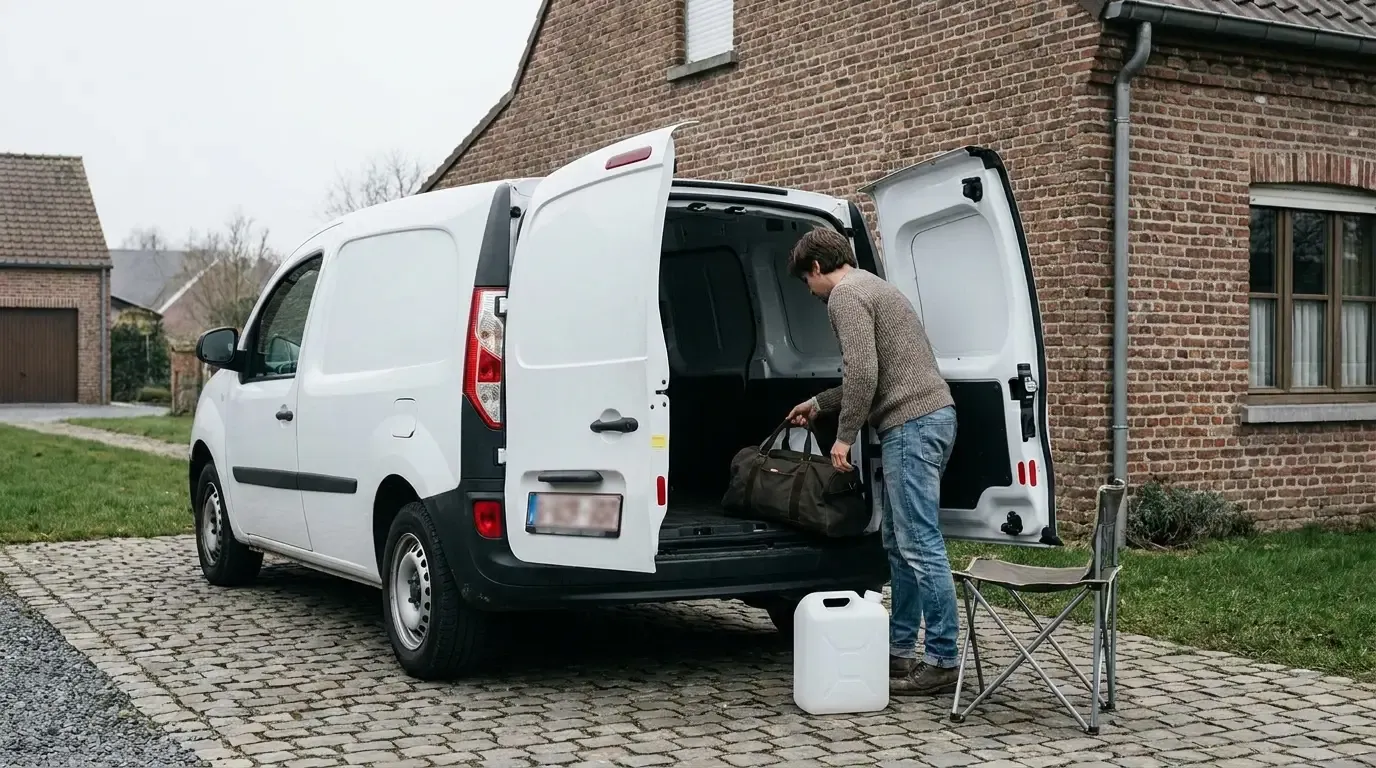
A van seems big when it is empty. Once you start packing, that changes quickly.
A few boxes of clothes, a cooking set, food, water, tools, chairs, electronics, bedding and some things “just in case”, and suddenly your van is full. Not only in terms of space, but also weight.
The result is familiar: you constantly have to move things around, cannot find anything, and end up using only half of what you brought.
Packing well does not mean cutting back on everything or living extremely minimally. Above all, it means choosing consciously.
Bring what makes your trip safer, more comfortable or easier. Leave at home what only takes up space, is heavy or will probably never come out of the cupboard.
Start with the trip you are taking
There is no universal packing list that works for every vanlifer.
You need different things for one summer night on the coast than for two weeks in the Ardennes in November. Someone working on the road brings different things than someone mainly going hiking. With children or a dog, a whole new category of gear is added.
So start by answering these questions:
- How long will you be away?
- What weather is expected?
- Are you travelling alone or with several people?
- Are you bringing a dog or children?
- Will you stay at campsites, motorhome stopovers or places without facilities?
- Can you refill water along the way?
- Can you do grocery shopping?
- Do you need to work while travelling?
- Will you go hiking, cycling, surfing or do another activity?
- Can you wash clothes along the way?
- How much weight margin does your van still have?
Pack for that specific trip, not for every possible situation that might ever arise.
If you are going away for two nights and pass through a village every day, you do not need to bring two weeks’ worth of food and one hundred litres of water.
Work with four categories
A useful way to assess your belongings is to divide them into four groups.
1. Essential and safe
These are documents, mandatory vehicle equipment, medication and emergency supplies. These are not things to cut back on lightly.
2. Needed every day
Think sleeping gear, clothing, water, food, toiletries and charging cables.
3. Trip-specific
These are items you only need for this trip, such as hiking boots, bicycles, winter gear or a laptop.
4. Comfort and luxury
An extra pillow, a second table, coffee machine, decoration or three different cooking pans can be pleasant, but they are not essential.
Start with the first two categories. Then only add what truly fits the planned trip.
If your van is already full by then, you immediately know that not everything from the comfort category can come along.
What should always come along?
Before you start cutting things out, there are a few things that simply need to be in order.
According to official Flemish information, these four items must be present in your vehicle:
- warning triangle
- fire extinguisher
- high-visibility vest
- first-aid kit
Do not just check whether they are somewhere in the van, but also whether you can reach them.
A fire extinguisher under three heavy boxes is of little use when you need it quickly. The same goes for a high-visibility vest tucked away at the back of the garage while you need to get out along the motorway.
In practice, I would bring a high-visibility vest for every occupant, even though the legal basic equipment mentions one.
Also bring your official documents:
- driving licence
- identity card
- insurance certificate
- registration certificate
- inspection certificate
- certificate of conformity
- any documents for a trailer, bike rack or specific equipment
If you are travelling abroad, check in advance which documents and safety equipment are mandatory there. The rules are not the same in every country.
A compact emergency kit
In addition to the legal equipment, a small emergency kit is sensible.
I would include at least:
- torch or headlamp
- charged power bank
- charging cable
- emergency numbers and roadside assistance details
- basic tools
- duct tape
- cable ties
- spare fuses that fit your setup
- work gloves
- bottle of drinking water
- warm blanket
- essential medication
- possibly a tyre pump or repair kit
You do not need to be able to survive a disaster scenario for three weeks. You mainly want to be able to deal with a small breakdown, a cold waiting period or a flat phone battery.
Clothing: pack for layers, not outfits
Clothing takes up a lot of space very quickly.
The classic mistake is bringing a completely new outfit for every day. In practice, you often wear the same comfortable trousers, jumper and jacket for several days while travelling.
It is better to work with layers:
- base layer
- warm mid-layer
- rain or wind layer
For a regular long weekend, you can often manage with:
- enough underwear and socks
- one or two T-shirts
- one comfortable pair of trousers
- one warm jumper or fleece
- rain jacket
- sleepwear
- one spare set
- clothing for your planned activity
It is better to bring one good warm jumper than three mediocre ones.
How many clothes for a longer trip?
For a two-week trip, you do not automatically need to bring two weeks of clothing.
Pack for around four to seven days and plan a laundry stop. That can be at a campsite, laundrette, or with family or friends.
Washing clothes on the road is usually more practical than carrying half a wardrobe.
Preferably use clothing that:
- dries quickly
- is easy to combine
- is not too delicate
- can be worn for several days
- takes up little space
A dark, comfortable pair of trousers is often more useful on the road than three separate outfits for different occasions.
How many shoes?
Shoes are bulky, heavy and usually dirty.
For many trips, two pairs are enough:
- sturdy everyday or walking shoes
- light slippers or easy slip-on shoes
Only bring separate hiking boots, cycling shoes or boots when you are actually going to use them.
Bringing four pairs of shoes for a weekend is almost always unnecessary.
Also provide a fixed shoe box by the door. Otherwise, they will end up in the walkway in no time.
What clothing items are better left at home?
Usually, these can stay at home:
- several heavy jackets
- clothing that does not go with anything else
- five jumpers for three days
- delicate clothing you do not want to get dirty
- shoes for an activity that is not planned
- spare clothing for every imaginable type of weather
- large suitcases for clothes
Use packing cubes or soft bags instead of hard suitcases. They adapt better to your storage space and rattle less while driving.
Sleeping: invest in what you use every night
Your bed is not the place to cut back excessively.
Bring:
- a mattress or sleeping mat that is genuinely comfortable
- a sleeping bag or duvet suited to the season
- pillow
- fitted sheet
- possibly one extra blanket
- earplugs
- possibly a sleep mask
That is enough for most trips.
You usually do not need three decorative cushions, several bedspreads and a full spare bedding set.
A good duvet and one decent pillow are more useful than a bed that looks perfectly styled during the day but is covered in things as soon as you want to sleep.
Keep bedding dry
Bedding does not only take up space. It can also retain moisture.
Air out your duvet or sleeping bag in the morning and make sure the mattress can ventilate underneath. Do not immediately pack damp bedding tightly into a closed cupboard.
Do you use a convertible bed? Then provide one clear place for all sleeping gear. Otherwise, blankets and pillows will be in the way every day.
Kitchen equipment: you are not building a restaurant
In a small van, you need surprisingly little to cook properly.
A practical basic set:
- one cooking pot
- one frying pan
- a lid that can fit both if possible
- sharp kitchen knife
- small chopping board
- wooden spoon or spatula
- plate or bowl per person
- cutlery
- mug or cup per person
- water bottle
- coffee or tea equipment
- washing-up brush or sponge
- small cloth
- biodegradable soap for use where permitted
- lighter if your cooking appliance needs one
Choose equipment with multiple functions.
A bowl can be used for breakfast, soup, pasta and snacks. One good pan is more useful than three specialised little pans.
What kitchen items are better left at home?
Usually unnecessary:
- full pan set
- six glasses or coffee mugs
- heavy ceramic plates
- large knife set
- food processor
- toaster
- blender
- heavy coffee machine
- large kettle
- several chopping boards
- kitchen tools that only serve one dish
Electric household appliances also require not only space, but power, a suitable inverter and often heavier wiring.
Ask yourself whether that one appliance truly adds so much comfort that it is worth making the entire electrical system heavier.
Plan your meals in advance
A simple meal plan prevents you from bringing far too much food.
Before leaving, roughly write down:
- how many breakfasts
- how many hot meals
- how many lunches
- how many snacks
- where you can shop along the way
Bring a small basic supply:
- coffee or tea
- oil
- salt and a few herbs or spices
- pasta, rice or couscous
- shelf-stable sauce or soup
- breakfast
- snacks
- something for a quick emergency meal
Buy fresh food along the way whenever possible.
You do not need to bring a complete pantry to a country where almost every village has a supermarket.
Avoid heavy and awkward food supplies
Glass jars, large tins and bottles are heavy and can break.
Where possible, choose:
- lightweight packaging
- smaller quantities
- refillable containers
- food you have actually planned for
- products that can be used for several meals
Remove unnecessary cardboard packaging at home. It saves space and waste on the road.
Also, do not bring five different sauces when you will probably only use one.
Water: enough, but not automatically as much as possible
Water is essential, but also heavy.
One litre of water weighs around one kilogram. So with 60 litres of water, you are carrying around 60 kilograms, without even counting the weight of the tank, pump and pipes.
Determine your supply based on:
- number of people
- expected temperature
- cooking and drinking needs
- ability to refill along the way
- presence of a shower
- time between two facilities
- water for a dog
For a weekend close to facilities, you usually do not need a huge tank.
Always bring a small emergency reserve of drinking water that you do not use up entirely in your daily plan.
Refill along the way instead of hauling everything from home
Do you know you will pass a reliable water point or campsite after half a day? Then you do not necessarily need to leave with a full tank.
Do pay attention to where you refill. Use a suitable, clean hose or water container for drinking water and avoid questionable sources.
If possible, keep drinking water and washing water separate. That way, you do not have to use all your best drinking water to rinse muddy shoes.
Toilet and hygiene
A compact hygiene kit is usually enough.
Bring:
- toothbrush and toothpaste
- soap
- deodorant
- toilet paper
- hand sanitiser
- washcloth
- quick-drying towel
- personal care products
- rubbish bags
- essential medication
- sunscreen and insect repellent when relevant
Use small refillable bottles instead of large household-size containers.
For a weekend, you do not need to haul along a litre of shampoo, a full supply of care products and three large towels.
Towels take up more space than you think
A thick bath towel dries slowly and quickly becomes musty in a small van.
A lightweight, quick-drying towel is usually more practical. You may want to bring a second small towel for:
- feet
- condensation
- washing up
- dog
- dirty jobs
Do not use the same towel for everything. But do not turn your van into a mobile linen cupboard either.
Electronics: bring what you actually use
Electronics always bring a second layer of things: cables, adapters, chargers, batteries and protection.
For a simple trip, you usually only need:
- smartphone
- charging cable
- power bank
- possibly laptop or tablet
- router or hotspot when needed
- headlamp or torch
- one good multi-port charger
Try to combine chargers. A good multi-port USB-C charger can replace several separate adapters.
Label cables or store them by category. A box full of black cables that nobody knows the purpose of is not useful equipment.
What electronics can stay at home?
Often unnecessary:
- spare devices without a clear purpose
- second tablet
- several large power banks
- heavy speaker
- extra screen you never set up
- drone without a planned place to fly
- three different cameras
- gaming equipment for an active weekend
- cables for devices that are not coming along
If you bring a device, make sure you also know when you are going to use it.
“Maybe I will want to film along the way” is usually not a good reason to load half a studio into the van.
Working from the van
If you need to work while travelling, your list changes.
The basics:
- laptop
- charger
- internet connection
- headset
- mouse if needed
- compact keyboard if you work for longer periods
- power bank or reliable power supply
- backup of important files
- VPN when working with sensitive data
Do not automatically bring your entire office.
A second screen, large docking station, printer and stack of documents only make sense when you truly need them.
For me as a web developer, a good laptop, reliable power and internet would be much more important than a desk full of accessories.
Tools: tailored to your own van
Every vanlifer needs a basic tool kit, but it does not have to be a complete garage.
A sensible compact set:
- bit set
- combination pliers
- adjustable wrench
- Allen keys
- knife
- duct tape
- electrical tape
- cable ties
- torch
- work gloves
- spare fuses
- a few specific screws and bolts
- tyre pump or repair kit
Only add specialised tools for parts that are actually in your van.
Not bringing a bike? Then you do not need to carry an extensive bike repair kit. No fixed water system? Then you need fewer spare connectors.
What tools are better left at home?
Usually:
- heavy drill for a short trip
- large socket set when you only use two sizes
- full carpentry toolbox
- heavy hammer
- angle grinder
- spare parts that do not fit your vehicle
- large quantities of screws
- equipment for major repairs you would not carry out on the road anyway
Bring enough to secure something, replace a fuse or make a temporary fix.
For major mechanical problems, you need roadside assistance or a garage, not a mobile workshop.
Sitting outside
A chair and small table make vanlife pleasant, but this can quickly get out of hand too.
A practical basic setup:
- one compact chair per person
- one small table if you actually use it
- possibly a simple groundsheet
- lightweight tarp or sunshade if it suits your trip
Leave large garden furniture, heavy loungers and half an outdoor kitchen at home if you are only away for two nights.
Also keep in mind that you cannot set out chairs, tables and an awning everywhere. In some places, you are only parking and camping behaviour is not allowed.
Equipment that is only useful outdoors has less value when you often stay in such places.
An awning, tarp or nothing at all?
A fixed awning is comfortable but heavy. A tarp is light but takes time and attachment points. Sometimes, nothing at all is perfectly fine too.
Only bring extra shelter when:
- a lot of rain or sun is expected
- you are staying at a campsite or suitable place
- you will spend enough time outdoors
- you can secure it safely
A large system you rarely open is mainly permanent weight.
Sports and hobby gear
This is a dangerous category.
Bikes, surfboards, climbing gear, fishing equipment, cameras and hiking gear can fill your van quickly.
Choose one or two activities you have actually planned.
Going on a hiking weekend? Bring hiking gear and leave the bike at home. Going cycling? Then perhaps you do not need to bring a full photography setup, barbecue and fishing gear as well.
You do not need to be prepared on every trip for every hobby you have ever found interesting.
With a dog
A dog brings extra gear, but you can stay compact here too.
A practical basic setup:
- passport
- regular lead
- possibly a long line
- harness
- food for the trip plus a small reserve
- water
- drinking and food bowl
- familiar blanket or bed
- towel
- poo bags
- medication
- tick remover
- small first-aid supplies
- possibly cooling mat or warm coat depending on the season
For Grephar, I would rather bring one good blanket and a good towel than three dog beds and a box full of toys.
One familiar toy or chew is usually enough.
With children
With children, you need more spares, but not everything from their room.
Think of:
- official documents
- suitable child seats
- sleeping gear
- spare clothing
- rain gear
- food and drinks
- medication
- small toys
- books or drawing supplies
- offline entertainment
- favourite cuddly toy
- toilet and hygiene supplies
Give each child one box or bag of their own. Whatever fits in it can come along.
That prevents toys from spreading throughout the van.
What is almost always better left at home?
A few categories very often cause noticeably overfilled vans.
Duplicate items
Two torches as a backup can be sensible. Four cooking pots, three knives and six mugs usually are not.
Decoration
A small plant or cushion can feel cosy. Lots of loose decoration takes up space and needs to be secured on every drive.
Fragile items
Glass drinking glasses, ceramic bowls and breakable decorations are heavier and more vulnerable than lightweight alternatives.
Heavy household appliances
Think coffee machine, kettle, toaster, microwave and hairdryer. Only bring them when your electrical setup is designed for them and you actually use them.
Large supplies
In Belgium and neighbouring countries, you are rarely completely cut off from shops and water points for days.
Backup upon backup
A spare pair of trousers makes sense. Four spare pairs for a weekend do not.
Equipment without a fixed place
Does an item not have a safe fixed place? Then it will probably end up in the walkway or on the bed. That is often a sign it should stay at home.
Things for an unlikely scenario
A winter coat in August, swim fins in November and a full barbecue for a rainy weekend are usually just ballast.
Load heavy equipment low and centrally
What you do bring needs to be stored safely.
Place heavy items:
- as low as possible
- preferably between or close to the axles
- not all on one side
- securely fastened
- not loose above your head
- not all the way at the back if that can be avoided
Think of:
- water
- battery
- tools
- food
- gas bottle
- fridge
- bikes
Use the roof and any roof box mainly for lighter items. Always check your vehicle’s permitted roof load.
Loose objects can fly forward with great force during an emergency stop. A laptop, water bottle or cooking pot sitting quietly on the table while parked must therefore be put away before driving.
Check your weight when ready to travel
With a category B driving licence, you may drive a vehicle in Belgium with a maximum authorised mass of 3,500 kg, subject to the other conditions of that category.
The only reliable way to know what your travel-ready van weighs is to weigh it.
Do this with:
- fuel
- water
- gas
- luggage
- food
- bikes
- camping equipment
- people or their weight included
- dog supplies
- everything that actually comes along
If possible, also check the load on each axle.
A van can remain below the total maximum and still be too heavy on the rear axle.
Space and weight are not the same thing
Just because something still fits in a cupboard does not mean it is still sensible to bring it.
A large van often has plenty of storage space, but that is not an invitation to fill everything.
Empty space is useful.
You need room on the road for:
- groceries
- wet clothes
- rubbish
- something that needs drying
- temporary clutter
- items you buy along the way
If every cupboard is completely full when you leave, your van becomes a mess from the first extra item onwards.
The five-question rule
Not sure about an item? Ask yourself five questions:
1. Will I actually use this on this trip?
2. Have I already brought something that serves the same purpose?
3. What happens if I do not bring it?
4. Can I buy, rent or borrow it along the way?
5. Is it worth the space and weight?
If the answer is mainly “maybe”, it can usually stay at home.
The three-trip rule
After every trip, look at which items came back unused.
A practical system:
- after one unused trip: no problem yet
- after two unused trips: take a critical look
- after three unused trips: leave it at home
Of course, make exceptions for:
- safety equipment
- first aid
- rain gear
- medication
- emergency tools
- mandatory equipment
But that third pan that remained unused for three trips probably does not need a permanent place in your van.
Lay everything out before you leave
This is a surprisingly useful exercise.
Lay all the things you want to bring next to the van. Sort them by category:
- safety
- sleeping
- clothing
- kitchen
- food and water
- hygiene
- electronics
- outdoor equipment
- hobby
- dog or children
You will immediately see how much stuff it really is.
Then remove duplicate and questionable items before you start loading.
When you pack directly from cupboards and rooms, you only realise too late how much you have gathered.
Give every item a fixed place
An item without a fixed place becomes clutter.
Before you leave, you should roughly know:
- where clothing goes
- where shoes go
- where dirty laundry goes
- where cooking equipment is kept
- where documents are stored
- where keys go
- where the torch hangs
- where wet items can go
- where safety equipment remains accessible
Cannot find a logical place for something? Then perhaps it is not important enough to bring.
Pack in order of importance
A simple loading order:
1. mandatory documents and safety equipment
2. medication and personal essentials
3. sleeping gear
4. clothing and hygiene
5. water and food
6. cooking equipment
7. technical gear and tools
8. trip-specific equipment
9. comfort items
Does the van fill up at step eight? Then the comfort items go first, not the first-aid kit or rain jacket.
A practical packing list for a regular weekend
For a simple trip of two or three nights, this basic list can be enough.
Documents and safety
- driving licence and identity card
- vehicle documents
- warning triangle
- fire extinguisher
- high-visibility vests
- first-aid kit
- torch
- roadside assistance details
Sleeping
- mattress
- sleeping bag or duvet
- pillow
- extra blanket depending on the season
- earplugs
Clothing
- underwear and socks
- two T-shirts
- one pair of trousers
- warm jumper
- rain jacket
- sleepwear
- everyday shoes
- slippers
Kitchen
- one cooking pot
- one frying pan
- cooking appliance and fuel
- knife and chopping board
- eating utensils
- mug
- water bottle
- coffee or tea
- washing-up supplies
Food and water
- planned meals
- snacks
- drinking water
- small emergency supply
- herbs or spices and oil in small packaging
Hygiene
- toiletry bag
- toilet paper
- soap
- hand sanitiser
- washcloth
- quick-drying towel
- rubbish bags
Technology
- phone
- charging cable
- power bank
- compact tool kit
- spare fuses
- duct tape and cable ties
Outdoors
- one chair per person
- small table when needed
- equipment for the planned activity
For many weekends, you really do not need more than that.
For a longer trip, do not multiply everything
A three-week trip does not require seven times as much stuff as a weekend.
What you mainly need is:
- more consumables or the option to buy more
- laundry stops
- regular water points
- a little more medication
- equipment for changing weather
- spares for critical parts
- better organisation
Do not automatically bring twenty T-shirts and a month’s worth of food. Plan to wash, refill and shop along the way.
A longer trip requires a better system, not necessarily a much fuller van.
Adapt your list to the season
Summer
Especially useful:
- sunscreen
- insect repellent
- cap
- extra drinking water
- fan
- light clothing
- sunshade
- cooling mat for dog
Usually leave at home:
- several heavy blankets
- thick winter boots
- large winter coat
Winter
Especially useful:
- thermal underwear
- warm socks
- hat and gloves
- dry spare set
- extra blanket
- good rain gear
- window cloth for condensation
- small shovel for snowy destinations
Usually leave at home:
- large amounts of summer gear
- items that only work outdoors in good weather
The best packing list emerges after your first trips
Your first packing list will never be perfect.
You will bring something you do not use. You will forget a hook, cloth or cable. That is part of it.
After every trip, note down:
- what did I use often?
- what did I miss?
- what came back unused?
- what was constantly in the way?
- what was too heavy?
- where did clutter build up?
- which box was difficult to reach?
Then adjust your regular list.
After a few trips, you will have a personal basic list that is far more valuable than any general checklist.
Fewer things give you more freedom
A well-packed van feels calm.
You can reach your bed, kitchen and doors. You know where everything is. You do not have to move three boxes at every stop. You are not driving unnecessarily heavy and you keep space for groceries or wet gear.
That does not mean you have to travel without comfort.
Bring a good pillow if it helps you sleep better. Bring your coffee set if it is part of your morning routine. Bring your laptop if you work on the road.
But choose consciously.
The difference between comfort and clutter is rarely the number of things. It lies in how many of them you actually use and whether they have a logical fixed place.
So bring what supports your trip.
Leave at home what you only bring because it might possibly come in handy someday.
Your van does not need to be prepared for every imaginable situation. It mainly needs to work well for the trip you are taking now.
Source: https://www.wegcode.be/nl/nieuws/uw-voertuig-laden-voor-vertrek~abekklzkxp
Source: https://www.politie.be/5415/vragen/verkeer/met-de-wagen-op-reis-checklist
Source: https://mobilit.belgium.be/nl/weg/rijden/rijbewijzen/belgisch-rijbewijs/personenwagen-categorie-b