Tidy your van in 10 minutes: a realistic routine
In a small van, it does not take much for things to look messy. One jacket over the seat, two bags on the floor, a cooking pot on the worktop and a few charging cables on the table can sometimes be enough. The advantage is that you can also make such a small space usable again quite quickly.
By Laurens De Leeuw · 12 August 2026
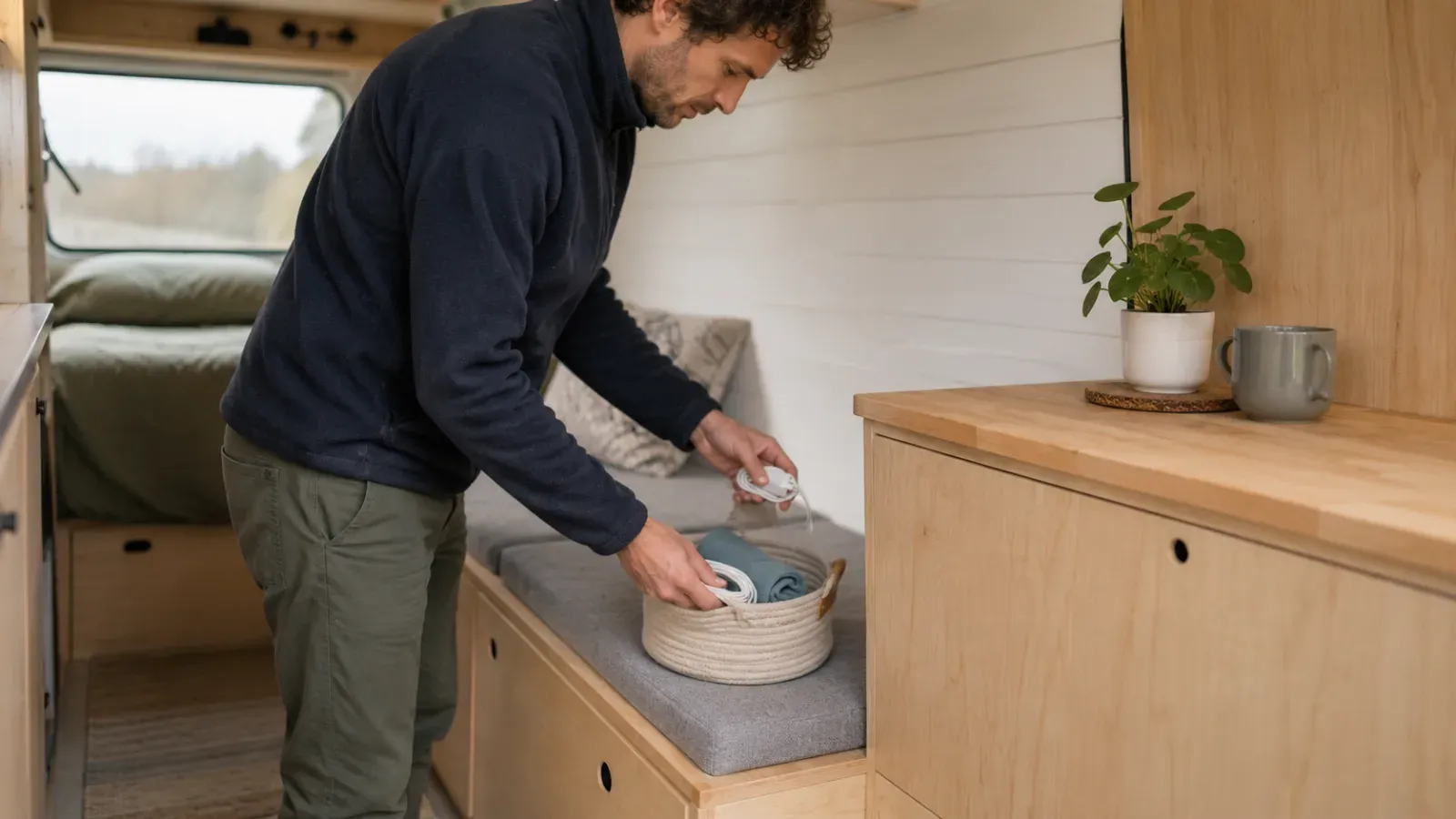
In a small van, it does not take much for things to look messy. One jacket over the seat, two bags on the floor, a cooking pot on the worktop and a few charging cables on the table can sometimes be enough. The advantage is that you can also make such a small space usable again quite quickly.
Ten minutes is not enough to thoroughly clean your entire van. It does not need to be. This routine is intended as a daily reset: rubbish and food are put away, the main surfaces are clear again, wet items can dry and you can move safely through the van.
The end result does not have to be photo-ready. If you can cook, sit down and step outside again without having to move anything first, the routine has worked.
Decide in advance what ‘tidy enough’ means
Without a clear end point, ten minutes of tidying can easily turn into half an hour of rearranging cupboards. So agree with yourself what needs to be in order after those ten minutes:
- Food leftovers and rubbish have been collected.
- The table and worktop are clear enough to use again.
- The floor and walkway are free of things you could trip over.
- Everyday items are back in their usual place.
- Wet clothes, towels and dishcloths can dry.
- If you are about to drive, loose items are stored away and cupboards and drawers are closed.
You do not need to do more during this short reset. Dust behind a cupboard, a messy storage box or bedding that needs changing can wait for a more thorough tidy-up.
Keep what you need within reach
If you first have to look for cleaning supplies in three different places, much of your time is already gone. You only need a few things for this routine:
- a small rubbish bag;
- a cloth and your usual cleaning product;
- a hand brush and dustpan;
- a dedicated bag or basket for dirty laundry;
- a place where wet items can dry in the open.
Store these items close to where you use them. A hand brush under a full bench seat is stored away in theory, but in practice you will rarely take it out.
You can set a ten-minute timer if you like. It is not meant to make you rush, but to stop you from starting to sort through a drawer halfway through and leaving the rest behind.
0:00 to 1:00 – Start with rubbish and food
Take one rubbish bag and do a quick round. Collect empty packaging, used cloths, receipts and other waste. Close opened food again and put everything back in the right storage box or cooler.
Food leftovers take priority. They cause odours, attract insects and only make the next tidy-up more unpleasant. Do not spend time thoroughly wiping away crumbs yet. That comes later. First remove everything from the table and worktop that is no longer needed there.
Keep different waste streams separate where practical and dispose of them according to local sorting rules. A full bag of rubbish from your van does not belong in a small street bin or a bin at a motorway service area. Keep it with you until you can dispose of it in an authorised place.
1:00 to 2:30 – Reset the kitchen
Wash the few used mugs, plates and cooking utensils straight away. With a small daily wash-up, you will usually be done faster than if you leave everything until the next morning.
If you do not have enough water or there is too much washing-up, at least remove the food leftovers and put everything together in the washing-up bowl. That way, it is not spread around the van. Consider this a postponement, not a finished task.
Put dry items back in their usual place. Let wet cooking utensils drain first and do not put a damp dishcloth in a closed cupboard. Also quickly check that bottles and packaging are properly closed. One leaking bottle of oil or washing-up liquid will create far more work later than this entire routine.
2:30 to 4:30 – Put loose items back in their usual place
Walk through the van once from front to back. Take along anything that is not where it belongs: charging cables, torch, book, dog lead, toiletries, power bank and other small items.
Put each item back straight away. Do not sort anything again and do not open a box to reorganise its entire contents ‘while you are at it’. That is exactly how a short reset gets derailed.
If you keep coming across the same items without a fixed place, use one small temporary box. That box is not a new junk drawer. Review it during your next thorough tidy-up and give its contents a proper place or remove them from the van.
If an item ends up on the table every day, its usual place is probably wrong. A charging cable you use every evening belongs by the charging spot, not at the back of a general electronics box.
4:30 to 6:00 – Deal with clothes, the bed and wet items
Put dirty clothes straight into the laundry bag and put clean clothes away. Hang up a wet jacket, dog towel, dishcloth or swimwear so everything can dry. Do not push wet textiles into a closed cupboard or plastic box. Moisture lingers there and more quickly causes musty smells and mould.
If you have a bed that also serves as seating during the day, fold it away only as much as needed to make the living space usable again. You do not need to make a perfectly neat hotel bed. With a fixed bed, it is enough to remove clothes and loose items and briefly fold back the duvet.
If you are staying parked for a while, you can air the van out a little extra while tidying if the weather and location allow it. Never block fixed ventilation openings with clothes, boxes or bedding.
6:00 to 7:30 – Clear the entrance and busiest floor area
Put shoes together, hang the dog lead back up and remove bags from the walkway. Pay particular attention to the sliding door, the passage to the cab and the area where you cook.
Sweep away sand, hair and crumbs only from the areas you walk on most. You do not need to get under every cupboard or mat. A full floor clean belongs to the thorough clean, not this daily reset.
Make sure at least one usable exit and the route to it remain clear. Putting a crate, shoe box or backpack in front of the door ‘just for a moment’ quickly becomes a habit and is especially inconvenient at night.
7:30 to 9:00 – Wipe down the usable surfaces
Now that the items are put away, you can quickly wipe down the table, kitchen worktop and sink. Focus on spilled drinks, grease, food leftovers and the places you will use again that evening or morning.
Cleaning before you have tidied up rarely works. You keep moving things around and clean the same spot twice. That is why this step comes near the end.
Do not use more product than necessary and store cleaning products closed again afterwards, separately from food and out of reach of children or pets.
9:00 to 10:00 – Finish with a safety check
The final minute is not cleaning time. Take one deliberate look around and check:
- Is there nothing near the pedals or the driver’s seat?
- Are the walkway and exit clear?
- Are bottles and other leak-prone items standing upright?
- Are heavy or hard objects stored low down and safely?
- Can boxes not shift when you brake or swerve?
- Are cupboards and drawers closed if you are about to leave?
- Are the necessary sightlines and mirrors clear?
The Belgian Highway Code states that a load must not obstruct visibility, endanger anyone, fall onto the road or compromise the stability of the vehicle. This also applies to loose items in your living space.
Vias warns that a loose 2-kilogram thermos flask can have an impact comparable to almost 60 kilograms when braking sharply from 80 km/h. So leaving a power bank, water bottle, cooking pot or toolbox loose is not just messy.
An evening reset is not the same as being ready to drive
When you are staying parked, a book, charging cable or water bottle can perfectly well remain in a practical place. Wet items need to be able to dry, and your bed may stay open.
Before you drive, the van needs to be in driving mode. That means putting away the items that could remain accessible while stationary too. Close cupboards and drawers, and secure loose boxes properly.
These ten minutes do not replace a full departure check. Before every trip, also check the things that apply to your van, such as windows, roof vent, step, awning, electrical connection, loose camping gear and the safe condition of your gas installation. Take your time with this. A timer is never a reason to rush a safety check.
What you deliberately do not do in these ten minutes
A manageable routine only works if you dare to postpone some tasks. During these ten minutes, do not start:
- counting supplies and checking expiry dates;
- reorganising cupboards or drawers;
- thoroughly cleaning the fridge;
- fully cleaning the toilet or water tank;
- changing bedding;
- dusting every corner;
- repairing equipment or modifying the conversion.
Plan a separate time for those tasks, for example after a trip or when you notice that a particular area is no longer working well. The daily routine prevents everyday clutter from piling up. It does not replace regular maintenance.
If it never takes just ten minutes
Then the problem is usually not your tidying speed, but your system. Look at where you keep losing time.
If you have to move three boxes to reach one charging cable, its usual place is not practical. If all cupboards are completely full, you cannot put anything away quickly. If a pile without a destination remains every evening, you have brought too many things or they do not yet have a logical place.
Solve one bottleneck at a time:
- Remove items from the van that you rarely use.
- Create some empty space in frequently used cupboards and drawers.
- Store everyday items close to where you use them.
- Give dirty laundry, rubbish and wet textiles each their own solution.
- Do a small wash-up after cooking instead of saving everything up.
- Reduce the number of loose items that permanently sit on the table or worktop.
The timer then becomes a simple test of your layout. If the same step takes too long every day, you do not need to become faster. The van needs to become easier to tidy.
The three-minute version for bad days
Sometimes you are tired, arrive late or simply do not feel like it. Then do only what is essential:
1. Put food away and collect rubbish.
2. Clear the walkway and exit.
3. Hang wet items out to dry and safely store dangerous, heavy or hard objects.
If you are still going to drive, spend those three minutes entirely on safety and then do your usual departure check as well. The table can wait.
A short minimum reset is better than doing nothing because the full routine does not work for you today. The next day, you will not immediately be starting with yesterday’s mess.
Do not turn it into a competition
Ten minutes is a guideline, not an exam. With children, a dog, wet weather or an elaborate meal, it sometimes takes a little longer. Let children collect their soft toys and divide a zone between two travellers, but always have an adult do the final safety check.
Work in the same order as much as possible. After a while, you will no longer have to think about it and will spot more quickly what is out of place.
I would rather spend ten manageable minutes tidying every evening than spend an hour staring at the mess every few days. My limit is simple: I need to be able to cook, sit down and step outside without having to move anything first. Anything that is still not perfect after that can wait.
Source: https://www.wegcode.be/nl/regelgeving/1975120109~hra8v386pu
Source: https://ovam.vlaanderen.be/afval-thuis-sorteren
Source: https://mooimakers.be/nieuws/vijf-dingen-die-je-moeten-weten-over-je-afval-op-vakantie