Solar panels on your van: how many watts are enough in Belgium?
The right question is not just how many watts fit on your roof. Above all, you need to know how many watt-hours you use each day, which months you travel in and how long you want to stay put without driving or mains power.
By Laurens De Leeuw · 12 August 2026
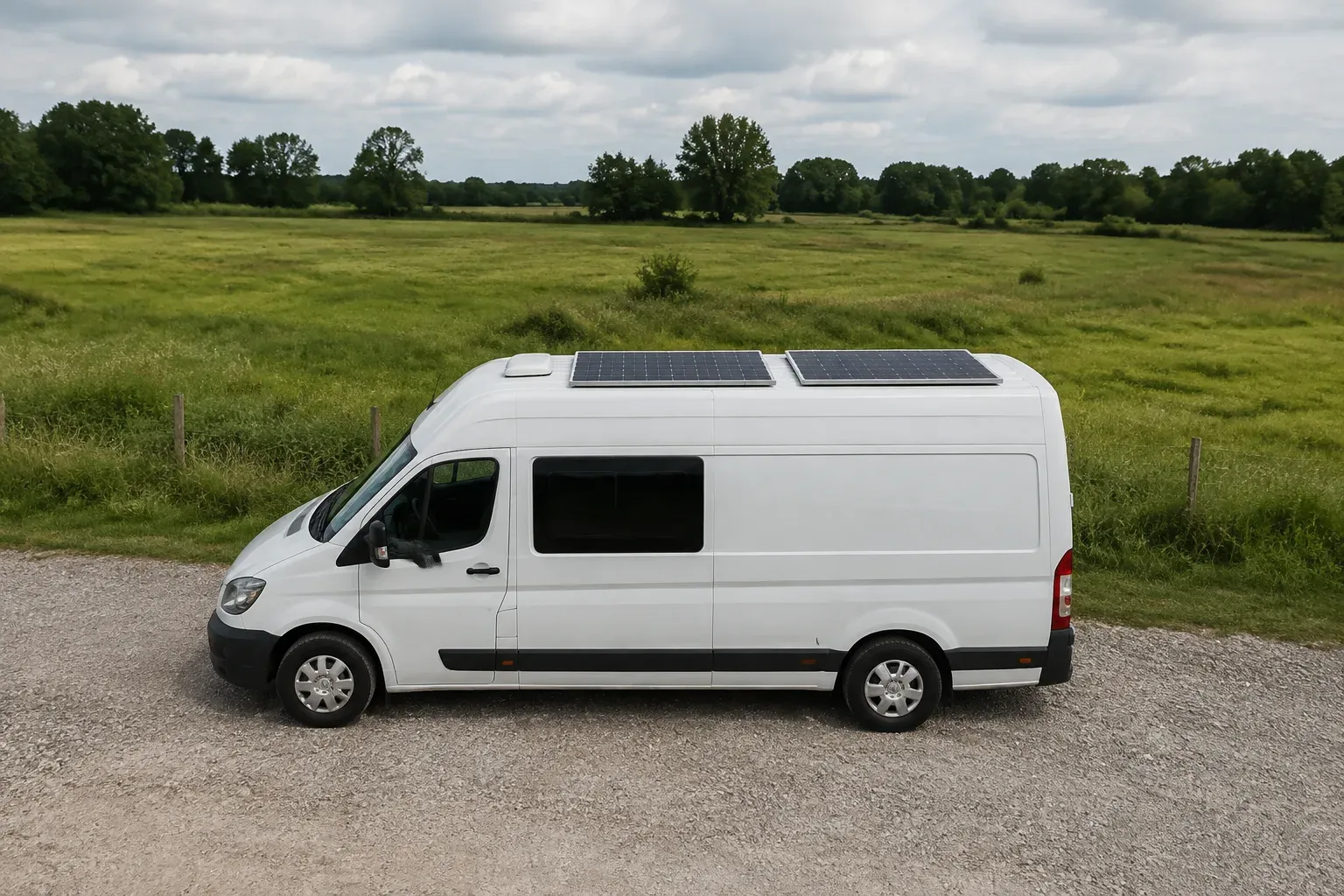
For most compact campervans, **200 to 300 watt-peak** is a useful starting point if you mainly travel from spring to early autumn. This will often cover an efficient compressor fridge, lighting, phones, a water pump and limited laptop use. If you spend a lot of time parked up, work on the road or want more reserve for changeable weather, it is better to look at **300 to 500 watt-peak**.
But there is no panel capacity that is enough for everyone. A van with only LED lighting and a phone needs something completely different from a van with a fridge, two laptops, an inverter and diesel heating. What is more, the same panel produces almost ten times as much energy on average in Belgium in June as it does in December.
So the right question is not just how many watts fit on your roof. Above all, you need to know how many watt-hours you use each day, which months you travel in and how long you want to stay put without driving or mains power.
Watt-peak and watt-hours are not the same
A solar panel may be labelled 200 Wp, for example. This is the maximum power the panel can deliver under specified test conditions. It does not mean it continuously produces 200 watts from sunrise to sunset.
**Watt-peak, abbreviated as Wp, tells you the maximum power of your panels. Watt-hours, abbreviated as Wh, tell you how much energy they actually generate or how much your devices use.**
A 20-watt device running for five hours uses:
20 watts × 5 hours = 100 Wh
A 200 Wp panel can generate much more than 200 Wh on a good summer day because it produces power for several hours. On a dark winter day, that same panel may produce less than 100 Wh. The battery stores that energy, but does not create new energy itself.
The Belgian season makes a huge difference
According to climate data from the KMI, average daily global solar radiation in Belgium is around 545 Wh per square metre in December and 5,270 Wh per square metre in June. That is almost a tenfold difference.
To translate this into van use, we made a calculation for Ukkel using the European Commission's PVGIS. We chose a flat-mounted, unshaded solar panel, as found on the roof of most vans. The calculation uses a long-term weather model and accounts for 14 percent system losses.
On average, **100 Wp** then produces around:
- 58 Wh per day in January;
- 220 Wh per day in March;
- 345 Wh per day in April;
- 432 Wh per day in June;
- 266 Wh per day in September;
- 152 Wh per day in October;
- 45 Wh per day in December.
With **200 Wp**, you double those figures. That gives an average of around 690 Wh per day in April, 864 Wh in June, 532 Wh in September, 304 Wh in October and just 90 Wh in December.
With **400 Wp**, you get an average of around 1,380 Wh per day in April, 1,728 Wh in June, 1,064 Wh in September, 608 Wh in October and 180 Wh in December.
These are monthly averages, not daily promises. In the winter calculation, a flat 400 Wp installation produced an average of around 270 Wh per day, but on one in ten winter days, output remained around 80 Wh or less. Three grey days in a row are not compensated for just because the monthly average looks neat.
Your location within Belgium makes a difference of a few percent. The coast is on average slightly sunnier than some other regions. That difference is much smaller than the effect of the season, shade and your own consumption.
First calculate what you actually use each day
Make a list of all electrical devices and note how many watts they use and how long they run each day. For appliances that switch on and off continuously, such as a compressor fridge, it is better to use the measured or stated consumption per 24 hours.
A few realistic examples show how quickly the total adds up:
- According to Dometic, a modern compressor fridge of around 47 litres uses approximately 268 Wh per day in one specific test model at an internal temperature of 5 °C and an ambient temperature of 25 °C. At an ambient temperature of 32 °C, this rises to around 557 Wh. Always check the figures for your own fridge.
- A full laptop charge often requires around 50 to 80 Wh, depending on the laptop and charging losses.
- For a phone, you can allow around 20 to 25 Wh per full charge.
- Two 4-watt LED lamps running for four hours use 32 Wh together.
- A small water pump only runs briefly and often stays below 5 Wh per day.
- A compact diesel heater does not only use fuel. An AUTOTERM Air 2D uses 10 to 29 watts of electricity while heating. Eight hours of heating can therefore require around 80 to 232 Wh.
Do not forget standby consumers either. An inverter that uses 7 watts without a device connected and remains switched on all day consumes 168 Wh without doing anything useful for you. So switch off an inverter when you do not need it, or use a suitable power-saving mode.
Three useful consumption profiles
Every installation remains bespoke, but these profiles provide a better starting point than simply choosing a panel size.
Light weekend use
You use LED lighting, charge one or two phones and occasionally run a water pump. You do not have an electric fridge running day and night, and you do not cook electrically.
Allow around **60 to 150 Wh per day**, depending on your devices. For weekends from spring to early autumn, **100 to 150 Wp** may be enough, especially if the leisure battery is also charged while driving.
This is not a good choice for someone who wants to run a fridge continuously or stay under trees for several days.
Typical van with a compressor fridge
You use an efficient fridge, phone, lighting and water pump. You may charge one laptop partly or fully.
A realistic estimate is around **350 to 450 Wh per day**. During the usual travel season, **200 to 300 Wp** is a logical size. With 200 Wp, you will often have a surplus in sunny summer months, but in September and October the margin quickly becomes smaller. A 300 Wp installation gives more reserve if the roof space, budget and rest of the installation allow it.
Working from the van or travelling as a couple
You have a fridge, two phones, one or two daily laptop charges, more lighting and possibly a router or other electronics.
You can quickly reach **500 to 700 Wh per day**. In warm weather, the fridge can add a substantial amount on top of that. For use from spring to autumn, **300 to 500 Wp** is a better fit. If you want to stay in the same place for several days, it is best to choose the upper end of that range and provide a second charging option.
In winter, the electrical consumption of the heating is added too, while the solar panels produce far less. Even 500 Wp does not automatically make you self-sufficient then.
High-power 230V appliances completely change the calculation
A solar installation that works perfectly for a fridge and laptop can fall short as soon as you start cooking or heating electrically.
A 1,200-watt hob running at full power for half an hour requires 600 Wh. That is more than the total daily consumption of many simple vans. A 1,000-watt kettle running for six minutes uses around 100 Wh. A hairdryer, coffee maker, boiler or electric heater can also drain the battery quickly.
And it is not only the solar panel that needs to be large enough. The battery must also be able to supply the required power, and the inverter, cabling, fuses and connections must be designed for it.
If you want to use such appliances every day, make a separate energy calculation. A general rule such as ‘400 watts is enough for a van’ is then worthless.
How to calculate how much watt-peak you need
First, add up your expected daily consumption in Wh. Then add a practical margin for charging losses, small consumers you have forgotten and days when a device runs longer. Fifteen to twenty percent is a useful starting point, but not a guarantee against bad weather.
Then use this formula:
**Required panel capacity = daily consumption ÷ expected daily yield per 100 Wp × 100**
Suppose you need 450 Wh per day. For a flat panel in Ukkel, the PVGIS calculation gives an average of:
- In June: 450 ÷ 432 × 100 = around 104 Wp.
- In October: 450 ÷ 152 × 100 = around 296 Wp.
- In December: 450 ÷ 45 × 100 = around 1,000 Wp.
These are theoretical capacities to match average daily consumption in that month. They do not yet include a real buffer for shade or several dark days. That is why 200 to 300 Wp is much more sensible for this example in summer, while in October you would be looking more towards 400 Wp. In December, 1,000 Wp usually does not even fit on a van, and you still have no guarantee during consecutive dark days.
So do not calculate based on the annual average if you mainly travel in winter. Choose the most difficult month in which you genuinely want to be self-sufficient.
A larger battery does not solve too little sun
A battery bridges the night and days with lower output. It can only store what was previously charged through solar panels, the alternator or mains power.
A 100 Ah LiFePO4 battery at 12.8 volts contains around 1,280 Wh nominally. How much of that you can actually use depends on the battery, the BMS, the settings and the temperature. Divide the usable capacity by your daily consumption to find out how long you can bridge without new charging.
At 450 Wh per day, 1,000 Wh of usable energy gives you just over two days of autonomy. After that, energy needs to come in again. A 200 Ah battery postpones that moment, but will eventually still run flat if your panels generate less each day in winter than you consume.
So match these three things to each other:
- your daily consumption;
- usable battery capacity;
- the charging sources that refill that battery.
In a van, shade is often more important than panel size
The PVGIS figures assume a clear, unshaded panel. In practice, you may prefer to park your van under a tree to keep the interior cool. That is pleasant for you or your dog, but bad for solar output.
Even a small object on the roof can cast moving shade during the day. Think of a roof hatch, fan, antenna, roof rack or roof box. A partially shaded cell group can severely limit the production of one panel or a series of panels. Bypass diodes help, but they do not make shade unimportant.
When installing, therefore take into account:
- shade from roof components in low morning and evening sun;
- trees and buildings around your usual parking spots;
- leaves, bird droppings, dust and other dirt;
- enough space to safely clean and inspect the panel;
- how multiple panels are electrically connected.
A larger panel in a poorly chosen location can produce less usable energy than a smaller panel that remains clear all day.
Flat mounting is practical, but not ideal in winter
A flat panel fits well on a moving vehicle. You do not need to point the van south, and the panel catches less wind than a tilted setup. The downside is that the low winter sun hits the panel at an unfavourable angle.
In the PVGIS calculation for Ukkel, a flat panel produced around 16 percent less annually than a fixed panel facing south at the optimal angle of around 39 degrees. In winter, the difference was much greater: the average output of the tilted panel was almost twice as high.
A tiltable or portable panel can therefore be useful if you stay in the same place for a long time. You do need to aim it correctly, set it up safely and pack it away again in wind or before leaving. For many travellers, extra fixed capacity on the roof is more practical than unfolding panels every day.
A portable panel has another advantage: the van can be parked in the shade while the panel sits a few metres away in the sun. Do take theft, trip hazards, permitted use of the location and sufficiently thick cables into account.
Do not only look at the number of watts on the roof
The panel, charge controller and battery must be electrically compatible. For the exact components, check at least:
- the maximum panel capacity the charge controller supports at your battery voltage;
- the combined open-circuit voltage or Voc of the panels, including in cold conditions;
- the combined short-circuit current or Isc;
- the maximum charging current allowed by the battery and BMS;
- the correct settings for the battery chemistry;
- cable thickness, fuses, connections and a waterproof roof cable entry.
Panels in series and parallel behave differently in shade and combine voltage and current in different ways. So do not first buy panels at random and then choose a charge controller that seems roughly large enough. Use the technical specifications of all components and have the system checked if you are not familiar with DC installations.
A warm solar cell also delivers less peak power. A fully bonded flexible panel on a hot metal roof may therefore perform differently from a rigid panel with air circulation underneath. Always follow the panel manufacturer's installation instructions.
For winter use, you almost always need a second charging source
If you only travel during the usual travel season, a well-calculated solar system can take you a long way. If you want to live in your van in Belgium all year round, it is best to combine solar panels with at least one other charging option:
- a suitable DC-DC charger that charges the leisure battery while driving;
- a 230V charger for home, a campsite or motorhome stopover;
- a portable solar panel that you can aim better while parked;
- lower consumption during dark periods.
How often you drive also plays a role in the choice. Someone who drives for an hour every two days can manage with less roof capacity than someone who stays in the same place for a week. Conversely, a huge solar installation is of little use if you usually park under trees.
Measure what actually happens after your first trips
A calculation remains a prediction. Use a battery monitor and check at least:
- how many Wh or Ah you actually use per 24 hours;
- how much the solar panels bring in on sunny and cloudy days;
- how low the battery is by morning;
- which devices use unexpectedly much power;
- how much energy is recharged while driving.
Ideally, measure in different months. An installation that is already full every afternoon in July may lose ground every day in October. Also look at energy that was not generated because the battery was already full. A large summer surplus says little about your winter shortfall.
So, how many watts are enough?
As a practical starting point for Belgium:
- **100 to 150 Wp:** light weekend use in the sunny season, without a permanent electric fridge or high-power appliances.
- **200 to 300 Wp:** an efficient compressor fridge, lighting, phones, water pump and limited laptop use from spring to early autumn.
- **300 to 500 Wp:** regular laptop use, two travellers, longer stays or more reserve in changeable weather.
- **More than 500 Wp:** higher daily consumption or as much summer autonomy as possible, provided the battery, charge controller and roof space are suitable.
- **Use during the Belgian winter:** do not rely on solar panels alone, regardless of how much can theoretically fit on the roof.
Personally, I would rather install 300 Wp on a van with normal power use than calculate 200 Wp down to the last watt. The added value is not a higher peak figure on a beautiful June day, but the extra margin when September turns grey, the fridge has to work harder or you stay put for an extra day.
Ultimately, the right system is not the biggest system that fits on your roof. It is the smallest system that reliably provides enough energy in your actual travel months, without pretending that a Belgian December day is the same as a day in high summer.
Source: https://autoterm.com/heating-systems/air-series-heaters/air-2d-compact-air-heater