Small items that always go missing: how to stay organised
A charging cable, torch, lighter, parking disc, roll of tape or the right adapter: it is rarely the big items that cause chaos in a van. It is mainly the dozens of small things that keep ending up somewhere different.
By Laurens De Leeuw · 8 August 2026
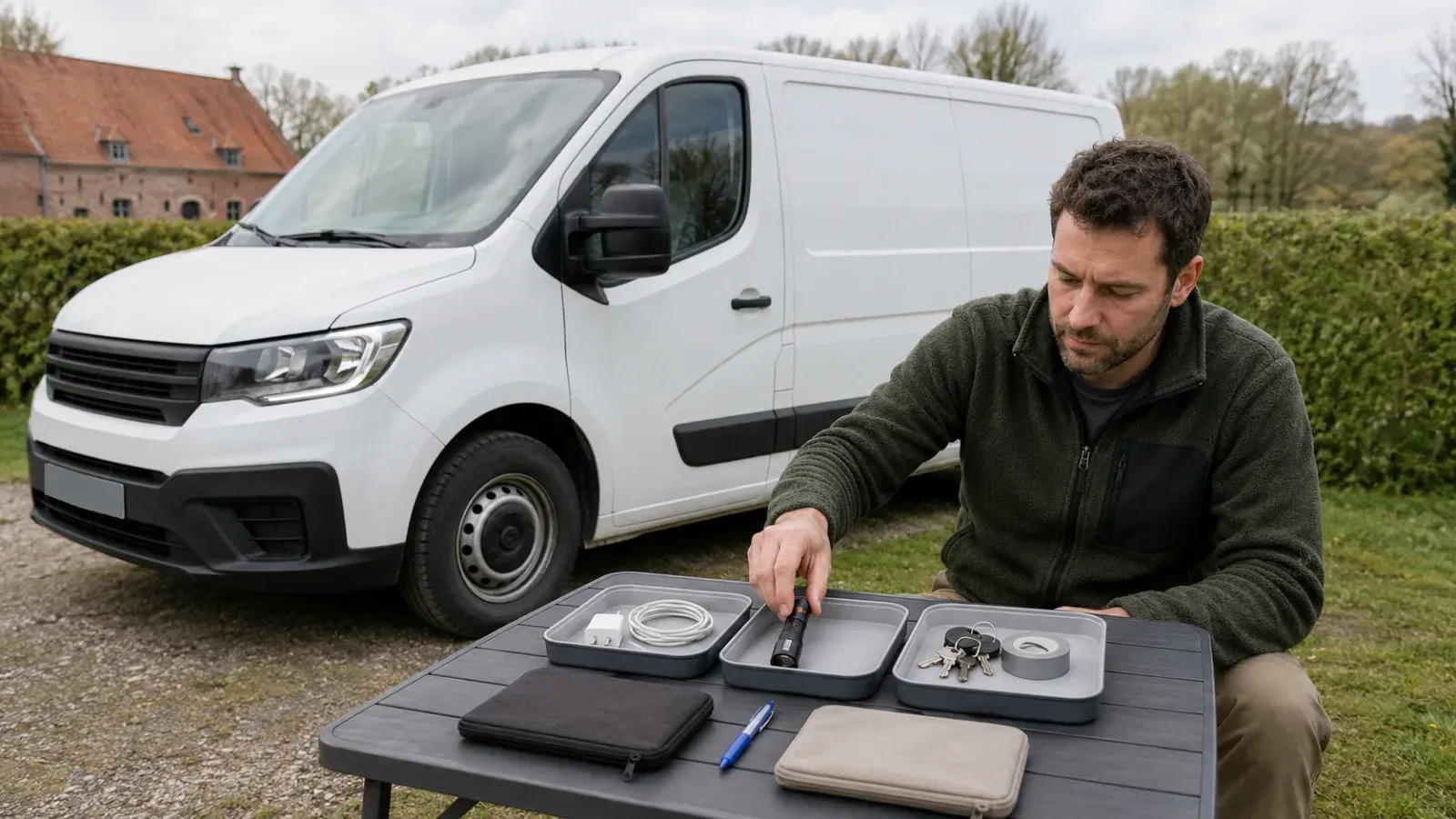
A charging cable, torch, lighter, parking disc, roll of tape or the right adapter: it is rarely the big items that cause chaos in a van. It is mainly the dozens of small things that keep ending up somewhere different.
You do not necessarily need more cupboard space or an expensive storage wall for that. What does help is a simple system in which every small group of items has a logical, fixed place. That way, you can find something without emptying three boxes, and everything is safely stored away when you set off.
Why small items disappear so easily
Large items usually naturally have a fixed place. A camping chair only fits in a few places, and a cooking pot normally belongs in the kitchen. Small objects, on the other hand, fit everywhere. That makes it easy to put them down “just for a moment” on the table, in a door pocket or on top of another box.
Things usually go wrong because of a combination of three factors:
- the item does not have a proper fixed place;
- its fixed place is too far from where you use it;
- different types of small items are all kept together in one deep clutter box.
A good storage system is actually rather boring. You no longer have to think about where something is, because it goes back to the same place every time.
Do not start by buying new boxes straight away
It is tempting to order a range of nice organisers first. Yet that is usually the wrong order. You then organise things you do not actually need and end up with boxes that do not quite fit in the cupboard.
So first take the small items out of the van, one zone at a time. Do not do the entire van at once, as it will become an overwhelming pile. Start with the cab, then the kitchen, followed by the technical equipment, for example.
Put everything together and ask yourself a few simple questions about each item:
- Do I actually use this during my trips?
- Do I need several of these?
- Is it a necessary spare or safety item?
- Does it belong to a particular task or device?
- Could I easily buy this again while travelling?
Then make three groups: needed daily, spare and leave at home. Naturally, keep safety equipment, essential spare parts and vehicle-specific tools. But a fourth USB adapter, three half-used rolls of tape and cables for devices that no longer come along can probably leave the van.
A useful rule of thumb is that anything not used during two or three consecutive trips can probably stay at home. Do make an exception for breakdown equipment, first aid, documents and other things you hopefully never need.
Divide the van according to tasks
Organising items by product type sounds logical, but it is not always practical. When making coffee, you may need a lighter, coffee filters, a measuring spoon and a cloth. Those items belong together, even though they are technically completely different products.
So think in small usage zones.
| Zone | Small items that logically belong there |
|---|---|
| Cab | sunglasses, parking disc, charging cable, pen and toll badge |
| Entrance | keys, head torch, rubbish bags, dog lead and bags |
| Kitchen | lighter, herbs and spices, coffee supplies, sponge and dishcloth |
| Sleeping area | glasses, earplugs, reading light and charging cable |
| Hygiene | toiletries, towel hooks and personal care items |
| Technical | fuses, adapters, test leads, tape and spare parts |
| Documents | vehicle papers, insurance details and travel documents |
The best place is usually as close as possible to where you use something. A dog lead next to the sliding door makes more sense than under the bed. A head torch beside the sleeping area works better than among the tools. The cable you use to charge your phone every evening does not need to be in the general electronics box at the back.
If an item always ends up somewhere else despite your new layout, that is usually not a lack of discipline. Its fixed place is probably simply wrong.
Work with three levels of use
Not every item deserves the most accessible place. Divide small items into three levels.
Daily use
You should be able to grab these items with one hand, without moving other boxes first. Think of keys, glasses, a torch, your daily charging cable, a lighter and rubbish bags.
Give them a small, clearly defined compartment. Do not make that compartment bigger than necessary, otherwise it will quickly turn into another junk drawer.
Regular use
Items you need every few days can go together in a removable box or zip pouch. This lets you take the whole module to where you use it.
Examples include a toiletry bag, a coffee box or a compact repair kit.
Spares and emergency supplies
Spare cables, fuses, batteries and less frequently used repair materials can be stored further away. Keep them together, clearly labelled and accessible without having to dismantle half the conversion.
Do not mix spare supplies with daily items. Otherwise, you will have to search through six cables every time when you only use one.
Choose small, lightweight and removable storage solutions
A large, deep box may seem efficient, but small items quickly disappear underneath one another. Several shallow boxes usually work better. You can see the contents more quickly and take one whole group out of the cupboard.
When choosing, keep a few practical points in mind:
- Measure the usable inside of the cupboard, including hinges and catches.
- Choose lightweight plastic or fabric storage solutions rather than heavy wooden systems.
- Use a lid for supplies, dust-sensitive items and equipment in the load area.
- Open boxes can be used inside a drawer or cupboard that closes securely itself.
- Choose a handle or cut-out if you need to remove the box often.
- Use compartment dividers for screws, fuses and other very small parts.
- Use zip pouches for cables, documents and personal belongings.
Transparent boxes are useful for rarely used supplies, as you can immediately see what is inside. Boxes that are visible in the living area can certainly be closed. It looks calmer, as long as it is clear what belongs in them.
Always place the label on the side you see when the box is in its fixed place. “Electronics” is rather vague. “USB cables, 12V adapter and power bank” tells you much more quickly what you need.
A complete digital inventory of every fork and toothbrush is excessive. A short list is useful for tools, spare fuses, medicines, first aid and vehicle-specific spare parts. You can also note the correct size, quantity and expiry date.
Tackle the classic problem items separately
Keys, wallet and glasses
Provide one small landing spot close to the entrance. A shallow box with a lid or a small closed compartment is enough. The spot should not be visible or easily accessible from outside.
Do not keep a spare key on the same keyring as the main key. Choose a separate, safe place and, if there are two travellers, clearly agree who keeps which key.
Cables and adapters
Cables mainly go missing because they are used in several places. Provide one central charging spot and let the daily cable live there. A second cable in the cab and one by the bed can be practical, but taking three spares of every type mainly creates confusion.
Roll up spare cables separately with reusable cable ties. Label unknown adapters straight away and remove cables that nobody remembers the purpose of. Do not store electronics, power banks and adapters together with wet toiletries or liquids that may leak.
Documents and valuables
Keep vehicle papers, insurance details and travel documents together in a water-resistant folder. Digital copies can be useful as a backup, but they do not automatically replace the original documents you may need to show while travelling.
The folder should be accessible when you need it, but not left open and visible in the cab. The same applies to cash, bank cards and spare keys.
Screws, fuses and small tools
Use a compartment box in which small parts cannot get mixed together. Clearly note the rating or purpose of fuses and electrical components. Never simply fit a heavier fuse because it happens to be left in the box.
Keep the repair kit limited to materials that suit your van and equipment. You do not need to take a complete workshop with you. A compact, well-considered repair box is more useful than a heavy toolbox of which you never use half.
Toiletries and medicines
Keep liquids upright in a small leak tray and do not store them above food, documents or electronics. Let wet flannels and cloths dry first before putting them in a closed box.
Store medicines according to the conditions in the package leaflet or the pharmacist’s advice. It is better not to leave products that cannot withstand heat or frost permanently in a van. The temperature in a parked vehicle can fluctuate far more than at home.
Being tidy while parked is not the same as being safe on the road
An open basket on the table can work perfectly when you are parked. While driving, that same basket becomes a collection of loose projectiles.
The Belgian Highway Code states that a load must not obstruct visibility, endanger anyone, fall onto the road or compromise the vehicle’s stability. Small items must therefore also be stored in such a way that they do not fly through the van when braking or swerving.
Vias illustrates that a loose object weighing 2 kilograms can, during sudden braking at 120 km/h, have an impact comparable to 63 kilograms. Leaving a water bottle, toolbox or power bank loose on the table is therefore not a minor detail.
Before setting off, it is best to check the following:
- The worktop, table, bed and floor are free of loose hard objects.
- Drawers, cupboard doors and boxes are fully closed.
- Storage boxes themselves cannot shift or fall out of a cupboard.
- Heavy items are placed low down and as centrally as possible in the vehicle.
- Overhead cupboards contain only lightweight items.
- Nothing is near the pedals, airbags or sightlines.
- Doors, passageways and technical access points remain clear.
- Open nets or elastic holders only contain items while driving that they are genuinely designed to hold.
A non-slip mat reduces sliding and rattling, but it is not a proper means of securing something. The same applies to a magnet, adhesive strip or light elastic band. The box itself must be enclosed, locked or securely fastened.
If you need to look for or pick up something while on the road, stop somewhere safe first. Feeling around for a dropped cable or pair of sunglasses while driving causes unnecessary distraction.
Rattling tells you where something is still moving
A quiet van is not only more pleasant. Rattling usually points to items moving around with every corner and bump.
Put non-slip material under lightweight boxes, fill overly large empty spaces and separate hard objects with a piece of felt, cloth or thin foam. Bottles are best kept upright in a compartment that roughly matches their diameter. Cutlery can go in a suitable drawer insert or roll-up case.
After a new layout, take a short test drive and listen for any remaining movement. Stop to solve the problem rather than searching for the sound while driving.
Also check that organisers do not block ventilation grilles, inspection hatches, electrical connections or technical components. Do not simply use the gas bottle locker or a technical space as extra storage. The intended ventilation and accessibility must be maintained.
Be careful with self-adhesive hooks and boxes. Heat, cold and condensation can cause adhesive to come loose unexpectedly in a vehicle. Only hang lightweight items from them. If you want to permanently screw something in near wiring, gas lines, airbags, seat belts or the vehicle structure, first have someone check what is behind the panel.
You need a different system for a weekend than for a long trip
If you mainly go away for weekends, removable modules are very useful. A small cooking box, toiletry bag and repair kit can be filled at home and only come along when needed. Take small quantities of consumables with you and remove anything from the van after the trip that does not need to stay there permanently.
During a longer trip, fixed zones become more important. Each traveller can have their own small compartment or zip pouch. Keep a limited supply of hard-to-find parts, but separate daily supplies from spares.
A simple stock rule is: as soon as you open the last spare, add the item to the shopping list. That way, you do not have to carry a large stock, yet you will not unexpectedly run out.
Also keep weight in mind. Dozens of boxes, spare parts, bottles and small tools weigh more together than you might think. The maximum permitted mass includes the vehicle, occupants and all cargo. So choose lightweight organisers and weigh a fully loaded tool or supply box once. The result is often surprising.
Keep one small temporary collection spot
Not every item can immediately go back to its fixed place. It is therefore perfectly fine to have one small temporary box for things you have just taken out of your pockets or will need again later.
Deliberately keep that box limited. A small compartment for keys, earplugs and coins works. An entire empty seat used as a collection spot will turn into chaos within a day.
Make a habit of emptying the temporary box every evening. That way, tidying up only takes a few minutes.
The daily reset only needs to take five minutes
A good system does not require a major weekly tidy-up. A short reset at the end of the day is usually enough:
1. Put daily items back in their fixed place.
2. Throw away rubbish and empty packaging.
3. Hang up wet cloths so they can dry.
4. Add the last used spare item to the shopping list.
5. Clear the table, worktop and floor.
6. Close all boxes, drawers and cupboard doors.
I would rather have six simple storage modules that work every day than twenty beautiful boxes that nobody remembers what belongs in. So first test your layout with items you already have. Only after a few trips will you know which dimensions and fixed places really work well.
Ultimately, order in a van is not about having as much storage space as possible. It is about searching as little as possible. Once every small item has a logical home, even a compact van feels much more spacious and peaceful.
Source: https://www.wegcode.be/nl/regelgeving/1975120109~hra8v386pu
Source: https://www.vias.be/nl/newsroom/met-de-auto-op-reis-1-op-4-rijdt-meer-dan-1000-kilometer-/
Source: https://www.vlaanderen.be/mobiliteit-en-openbare-werken/auto-en-motor/aanhangwagens
Source: https://www.promobil.de/zubehoer/ueberblick-verstausystem-stauraumloesung-im-caravan/