How much power do you really need in a van?
Power in a van often seems more complicated than it is at first. You hear terms like watts, amps, amp-hours, lithium, AGM, inverter, charge booster, MPPT, fuses, and solar panels. Before you know it, it feels like you need to become an electrician before you can even leave for a weekend trip in your van.
By Laurens De Leeuw · 25 June 2026
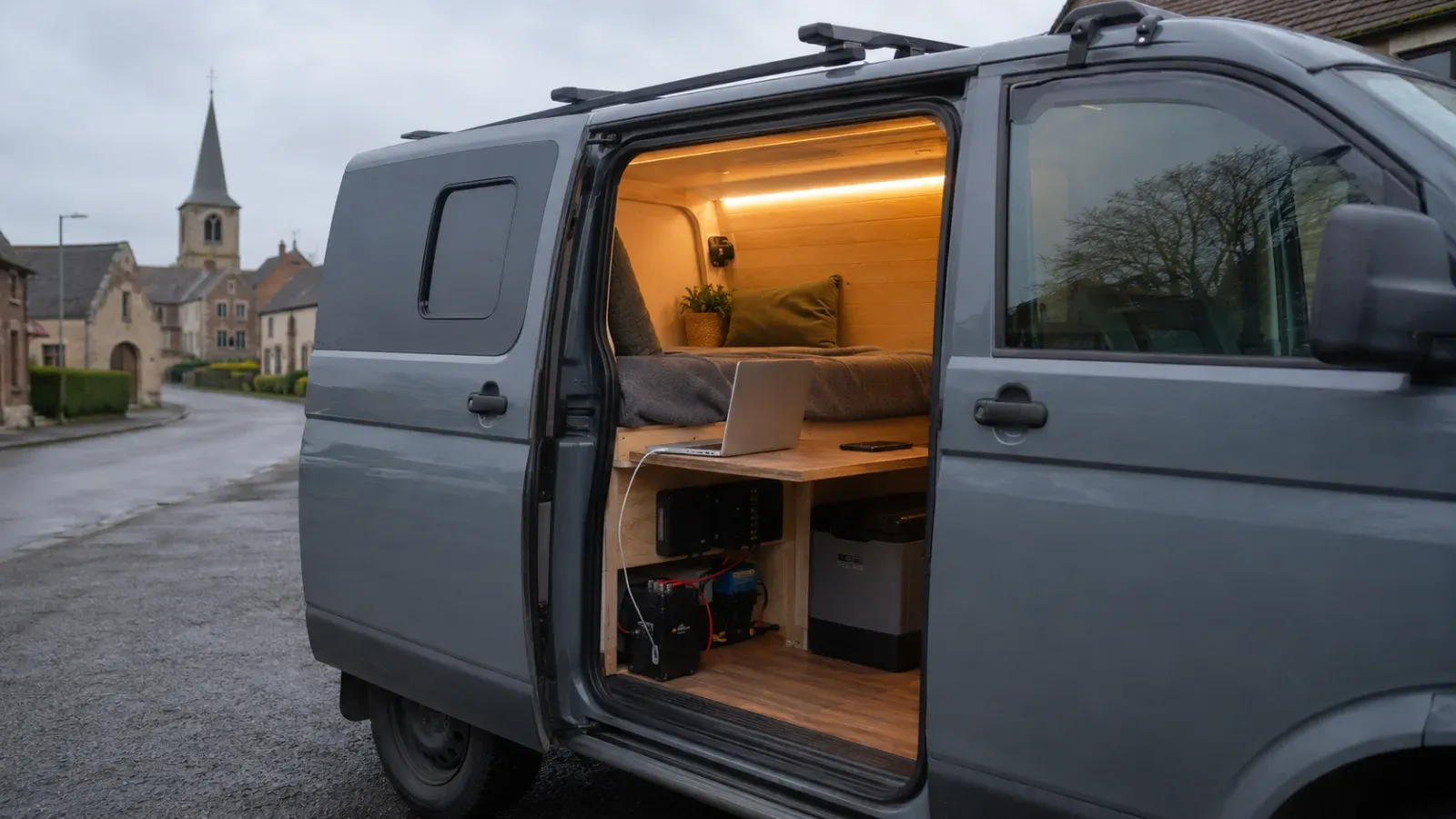
Power in a van often seems more complicated than it is at first. You hear terms like watts, amps, amp-hours, lithium, AGM, inverter, charge booster, MPPT, fuses, and solar panels. Before you know it, it feels like you need to become an electrician before you can even leave for a weekend trip in your van.
Fortunately, it doesn't have to start that way.
The most important question isn't: which battery should I buy? The most important question is: what do I want to use on the road?
Only when you know that can you realistically determine how much power you need. Not because someone on YouTube has a gigantic setup, but based on your own consumption, your travel style, and how long you want to be able to stay without a power outlet.
Don't start with your battery, start with your consumption
Many beginners start with the battery. That's logical, because it's expensive and feels like the heart of your system. Yet, that's actually step two.
Step one is calculating your daily consumption.
For this, you use watt-hours, abbreviated Wh. This tells you how much energy a device uses over a certain period.
The basic formula is simple:
power in watts x hours of use = consumption in watt-hours
A 10-watt lamp that burns for 4 hours therefore uses 40 Wh. A 60-watt laptop charger used for 3 hours comes to approximately 180 Wh. That's simple enough, but it gets interesting once you add everything up.
Because one device is usually not too bad. The total of lighting, phone, laptop, refrigerator, fan, router, and pump can add up significantly.
Watts, amps, and amp-hours simply explained
You don't have to be a technical expert, but a few concepts do help.
Watt is the power of a device. It tells you how much energy a device requires while it's on.
Ampere is the current flowing through your cables. In 12-volt systems, this current can quickly increase, especially with heavier devices.
Amp-hour, or Ah, is often used to indicate battery capacity. A 100 Ah battery sounds clear, but without voltage, you don't yet know how much energy it contains.
In a 12-volt system, you can roughly calculate:
12 volts x 100 Ah = approximately 1200 Wh
That is the theoretical capacity. In practice, it's best not to always use everything down to zero. With lithium, you can usually use a larger portion of the battery than with AGM or lead-acid, but it's always best to build in a margin.
A battery that seems sufficient on paper can quickly feel tight on the road if you almost completely drain it every day.
First make a list of your devices
Take a piece of paper, a note app, or a spreadsheet and write down everything that uses power. Really everything.
Think of lighting, phone, laptop, refrigerator, water pump, roof fan, router, camera, drone, diesel heater, electric toothbrush, tablet, power bank, e-reader, small pump, inverter, and possibly cooking appliances.
Then, for each device, note three things:
1. how many watts the device uses
2. how many hours per day you use it
3. how many watt-hours that amounts to per day
An example:
| Device | Power | Usage per day | Consumption per day |
|---|---:|---:|---:|
| LED lighting | 10 W | 4 hours | 40 Wh |
| Phone charging | 15 W | 2 hours | 30 Wh |
| Laptop | 60 W | 3 hours | 180 Wh |
| Roof fan | 15 W | 4 hours | 60 Wh |
| Water pump | 30 W | 10 minutes | 5 Wh |
| Router | 8 W | 8 hours | 64 Wh |
In this example, without a refrigerator, you're already around 379 Wh per day. If you add a compressor refrigerator, that often adds a significant chunk. How much exactly depends on the model, the outside temperature, how often you open the refrigerator, and how well it's installed.
The refrigerator is often the largest constant consumer
A 12-volt compressor refrigerator is the largest daily consumer for many people. Not because it runs continuously at full power, but because it's on day and night.
In summer, it has to work harder. In a hot van, even more so. In winter, it consumes less, but then you often have other consumers like heating, lighting, and laptop use.
If you only do weekend trips with a cooler and ice packs, you might need little power. If you want a permanent refrigerator that runs all the time, your electrical system must be equipped for it.
For many small vans, the refrigerator is practically in the same category as the laptop: not a luxury detail, but a device that truly determines your power planning.
Working on the road changes everything
Anyone who only charges a phone on the road needs little. Anyone who works on the road with a laptop, second screen, internet router, and perhaps cameras or external drives, is in a completely different situation.
As a web developer, I would never rely solely on “a little power for my laptop.” A laptop seems simple, but if you work on it for several hours every day, it becomes a constant base load. Add a router, phone, power bank, and lighting, and you quickly reach a few hundred watt-hours per day.
If you often work from your van, I would rather calculate a bit too generously than too tightly. Not extremely overbuild, but avoid having to look for a power outlet after just one cloudy day.
Think in profiles instead of one standard answer
There is no perfect battery size for everyone. You can work with profiles.
Profile 1: the simple weekend van
You mainly use your phone, some lighting, maybe a small fan, and occasionally a small water pump. You cook with gas, don't use a permanent refrigerator, and don't work long on a laptop.
Guideline: approximately 150 to 300 Wh per day.
For this profile, a small leisure battery, portable power station, or simple 12-volt setup may be enough. Especially if you only go away for one or two nights and can recharge at home.
Profile 2: the normal compact van
You have LED lighting, phones, a laptop, a 12-volt refrigerator, a water pump, and maybe a fan. You want to be able to stand freely for a weekend or a few days without immediately nervously checking your battery percentage.
Guideline: approximately 400 to 800 Wh per day.
This is the most realistic category for many small vans. Here, a decent leisure battery becomes interesting, often combined with charging while driving and possibly solar panels.
Profile 3: the digital nomad or longer traveler
You work regularly on the road, use a laptop several hours a day, have internet, a refrigerator, lighting, ventilation, devices that need charging, perhaps a diesel heater in colder months, and you want to be able to stay put even in less favorable weather.
Guideline: approximately 800 to 1500 Wh per day.
Here you really need to plan. Not just battery capacity, but also how you get that battery full again. Solar panels alone are not always enough in Belgium and Northern Europe, especially not in autumn and winter.
Profile 4: electric cooking and heavy appliances
If you want to use induction, an electric kettle, coffee machine, hairdryer, or microwave, you enter a much heavier category.
Not because these devices always run for a long time, but because they demand a lot of power. A 1500-watt kettle that runs for 10 minutes uses approximately 250 Wh. That still seems manageable, but you need a heavy inverter, thick cables, a strong battery, and correct protection.
Induction is certainly possible in a van, but it's not the simplest standard choice for a beginner. For many people, cooking with gas or another simple cooking solution is more practical, cheaper, and less taxing on the electrical system.
Solar panels are useful, but not a miracle cure in Belgium
Solar panels on your roof are great. They charge silently, free, and automatically. But in Belgium, you have to remain realistic.
According to the KMI, the average daily sunshine duration varies greatly by season. In December, it's generally much gloomier than in summer. You feel that directly on a flat panel on a van roof, especially if you're between houses, trees, or in cloudy weather.
Therefore, I would primarily see solar panels in Belgium as one charging source, not your only salvation. In summer, they can do a lot. In winter, they are often more of a support.
A fixed charge booster, also called a DC DC charger, is at least as important for many vans. It charges your leisure battery while driving. Especially if you move frequently, that's more reliable than hoping for sun.
Shore power also remains useful. If you occasionally stay at a campsite, with friends, or in a place with an outlet, you can calmly fully recharge your battery.
How big should your battery be then?
Once you know your daily consumption, you can estimate battery capacity.
A practical way:
daily consumption x number of days without charging = necessary usable capacity
Suppose you use 600 Wh per day and want to be able to stand for two days without recharging:
600 Wh x 2 = 1200 Wh usable capacity
In a 12-volt system, that's approximately 100 Ah nominal capacity, but only if your battery can actually deliver that usable capacity. With lithium, you're much more comfortable than with AGM. With AGM, you need to provide more margin, because deep discharging is bad for its lifespan.
That's why a 100 Ah lithium battery often feels larger in practice than a 100 Ah AGM battery.
For a small weekend van, 50 Ah lithium might already be enough. For a compact travel van with a refrigerator and laptop, 100 Ah lithium is often a good basis. For longer off-grid, working on the road, or winter use, 200 Ah or more quickly becomes more interesting.
But don't blindly buy too big. Batteries cost money, take up space, and also weigh something. The right battery is not the biggest battery, but the battery that fits your actual use and charging possibilities.
You don't just have to store power, you also have to replenish it
A large battery sounds safe, but it also needs to get full again. A 200 Ah battery is nice, but if you drain it and barely charge it, you just have a bigger empty battery.
Therefore, always think in three parts:
1. how much do I consume per day?
2. how much do I want to be able to store?
3. how do I recharge it?
The most logical charging sources are:
- charging while driving via a DC DC charger
- solar panels via an MPPT charge controller
- shore power via a battery charger
- possibly a portable power station as a simple starting solution
For those who often make short trips, a strong charge booster is important. For those who stay in one place for a long time in summer, solar panels are interesting. For those who mainly use campsites, shore power is useful. The best setup therefore depends not only on your devices, but also on your travel style.
12 volt is often smarter than 230 volt
Many beginners immediately want outlets like at home. That's possible, but it's not always necessary.
Many vanlife devices simply exist in 12 volts: lighting, refrigerator, fan, water pump, USB chargers, and sometimes even laptop chargers via USB C or 12-volt adapters. If you work as much as possible on 12 volts, you have less loss and less need for a heavy inverter.
An inverter is useful for devices that truly need 230 volts. But an inverter itself also uses energy and must be correctly chosen and protected. The heavier your inverter, the more serious your cables, fuses, and battery must be.
My advice for beginners: keep your base on 12 volts and only add 230 volts where you truly need it.
Don't forget safety
Power in a van is not something to be careless with. You're driving around with vibrations, moisture, wood, insulation, metal, batteries, and sometimes high currents over short distances.
A few basic rules:
- place fuses as close to the battery as possible
- use cables that are thick enough for the current and distance
- protect cables from chafing against metal
- use decent cable lugs and connections
- secure batteries firmly
- don't build a loose spaghetti of wires behind your panels
- use a battery with good protection or BMS
- have doubtful cases checked by someone with expertise
Especially with 230 volts, heavy inverters, or fixed installations, it's wise not to gamble. In Belgium, the AREI exists as a safety framework for electrical installations. A self-built camper is not the same as a home installation, but it does show how seriously electrical safety is taken. If you are unsure, ask for help.
Cheap cables, bad crimp connections, and no fuses can become dangerous. It's better not to save on those.
Test your consumption before you build everything permanently
You can learn a lot by simply testing first.
Use a power station, an energy meter, or a temporary battery setup and see what you actually consume during a weekend. Charge your laptop, use your lighting, run your refrigerator, cook as you would on the road, and note what happens.
After one or two weekends, you often know more than after ten theoretical diagrams.
Perhaps you'll notice that you don't need a large inverter at all. Or that your laptop demands much more than expected. Or that your refrigerator is fine, but your internet router keeps consuming power all day. These kinds of insights make your final system much better.
Practical rule of thumb for beginners
Do you just want to start without making everything complicated? Then I would think like this.
For a simple weekend van without a refrigerator: keep it small and simple. A power station or small leisure battery may be enough.
For a small van with a refrigerator, lights, phone, and occasional laptop: aim for a decent 12-volt system with approximately 100 Ah lithium, charging while driving, and possibly 100 to 200 Wp solar panels.
For longer trips, working on the road, or autumn and winter: think more towards 200 Ah lithium, a good DC DC charger, solar panels as extra help, and possibly shore power.
For induction, coffee machine, hairdryer, or other heavy appliances: have your system really well calculated and built. You're no longer in "connecting a few wires" there.
The best power setup is the setup that fits your life
How much power you need doesn't depend on what someone else has in their van. It depends on how you travel.
A weekend van doesn't need a gigantic installation. A work van with a laptop and refrigerator does. A winter van requires more than a summer van. And anyone who wants to cook electrically must plan much more heavily than someone who cooks with gas.
So start with your consumption. Calculate in watt-hours. Build in a margin. Think about how you recharge. Keep your system as simple as possible. And don't skimp on safety.
A good power setup is almost unnoticeable. Your lights work, your refrigerator stays cold, your laptop charges, and you don't have to nervously check your battery percentage every evening. That's ultimately what you want: enough power to travel freely, without your electrical system taking over your entire van project.
Source: https://www.energy.gov/energysaver/estimating-appliance-and-home-electronic-energy-use
Source: https://joint-research-centre.ec.europa.eu/photovoltaic-geographical-information-system-pvgis_en
Source: https://economie.fgov.be/nl/publicaties/algemeen-reglement-op-de
Source: https://www.victronenergy.com/media/pg/The_Wiring_Unlimited_book/en/index-en.html