Cooking in your van: gas, induction, or outdoor cooking?
Cooking in your van seems like a simple choice until you start building. Will you go for gas? Induction? A separate cooking set that you use outdoors? Or a combination of everything?
By Laurens De Leeuw · 25 June 2026
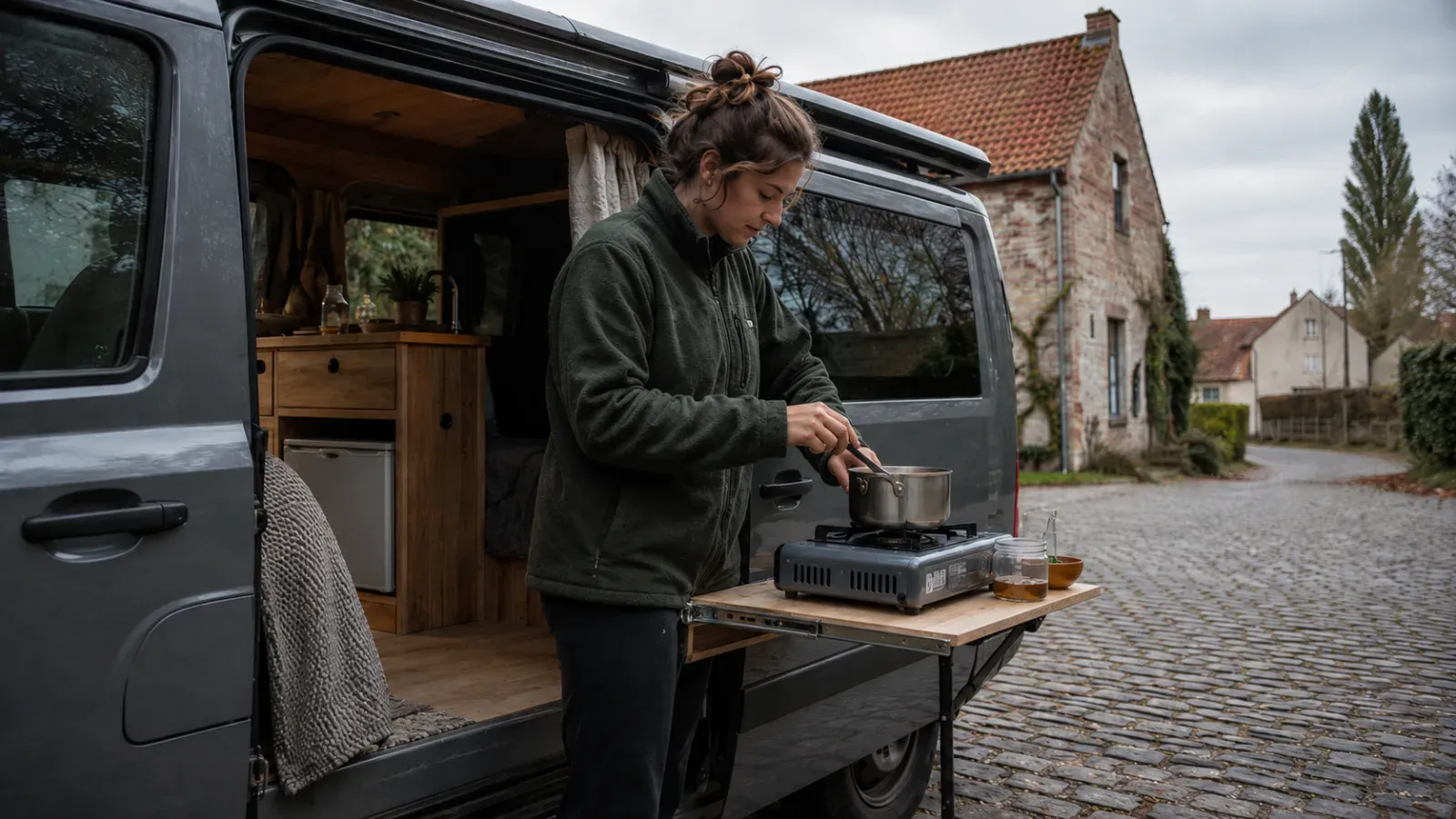
Cooking in your van seems like a simple choice until you start building. Will you go for gas? Induction? A separate cooking set that you use outdoors? Or a combination of everything?
There is no perfect solution for everyone. A weekend van, primarily used in good weather, needs something different than a van in which you travel for weeks, even in autumn or winter. And someone who often stays at campsites can make different choices than someone who prefers to stay off-grid.
The best cooking solution is not the most impressive. It's the one that fits your space, power supply, safety, travel style, and how often you actually cook.
Start with how you eat on the road
Before you decide between gas, induction, or outdoor cooking, you need to honestly look at your own eating habits.
Do you enjoy elaborate cooking? Do you make coffee every morning? Do you want hot food when it rains? Do you often eat simple meals, like bread, pasta, wraps, and soup? Or do you want to cook as comfortably on the road as you do at home?
That makes a big difference.
Someone who only occasionally boils water for coffee and noodles doesn't need a full kitchen. Someone who cooks fresh meals every day needs more workspace, ventilation, water, storage, and a more robust cooking solution.
First, ask yourself these questions:
- Do I mainly cook indoors or outdoors?
- Do I want to be able to cook even in rain and wind?
- Do I travel alone, with two, with children, or with a dog?
- Do I have enough power for electric cooking?
- Do I want a fixed kitchen or something more modular?
- Do I often stay at campsites or prefer free and simple spots?
- Do I want to have my vehicle officially inspected as a camper van later?
That last question is important. If you want to officially convert your vehicle into a camper van, a cooking facility is part of the basic equipment of the living area. So, think about this in time, preferably before you build everything permanently.
Option 1: cooking with gas
Gas is still the most commonly used solution in vans and campers. And there's a reason for that: it's powerful, affordable, relatively simple, and you don't need a gigantic battery for it.
For many beginners, gas is the most logical choice. You can cook without an inverter, without a heavy lithium battery, and without being dependent on sun or shore power. Especially in a small van, that's appealing.
A gas stove is also fast. Boiling water, making pasta, heating soup, or frying vegetables is simply quick. For those who like to travel simply and practically, gas works well.
But gas demands respect. You are cooking with an open flame in a small space full of wood, dust, cushions, curtains, insulation, and belongings. This must be done safely.
The advantages of gas
Gas has a few clear advantages.
You need little electrical installation. This is useful if your power setup is limited to lighting, phone, laptop, and maybe a refrigerator. You cook without draining your battery.
Gas also works well for people who stay in one place longer without driving much. You don't need to recharge power every day to have warm food.
Additionally, gas is affordable and easy to understand. A good stove, correct pressure regulator, decent hose, and safe gas storage will get you far.
For many Belgian vanlifers, gas is simply the most practical basis, especially if you want to travel in colder or darker months.
The disadvantages of gas
The biggest disadvantage is safety.
During combustion, combustion gases can be released. Carbon monoxide, or CO, is extra dangerous because you cannot see, smell, or taste it. The Poison Control Centre warns that CO is produced during incomplete combustion of fuels such as gas, wood, coal, petroleum, or fuel oil. Insufficient fresh air supply and poor exhaust of combustion gases increase the risk.
In a small van, you must always ventilate when cooking with gas. A window ajar, a roof hatch open, a fan, or at least sufficient air supply is not a luxury. It is basic safety.
Also, never use a gas stove as heating. That might seem tempting on a cold evening, but it's not a good idea. You'll get moisture, oxygen consumption, and potentially dangerous combustion gases in your living space.
A barbecue, charcoal grill, or appliance intended for outdoor use also does not belong inside your van. Even a garage or tent is not a safe place for this.
Gas bottles and cartridges: think about storage
Those who cook with gas must also think about storage.
A gas bottle or gas cartridge should not just roll around loose in the van. It must be securely fastened, preferably upright, protected from falling, and in a well-ventilated area. Gas is heavier than air and can accumulate low down in case of a leak. Therefore, low ventilation is important.
For a fixed gas installation, a separate gas locker or gas cabinet with ventilation to the outside is often used. This takes up space but is much safer than a loose bottle somewhere under the bed.
A small loose camping stove with a cartridge seems simpler, but you must also be careful with it. Store cartridges cool, dry, and ventilated. Remove them from the appliance during transport if the manual requires it. Use the appliance according to the manufacturer's instructions.
Also, regularly check your hose, pressure regulator, and connections. Never use a flame to search for a leak. Use leak detection spray or soapy water for this and have doubtful cases checked by someone who knows about it.
Propane or butane?
For those traveling in Belgium and neighboring countries, the difference between propane and butane is practically important.
Butane works less well at cold temperatures. Around freezing point, it can become difficult. Propane remains much more usable at low temperatures and is therefore more interesting if you want to travel in autumn or winter.
For summer trips, that matters less. For those who travel all year round, propane is often the more logical choice.
Note: not every bottle, pressure regulator, or connection is simply the same. Use materials that match and follow the manufacturer's and installer's regulations.
Option 2: induction cooking
Induction sounds very appealing. No gas bottle, no open flame, easy to clean, and modern. Especially if you want a gas-free van, induction is tempting.
But induction requires a lot of power.
An induction hob of 1000 to 2000 watts is not a small appliance. Even if you only cook for a short time, your battery and inverter must be able to deliver that power. This means thick cables, correct fuses, a good battery, a suitable inverter, and a system that is safely built.
Let's calculate: a 1500-watt hob running for 10 minutes uses approximately 250 Wh. That seems manageable in itself. But if you cook multiple times a day, boil water, make coffee, and also use a refrigerator, laptop, and lighting, that quickly adds up.
So, induction is not impossible, but it is rarely the simplest choice for beginners.
The advantages of induction
The biggest advantage is that you don't need gas on board. No gas bottle, no gas hose, no pressure regulator, no gas leaks, and no open flame.
Induction is also clean. Your hob is flat, quick to wipe clean, and less susceptible to grease and food residues. In a small van, that's pleasant.
Additionally, induction is convenient if you already have a strong electrical installation. Think of a larger lithium battery, powerful inverter, DC DC charger, solar panels, and possibly shore power. If your system is already equipped for this, electric cooking can become logical.
For people who often stay at campsites and use shore power, induction can also be interesting. Then you cook partly on the socket instead of on your battery.
The disadvantages of induction
The biggest disadvantage is the power demand.
Induction not only requires a lot of energy but especially a lot of power in a short time. So, "a battery" is not enough. You need a battery that can deliver that power, an inverter that is powerful enough, cables that are thick enough, and fuses that are correctly placed.
In a 12-volt system, currents quickly run high. The heavier your inverter, the more important correct cable thickness, fusing, and connection become. You don't want to gamble on that.
Induction also makes your van more dependent on your charging system. If your battery is low, cooking suddenly becomes a problem. With gas, you can still make food as long as you have gas. With induction, power must be available.
Therefore, I would mainly recommend induction if you consciously build your electrical system around that choice. Not as a late addition because it "seems convenient."
Option 3: outdoor cooking
Outdoor cooking is wonderful when the weather cooperates.
You keep odors, steam, and grease out of your van. You have more air, less condensation, and often more workspace. Especially with a slide-out kitchen at the back or a separate cooking box, outdoor cooking can be very pleasant.
For small vans, this is often the most space-saving solution. You don't have to build a fixed kitchen inside and can simply store your cooking equipment in a box, drawer, or rear kitchen.
But Belgium is Belgium. Rain, wind, cold evenings, and muddy parking lots are part of it. Outdoor cooking is fantastic in June in a quiet spot, but less enjoyable on a wet November evening along a windy parking lot.
The advantages of outdoor cooking
Your van stays fresher. No cooking smells in your bed, less moisture inside, and less chance of your cushions smelling like onions.
You can also be more flexible. A separate cooking set can be placed on a camping table, used next to your van, or taken to a picnic spot where it is allowed.
For microvans or very minimalist setups, outdoor cooking is often the best start. You don't need a complicated installation and quickly discover what you actually use.
The disadvantages of outdoor cooking
The biggest disadvantage is dependence on weather and location.
In case of rain, you need an awning, tailgate, tarp, or other shelter. In strong winds, cooking becomes difficult and sometimes unsafe. In busy parking lots, you might not want to visibly start cooking. And in nature reserves, forests, or dunes, you are not allowed to simply make a fire or cook wherever you want.
Note the difference between using a small cooking appliance and making an open fire. Stricter rules apply in or near nature reserves. Often you need permission from the owner or manager, and in case of increased fire risk, fire and cooking fires may be prohibited.
Also, at campsites, camper pitches, festival grounds, and parking lots, their own rules often apply. So, always check the place where you are staying.
The hybrid solution is often the smartest
For many Belgian vanlifers, the best solution is not a pure choice, but a combination.
For example: a simple indoor cooking option for rain, coffee, and quick meals, plus an outdoor setup for good weather. That way, you're not stuck.
You can have a small fixed cooking point inside on gas or a safe loose solution that you use correctly. Outside, you can work with a cooking box, pull-out drawer, or small table. Then you cook outside when it's pleasant and inside when you have to.
This is especially practical in Belgium. You want to be able to enjoy outdoor cooking, but you don't want to be forced to stand outside when it's pouring.
What suits which type of vanlifer?
For a small weekend van, a loose cooking box is often enough. Think of a compact gas stove, cooking pot, pan, coffee set, cutting board, spices, and washing-up equipment in one box. You mainly cook outside and possibly keep space inside to simply boil water if that can be done safely.
For a compact travel van, a small fixed kitchen is more interesting. A two-burner gas stove, small sink, water jerrycan, and good ventilation make life on the road much easier. Combine that with an outdoor cooking option, and you're good to go.
For an electric, modern van with a large battery, induction can be logical. But then your electrical system must be designed for it. Think of sufficient lithium capacity, a strong inverter, correct cables, good fuses, and serious charging options.
For those who are full-time or long-term on the road, I would mainly choose reliability. You don't want cooking to depend on perfect weather or a full battery. A system that works on bad days is more important than a system that looks good in a photo.
Workspace is at least as important as your cooking appliance
Many people choose a hob first and only then think about workspace. Actually, it should be the other way around.
Cooking in a small van is mainly about organizing. Where do you put your cutting board? Where is your knife? Where do you put a hot pan? Where do you leave dirty dishes? Where does your coffee cup go while you're doing something else?
A small cooking appliance with good workspace is often better than a large hob without space around it.
Provide at least one flat surface where you can safely cut and prepare. Also, make sure hot pots are not next to cushions, curtains, or loose items. And think about ventilation directly above or next to your cooking area.
Don't forget moisture and odor
Cooking brings moisture into your van. Draining pasta, boiling water, heating soup, and washing dishes all create steam. In a small van, this quickly condenses on windows and cold surfaces.
That's why ventilation is so important. Especially with gas, but actually with every form of cooking. Open a window, use a roof fan, or ensure air can circulate.
Odors are also something to consider. Frying bacon in a small van sounds fun until your bed smells of grease for three days. Outdoor cooking helps, but simple habits also make a difference: lid on the pan, wash up immediately, dispose of waste quickly, and no open garbage bag next to your bed.
Safety you cannot skip
Whatever cooking solution you choose, safety must be included in your design.
For gas:
- always ventilate while cooking
- use a CO detector
- use a smoke detector
- secure gas bottles or cartridges firmly
- close the gas tap after use
- check hose, regulator, and connections
- do not use a barbecue or outdoor cooking appliance indoors
- never use a gas stove as heating
For induction:
- use an inverter that is powerful enough
- use correct cable thicknesses and fuses
- secure battery and appliances firmly
- protect cables from chafing and moisture
- have doubtful cases checked
- do not underestimate the power of cooking appliances
For outdoor cooking:
- cook stably and out of the wind
- keep a distance from dry grass, wood, fabric, and awnings
- respect rules of nature reserves, campsites, or parking lots
- do not leave fire or appliances unattended
- let everything cool down before storing it
A small fire extinguisher and fire blanket are not an unnecessary luxury. Hopefully, you'll never use them, but you'll want to have them if something goes wrong.
What would I choose myself?
For a first small or medium-sized van, I personally wouldn't immediately start with induction, unless the entire electrical installation is designed for it.
I would rather go for a simple, safe gas solution with good ventilation, combined with the possibility of outdoor cooking. That gives the most freedom for Belgium: you can make something warm inside when it rains, but you can cook outside when the weather is nice.
With Grephar around, I would also think extra about safety and space. No loose hot pan at dog height, no gas cartridge that can fall over, no cooking area he has to pass every time. In a small van, these are not details. These are things that determine whether cooking remains calm.
If I were to build a larger electrical setup later, I would reconsider induction. But as a beginner, I would choose simple, reliable, and safe.
Quick choice guide
Choose gas if you want simple, affordable, and reliable cooking without a large battery.
Choose induction if you want to live gas-free and your electrical system is strong enough.
Choose outdoor cooking if you have little space, mainly travel in good weather, and want to remain flexible.
Choose a hybrid system if you want to travel realistically in Belgium: outside when you can, inside when you have to.
Keep it simple enough to actually use
A good kitchen in a van doesn't have to be big. It mainly has to work.
You want to be able to make coffee without having to rearrange half your van first. You want to be able to cook when it rains. You don't want to be afraid of your gas installation. And you don't want your battery to be dead because you made pasta once.
Gas, induction, and outdoor cooking each have their place. The trick is not to choose based on what looks best, but based on how you travel.
For many Belgian vanlifers, the best solution will be simple: a safe indoor option, a nice outdoor option, and enough common sense to know when to use which.
Source: https://www.antigifcentrum.be/Toxinfos/koolstofmonoxyde-co-in-detail/
Source: https://www.brandweer.nl/wp-content/uploads/2021/07/brandveilige_vakantie-los-17.pdf
Source: https://www.victronenergy.com/media/pg/The_Wiring_Unlimited_book/en/index-en.html