Using second-hand materials in your conversion: smart or regret later?
Using second-hand materials in your van conversion can be a very smart choice. You save money, give decent parts a second life, and sometimes find materials that are no longer available new.
By Laurens De Leeuw · 17 July 2026
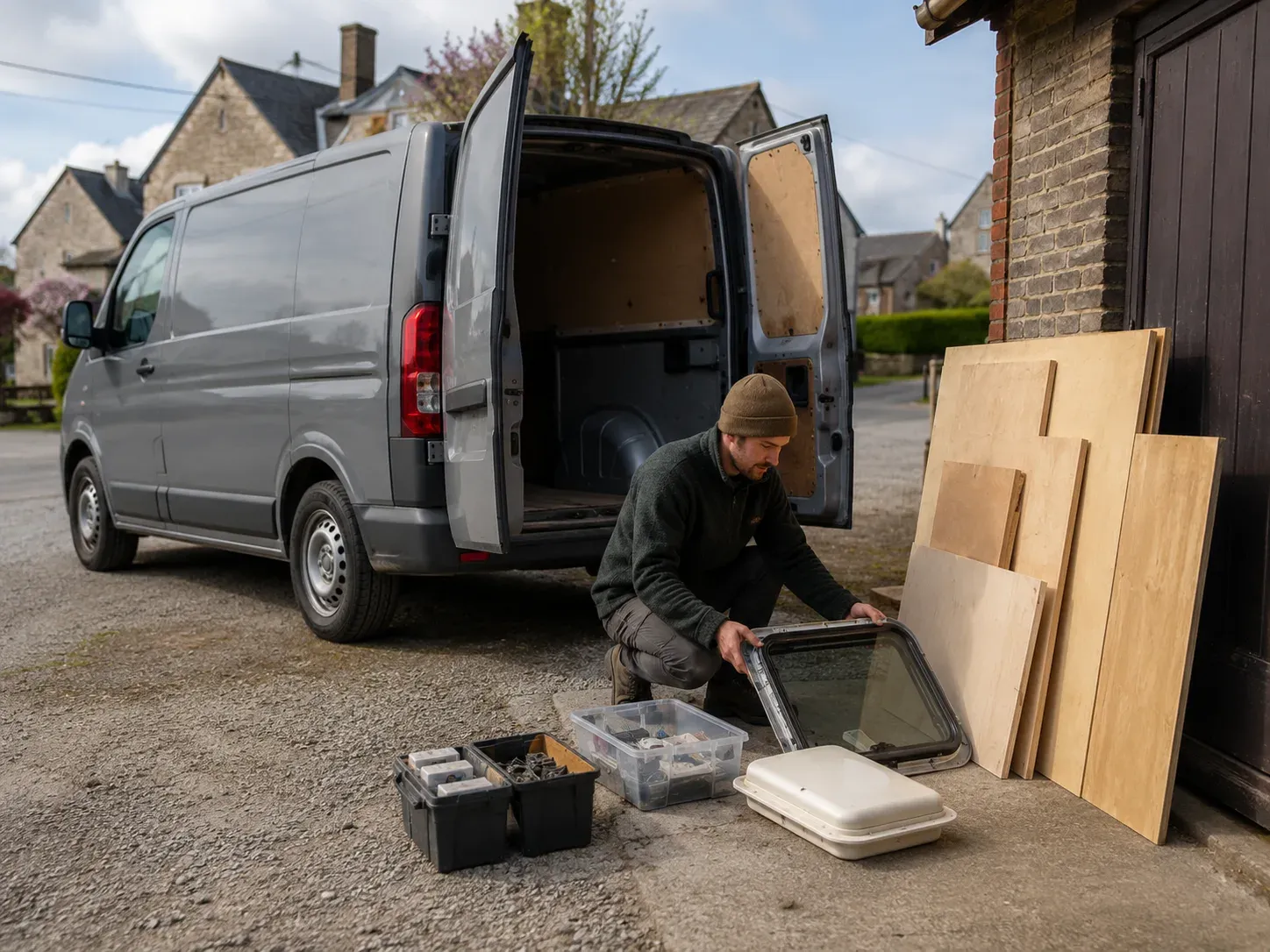
Using second-hand materials in your van conversion can be a very smart choice. You save money, give decent parts a second life, and sometimes find materials that are no longer available new.
But second-hand is not automatically cheap.
A window for 150 euros is not a bargain if it turns out to be the wrong size. A used refrigerator quickly becomes expensive if you still need a new controller, cable set, and mounting frame. And a cheap house battery can turn out to be mainly a heavy box with hardly any capacity left after a few months.
The question is therefore not whether second-hand material is good or bad.
The real question is: with which parts can you save money without much risk, and with which parts are you mainly buying uncertainty?
Not every second-hand part is the same
A used table leg is completely different from a used lithium battery.
If a table leg turns out to be worn, you mainly experience some irritation. If a damaged battery, gas installation, or seat belt does not work properly, the consequences can be much more serious.
A simple rule I would use myself:
> The greater the consequences of a defect, the more careful you should be with second-hand items.
Second-hand is often interesting for parts that are:
- easy to inspect
- contain little hidden technology
- not directly related to safety
- easy to test
- can be easily replaced later
- do not require complex homologation
New or professionally checked is usually smarter for parts where a fault can lead to:
- fire
- carbon monoxide
- electrical problems
- water ingress
- a loose piece of furniture
- defective seat belts
- problems with homologation or inspection
- an unusable van in the middle of your trip
Calculate the true price, not just the purchase price
An advertisement only shows what the seller is asking. Not what the part will ultimately cost you.
The actual price is:
purchase price + transport + missing parts + maintenance + new seal + adapters + professional check + your own time
Suppose you find a used roof hatch for 180 euros. That sounds interesting if a new one costs 400 euros.
But then it turns out you still need:
- new inner frame
- new insect screen
- new sealing rubber
- mounting material
- sealant
- two hours of driving
- a replacement handle
Then you can suddenly come very close to the new price, without a full warranty.
Therefore, always compare the complete package.
Ask yourself:
- Is the part complete?
- What is missing?
- Are spare parts still available?
- Does it need maintenance or repair?
- Can I test it before purchase?
- Do I still need mounting material?
- Is transport safe and affordable?
- What does a new alternative with warranty cost?
The cheapest part is often the part you only have to buy once.
Professional seller or private individual?
Where you buy makes a difference.
If you, as a consumer, buy for private use from a professional seller, the legal warranty applies. For second-hand goods, this period can be clearly and previously limited, but not to less than one year. If no shorter period is agreed upon, the normal period of two years generally applies.
When purchasing from a private individual, you do not have the same legal consumer protection.
That does not mean that every private seller is unreliable. You just have to check a lot more yourself.
When making a private purchase, ask at least for:
- full name and contact details
- brand and exact model
- serial number
- age
- reason for sale
- original invoice if available
- manual
- any warranty documents
- photo of the type plate
- written proof of what was sold
A simple sales receipt with date, description, and price can be useful later.
For expensive technical parts, I personally prefer to pay a little more to a professional seller who has tested the device and provides an invoice.
A CE marking is useful, but no proof that everything is still safe
For various product categories, including electrical equipment and gas appliances, a CE marking may be mandatory.
With this marking, the manufacturer declares that the product complied with the applicable European requirements when it was placed on the market.
But a CE logo does not say:
- how the device was used
- whether it has fallen
- whether it has water damage
- whether someone has tampered with it
- whether the cables are still original
- whether internal parts are worn
- whether the device still functions safely today
So check both the type plate and the actual condition.
A damaged device does not become safe again because there is a CE sticker on it somewhere.
Which parts are usually interesting to buy second-hand?
Some materials are particularly suitable for reuse.
Wood and sheet material
Scraps of plywood, furniture panels, and wooden slats can be interesting if they are:
- dry
- straight
- free of mold
- do not smell of moisture or chemicals
- not full of hidden screws or staples
- light enough for your conversion
- still large enough for the planned part
Measure and weigh the material before you buy it.
An old household kitchen can be cheap, but is often made of heavy chipboard or MDF. This material is less suitable if you want to build lightly and can be sensitive to moisture.
Old solid furniture is also not automatically ideal. It is sometimes beautiful, but weighs much more than a light construction made of plywood.
Prefer to use reclaimed wood for:
- cabinet doors
- a tabletop
- small finishing touches
- shelves
- decorative elements
For load-bearing structures, you want to be sure that the wood is still sound and strong.
Pallet and reclaimed wood
Pallet wood seems free and sturdy, but is not always the smart choice.
It can be:
- contaminated
- have transported unknown substances
- warped or cracked
- contain hidden nails
- require a lot of sanding
- relatively heavy
- smell unpleasant
For a small decorative detail, known and clean wood can be useful. For your entire interior, I would prefer to use material whose origin and properties I know.
Free material is not free if you spend two weekends working on it and then replace it anyway.
Aluminum profiles and metal parts
Used aluminum profiles, angle irons, table legs, and fasteners are often perfectly reusable.
Check for:
- cracks
- deformation
- corrosion
- damaged thread
- drilled holes
- sharp edges
Aluminum is relatively easy to clean and visually assess.
For structural parts, you must be sure that the profile is strong enough for the application. A light curtain rail is not a bed frame.
Sinks and simple kitchen parts
An stainless steel sink is a classic example of something you can perfectly buy second-hand.
Check:
- rust or pitting corrosion
- the drain size
- the rim
- the underside
- any old sealant
- whether the drain and stopper are included
A used tap is also possible, but internal seals and cartridges are more difficult to assess. For a simple and cheap tap, new may ultimately be more practical.
Table legs, hinges, and latches
Solid mechanical fittings can last a long time.
Second-hand is interesting when:
- it is not bent
- there is no significant play
- the locking mechanism still works well
- all mounting parts are present
- spare parts are available
Be careful with drawer slides. Old household slides are not always designed to stay closed while driving. For heavy drawers in a moving vehicle, sturdy slides and good locking mechanisms are important.
Storage bins and camping equipment
Plastic bins, camping chairs, tables, cooking pots, and other simple items are often easily found second-hand.
Mainly check for:
- cracks
- mold
- odor
- brittle plastic
- missing parts
- stability
These are ideal parts to buy cheaply second-hand, as you can easily test and replace them.
Which parts can be second-hand, but only after a thorough check?
This is where it gets more interesting. These parts can be a good buy, but you really need to test them.
Roof hatches and roof ventilators
A good used roof hatch can save a lot of money.
Carefully check:
- exact outer dimensions
- required roof cutout
- thickness for which the inner frame is suitable
- cracks in the plastic dome
- brittle or discolored parts
- hinges
- opening mechanism
- insect screen
- fan motor
- direction of rotation
- power consumption
- control panel
- rain sensor if present
- availability of parts
Before purchasing, have the device fully opened and closed. Test all fan settings.
Always use new sealing material during installation. Reusing old sealant or a used rubber seal is a bad idea. A small leak in your roof can cause much more damage than the price difference between new and second-hand.
Windows
Second-hand camper windows can be interesting, especially when they are complete.
Ideally, you have:
- outer window
- inner frame
- blackout blind
- insect screen
- hinges
- latches
- mounting material
- correct dimensions
- type or model data
Check transparent plastic for hairline cracks, especially around screws and hinges. Old acrylic can become brittle due to UV radiation.
For an official camper van, glazing and transparent panels must bear a European marking. So don't just buy a homemade or unknown window because it happens to fit the hole.
If in doubt, discuss the choice with your technical service beforehand. Buying the wrong window is annoying. Sawing the wrong hole in your bodywork is much worse.
Solar panels
Used solar panels can be interesting because panels generally have few moving parts.
Check:
- brand and type
- age
- stated power
- dimensions
- weight
- voltage and current on the type plate
- glass for cracks
- damage to the backsheet
- frame
- junction box
- connectors
- moisture traces
Preferably have the panel electrically tested. Only measuring the open-circuit voltage does not automatically show that the panel still delivers its normal power under load.
Also pay attention to compatibility. A large used household panel can be cheap, but have a higher voltage than your charge controller can handle. It can also be inconveniently large or heavy for the roof of your van.
So first check the maximum input voltage and current of your charge controller.
A 12 volt compressor refrigerator
A decent second-hand compressor refrigerator from a known brand can be a good purchase.
Don't test it for five minutes. Preferably let it run for at least a full day.
Check:
- whether it reaches the set temperature
- how often the compressor runs
- power consumption
- noise and vibrations
- door seal
- hinges
- rust
- condensation
- ventilation openings
- error codes
- thermostat
- connection cable
Ask why the refrigerator is being sold. “We're converting our van differently” sounds more credible than “it still worked last summer”.
With an absorption refrigerator that also runs on gas, the story becomes more sensitive. Have such a device and its installation checked by someone with expertise.
Diesel heater
A used heater from a known brand can be interesting if there is a clear maintenance history.
Ask for:
- operating hours
- maintenance
- error codes
- soot formation
- fuel pump
- control panel
- serial number
- reason for disassembly
- original manual
For the new installation, preferably use new:
- fuel line
- hose clamps
- gaskets
- exhaust parts where necessary
- mounting materials
An unknown device with an incomplete wiring harness and missing exhaust quickly becomes a frustrating project.
For any combustion appliance, correct installation, exhaust gas discharge, ventilation, and a CO detector remain important.
Inverters, charge boosters, and battery chargers
Electronics can last for years, but damage is not always visible.
Second-hand is possible if:
- it is a known brand
- the type plate is legible
- the manual is available
- the device has not been opened or modified
- there are no fire or moisture traces
- all connection caps are present
- you can test it under load
- the specifications match your system
Smell the device. A burnt electrical smell is a clear alarm signal.
Also look at the production date and software support. A very old device can still work perfectly, but may not be suitable for a modern lithium battery.
Water pumps
A water pump can be usable second-hand, but test it under real conditions.
Check:
- startup
- pressure buildup
- leakage
- pulsating behavior
- noise
- connections
- dry-run protection if present
- frost damage
- odor or contamination
I would not place a pump that has been used for years with contaminated water in a drinking water system.
Because small pumps are not extremely expensive, new is often more attractive once the history is unclear.
What would I be particularly careful with?
Some parts are better bought new or only through a reliable specialist.
Lithium batteries
A lithium battery is expensive, so second-hand seems attractive. At the same time, the actual condition is difficult to assess from the outside.
Ask at least for:
- exact chemistry
- brand and model
- age
- number of charge cycles
- usage history
- charge and discharge currents
- reason for sale
- compatible charger
- any BMS data
- remaining capacity
- original invoice
Check for:
- swelling
- deformation
- dents
- corrosion
- damaged terminals
- moisture
- chemical odor
- unusual heat
A capacity test is much more useful than just a voltage measurement. A battery can show a normal resting voltage and still only have a fraction of its original capacity.
A damaged lithium battery can cause fire. Therefore, do not buy an unknown DIY kit or battery with an unclear history unless you really know how to safely assess it.
When in doubt, I would buy a house battery new from a reliable seller.
AGM and lead-acid batteries
Here too, age is important.
An older AGM battery can look perfect, but have lost a lot of capacity due to deep discharge or long periods of inactivity.
Ask for:
- age
- usage
- charging regime
- storage
- capacity test
A particularly cheap used AGM battery is often cheap because a new owner will soon have to dispose of it.
Electrical cables, fuses, and connectors
I would rarely buy these second-hand.
New cables, fuses, cable lugs, and connectors cost relatively little compared to their importance.
Used cable can be:
- internally damaged
- corroded
- too thin
- incorrectly marked
- kinked in bad places
- have heat or water damage
Use new cable with the correct cross-section and new protections that match your own installation.
The same applies to fuse holders, main switches, and critical connections. You want to know what you are installing.
Gas lines, hoses, regulators, and seals
These parts age, and their condition is not always visually reliably assessable.
Therefore, I would normally buy new:
- flexible gas hoses
- pressure regulator
- seals
- hose clamps
- critical couplings
A used cooking appliance may be usable if it is complete, undamaged, and correctly tested. But the parts that safely bring gas to that appliance, I would not reuse from an unknown old installation.
Check that the appliance is suitable for the gas used and the correct pressure. Do not use improvised adapters.
If in doubt, have a fixed gas installation professionally checked and install a CO detector.
Gas heaters and gas boilers
For a used gas heater or boiler, you want certainty about:
- type plate
- correct fuel and pressure
- combustion chamber
- exhaust
- safety devices
- maintenance history
- availability of parts
- correct installation
An unprofessionally installed or poorly maintained combustion appliance can produce carbon monoxide.
A particularly cheap old boiler without documentation, I would simply leave it.
Smoke detectors and CO detectors
I would buy those new.
You want to know:
- how old the sensor is
- whether the device was stored correctly
- what the expiration date is
- whether the battery is still reliable
- whether the model is suitable for the application
A safety detector is not the part where you save a lot of money.
Water pipes, filters, and drinking water hoses
A used tank can sometimes be okay. Used hoses and filters, I would usually replace.
You often don't know:
- what water was in it
- whether biofilm is present
- whether the hose has ever frozen
- whether plasticizers or odors have been absorbed
- how long a filter has been used
New drinking water hoses, seals, and filters give you a clean starting point.
Fasteners for heavy or safety-critical parts
For a decorative shelf, you can reuse a decent old screw. For heavy and safety-critical parts, I would use new fasteners with known specifications.
Think of:
- battery mounting
- bed frame
- heavy furniture
- gas bottle
- roof material
- seats
- seat belt points
- swivel bases
An old bolt from an anonymous box tells you nothing about strength, fatigue, or origin.
Seats, seat belts, and anchor points
Here you must be extremely careful.
A used seat from another vehicle is not automatically an approved extra row seat in your van.
For seats used while driving, the seat, headrest, seat belts, and anchor points, among other things, must have the necessary European approvals. When an original seat is modified, for example, with a swivel system, the original partial approval may lapse, and a new approval or a test report may be required.
Therefore, do not buy a used bench, seat belt, or swivel base before you have checked with your technical service:
- whether the part is suitable for your exact vehicle
- what approval is needed
- what documentation is required
- how the mounting should be done
- whether the part may be used while driving
Never use a seat belt or seat that you know or suspect was involved in an accident.
This is not a place to blindly look for a bargain.
Used windows and homologation
A window also needs more than just the right dimensions.
For an official camper van, glazing and transparent panels must bear a European marking.
So, before purchasing, ask for clear photos of:
- the marking
- the type plate
- the brand
- model number
- inner and outer dimensions
- required cutout
Don't buy a window first and then ask if it will be accepted.
The same applies to used pop-top roofs, sleeping roofs, and other structural parts. They must fit within the technical possibilities and approval of the base vehicle.
Using second-hand insulation
Clean scraps from another construction project can be interesting.
Only use them if they are:
- dry
- clean
- not moldy
- not compressed or damaged
- still have their original shape
- suitable for a vehicle
Insulation removed from an old damp camper, I would not reinstall. You save little and possibly trap moisture, odor, or mold in your new wall.
Self-adhesive foam that has been removed once usually no longer sticks reliably. Building a wall from dozens of small loose pieces can also create many seams and unnecessary work.
Scrap material is smart. Installing waste because it's free, usually not.
Mattresses and cushions
A second-hand mattress can be financially attractive, but check strictly for:
- odor
- moisture
- mold
- stains
- sagging areas
- damaged covers
- ventilation
- correct size
An old household mattress can also be heavy and too thick for a small van.
Cushions for a bench are more interesting if the covers are removable and washable and the foam still provides sufficient support.
Personally, for a bed, I would usually invest in a new mattress that exactly fits my layout and body. Good sleep determines much more of your travel pleasure than a nice cabinet front.
Second-hand household furniture: often less interesting than it seems
A cabinet or kitchen module from a home can be cheap. But household furniture is not designed for:
- vibrations
- turns
- emergency stops
- temperature fluctuations
- moisture
- limited load capacity
They are often made of heavy chipboard and have doors or drawers without driving locks.
You can reuse parts, but do not automatically adopt the entire construction.
An old countertop, stainless steel sink, or a few light cabinet doors can be useful. Sliding a complete heavy kitchen block into your bus is usually less smart.
Red flags in an advertisement
Be careful with descriptions such as:
- “operation not tested”
- “came from a project”
- “no time to test”
- “should work”
- “previous owner said it was good”
- “no type plate anymore”
- “only needs a cable”
- “small repair”
- “for the handy person”
- “no returns”
- “don't know how old”
- “battery is still good according to me”
That does not automatically mean that the seller is hiding something. It does mean that you take all the risk.
Pay for an untested device as if it is defective. Not as if it probably works.
Test as you will actually use the part
A quick visual check is not enough for technical equipment.
For example, test:
Refrigerator Let it cool for a long time and measure power consumption.
Fan Test all settings, directions of rotation, and controls.
Inverter Let it power a realistic load.
Battery Have a capacity test performed.
Water pump Test pressure, noise, and leakage.
Solar panel Measure and test under load.
Heater Perform a complete start and stop cycle and check for error messages.
Window or roof hatch Open and close everything multiple times and check for cracks and play.
If the seller cannot test anything? Then the price must reflect that risk.
Check if spare parts still exist
A decent device can become worthless due to one missing specific part.
Before purchasing, check if you can still find:
- hinges
- door seals
- control panels
- inner frames
- fan motors
- sensors
- wiring harnesses
- filters
- cover plates
- mounting kits
- manuals
A fifteen-year-old refrigerator can still be technically fine, but becomes less interesting if the door seal is no longer available anywhere.
Look up the exact model number, not just the brand name.
Weight remains important
Second-hand material often comes from homes, caravans, or older campers. That can be heavier than modern, lighter alternatives.
Therefore, also weigh a used part.
Pay particular attention to:
- solid wood
- chipboard
- old absorption refrigerator
- heavy metal bed frames
- large household batteries
- old solar panels
- solid tables
- heavy drawer constructions
- old awnings
A part can be cheap and decent, but still not fit within your weight budget.
A heavy cabinet that is almost free still costs you useful payload on every trip.
A practical decision matrix
| Part | Buy second-hand? | My condition |
|---|---|---|
| Plywood and wooden slats | Often yes | Dry, straight, light, and known condition |
| Stainless steel sink | Yes | No damage and correct size |
| Table leg and simple fittings | Yes | Mechanically good and complete |
| Storage bins and camping furniture | Yes | No cracks, mold, or odor |
| Roof hatch | Possibly | Complete, tested, and without cracks |
| Camper window | Possibly | Correct size, marking, and complete frame |
| Solar panel | Possibly | Electrically tested and compatible |
| Compressor refrigerator | Possibly | Long-term tested and parts available |
| Inverter or charger | Possibly | Known brand, tested, and documented |
| Diesel heater | Only carefully | Maintenance history and correct check |
| Water pump | Possibly | Clean and pressure tested |
| Water tank | Only with known history | Suitable for drinking water and cleanable |
| Drinking water hoses and filters | Preferably new | Hygiene and reliability |
| Electrical cables and fuses | New | Correct size and known specification |
| Lithium battery | Only with thorough test | Known history and capacity |
| Gas hose and pressure regulator | New | Safety-critical |
| Smoke and CO detector | New | Sensor age must be known |
| Seat belts and driving seats | Don't buy blindly | First check technical approval |
| Structural bolts | New | Known strength and application |
| Mattress | Usually new | Comfort, hygiene, and correct size |
What I would buy second-hand myself without much doubt
For my own conversion, I would mainly look for:
- dry light plywood scraps
- aluminum profiles
- stainless steel sink
- simple table leg
- decent storage bins
- camping chairs and table
- light cabinet doors
- mechanical fittings in good condition
- roof racks that are exactly suitable for the vehicle
- a fully tested roof hatch
- a tested solar panel
- a refrigerator from a known brand with invoice or clear history
There you can save a lot of money without immediately taking enormous risks.
What I would usually buy new
I would rather buy new:
- electrical cables
- fuses and fuse holders
- cable lugs and connectors
- gas hose
- pressure regulator
- gas seals
- drinking water hoses
- filters
- smoke detector
- CO detector
- critical mounting bolts
- sealant and sealing material
- mattress
- house battery when the history is uncertain
These are parts where reliability, safety, or hygiene is more important than a limited saving.
The checklist before you pick something up
Take these questions with you when you look at a second-hand part:
1. What is the exact brand and model?
2. How old is it?
3. Why is it being sold?
4. Is it complete?
5. Can I test it working?
6. Are the type plate and markings legible?
7. Is the manual available?
8. Is there an original invoice?
9. Are spare parts still available?
10. Does it physically fit my layout?
11. Does it technically fit my system?
12. What does it weigh?
13. Which extra parts do I still need to buy?
14. Can it affect homologation?
15. What does a new alternative with warranty cost?
16. Is the defect only annoying, or potentially dangerous?
If the seller cannot answer several basic questions, I would only proceed if it is a simple and safe-to-assess part.
Second-hand is especially smart when you are selective
You don't have to buy your conversion completely new. That would be expensive and often unnecessary.
But you also don't have to save every worn part because reuse sounds sympathetic.
Good second-hand purchases usually have three things in common:
- you understand what you are buying
- you can check the condition
- the risk of a defect remains manageable
Use second-hand for simple, visible, and testable parts. Be much stricter with gas, electricity, batteries, heating, seats, and anything structurally installed in your vehicle.
And always calculate the full price.
A used part that fits perfectly, is well tested, and will last for years is a truly smart saving. A cheap part that slows down your conversion, requires extra adapters, and needs to be replaced after one season is simply paying twice.
Second-hand material can make your van more personal, cheaper, and more sustainable.
But only if you don't just look at the price.
Source: https://economie.fgov.be/nl/themas/consumentenbescherming/de-garantie
Source: https://www.brandweer.nl/onderwerpen/opladers-batterijen-en-accus/
Source: https://www.antigifcentrum.be/Toxinfos/co-de-apparaten/