Choosing a practical layout: fixed bed, bench, or pull-out bed?
The layout of your van determines much more than where you sleep. It dictates how you enter, where you cook, how much gear you can bring, whether you can sit comfortably inside when it rains, and how much work you have each evening before finally getting into bed.
By Laurens De Leeuw · 16 July 2026
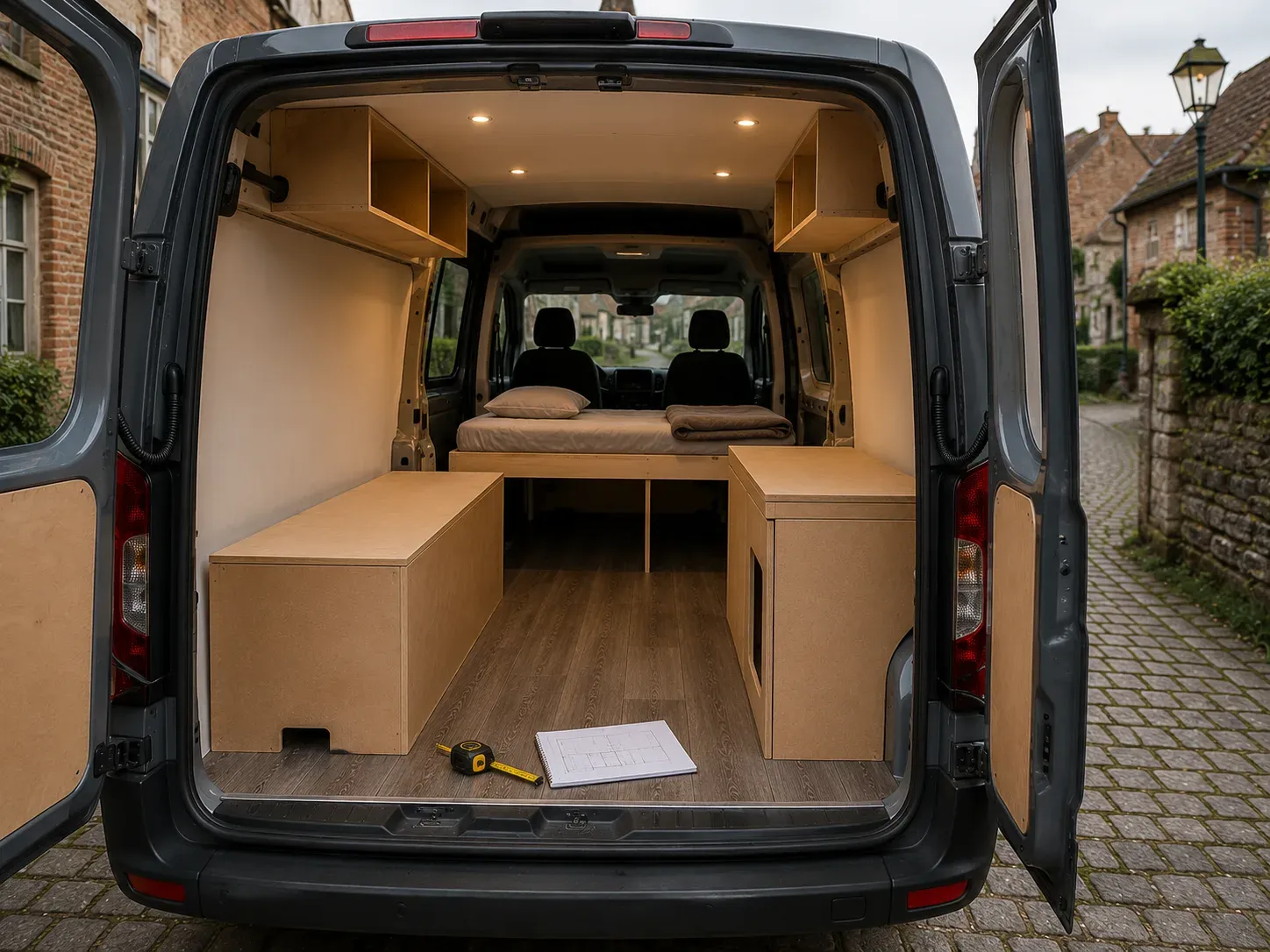
The layout of your van determines much more than where you sleep. It dictates how you enter, where you cook, how much gear you can bring, whether you can sit comfortably inside when it rains, and how much work you have each evening before finally getting into bed.
That's why the choice between a fixed bed, a convertible bench, and a pull-out bed is one of the most important decisions of your entire build.
There is no one-size-fits-all solution. A fixed bed is not automatically more comfortable, a bench is not always space-saving, and a pull-out bed is not by definition the perfect middle ground. Everything depends on your vehicle, height, travel companions, and daily routine.
The best layout is the one that still works when it's raining, you're tired, your shoes are wet, and you don't want to move twenty things before you can sleep.
Don't start with the bed, but with your daily routine
The first question isn't which bed you like. The first question is how you want to live in the van.
Imagine a typical travel day.
You wake up. Where do you put the bedding? Can you make coffee right away? Can someone still sleep while the other gets up? Where do you eat when it rains? Where do you sit with a laptop? What happens to wet jackets and shoes? And how much do you feel like converting your entire interior every evening?
Think in advance about:
- Do you travel alone or with two?
- Are children or a dog coming along?
- Do you use the van only for weekends or also for longer trips?
- Do you want to be able to work inside?
- Do you mainly cook inside or outside?
- Do you also travel in autumn and winter?
- Do you want to store bikes or large equipment under the bed?
- Do you have the same sleep rhythm?
- Does the van need a lot of free floor space during the day?
- How much storage space do you really need?
- Do you want to be able to adjust the interior later?
- Will the van be officially registered as a campervan?
Those who mainly travel in summer and live a lot outdoors can make more compromises. Those who also want to sit comfortably inside on wet Belgian days must take the daily layout much more seriously.
Measure the actual interior space
Don't just rely on the exterior dimensions or the technical specifications of your vehicle.
A van is narrower inside than you think. Wheel arches, sloped walls, doors, reinforcement ribs, insulation, and wall cladding all take up space. The usable width at mattress height can also be different from the width at floor level.
Therefore, measure at least:
- the width between the finished walls
- the width at the planned height of the bed
- the length of the straight floor area
- the distance between the wheel arches
- the height after floor and ceiling finishing
- the full opening of the sliding door
- the space required by rear doors
- the position of seatbelts, pillars, and door mechanisms
- the height of your mattress
- the required sitting height above and below the bed
Also measure yourself.
Sit in the van as you would at a table. Measure how much height you need above your head. Lie down with a real pillow and don't unnaturally pull in your toes. Also consider that you move during sleep.
A bed that is exactly as long as you are sounds efficient, but often feels cramped in practice.
First create a temporary layout
Before you start building definitively, it's best to create a full-scale test setup.
Use for this:
- cardboard boxes
- painter's tape
- empty crates
- cheap wooden slats
- camping pillows
- a temporary mattress
- old boards or a simple bed base
Recreate the volume of your bed, bench, kitchen, and cabinets. Don't just leave that setup looking pretty, but use it.
Try to enter with a jacket and shoes on. Sit on the bed. Lie down. Open imaginary cabinet doors. Pretend to cook. Set up the table. Convert the bed in low light.
Preferably do this with all the people who usually come along.
A layout can seem perfect when you're alone in an empty van. With two people, two backpacks, a dog, and a wet jacket, the same space suddenly feels very different.
Option 1: a fixed bed
A fixed bed remains permanently in sleeping mode. You don't have to fold out or convert anything in the evening. Your bedding can simply stay in place, and the space underneath is usually used for storage.
For many people, this is the most comfortable solution.
The advantages of a fixed bed
The biggest advantage is convenience.
After a long drive, you don't have to remove a table, move cushions, or pull out slats. You just get into bed.
This is especially nice when:
- you often arrive late
- you sleep in the van daily
- you travel with two
- one person goes to bed earlier
- you don't want to store bedding every time
- your back is sensitive to uneven cushions
- you want to use a real mattress
- you need a lot of storage under the bed
A fixed bed also brings calm to your interior. The sleeping area is clearly defined, and you don't have to decide every day where blankets, pillows, and mattress parts should go.
Under a higher bed, a large garage often forms. This is useful for:
- bicycles
- camping chairs
- table
- tools
- water
- cables
- outdoor sports equipment
- dog supplies
- provisions
- dirty or wet items in separate bins
For those who bring a lot of gear, this can be decisive.
The disadvantages of a fixed bed
A fixed bed permanently takes up a lot of space.
During the day, a large part of your van remains a bedroom, even when you're not using the bed. In a small van, this can leave little actual living space.
Other disadvantages:
- less free floor space
- less room for a full-fledged seating area
- often a higher and heavier construction
- harder to access when the bed is high
- risk that the space under the bed becomes a cluttered garage
- less flexible if your layout changes later
- more difficult to transport large items through the van
- possibly less headroom above the mattress
A high fixed bed provides a lot of storage, but you also need to be able to comfortably get into it. If you crawl to your pillow on your hands and knees every evening, some of the comfort disappears.
A low bed is easier to access and provides more headroom, but offers less storage.
Sleeping crosswise or lengthwise?
With a fixed bed, you also have to choose which direction you sleep in.
Crosswise bed
With a crosswise bed, you sleep from one side wall to the other. This means the bed takes up less length of the vehicle, leaving more living space at the front.
This works especially when the interior width is sufficient for the tallest sleeper.
Note:
- measure at mattress height
- include wall cladding and insulation
- test with a pillow
- consider curved walls
- ensure feet and head are not constantly against a cold wall
For tall people, a crosswise bed may be too short. Some conversions use wideners in the side wall, but that is a structural modification that you need to check technically and legally in advance.
Lengthwise bed
With a lengthwise bed, you sleep in the direction of travel. This requires more length but is often more comfortable for tall people.
You can choose from:
- one wide bed
- two separate lengthwise beds
- two beds with a middle section
- one bed with a narrow passage next to it
Two lengthwise beds make getting in and out easier. You have to crawl over each other less, and they can sometimes serve as benches during the day.
The disadvantage is that they use a lot of the available vehicle length.
Who is a fixed bed suitable for?
A fixed bed is often a good choice when you:
- have a medium or large van
- are often or long on the road
- value sleeping comfort
- want to convert as little as possible
- need a lot of storage
- want to store bikes or sports equipment inside
- have two different sleep rhythms
- prefer a permanent mattress
In a very small van, a fixed bed can also work, but then almost the entire van becomes a sleeping area. That's fine for those who mainly live outdoors, but less pleasant if you often have to sit inside.
Option 2: a bench that converts into a bed
In this layout, you use the sleeping area as a seating area during the day. In the evening, the bench, table, and cushions are transformed into a bed.
This can be done in various ways:
- two benches facing each other with a table in between
- a U-shaped seating area
- a bench with a folding backrest
- a seating group where the table serves as bed support
- a so-called rock-and-roll bed
- a combination of fixed benches and loose mattress cushions
The big advantage is that the same space gets two functions.
The advantages of a convertible bench
During the day, you have a real living space.
You can:
- eat
- work
- read
- sit inside when it rains
- talk with several people
- play a game
- let children draw
- comfortably look outside
For those who regularly work in the van or live indoors in bad weather, this is a big advantage.
A bench also makes the van feel more spacious during the day. Your bed doesn't permanently occupy the entire space, and you maintain more free passage.
In a compact bus, this can make the difference between a mobile bedroom and a small living space.
The disadvantages of a convertible bench
The daily conversion is often underestimated.
You may need to:
- detach the table
- clear items from the table
- move cushions
- fold out a bed base
- lay out mattress parts
- retrieve bedding from a cabinet
- puzzle loose cushions into place
In the morning, the same happens in reverse order.
On a sunny weekend trip, this is manageable. After ten days, with wet weather and little space, it can start to become annoying.
You also need to provide a fixed place for:
- duvet or sleeping bags
- pillows
- sheets
- loose mattress parts
- the table during the night
- items that are on the bench during the day
A convertible bed only saves space if all these parts can also be logically stored.
Sleeping comfort with a bench
A bench usually consists of multiple cushions. This is convenient for sitting, but not automatically ideal for sleeping on.
Possible problems:
- seams between the cushions
- different firmness levels
- rounded seat cushions
- shifting parts
- height differences
- back cushions that don't fit exactly
- too soft filling
- a tabletop that sags slightly
So don't just test the bed for five minutes. Actually sleep on it for a night before having the final cushions made.
A thin topper mattress can reduce seams and height differences. But that also needs to go somewhere during the day.
A bench is not automatically a driving seat
This distinction is very important.
A self-built wooden bench can be perfectly used when the van is stationary, but it does not thereby become an approved seat for driving.
Seats used while driving must meet technical requirements. The seatbelts, headrests, and anchor points must also be correctly approved.
The official Flemish information also states that side-facing seats may no longer be used while driving since October 20, 2007.
If you want to transport children or other passengers in the back, you must include this in your vehicle choice and homologation plan from the start.
Never just install a seatbelt on a self-built bench. A seatbelt is only useful if the entire structure and anchoring can withstand the forces of a collision.
Who is a convertible bench suitable for?
A bench that becomes a bed often works well when you:
- have a compact or medium-sized van
- spend a lot of time indoors during the day
- work on the road
- regularly sit at a table with several people
- value free floor space
- don't mind daily conversion
- mainly take shorter trips
- value the seating area more than a permanent mattress
This solution works less well when one person wants to sleep while the other still wants to work or eat. As soon as the bed is made, the living space usually disappears completely.
Option 3: a pull-out bed
A pull-out bed usually sits as a relatively narrow bench against one side wall during the day. In the evening, you slide or pull out the bed base, so it becomes wider and covers a large part of the floor.
It is a popular middle ground between a fixed bed and a full seating group.
How does a pull-out bed work?
Common systems include:
- interlocking wooden slats
- a frame on drawer slides
- two bed frames that slide over each other
- a bench with fold-out legs
- a telescopic metal frame
- a fixed narrow mattress with a second foldable part
During the day, you use the fixed part as a bench. In the evening, you slide the frame over the free floor and place the mattress parts next to each other.
Some pull-out beds can be used half-open. This is useful when you travel alone and don't need the full width.
The advantages of a pull-out bed
A pull-out bed provides more floor space during the day than a fixed bed, but usually requires less conversion than a full dinette.
Often, you only need to:
- put away a table
- pull out the frame
- move one or two cushions
- lay out bedding
Space remains for storage under the fixed bench.
This layout works well when you:
- want a long, usable aisle
- want to sit on a bench during the day
- need a wider bed at night
- place the kitchen on the opposite wall
- are looking for a simple modular build
- sometimes travel alone and sometimes with two
A pull-out bed can also be built quite lightly, as long as the frame is cleverly designed and securely attached.
The disadvantages of a pull-out bed
The free floor must be completely clear in the evening.
Everything that is there during the day must first be removed:
- shoes
- bags
- dog bed
- groceries
- table
- water bottle
- loose bins
- children's items
A pull-out bed therefore only works well if these items have another fixed place.
Other possible disadvantages:
- slats can rattle while driving
- the system can jam when wood warps
- pull-out parts can sag
- loose legs can be unstable
- mattress parts can shift
- seams can be noticeable
- dirt on the floor comes close to the bed
- the aisle disappears completely in sleeping mode
Also consider your travel companions. If a dog sleeps on the floor at night, the unfolded bed may take up its entire space. With children, you need to consider whether they can still safely get outside or to the toilet.
Who is a pull-out bed suitable for?
A pull-out bed is often a good choice when you:
- have a small or medium-sized van
- want free floor space during the day
- need a simple bench
- don't want to build a full dinette
- travel alone or with two
- are willing to briefly convert the bed daily
- provide sufficient storage space for loose items
- want a flexible bed size
For many first-time builders, this is an interesting start, as the system can be relatively simple and adaptable later on.
The three options side by side
| Feature | Fixed bed | Bench to bed | Pull-out bed |
|---|---|---|---|
| Daily conversion | Not needed | Usually extensive | Limited to moderate |
| Sleeping comfort | Often the best | Depends on cushions | Good with correct mattress |
| Living space during the day | Limited | Very good | Good |
| Storage space | A lot under the bed | Under benches and in cabinets | Under the fixed bench |
| Free floor at night | Little | Little | Usually almost completely covered |
| Suitable for working | Only with separate seating | Very suitable | Good with table |
| Suitable for long trips | Very good | Good if conversion doesn't bother | Good |
| Build complexity | Simple to moderate | Moderate to high | Moderate |
| Flexibility | Limited | High | High |
| Different sleep rhythms | Good | Less good | Less good |
| Space for bikes inside | Often good | More limited | Depends on design |
| Best for | Comfort and storage | Living and sitting | Compromise between both |
Think about the layout when the bed is ready
Many designs are judged in day mode. But you also use the van at night.
Therefore, for each option, consider what happens when the bed is fully ready.
Can you still then:
- open the sliding door?
- access the rear door?
- reach the driver's seat?
- go to the toilet?
- get water?
- access your phone and keys?
- operate the ventilation?
- safely get outside?
- reach a dog or child?
- use a night light?
According to the official Flemish conditions for campervans, you must consider access and evacuation. If the normal access door is blocked, an alternative evacuation option must be provided. Furthermore, parts that obstruct a passage must be easily removable.
Even without official homologation, that's just common sense. Don't build a sleeping system in which you literally get trapped.
The sliding door is not lost space
The sliding door is one of the most important parts of your van. It is not only an opening but also your daily entrance, ventilation point, and connection to the outside.
Yet, the passage is sometimes half-built to gain a few extra centimeters of bed space.
Therefore, always test:
- how wide the free entry remains
- where your feet land
- whether you can enter with groceries
- whether you can enter with a wet jacket
- whether a dog can enter independently
- whether a child can safely get on and off
- whether you can quickly get outside at night
- whether the bed frame protrudes into the doorway
A narrow passage may seem acceptable on paper. In daily use, it can become particularly irritating.
Consider different sleep rhythms
If you travel with two, you may not always go to sleep at the same time.
With a fixed bed, one person can already be sleeping while the other is still reading, working, or making coffee. With a convertible bed or pull-out bed, the seating area disappears as soon as one person wants to go to bed.
This can become important when:
- one person gets up early
- someone works in the evening
- one of you is sick
- someone often needs to go to the toilet at night
- a child goes to bed earlier
- the dog needs a fixed resting place
Discuss this in advance. A layout is not just a collection of furniture, but also a set of agreements about how you live together in a small space.
Think about working and eating
Those who work on the road don't just need "somewhere to sit."
You need a table and sitting posture that can be maintained for a few hours. With a fixed bed, you may therefore need to provide a separate bench, swivel chair, or small workspace.
A seating group is usually easiest for working. With a pull-out bed, the fixed bench can function well, as long as the table is at the correct height.
Test:
- table height
- seat depth
- cushion height
- knee room
- back support
- screen placement
- daylight and reflections
- reach of power outlets and USB ports
A table that is perfect for a quick meal may turn out to be too low or too small after two hours of laptop work.
Think about wet weather
On a sunny day, almost any layout makes a good impression.
The real test comes when it rains and everything has to happen inside.
Imagine that:
- all doors are closed
- two jackets are wet
- shoes are muddy
- cooking is happening
- bedding is inside
- someone wants to sit
- the dog comes in wet
- no camping table can be outside
With a fixed bed, you then need to retain sufficient separate seating space. With a bench, you need to remove wet items before making the bed. With a pull-out bed, the entire floor must be cleared.
The best Belgian van layout is not the one that feels most spacious with open doors. It's the one that also works during a grey, rainy day.
Ventilation under the mattress
Whatever bed shape you choose, you must allow air to circulate under the mattress.
Moisture is released during sleep. The top of the mattress becomes warm, while the underlying surface can remain colder. Without air circulation, moisture can accumulate under the mattress.
Possible solutions include:
- a slatted base
- a ventilation mat
- perforated panels
- openings in the bed board
- sufficient space around the mattress
- regularly lifting the mattress
- actively ventilating after sleeping
Do not leave a mattress directly on a completely closed cold surface for a long time without regularly checking it.
With loose cushions of a convertible bed, you also need to be careful. When they are tightly packed together or in a sealed container during the day, they can be difficult to dry.
Storage space: look at accessibility, not just liters
A fixed bed usually provides the most storage. But a large garage is not automatically well organized.
Think about what you need daily.
Daily items must remain accessible without you having to:
- lift the bed
- unload all luggage
- remove a bicycle
- move mattresses
- fully open rear doors
- stand outside in the rain
Divide storage into zones:
Daily accessible
- clothing
- toiletries
- charging cables
- food
- drinking water
- shoes
- jacket
- dog supplies
Less frequently needed
- tools
- spare parts
- extra blankets
- camping gear
- seasonal clothing
- provisions
Accessible from outside
- dirty items
- camping chairs
- table
- hiking boots
- cable reel
- bicycle equipment
A large compartment where everything is piled up quickly becomes a cluttered space. Multiple simple zones usually work better.
Weight and construction
A complex convertible bed is not automatically lighter than a fixed bed.
Sliding rails, extra frames, heavy hinges, loose support legs, table constructions, and thick cushions all add up. A fixed bed garage can also become heavy if you build it with thick beams and solid panels.
Keep a weight table and choose materials based on function.
Heavy components are best placed:
- as low as possible
- securely fastened
- logically distributed
- not all on one side
- not unnecessarily far behind the rear axle
With a regular B driving license, you can drive a vehicle with a maximum permissible mass (MPM) of 3,500 kg, within the other conditions of category B. The interior, passengers, water, and luggage must therefore collectively remain within the permitted mass.
Do not use the storage under a large fixed bed as an invitation to take everything that fits.
Ensure everything is secured while driving
A bed frame, bench, or table moves with the vehicle. The construction must therefore be able to withstand more than the weight of someone quietly lying on it.
Pay attention to:
- secure attachment to suitable points
- locking of pull-out parts
- latches that do not open by themselves
- rounded corners
- no loose support legs
- no heavy mattress parts above passengers
- no table that can come loose while driving
- no shifting seat cushions
- no luggage flying out of the bed garage
The official conditions for campervans state that the living equipment must be securely fastened. Doors and drawers of storage spaces must remain closed during abrupt maneuvers.
So don't just test your construction while stationary. Take a quiet test drive and listen for rattles, movement, and parts hitting each other.
A layout for a dog
With a dog, you need to consider an extra fixed sleeping and resting place.
With a fixed bed, a dog can sometimes lie under the bed or in a free corner. With a pull-out bed, its floor space may disappear as soon as the bed opens. With a bench, the dog blanket can lie in the aisle during the day and may need to be moved in the evening.
Think in advance about:
- where the dog sits while driving
- where it sleeps at night
- whether it can still reach the door
- where water is located
- where wet paws are dried
- whether it can safely lie under a high bed
- whether a pull-out mechanism can hit its paws
- where its blanket stays during the day
For Grephar, I personally would never choose a bed system where his fixed spot completely disappears every evening. That doesn't mean a pull-out bed is impossible, but it does mean you need to provide a second logical resting place in advance.
A layout with children
With children, sleeping places, driving seats, and passages become even more important.
A bench in the living area is not automatically an approved seat while driving. Children must be transported in official seats with correct seatbelts and child seats.
For sleeping places, consider:
- fall protection
- safe access
- individual reading lights
- sufficient ventilation
- reach of a night toilet
- clear exit
- privacy for older children
- a bed that does not hang above a stove
- no sharp corners
A fixed bunk bed can provide peace of mind, as each child has their own place. A convertible seating area provides more play space during the day but requires more work every evening.
With children, it is extra important that your layout also works when everyone is tired at the same time.
A few practical combinations
You are not obliged to follow one system purely. Hybrid layouts can work very well.
Fixed bed with small bench
A classic in larger vans.
At the back is a fixed bed with storage underneath. At the front is a compact bench with a table, possibly combined with swivel front seats.
Good for:
- longer trips
- working on the road
- a lot of storage
- different sleep rhythms
Disadvantage:
- requires sufficient vehicle length
- less free floor space
- more furniture and weight
Pull-out bed with side kitchen
Along one wall is a bench that slides out towards the middle. On the other side is a narrow kitchen.
Good for:
- compact or medium-sized vans
- one or two people
- simple daily layout
- free passage during the day
Disadvantage:
- little floor space at night
- kitchen may be less accessible when the bed is open
Two benches with a table in between
The table lowers between the benches in the evening and, together with the cushions, forms the bed.
Good for:
- eating and working indoors
- social seating area
- multiple people during the day
Disadvantage:
- many loose cushions
- extensive daily conversion
- table construction must be sturdy
- bedding requires separate storage
Two lengthwise benches with a middle aisle
During the day, you have two benches and a passage. In the evening, parts slide together to create a wide bed.
Good for:
- two people
- easy sitting
- flexible sleeping width
- good access to storage under both benches
Disadvantage:
- entire floor disappears in sleeping mode
- two bench constructions take up storage volume
Fixed bed with pull-out extension
During the day, the bed remains narrower. At night, a part slides out to create extra width or length.
Good for:
- solo travel with an occasional second person
- a compromise between fixed and flexible
- limited daily conversion
Disadvantage:
- more complex frame
- extra mattress part
- free space must remain available
Which layout suits a small van?
In a small van, every centimeter is important. A large fixed bed makes the van primarily suitable for sleeping, while a pull-out bed or convertible bench provides more room to move during the day.
For short trips, I would usually first test a simple, removable, or pull-out solution.
Interesting choices:
- a bed platform with bins underneath
- a narrow bench that slides out
- two separate modules with a middle panel
- a sleeping platform that can be partially removed
- a bed that goes over folded-down official rear seats
Keep the build light and simple. Small vans don't get better by filling every corner with a complicated mechanism.
Which layout suits a medium-sized van?
A medium-sized van offers more possibilities but still requires clear choices.
A fixed crosswise bed can work for shorter people. A pull-out bed along one wall provides a good aisle during the day. A compact seating group is interesting for those who often work indoors.
A good middle ground could be:
- pull-out bed at the back or along the side wall
- narrow kitchen
- swivel front seat if technically approved
- compact table
- free access via the sliding door
- storage under the bench
In this category, a test setup is extra worthwhile, because you have just enough space to hesitate between different systems.
Which layout suits a large van?
In a large van, a fixed bed is often logical. You usually still have enough space for a kitchen, bench, and storage.
That doesn't mean the bed automatically has to be gigantic.
First determine:
- lengthwise or crosswise
- height of the garage
- headroom
- accessibility of rear doors
- ventilation around the mattress
- access to technical systems
- placement of bicycles
- weight distribution
A large vehicle invites you to build more and bring more. So consciously leave some empty space there too.
A simple decision aid
Choose a fixed bed when:
- you want to convert as little as possible
- sleeping comfort is most important
- you take long trips
- you need a lot of storage
- you have sufficient vehicle space
- you have different sleep rhythms
- you want to use a real mattress
Choose a bench that becomes a bed when:
- you spend a lot of time indoors during the day
- you regularly work or sit at a table
- you value social seating space
- you have a compact van
- you don't mind daily conversion
- you provide a good place for bedding
Choose a pull-out bed when:
- you are looking for a compromise
- you want free floor space during the day
- you need a simple bench
- you want a wider bed at night
- you travel alone or with two
- you can easily clear the floor before sleeping
- you want to build a modular system
The questions you need to answer before building
Before making a final choice, you should be able to answer these questions:
- How many people need to sleep?
- How long and wide does the bed actually need to be?
- Can I sit upright on the bed or bench?
- Where does the bedding go during the day?
- Can I fully use the sliding door?
- Does a safe exit remain accessible?
- Where is the table during sleep?
- Where are shoes and wet jackets?
- Can I access water, battery, and fuses?
- Can someone sleep while the other stays awake?
- Where does the dog sleep?
- Is the bench also intended as an official driving seat?
- How much weight does the construction add?
- Can air circulate under the mattress?
- Can I adjust the interior later?
- Does this system also work after a long, wet day?
If you can't answer several questions well yet? Then build a temporary version first.
My practical advice
For a first build, I wouldn't immediately choose the most complicated bed mechanism.
A simple fixed bed or a decent pull-out bed is easier to build, test, and repair than a construction with multiple hinges, rails, table legs, and loose mattress parts.
But also don't automatically choose a fixed bed because it's easy. In a small van, a good seating area can provide much more daily comfort than an enormous permanent sleeping place.
Therefore, test at least one night with a temporary setup.
Build the bed. Put all your belongings in the van. Cook something. Prepare the sleeping area in the dark. Get up in the morning and try to have breakfast while it's raining outside.
Then you'll quickly notice which layout looked good on paper and which works in real life.
The best layout is the one that needs little explanation
A practical van layout feels self-evident.
You know where you're going to sit. You can enter without climbing. Your bed is quickly ready. Your belongings have a place. You can go outside when needed, and you don't have to do half a renovation every day.
A fixed bed provides peace and storage. A convertible bench provides living space. A pull-out bed tries to combine both.
No choice is perfect. Every solution trades space, convenience, and flexibility against each other.
Therefore, don't choose what looks best in a photo. Choose the system that suits your actual travel day, your vehicle, and the people or animals coming along.
Because ultimately, you only use a bed for part of the day. The layout around it determines whether you also enjoy being in your van the rest of the time.
Source: https://mobilit.belgium.be/nl/weg/rijden/rijbewijzen/belgisch-rijbewijs/personenwagen-categorie-b
Source: https://www.wegcode.be/nl/nieuws/uw-voertuig-laden-voor-vertrek