Park4Night and other apps: why an online location isn't automatically legal
Park4Night, Campercontact, Google Maps, Facebook groups, and other apps can be super handy. You open the app, see a few pins nearby, and think: great, we can stay there tonight.
By Laurens De Leeuw · 24 June 2026
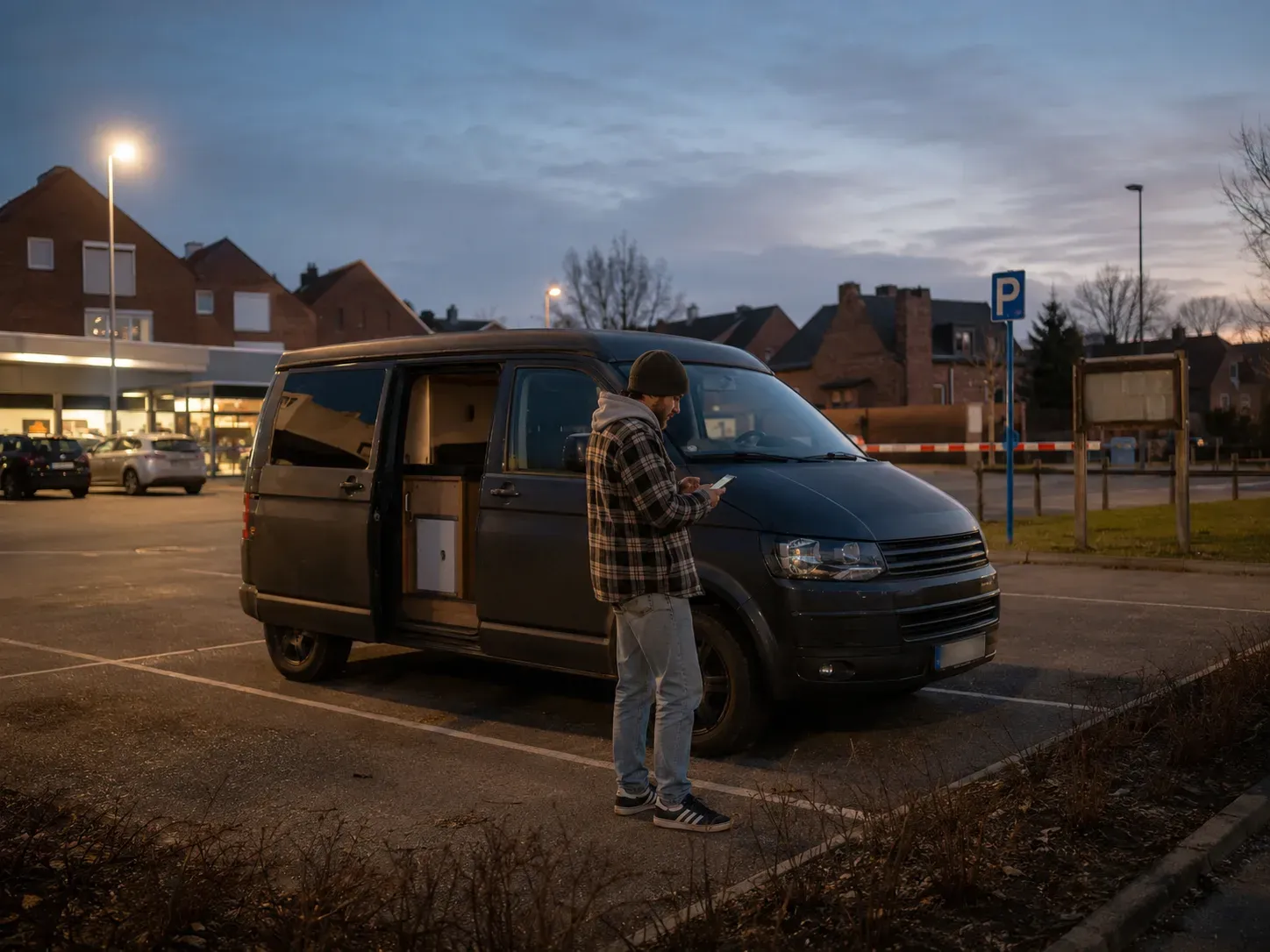
Park4Night, Campercontact, Google Maps, Facebook groups, and other apps can be super handy. You open the app, see a few pins nearby, and think: great, we can stay there tonight.
But here's the important warning: just because a spot is in an app doesn't mean you're legally allowed to stay there overnight.
An online location is not official permission. It's usually just a tip from someone else. Sometimes that tip is correct. Sometimes it's outdated. Sometimes it was always questionable. And sometimes someone just stayed there without being checked, and then calls it “allowed”.
For vanlifers, this is really important. Apps are useful as a starting point, but you still need to think for yourself on site.
An app is not a law book
An app shows what other users have shared. That can be useful, but it's not an official source.
A spot might be in an app because someone once slept there peacefully. But that doesn't automatically mean that:
- overnight stays are permitted there
- camping is allowed there
- the owner gives permission
- the municipality approves it
- the rules are still the same today
- you can park there with your type of vehicle
- you can stay there for multiple nights
That's the difference between “someone did it” and “it is allowed”.
So, apps are useful for finding ideas. But the rules come from the owner, manager, municipality, traffic signs, and legislation. Not from the app.
Sleeping, parking, and camping are not the same
In Belgium, there is no general prohibition against sleeping in a correctly parked car. A short rest or power nap can therefore be perfectly logical, especially if you are tired and want to stop safely.
However, staying overnight in a van or camper can be viewed differently, especially when it looks like camping.
Parking means: your vehicle is correctly parked in a spot or in an allowed place.
Sleeping means: you rest in your vehicle, without setting up the place as a dwelling.
Camping means: you turn the spot into a temporary living space.
Think of chairs outside, table outside, awning open, leveling blocks, cooking appliance outside, clothesline, grey water, staying for multiple days, or clear outdoor living around your bus.
Many spots in apps might be okay for short and discreet parking. That doesn't make them a campsite.
Why a location was once okay, but no longer is
A review from two years ago can be worthless today.
A lot can have changed in the meantime:
- new prohibition signs
- complaints from local residents
- stricter controls
- adjusted municipal rules
- barrier installed
- owner changed
- parking redeveloped
- nature reserve more strictly controlled
- too many campers in the same spot
- litter or nuisance from previous visitors
This often happens. A quiet spot comes online, becomes popular, more vans arrive, someone leaves trash, neighbors complain, and suddenly there's a prohibition sign.
Then the pin sometimes remains in the app for months or years. But the reality on site has changed.
That's why you should read recent reviews and, most importantly, check the signs on site.
Always look at the signs
Signs take precedence over app reviews.
Pay attention to signals such as:
- no parking
- no overnight stays
- for customers only
- private parking
- maximum parking duration
- for passenger cars only
- no motorhomes
- nature reserve
- quiet zone
- barrier or access hours
- paid parking
- no parking between certain hours
If there is a clear prohibition, then it's actually simple. You don't stay there because Park4Night says it's “a quiet spot”.
An app can be wrong. A traffic sign on site is much more important.
Private property remains private property
Many spots in apps are not public places.
Think of:
- shopping center car parks
- restaurant car parks
- sports halls
- businesses
- farms
- driveways
- car parks near nature reserves
- recreational areas
- marinas
- campsites outside opening hours
- hotel or cafe car parks
Some of these places are publicly accessible, but still private. You might be able to drive in, but that doesn't mean you can stay overnight.
A supermarket car park is for customers. A sports hall car park for athletes and visitors. A business car park for staff or suppliers. A restaurant car park for customers.
Want to sleep on private property? Ask for permission.
And even with permission, remain respectful: one night, no mess, no camping behavior, and leave when asked.
Nature spots are extra sensitive
Apps are full of beautiful spots near forests, fields, lakes, rivers, and nature reserves. These are, of course, the places where vanlifers love to be.
But precisely there, you need to be extra careful.
Nature reserves often have their own rules. There may be restrictions on parking, access after sunset, fire, litter, dogs, quiet, verges, dirt roads, or overnight stays.
A spot can be beautiful and yet not suitable for overnight stays.
If you have to doubt somewhere, rather doubt in the direction of respect. Especially in nature. One van seems innocent. Ten vans, tracks in the verge, litter, music, and a campfire quickly ruin a place.
Local rules differ
Belgium is small, but the rules can vary by municipality.
One municipality has designated camper spots. Another allows short-term parking but prohibits overnight stays. Some municipalities are tolerant as long as there is no nuisance. Other municipalities control more strictly, especially on the coast, in tourist areas, or near nature reserves.
An app doesn't always keep track of this well.
What is tolerated in one municipality may be prohibited in another. Even within the same municipality, it can make a difference whether you are in a regular car park, on a sea dike, a nature car park, a village square, or an official camper spot.
That's why “but that's allowed in Belgium, isn't it?” is never a good enough answer.
Reviews are opinions, not permission
Reviews in apps are useful, but you need to learn to read them.
A review like “had a quiet night, saw no one” only means that person was not approached. It doesn't mean the spot was legal.
A review like “police came by but said nothing” also doesn't mean the spot is officially allowed. Maybe they had other priorities. Maybe it was tolerated. Maybe there was no complaint.
Better are reviews that are concrete:
- there's a sign allowing campers
- official camper spot
- permission asked from owner
- payment via machine
- maximum 24 hours allowed
- waste disposal point available
- municipality refers to this car park
But even then, you check on site.
The app doesn't know your behavior
A spot might be suitable for one discreet night, but not for camping behavior.
Perhaps someone slept there in a small stealth van. You arrive with a high camper, roof hatch open, awning out, and chairs outside. Then the situation is different.
Perhaps someone was there in November, when it was quiet. You come in July, in the middle of the tourist season. Then checks are much more frequent.
Perhaps someone was there alone. You come with three other vans. Then it immediately stands out.
An app shows a spot, but not the context of your vehicle, behavior, season, and crowd.
How do you recognize a reliable spot?
A reliable spot preferably has one or more of these signals:
- official camper spot
- clear signs allowing overnight stays
- municipal information confirming the spot
- payment via official machine or app
- waste disposal point or camper facilities
- recent positive reviews without complaints
- no contradictory signs
- no private property without permission
- no nature reserve with questionable access
- clear parking layout
- no feeling that you have to hide
The more of these things are true, the better.
An anonymous pin in a verge with reviews like “didn't get caught” is not a strong basis.
How to use apps smartly then?
Use apps as a tool, not as permission.
This is how I would approach it:
1. Find a few possible spots nearby.
2. Read recent reviews.
3. Look at photos, but don't blindly trust them.
4. Check on Google Maps if it seems logical.
5. See if it's private, public, a nature reserve, or an official car park.
6. Read the signs on site.
7. Assess whether you are bothering anyone.
8. Stay short and discreet.
9. Leave if it doesn't feel right.
10. Leave an honest review for others.
Apps are great for finding options. But you remain responsible for what you do.
Don't just put questionable spots online
This is perhaps the most important community point.
Not every good spot needs to be online.
A quiet spot near a village, forest edge, or local viewpoint can work perfectly for one respectful overnight stay. But as soon as that spot appears in a popular app, things can quickly go wrong.
More visitors mean a greater chance of:
- complaints
- litter
- traffic congestion
- noise
- nuisance
- checks
- prohibition signs
- fines
- closures
Sometimes you protect a place better by not sharing it.
That might sound contradictory for a community website, but it's honest. We shouldn't share every quiet spot to death.
Leave honest reviews
If you use an app, help others with honest information.
Don't just write “great spot”. Write what's useful:
- were there signs?
- was overnight stay allowed?
- did it feel safe?
- was there noise?
- was it private property?
- were there checks?
- was there litter?
- were there facilities?
- has the spot become unsuitable?
- is it better to stay away?
If a spot is not legal or not respectfully usable, say so. That helps more than pretending everything is okay because you happened to have a quiet night there.
What if you are approached?
Stay friendly.
Just say you were tired, that you wanted to rest discreetly, and that you'll leave if it's not desired. Don't wave app reviews around as if they're a permit.
An owner, police officer, forest ranger, or municipal employee has nothing to do with what someone put in an app.
If asked to leave, you leave.
A good reputation for vanlife starts with how we react when someone approaches us.
What if there's no sign?
No sign does not automatically mean permission.
It only means you have to better assess what the place is yourself.
Ask yourself:
- is this private property?
- does this belong to a shop, business, or sports hall?
- is this a nature reserve?
- is this a regular car park?
- are there houses nearby?
- can I bother anyone?
- is there a reason why this shouldn't be a sleeping place?
- would I be okay with this if it were my property?
If you doubt several questions, it's better to look for something else.
Apps and safety
Not every spot in an app is safe.
Some spots are remote, dark, or unclear. Others are on busy car parks with a lot of traffic. Some reviews mention theft, suspicious people, noise, loitering youths, truck traffic, or police checks.
Read those reviews. Not to be scared, but to choose smartly.
Rather choose a less beautiful spot where you feel safe than an idyllic spot where you lie awake all night.
With Grephar, I might feel safer in some places, but that's no reason to seek out risks. Your gut feeling remains important.
Apps and responsibility
It's tempting to think: “If it's in the app, it must be allowed.”
But responsibility remains with you.
You choose where to park. You decide whether to stay. You leave or don't leave trash. You put out or don't put out chairs. You read or ignore signs. You react to residents or police.
The app is just a map with tips. No insurance, no permit, and no free pass.
Common mistakes
A first mistake is thinking that a Park4Night pin means overnight stays are legal.
A second mistake is trusting old reviews without checking on site.
A third mistake is ignoring signs because others were also there.
A fourth mistake is using private car parks without permission.
A fifth mistake is exhibiting camping behavior in places where at most discreet parking is possible.
A sixth mistake is sharing sensitive nature spots online.
A seventh mistake is writing reviews that only say “perfect spot”, without legal or practical info.
An eighth mistake is continuing to argue when the owner, police, or manager approaches you.
Practical checklist
Before you stay at a location from an app, it's best to check:
- Are there recent reviews?
- Is there anything about checks, fines, or complaints?
- Is it an official camper spot?
- Are there signs on site?
- Are overnight stays or camping prohibited?
- Is it private property?
- Do I need permission?
- Is it a nature reserve?
- Am I parked correctly?
- Am I bothering anyone?
- Am I not showing camping behavior?
- Am I only staying for a short time?
- Does the spot feel safe?
- Can I leave quickly?
- Am I leaving nothing behind?
- Is it wise to share this spot online myself?
If you don't have a good answer to several questions, it's better to look further.
Conclusion
Park4Night and other apps are useful, but they don't automatically make a spot legal. A pin on the map is not permission, not a municipal decision, and not a sign allowing overnight stays.
So use apps smartly. Read recent reviews, check signs, respect private property, avoid camping behavior in regular car parks, and be extra careful with nature spots.
For me, the best rule is simple: use an app to find spots, but use your common sense to decide whether to stay.
Vanlife only remains enjoyable if we use places respectfully. Not every place that can be shared, should be online. And not every place that is online, is allowed.
Source: https://www.veiligverkeer.be/veilig-rijden/slaperigheid/wegcode-parkeren-slapen-auto/
Source: https://www.vlaanderen.be/omgevingsvergunning/stedenbouwkundige-handelingen/opslag
Source: https://toerismevlaanderen.be/nl/logies/uitbatingsnormen-camperterrein
Source: https://www.wegcode.be/nl/regelgeving/2024005817~0mocswfbry
Source: https://www.politie.be/5450/vragen/parkeren/mag-ik-met-een-motorhome-parkeren-bredenede-haan