Shopping center car parks, sports halls and industrial areas: publicly accessible is not the same as free camping
Some places seem ideal for a quick night in your van. A large shopping center car park. The car park of a sports hall. A quiet industrial area where no one is left after 6 PM. Plenty of space, flat ground, often lighting, sometimes even cameras. Sounds convenient.
By Laurens De Leeuw · 24 June 2026
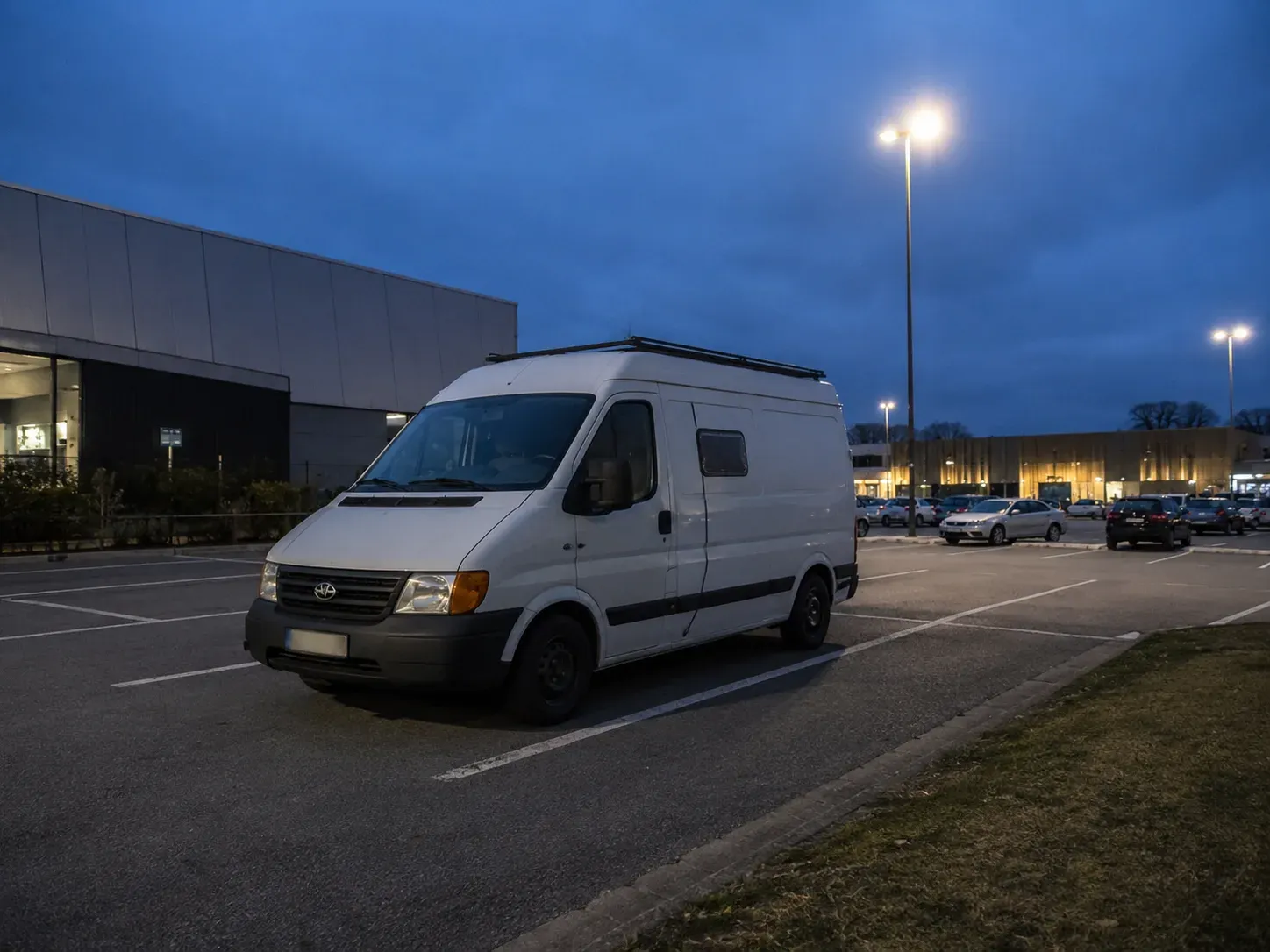
Some places seem ideal for a quick night in your van. A large shopping center car park. The car park of a sports hall. A quiet industrial area where no one is left after 6 PM. Plenty of space, flat ground, often lighting, sometimes even cameras. Sounds convenient.
But here's the important nuance: a place that is publicly accessible is not necessarily a place where you are allowed to camp freely.
For vanlifers, that difference is really important. You might be able to park perfectly somewhere, but that doesn't automatically mean you can stay overnight, sit outside, cook, open your awning, or use your bus as a mini campsite.
Publicly accessible does not automatically mean public
A shopping center car park can be accessible to everyone, yet still be private property. Think of the car park of a supermarket, shopping center, furniture store, gym, fast-food chain, or petrol station.
Often you are allowed to drive in because the owner wants to welcome customers. That doesn't mean you can stay there when the store is closed. And it certainly doesn't mean you can camp there.
The same applies to car parks at sports halls, swimming pools, schools, municipal halls, and industrial areas. They may seem open and accessible, but they usually have a purpose: to allow visitors, staff, customers, suppliers, or athletes to park.
That's different from a free overnight spot.
Parking is different from camping
This remains the golden rule.
Parking means: your vehicle is correctly parked in a spot, without causing obstruction, without items outside, and without clear signs of habitation.
Camping means: you turn the spot into a temporary living space.
Think of:
- chairs outside
- table outside
- awning open
- cooking appliance next to the bus
- leveling blocks
- hanging laundry
- shoes or bins outside
- music
- discharging grey water
- staying longer
- staying in the same spot for multiple days
In shopping center car parks, sports halls, and industrial areas, you absolutely do not want to fall into that second category. Even if you only want to sleep, it's best to keep it as minimal as possible.
Stay inside, leave nothing behind, make no noise, and leave again.
Can you sleep in a shopping center car park?
That depends on the place.
At some stores, a short night is tolerated, especially if you do nothing wrong and bother no one. At other stores, it's simply not desired. Sometimes there are signs saying “parking for customers only”, “no overnight parking”, “maximum 2 hours parking”, “private parking”, or “towing possible”.
If there's such a sign, it's clear. Then you respect that.
If there's no sign, that doesn't automatically mean overnight stays are allowed. The site still has an owner or manager. They can ask you to leave. Security can address you. Police can intervene if there are complaints, nuisance, or a violation.
The safest rule is simple: if you want to stay overnight on private property, ask for permission. Especially at small shops, restaurants, sports clubs, or businesses, this can sometimes be arranged simply by being human. But don't assume it's allowed just because the barrier is open.
Shopping center car park during opening hours
During opening hours, a shopping center car park is intended for customers.
If you are there during the day with your van while doing groceries, that's usually not a problem as long as you park correctly and don't cause any nuisance.
But staying for a long time without being a customer can cause problems. You are then taking up space for actual customers. This will be especially noticeable in busy car parks, small shops, supermarkets, or car parks with limited space.
A bus that does groceries once and then leaves is different from a camper that stays in the same spot all afternoon and night.
Shopping center car park after closing time
After closing time, it becomes more sensitive.
Some car parks remain open because there is no barrier. That doesn't mean they are intended as night parking. The owner cannot physically close every open car park.
Staying overnight in a shopping center car park can sometimes seem quiet, but you are also visible. Camera footage, security rounds, police patrols, or local residents can notice you.
If you do stay somewhere, behave as if you are visiting and could be asked to leave at any moment. No camping behavior. No mess. No noise. No discussion.
Sports halls and municipal car parks
Sports halls, swimming pools, football fields, and municipal halls often have large car parks. Outside opening hours, these are sometimes empty. That makes them tempting.
But here too: empty is not the same as free.
A sports hall car park can be owned by the municipality, a sports club, a school, or a private operator. It is usually intended for visitors to the facilities. Some municipalities have local rules regarding overnight stays in vehicles, campervans, or motorhomes in public places.
There are municipalities that explicitly prohibit overnight stays in campervans in certain public places. Other municipalities allow it in designated camper spots or with time restrictions. Still other municipalities mainly react if there is nuisance or complaints.
So you always have to look at the local rules and the signs on site.
Industrial areas: quiet, but not always smart
Industrial areas are popular with people who want to stealth camp. Empty in the evening, few residents, wide streets, sometimes flat car parks, and little social pressure.
But industrial areas have their own risks.
You are often among businesses, loading docks, freight traffic, surveillance cameras, and private property. What seems quiet at 11 PM can suddenly be full of trucks, forklifts, staff, and suppliers at 5 AM.
In addition, an unknown bus in an industrial car park can seem suspicious. Especially if there are thefts, burglaries, or night checks. A company or security firm can react faster than you expect.
So an industrial area is not necessarily illegal, but it is also not automatically a good sleeping place.
Publicly accessible areas and traffic rules
In Belgium, traffic rules can also be relevant in places accessible to the public. The legislation not only refers to public roads, but also to areas accessible to the public and even non-public areas accessible to a certain number of people.
In practice, this means: even in a shopping center car park or other publicly accessible car park, you cannot just do whatever you want with your vehicle.
You must take into account:
- traffic signs
- markings
- reserved spaces
- passages
- fire lanes
- loading and unloading zones
- spaces for disabled people
- direction of travel
- maximum duration
- rules of the owner or manager
If you park incorrectly, cause obstruction, or occupy a reserved space, “I'm just sleeping” is not a strong argument.
Vanlife is not a right to every empty car park
This may sound strict, but it is important for the community.
An empty car park feels like unused space. But that space almost always has a function, owner, and context.
A shopping center car park is for customers. A sports hall car park for athletes and visitors. An industrial car park for staff, suppliers, and trucks. A municipal car park for visitors to the neighborhood or infrastructure.
If vanlifers treat these places as free campsites, you will quickly get signs, prohibitions, and controls. One bad experience with litter, chairs, noise, or nuisance can be enough to permanently make a place “camper unfriendly”.
Freedom works better if we don't become a nuisance.
When might it be possible?
Sometimes a short overnight stay can be practical and responsible.
For example:
- you are tired and don't want to drive further
- you are parked correctly and discreetly
- there are no prohibition signs
- you are not bothering anyone
- you only stay one night
- you leave nothing behind
- you leave early
- you ask for permission where it makes sense
At some shops, restaurants, or sports clubs, you can even get permission if you ask kindly. Especially if you are a customer, buy something, or clearly explain that you just want to stay quietly for one night.
A simple question can solve a lot.
When is it better not to do it?
Some situations are simply not a good idea.
It's better not to do it if:
- there are prohibition signs
- there are barriers or clear private access
- you are in a loading and unloading zone
- you are blocking a fire lane
- you are in front of a gate, warehouse, or industrial building
- there is a lot of freight traffic
- the area is clearly closed off or guarded
- there are already many campers
- you want to cook or sit outside
- you want to stay for multiple nights
- you don't feel safe
- you feel like you have to hide
That last point is important. If you are somewhere and you constantly feel stressed, then it's not a good place.
What about permission?
Permission makes a big difference, but it doesn't solve everything.
If the owner or manager says you can stay on their car park for one night, that's much better than just staying. But even then, you have to take into account local rules, safety, insurance, nuisance, and possibly spatial or tourist regulations if it becomes structural.
An owner allowing one traveler to stay for one night is different from operating a site as a camper spot. As soon as people are allowed to stay overnight for a fee or structurally, rules regarding tourist accommodation, camper sites, fire safety, and permits can come into play.
For you as a vanlifer, the simple rule is: ask for permission where necessary, stay short, behave discreetly, and don't make it a permanent spot.
What if police, security, or the owner approaches you?
Stay calm and friendly.
Just honestly say what you are doing: you were tired, you wanted to park safely and rest, you are only staying for a short time, and you will leave if necessary.
Don't argue about rights if you are on private property or if there are clear signs. You rarely win anything that way. A friendly attitude makes it much more likely that you can just leave quietly without any hassle.
If they ask you to leave, then leave.
A good vanlifer leaves no conflict behind.
How do you recognize a better spot?
A better spot is not just empty, but also logical.
Look for:
- clear parking spaces
- no prohibition signs
- no loading dock or gate
- no reserved zones
- no busy residential area
- no risk of obstructing trucks
- lighting without being in the spotlight
- safe exit
- no mess or strange atmosphere
- possibility to leave early
You want to be somewhere where you don't stand out as a problem. Not because you want to do something wrong, but because you don't want to bother anyone.
What about apps and tips from others?
Apps can be useful, but they are not sacred.
If someone wrote “slept well here” two years ago, that doesn't mean it's still possible today. There may be new signs, the owner may have changed, the municipality may be stricter, or there may have been complaints.
Read recent reviews, look at the signs, and use your own judgment.
And write honest reviews yourself. If a place is actually not suitable, say so. This way, we prevent too many people from going to the same questionable car park.
Leave no trace
This should be self-evident, but it still needs to be said.
Leave no litter. Do not discharge water. Do not use bushes as a toilet. Make no noise. Do not put chairs outside. Do not leave dog poop. Do not make anything dirty.
Especially in shopping center car parks and sports halls, one bad vanlifer is enough to disadvantage everyone after you.
I know that most people in the community handle this respectfully. But that's precisely why we should keep repeating this. We don't want every empty car park to automatically get a prohibition sign soon.
Shopping center car park, sports hall, or industrial area as an emergency spot
For me, these are mainly emergency spots or stopovers.
A shopping center car park can be useful if you are doing late groceries and need to rest for a while. A sports hall car park can be practical if you want to park somewhere briefly and the signs allow it. An industrial area can sometimes work as a quiet stealth spot, but also has risks.
But for a real night, it's better to choose a place intended for that:
- official camper spot
- campsite
- permitted car park
- private property with clear permission
- hospitable place with friends or family
- area where overnight stays are explicitly allowed
That's calmer for you and better for the reputation of vanlife.
Common mistakes
A first mistake is thinking that publicly accessible means you can do anything there. That's not true.
A second mistake is confusing parking with camping.
A third mistake is staying in a shopping center car park after closing time without permission.
A fourth mistake is thinking that an empty industrial area is automatically safe or allowed.
A fifth mistake is ignoring signs.
A sixth mistake is blocking truck zones, loading docks, or passages.
A seventh mistake is staying in the same spot for multiple nights.
An eighth mistake is leaving behind litter, grey water, or noise.
Practical checklist
Before staying in a shopping center car park, sports hall car park, or industrial area, it's best to check:
- Is the area private, public, or municipal?
- Are there signs with restrictions?
- Is overnight or long-term parking prohibited?
- Is the car park intended for customers, visitors, or staff?
- Am I in an actual parking space?
- Am I not blocking anything?
- Am I not in a loading and unloading zone?
- Am I not in a fire lane?
- Is it safe to stay here?
- Can I leave quickly if necessary?
- Is permission needed or wise?
- Am I only staying for a short time?
- Does my setup not show camping behavior?
- Am I leaving nothing behind?
If you have doubts about multiple questions, it's better to look for another place.
Conclusion
Shopping center car parks, sports halls, and industrial areas can sometimes be useful for a short stop or exceptional overnight stay. But publicly accessible is not the same as free camping.
A shopping center car park often remains private property. A sports hall car park may have municipal rules. An industrial area may seem quiet, but is intended for businesses, staff, and freight traffic. The same principle applies everywhere: parking is different from camping.
My advice: use such places only briefly, discreetly, and respectfully. Ask for permission when it makes sense, always read the signs, leave nothing behind, and leave without discussion if you are approached.
Vanlife remains easier if we show that we are not a nuisance.
Source: https://www.wegcode.be/nl/regelgeving/1968031601~invynqx4tj
Source: https://www.vlaanderen.be/omgevingsvergunning/stedenbouwkundige-handelingen/opslag
Source: https://www.veiligverkeer.be/veilig-rijden/slaperigheid/wegcode-parkeren-slapen-auto/
Source: https://www.politie.be/5450/vragen/parkeren/mag-ik-met-een-motorhome-parkeren-bredenede-haan
Source: https://toerismevlaanderen.be/nl/logies/uitbatingsnormen-terreingebonden-logies