Filling up with water on the road: public taps, cemeteries, petrol stations and permission
Water is one of those things you only really think about when your tank is almost empty. You want to make coffee, wash dishes, wash hands, cook, water your dog, maybe shower or just have enough drinking water with you.
By Laurens De Leeuw · 24 June 2026
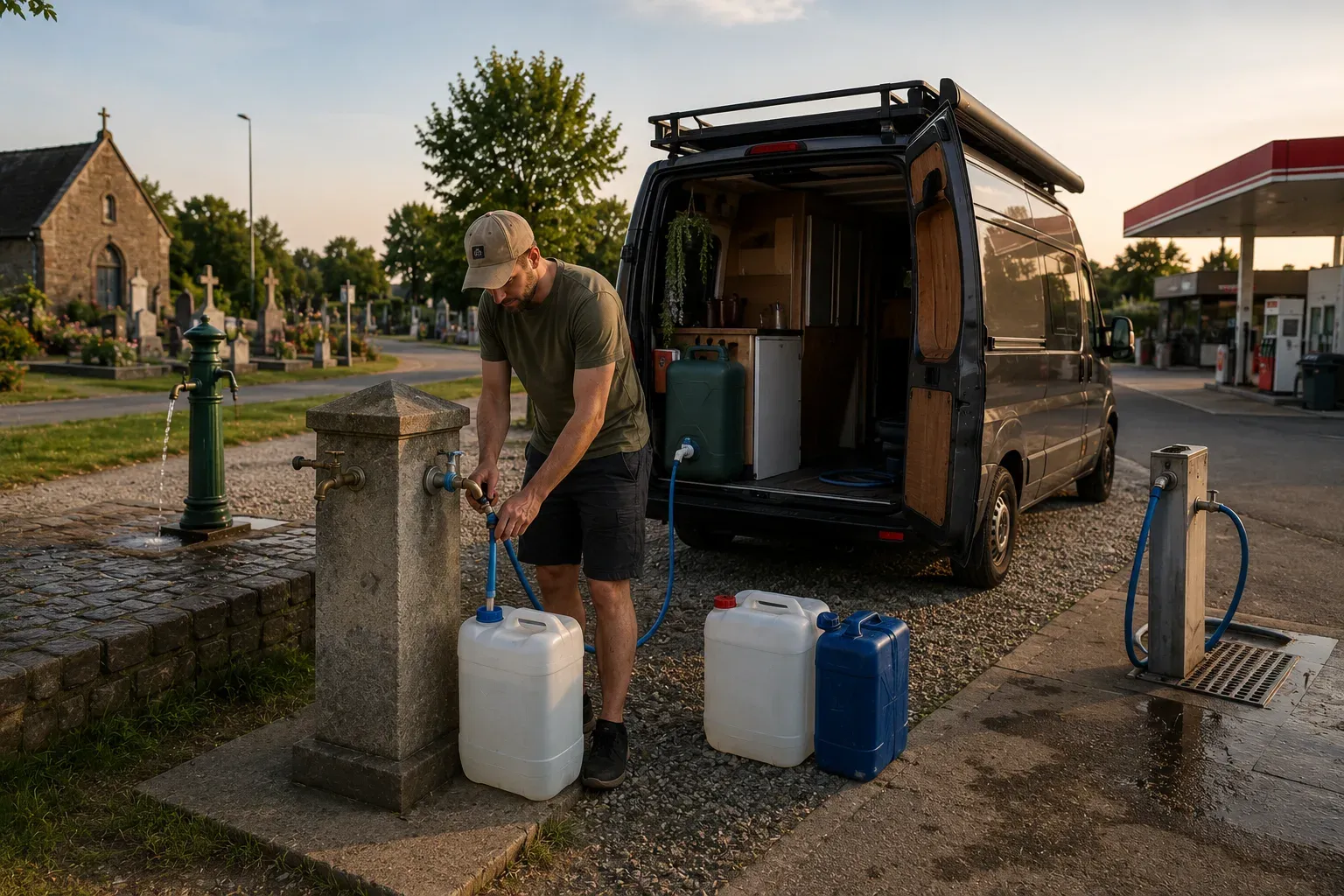
Water is one of those things you only really think about when your tank is almost empty. You want to make coffee, wash dishes, wash hands, cook, water your dog, maybe shower or just have enough drinking water with you.
And then suddenly you see a tap on the way.
At a cemetery. At a sports hall. At a petrol station. Next to a public toilet. In a car park. At a beach shower. Or somewhere at a municipal building.
The question then is: can you just fill your water tank there?
The short answer: sometimes you can, but ask for permission when the tap is not clearly intended as a public drinking water point. And certainly don't just use large quantities of water in places where that water is intended for something else.
For vanlifers, this is not just about legislation, but also about respect. Water is not a free, infinite resource that you are entitled to everywhere.
Tap water in Flanders is usually good, but the tap itself also counts
In Flanders, tap water is normally well-controlled and suitable as drinking water. The quality of tap water is monitored by the drinking water companies and must meet quality requirements.
But that doesn't mean that every tap on the road is automatically a good drinking water point.
There is a difference between tap water in a house or building that is used regularly, and an outdoor tap that may be used little for days, weeks or months. Stagnant water in pipes, old pipes, dirt on the tap mouth, a garden hose lying in the sun or an unknown connection can affect the quality.
So even if the water comes from the mains, you still need to think about where you are drawing it from.
Drinking water or technical water?
Not every tap provides drinking water.
Some taps are connected to mains water. Others can provide rainwater, well water or technical water. Sometimes this is indicated, sometimes not.
If it says “no drinking water”, “not potable” or something similar, do not use that water for drinking, cooking or filling your drinking water tank. It may be useful for rinsing or cleaning, but even then you need to know what you are doing.
A tap without a sign is also not automatically safe. Especially with outdoor taps, old buildings, cemeteries, sports fields or workplaces, you often don't know exactly how the installation works.
When in doubt: not in your drinking water tank.
Public taps: not always intended for campers
Some villages or cities have public taps, drinking fountains or water points. These are often intended for filling a water bottle, washing your hands or taking a short drink of water.
That's different from filling a camper tank of 60, 80 or 100 litres.
If a tap is clearly intended as a drinking water point, and there is no prohibition or restriction, you can usually fill a bottle or small jerrycan. But taking large quantities of water is another story.
A public tap is not automatically a free camper service point.
Use your common sense. A drinking fountain in a square is not a place to fill your entire bus with a hose.
Cemeteries: usually don't do it
Cemeteries often have water taps. Logically, people use them to water flowers, clean a tombstone or fill a watering can.
But that doesn't make a cemetery tap a camper water point.
Taking water at a cemetery to fill your entire tank not only feels wrong, it can also go against local rules or the intention of the place. Cemeteries are places of peace and respect. Standing there with your jerrycans or hose to fill up for your vanlife setup just doesn't look good.
Filling a small water bottle in an emergency is one thing. I would personally avoid filling your camper tank at a cemetery.
Not because the water is necessarily bad, but because the place is not intended for that.
Petrol stations: just ask
Petrol stations are often the best option on the road, but even there: ask.
Some petrol stations have a tap for customers, trucks, windscreen wipers, cleaning or technical purposes. Some are happy to let you take water if you ask politely, especially if you also refuel or buy something. Others don't want to, don't have a suitable connection or use water that is not intended as drinking water.
So just ask:
“May I fill my jerrycan with drinking water?”
Or:
“May I top up my water tank? I'm happy to pay something for the water.”
That may sound awkward, but it's much better than secretly connecting a hose.
If they say yes, great. If they say no, that's okay too. Thank them kindly and move on.
Camper pitches and campsites are the easiest option
The most logical places to fill up with water are official camper pitches and campsites.
Water is usually provided there for campers. Sometimes free, sometimes included in the overnight stay, sometimes paid for via a machine. There is often also a grey water or toilet emptying point.
That is actually the cleanest way:
- you know it's intended
- you don't bother anyone
- you can usually also empty
- you don't take water in a place where it's not intended
- you avoid discussion
For those who are often on the road, it is smart to plan your water around such points. Don't wait until your tank is completely empty.
Ask for permission on private property
A tap at a café, restaurant, shop, farm, sports club, business or home is private, even if you can easily access it.
That means: don't just use it.
Ask for permission. And be clear about how much water you need. Filling a bottle is different from a 100-litre tank.
For example, say:
“May I fill 10 litres of water here? I'm on the road with my bus.”
That sounds much more reasonable than showing up unannounced with a hose and a large tank.
Pay something if it feels appropriate. Or buy something. A coffee, sandwich, refuelling or small fee often makes it much more normal.
How much water do you actually take?
A vanlifer quickly uses more water than they think.
A few examples:
- 1 litre to make coffee and tea
- 2 to 5 litres for cooking and washing dishes
- 5 to 10 litres for hand washing and basic hygiene
- 10 to 20 litres for a short shower, depending on your system
- extra water for dog, cleaning or toilet
A tank of 80 litres seems like a lot, but if you shower, cook and wash dishes, it will be empty faster than expected.
That's precisely why it's tempting to top up everywhere on the road. But the more water you need, the more important it becomes to use official or permitted water points.
Saving water makes everything easier
The best way to have to look for water less often is simple: use less.
That sounds boring, but it makes vanlife much calmer.
Practical tips:
- use a jerrycan with a tap instead of always a pump
- turn off your pump when you don't need it
- wash dishes with little water
- use a plant sprayer for small cleaning jobs
- take short showers or shower outside the bus where possible
- use biodegradable soap, but still dispose of it correctly
- collect rinse water
- don't always fill your tank completely if you're only driving a short distance
- repair leaks immediately
Saving water is not only ecological. It's just practical. Less water searching, less weight, less stress.
Pay attention to weight
Water is heavy.
1 litre of water weighs approximately 1 kg. A tank of 100 litres therefore means approximately 100 kg of extra weight. That counts towards your payload and MTM.
If your bus is already tight on weight, you don't always have to drive around with a full tank. Sometimes it's smarter to have enough water for the next few days, but not unnecessarily much.
Especially on longer trips, mountain roads or a bus that is already heavily built, water really counts.
I know that “water weighs a lot” is not the most romantic vanlife advice, but on the weighbridge, romance doesn't matter much.
Use clean equipment
Your water quality also depends on your own system.
Use clean equipment:
- drinking water hose
- clean jerrycans
- sealable caps
- tap connection that you only use for clean water
- no old garden hose for drinking water
- no hose that is also used for waste water
- regular cleaning of tank and pipes
- do not push a dirty nozzle against the tap
A good habit: do not touch the tap mouth with your hose or jerrycan. Briefly flush the tap if it seems not to have been used for a long time. And it's better to fill with a clean jerrycan than with a dubious hose hanging somewhere on a wall.
Flush the tap briefly
For outdoor taps or little-used taps, it is best to let the water run for a while before filling. Not wasting it for minutes, but short enough to get stagnant water out of the first part of the pipe.
This is especially useful for:
- outdoor taps
- taps at sports fields
- old buildings
- taps that are warm in the sun
- taps that are visibly little used
- taps with a garden hose attached
Use your nose and eyes. Does it smell strange, does the water look cloudy or rusty, or do you not trust the place? Do not use as drinking water.
Public toilets and washing facilities
At public toilets, it is tempting to take water. Sometimes you can do this with a small bottle. But filling a camper tank at a toilet fountain is usually impractical and not the intention.
Moreover, washbasins in toilets are not always clean. The tap itself can be touched by many people, the space is not ideal and sometimes the water is not intended for drinking.
Use this mainly for washing hands or a bottle in an emergency, not as a standard filling point.
Beach showers and fountains
Beach showers, public showers and fountains are usually intended for short-term use on site. Not for filling jerrycans or camper tanks.
With beach showers, there's another thing: in dry periods or when it's busy, they are sometimes restricted or closed. They are intended to rinse off sand and salt, not to supply campers.
Here too: a small emergency is different from systematically taking water.
Drought and water restrictions
In dry periods, you need to be extra careful.
Flanders and the water companies regularly ask to use water sparingly. In periods of drought, there may also be local measures, restrictions or warnings.
If it says somewhere that water use is restricted, don't happily fill your tank because you're “just one bus”.
One bus is little. But a hundred buses together are not.
In dry periods, it is best to use official camper points, petrol stations with permission or campsites, and limit your consumption.
Do not take water by bypassing closures
If a tap is closed, leave it closed.
Do not use pliers. Do not open a cabinet. Do not connect a hose to a fire hydrant. Do not open a tap where public use is clearly not intended. Do not use a technical connection at a building.
That is not smart, not respectful and can simply cause problems.
A tap that is physically accessible is not automatically free to use.
Fire hydrants are absolutely not a water point
This should actually go without saying, but still: never use a fire hydrant to fill up with water.
Fire hydrants are for the fire brigade and water services. Opening them without permission can be dangerous, cause damage, cause pressure problems and is not normal public use.
Do you see people doing that online somewhere? Don't imitate them.
Water at farms or houses
In the countryside, you can sometimes politely ask a farmer, B&B, café or private individual. Many people are happy to help if you are polite and don't immediately come with a huge tank.
But keep it human:
- ask first
- explain how much you need
- offer to pay
- don't spill
- don't block access
- leave everything clean
- don't expect a yes
A smile and an honest story work better than acting as if taking water is a given.
Is taking water without permission theft?
I'm not going to be tough legally here, but the basic principle is simple: water has an owner or manager. Whether that's a municipality, company, petrol station, sports club, church council, private individual or water company.
If you just take water in a place where you don't have permission, that can at least be seen as unwanted use. Especially if it involves large quantities or if you force, bypass or misuse something.
For a bottle of water, usually no one will make a fuss. For an entire camper tank without permission, that's different.
So: ask for permission. Then there's no hassle.
What about paying for water?
Paying for water is normal.
Many official camper pitches charge a small amount for water. That's logical. You use infrastructure, maintenance, tap water and sometimes drainage.
So don't always try to find free water. Sometimes paying 1 or 2 euros is simply the cleanest solution.
For me, that's part of responsible vanlife. If we want more camper points, we also have to show that we are willing to pay correctly for facilities.
Do not leave rubbish at water points
Water points quickly get dirty if people are messy.
So don't leave behind:
- empty bottles
- caps
- wet wipes
- dirty water
- soap residues
- mud
- pieces of hose
- tie wraps
- packaging
- dog poop
- toilet waste
Keep the place clean. Rinse away spilled water if necessary. Close the tap properly. Leave the hose or connection as you found it.
A water point that gets dirty will be closed faster.
Practical system for vanlifers
The most convenient system is usually a combination.
For example, use:
- fixed water tank for basic supply
- one or two loose jerrycans
- water bottle for on the go
- small reserve bottle for emergencies
- water filter if useful
- clean filling hose
- various tap connections
- good caps and funnel
A loose jerrycan is often much less conspicuous than filling an entire camper tank. It's easier to ask to fill 10 litres than 80 litres.
And if you're not sure about the tap, you can keep that water separate for washing dishes or cleaning instead of immediately pouring it into your drinking water tank.
Where to find better water points?
Good places to look for water are:
- official camper pitches
- campsites
- some petrol stations
- marinas, if permission or payment is provided
- paid service columns
- public drinking water points
- friends or family
- some sports or recreation areas with permission
- catering establishments where you are a customer and get permission
Feel free to use apps to find water points, but check on site if it's correct. An app pin does not automatically mean that the tap is public or potable.
Common mistakes
A first mistake is thinking that every outdoor tap can be used for free.
A second mistake is using cemeteries as a standard water point.
A third mistake is using a petrol station tap without asking.
A fourth mistake is trusting an unknown tap as drinking water.
A fifth mistake is using old garden hoses for drinking water.
A sixth mistake is filling an entire tank at a drinking fountain or beach shower.
A seventh mistake is wasting water in dry periods.
An eighth mistake is leaving dirt at water points.
A ninth mistake is forgetting that 100 litres of water is also 100 kg of extra weight.
Practical checklist
Before you fill up with water somewhere, it's best to check:
- Is this clearly a drinking water point?
- Does it say “no drinking water” or another prohibition?
- Is the tap intended for public use?
- Is this private property?
- Do I need permission?
- Am I taking a reasonable amount?
- Is the tap clean?
- Is my own hose or jerrycan clean?
- Do I briefly flush away stagnant water?
- Do I only fill my drinking water tank with reliable water?
- Is there drought or water restriction?
- Do I leave the place clean?
- Do I close the tap properly?
- Does the extra weight count towards my payload?
If in doubt, do not fill your drinking water tank. Find a better point.
Conclusion
Filling up with water on the road is part of vanlife, but it requires respect and common sense.
Public taps are not automatically camper service points. Cemetery taps are for graves and flowers, not for your entire water tank. Petrol stations can be handy, but ask for permission. Official camper pitches and campsites remain the cleanest solution.
Only use reliable water for your drinking water tank, keep your equipment clean, do not take large quantities without permission and do not waste water. Especially in dry periods, as vanlifers, we must show that we use what we use responsibly.
My advice: plan water like you plan fuel. Don't wait until your tank is empty, ask politely where necessary and leave every tap cleaner than you found it.
Source: https://vmm.vlaanderen.be/feiten-cijfers/water/drinkwater/indicator-drinkwaterkwaliteit
Source: https://www.departementzorg.be/nl/leidingwater-als-drinkwater
Source: https://www.departementzorg.be/nl/wat-kan-de-waterkwaliteit-beinvloeden
Source: https://www.vlaanderen.be/bouwen-wonen-en-energie/water/water-besparen
Source: https://vmm.vlaanderen.be/feiten-cijfers/water/drinkwater/actuele-toestand-drinkwaterbevoorrading