Festivals and temporary campervan parking: what rules apply?
A festival with campervan parking sounds ideal. You drive there, park your van, sleep right near the site, and don't have to search for a spot in the dark after the last band.
By Laurens De Leeuw · 24 June 2026
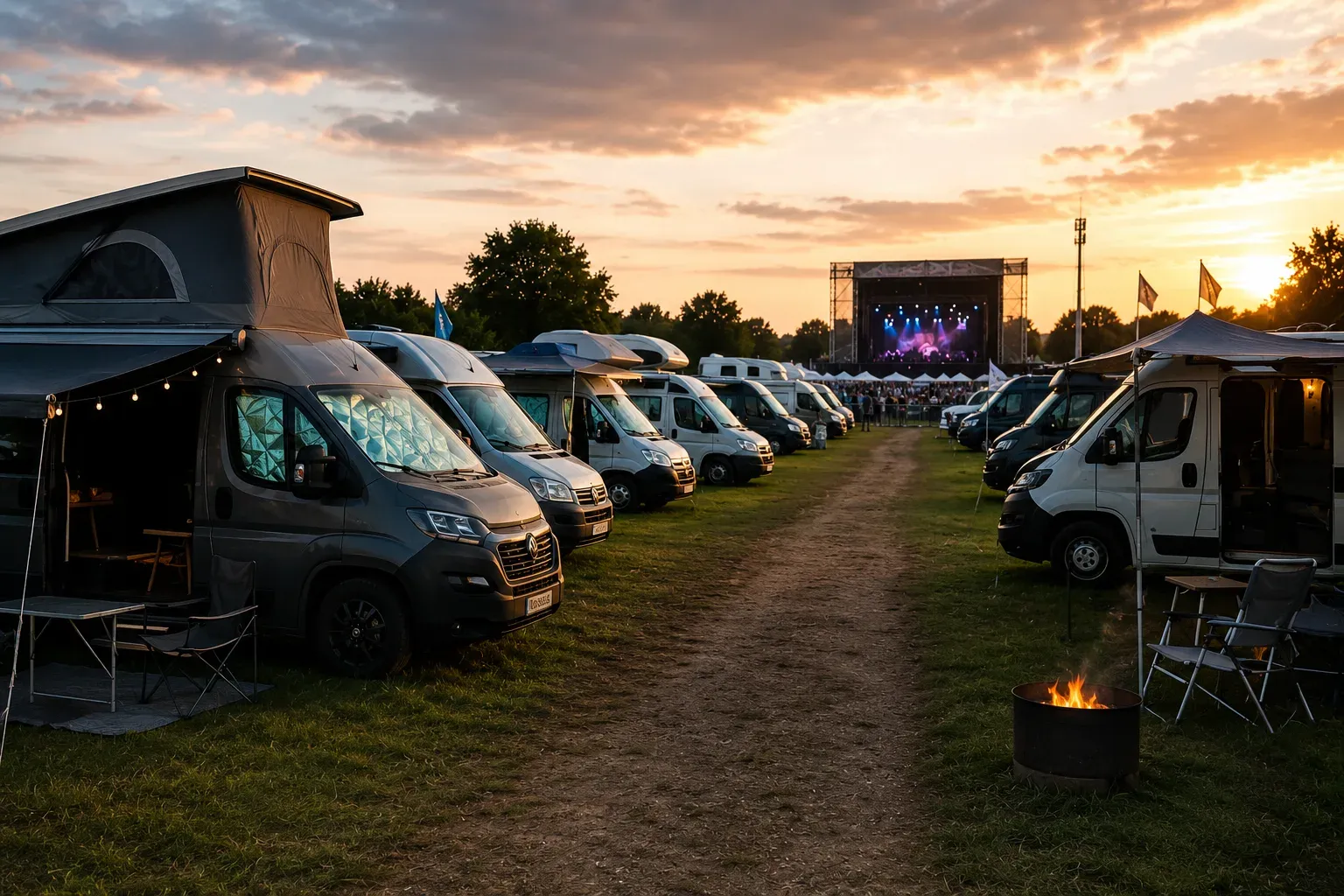
A festival with campervan parking sounds ideal. You drive there, park your van, sleep right near the site, and don't have to search for a spot in the dark after the last band.
But even here, just because it says “campervan parking” or “festival camping” doesn't mean anything goes.
A temporary campervan parking at a festival is not a regular parking lot, but also not always a classic campsite. It's a bit of a mix between an event, parking, temporary stay, and site management. And because of that, rules apply from the organizer, the municipality, the fire department, the police, and sometimes also regarding spatial planning.
For you as a visitor, the most important thing is: follow the rules of the site, stay in the designated spot, don't set up camp outside the camping area, and don't leave any mess behind.
Festival camping is not the same as wild camping
If a festival offers an official campsite or campervan parking, it is usually part of the event. The organizer has normally made arrangements for this with the municipality, the owner of the site, the security services, and sometimes also the fire department.
That is completely different from choosing a field, parking lot, or street somewhere nearby and setting up there yourself.
So, a ticket for the festival does not automatically give you the right to stay overnight anywhere in the vicinity. It only gives you access to the zones that the organizer provides for that purpose.
In short: within the official campervan parking, you follow the festival rules. Outside that zone, the normal parking rules, local regulations, and property rights simply apply.
Temporary event campsites sometimes fall outside the regular Accommodation Decree
In Flanders, there are rules for tourist accommodations, such as campsites and campervan sites. But Toerisme Vlaanderen states that temporary event campsites, with a maximum of 75 days per year, do not fall under the regular Accommodation Decree.
That sounds like there are fewer rules, but be careful: that doesn't mean the site is suddenly rule-free.
It mainly means that a temporary festival campsite does not automatically have to be treated as a regular campsite or campervan site according to all normal accommodation rules. But the organizer must still take into account safety, fire department, hygiene, waste, sanitary facilities, accessibility, crowd control, traffic, neighbors, emergency routes, and local conditions.
For visitors, that changes little: you simply follow the rules of the festival site.
The municipality plays a big role
A festival or temporary campervan parking is almost always viewed locally. The municipality can impose conditions via the event permit or license.
Think of conditions regarding:
- camping opening hours
- maximum number of vehicles
- where campervans may park
- passages for emergency services
- fire safety
- sanitary facilities
- waste collection
- noise
- lighting
- traffic and parking
- security or stewards
- alcohol and nuisance
- closing time and cleanup
That's why one festival can allow a lot and another almost nothing. The rules depend on the site, the municipality, the size of the event, the risk analysis, and the agreements with the fire department and police.
As a visitor, you shouldn't just think: “this was allowed at other festivals too”. Each site can have different rules.
A campervan parking is usually not a free campsite
At a festival campervan parking, you can usually sleep in your vehicle. That's the whole point. But that doesn't mean you can unlimitedly unfold your entire vanlife setup.
Some festival campervan parkings allow you to place a chair next to your bus. Others want everything to remain compact. Sometimes an awning may not be opened. Sometimes cooking is not allowed. Sometimes gas bottles are restricted. Sometimes a clear strip must remain between vehicles.
That has little to do with coziness and a lot to do with safety.
A campervan parking can quickly become full. If everyone starts putting out awnings, tables, barbecues, party tents, and bicycles, passages become narrower and the fire department can no longer get through.
So even if you have booked “campervan parking”, always check the house rules.
Fire safety is serious on festival grounds
Fire safety is one of the most important points at temporary campsites and campervan parkings.
At a festival, many people are close together. There are tents, campervans, cables, gas stoves, vehicles, generators, sleeping bags, alcohol, nighttime crowds, and sometimes tired people who are less attentive.
Therefore, organizers can impose strict rules regarding:
- open fires
- barbecues
- gas bottles
- cooking appliances
- candles
- torches
- fireworks
- generators
- electrical cables
- distance between vehicles
- clear emergency routes
- extinguishing agents
- emergency exits
Fire safety information for events advises against camping fires at short festivals and states that candles, torches, campfires, and fireworks are prohibited. At multi-day festivals, small gas bottles may be allowed under certain conditions, but that always depends on the rules of the event and the emergency services.
For you as a vanlifer, the practical rule is simple: do not use fire or gas if it is not clearly permitted.
Can you cook in your van?
That depends on the festival.
Some campervan parkings allow cooking in or near your vehicle, as long as you work safely. Others prohibit cooking entirely or only allow small appliances. Sometimes gas is not allowed, but electric is. Sometimes cooking is only allowed in a separate cooking zone.
The reason is safety. A gas stove next to a bus among dozens of other vehicles is not the same as cooking at a quiet campervan site.
If you do cook, only do so if it is allowed and keep it safe:
- no open fire near dry grass
- no cooking appliance in a passage
- no loose gas bottle outside
- always ventilation when cooking inside
- never cook while you sleep
- do not leave anything burning unattended
- fire extinguisher within reach
And if the festival says cooking is not allowed, then it is not allowed. Not even “just for a quick moment”.
What about gas, LPG, and diesel heaters?
At a festival, the organizer may impose additional rules regarding gas, LPG, and heaters.
A diesel heater in your van may be technically safe, but restrictions may still be imposed on a crowded site. An LPG installation may be perfectly legal in your vehicle, but the festival may still have rules regarding its use on the campsite. Loose gas bottles may be restricted or prohibited.
So, follow not only the general vehicle rules, but also the festival rules.
If there is a check at the entrance, questions may be asked about gas bottles, fuel, generators, or other risky items. This is not to be difficult, but to keep the site safe.
Electricity and generators
Some festival campervan parkings offer electricity. Others do not.
If there is electricity, only use proper equipment. No broken extension cords, no loose power strips in wet grass, and no cables across driveways or emergency routes.
Generators are often prohibited or severely restricted. They make noise, smell, can pose a fire hazard, and are disruptive to neighbors. So, don't assume your generator can run just because you have it with you.
Here too, what is technically possible is not automatically allowed.
Wastewater and toilet
A temporary campervan parking is not a place to discharge dirty water.
Only use the facilities offered by the organizer. If there is no discharge point, you take your grey water and toilet contents with you until you can dispose of them correctly somewhere.
Definitely do not:
- let grey water run into the verge
- dump toilet contents in a portable toilet if not allowed
- throw wastewater into a ditch or sewer pit
- place garbage next to a full container
- leave wet wipes or waste behind
Festival sites already have enough cleanup work afterwards. Vanlifers should not be the reason why campervan parkings become stricter at future editions.
Arrival and departure
At festivals, arrival and departure are often strictly regulated.
You usually cannot just drive in and out at any time. This is regulated.
You usually have to deal with safety, pedestrians, other visitors, darkness, alcohol, noise, and site management.
Pay attention to:
- arrival times
- departure times
- separate entrance for campervans
- check-in documents
- order of placement
- whether you can drive away in between
- whether you can re-enter after departure
- whether your vehicle must remain parked until a certain time
Some campervan parkings work like a regular parking lot: you drive in and can leave later. Others work more like a campsite: once placed, you stay until departure.
Read this in advance, because “just driving to the shop” may sometimes not be possible.
Your ticket is not a general permit
A campervan parking ticket means you can park in that specific spot according to the organizer's rules.
It does not mean:
- that you can stay overnight outside the festival zone
- that you can park in neighboring fields
- that you can sleep on the street if the campsite is full
- that you can make an open fire
- that you can discharge wastewater
- that you can stay longer than the allotted period
- that you can let someone else join without a ticket
Actually, it's simple: the ticket grants access to the provided arrangement. Nothing more than that.
What if the official campervan parking is full?
Then it's full.
Do not create an alternative yourself in a nearby field, shopping center parking, sports hall parking, or industrial zone. Chances are you will then fall outside the festival's regulations.
That can cause problems with:
- police
- local residents
- site manager
- festival organization
- insurance
- fire safety
- traffic
- waste and nuisance
Instead, look for an official campervan site, campsite, hotel parking with permission, or a place where overnight stays are clearly allowed.
And book on time. At popular festivals, campervan spots are often full faster than regular tickets.
Temporary campervan parking on a meadow or private land
Many festivals use a meadow, agricultural land, or private land as temporary parking or camping.
That is possible, but it must be arranged by the organizer. They must make agreements with the owner, municipality, and security services. Spatial and practical conditions may also apply.
For you as a visitor, that difference between “official site” and “just a field” makes a huge difference.
A meadow set up, signposted, and approved by the organizer is different from a random meadow next to the festival where someone parks their bus.
What about local residents?
Festivals often already put pressure on the neighborhood: noise, traffic, waste, visitors, nighttime noise, and parking pressure.
If vanlifers then also start wild parking or staying overnight around the site, complaints are quickly made. That is bad for the organization and for other visitors.
So respect the neighborhood.
Do not park in front of driveways. No noise at night. No waste. Do not urinate against hedges. Do not leave the engine running. Do not cook on a sidewalk. Do not act as if the whole village is a festival campsite.
I know that sounds logical, but at festivals, common sense sometimes thins out as the evening progresses.
What if you are approached?
If a steward, security, police, or organizer approaches you, remain friendly.
They are there to ensure the rules of the site are followed. Sometimes something is not clearly indicated. Sometimes you have misunderstood something. Sometimes vehicles are not parked correctly.
Do not argue as if you are at a regular campervan site. On a festival site, the organizer often has clear site rules and may ask you to move or, in the worst case, to leave.
A calm attitude solves much more than being stubborn.
Tips for vanlifers at festival campervan parkings
A festival campervan parking can be a lot of fun if you use it well.
My practical tips:
- read the rules before you leave
- book your campervan spot on time
- arrive within the designated arrival times
- do not bring prohibited items
- keep your setup compact
- keep awning and chairs inside if requested
- do not use gas or fire if not allowed
- respect quiet hours at the campsite
- keep passages clear
- take garbage with you or use the correct containers
- do not discharge anything on the site
- leave on time
- leave your spot clean
With a little respect, it remains pleasant for everyone.
Tips for organizers
Are you organizing a meetup, festival, or temporary campervan parking yourself? Then it's not enough to just open a field.
Consider at least:
- permission from the owner
- authorization or permit via the municipality
- fire department advice
- police or mobility plan
- clear entrance and exit
- emergency routes
- maximum number of vehicles
- distance between vehicles
- lighting
- sanitary facilities
- waste collection
- water
- agreements regarding gas and fire
- insurance
- stewards or contact person
- clear house rules
- plan for bad weather
- cleanup afterwards
Especially with larger groups, you need to approach this professionally. A temporary campervan parking seems simple, until it rains, someone gets stuck, a passage is blocked, or the fire department needs to get through.
Common mistakes
A first mistake is thinking that a festival campsite is the same as a regular campsite.
A second mistake is thinking that a campervan parking ticket allows you to stay overnight anywhere nearby.
A third mistake is not reading the house rules.
A fourth mistake is cooking, barbecuing, or using gas when it's not allowed.
A fifth mistake is bringing a generator and thinking no one will be bothered by it.
A sixth mistake is discharging wastewater on the site.
A seventh mistake is staying longer than allowed afterwards.
An eighth mistake is parking outside the official zones because the campervan parking is full.
Practical checklist
Before you go to a festival with your van, it's best to check:
- Is there an official campervan parking?
- Do you need to book in advance?
- Can you sleep in your vehicle?
- Are bus campervans and self-built vans allowed?
- Are there size or weight limits?
- Can you use an awning?
- Can you put chairs or a table outside?
- Can you cook?
- Are gas bottles allowed?
- Are diesel heaters or generators allowed?
- Is there electricity?
- Is there water?
- Are there sanitary facilities?
- Is there a discharge point?
- When can you arrive?
- When do you have to leave?
- Can you drive away in between?
- What are the rules regarding waste?
- Who do you contact in case of problems?
If you can't find answers to many questions, send a message to the organizer in advance.
Conclusion
Festivals and temporary campervan parkings can work perfectly for vanlifers, but they are not a free pass to camp anywhere.
An official festival campervan parking is a temporary arrangement within an event. It may fall outside the regular Accommodation Decree, but that does not mean that no rules apply. The municipality, organizer, fire department, police, and site owner can all impose conditions.
For visitors, the rule is simple: stay in the official spot, follow the house rules, keep your setup compact, do not use fire or gas if not allowed, do not discharge anything, and leave on time.
My advice: see a festival campervan parking as a practical festival solution, not as a regular campervan site. Use them with respect, and they will remain welcome at future editions.
Source: https://www.vlaanderen.be/aanmelding-en-erkenning-van-een-toeristisch-logies
Source: https://toerismevlaanderen.be/nl/logies/basisnormen
Source: https://toerismevlaanderen.be/nl/logies/uitbatingsnormen-terreingebonden-logies
Source: https://www.vlaanderen.be/omgevingsvergunning/stedenbouwkundige-handelingen/opslag
Source: https://debrandweer.be/nl/brandpreentietips-voor-evenementen