Can you sleep in your van in Belgium?
Anyone traveling through Belgium in a van will sooner or later ask the same question: can I actually sleep here? The short answer is: sometimes, but not everywhere and not just like that.
By Laurens De Leeuw · 22 June 2026
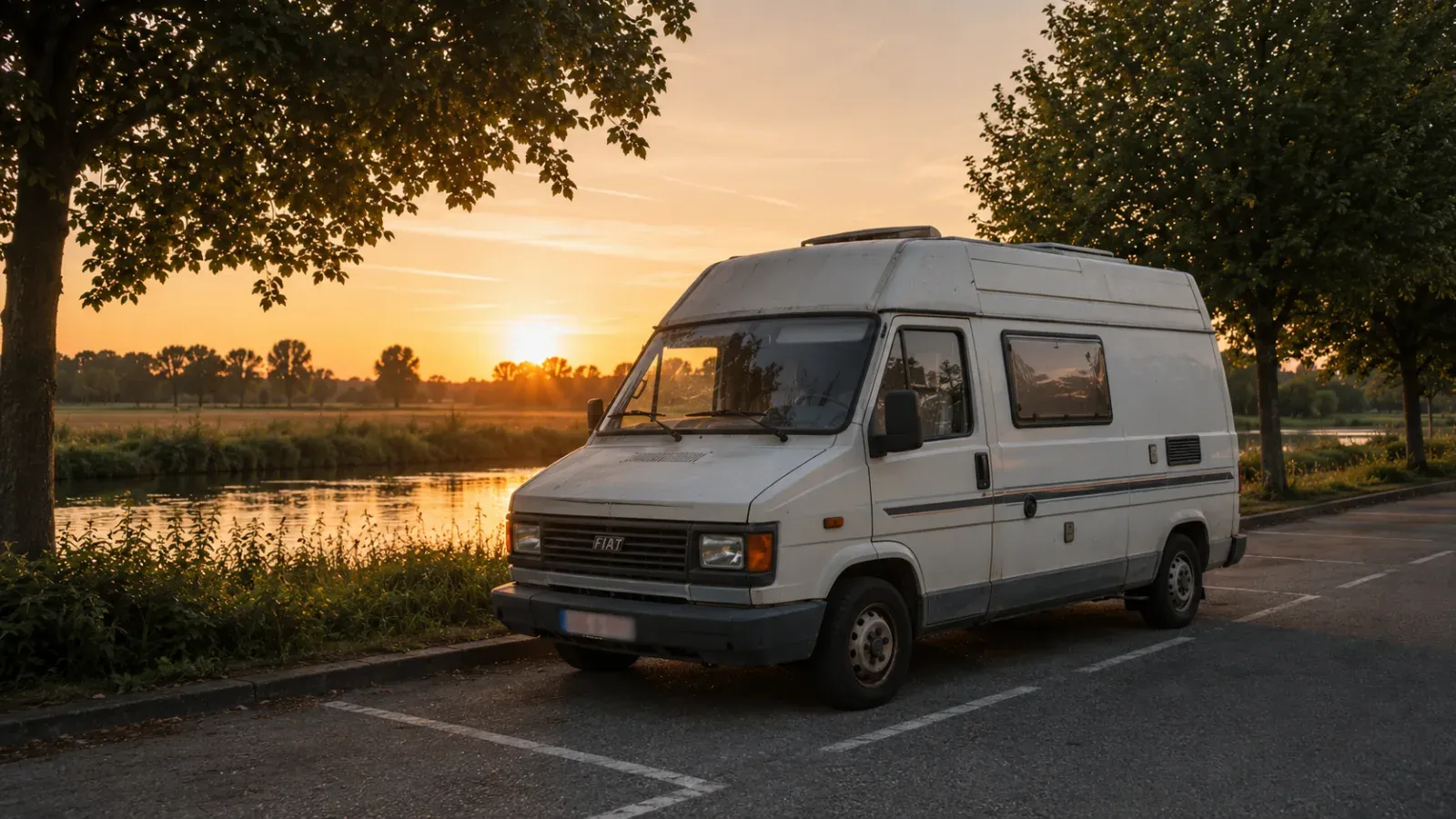
Anyone traveling through Belgium in a van will sooner or later ask the same question: can I actually sleep here? The short answer is: sometimes, but not everywhere and not just like that.
There is no simple national sign in Belgium saying “vanlife allowed” or “vanlife not allowed”. It depends on where you are, how your vehicle is parked, whether you are just sleeping or actually camping, and especially on the local rules of the municipality or police zone.
This article gives you the basics.
Sleeping in your van is not automatically forbidden
The Belgian road code mainly distinguishes between stopping and parking. A vehicle is stopped when it does not remain stationary longer than necessary for people to get in or out or to load and unload. If you stay longer, your vehicle is legally just parked.
Important: the road code does not contain a general prohibition on sleeping in a parked vehicle. The Flemish Traffic Knowledge Foundation, for example, clearly states that you may take a power nap in a correctly parked car, as long as you are parked according to regulations.
But that immediately highlights the nuance: sleeping should not mean that you ignore all other rules. Your van must be parked correctly, you must not cause any nuisance, and you must respect local signs and police regulations.
Parking is not the same as camping
For vanlifers, this is the most important distinction.
Parking means that your vehicle is simply in an allowed parking spot. You don't take up extra space, you don't put chairs outside, you don't extend an awning, you don't put blocks under your wheels, you don't make a campfire, you don't leave any waste behind, and you don't behave as if the parking lot is a campsite.
Camping begins as soon as you start setting up the spot as a place of residence. Think of tables and chairs outside, cooking next to your bus, awning open, clothesline strung, music, staying for multiple nights, or discharging wastewater. That kind of behavior falls much more quickly under local camping rules, nuisance rules, or nature rules.
In practice, the difference is often simple: someone who arrives late, sleeps discreetly, and leaves in the morning is usually viewed very differently from someone who occupies a parking lot as if it were a free campsite.
First check: can you park there?
Before you think about sleeping, you first need to know if you can even park there. Signs like E1 and E3 are important: E1 means no parking, E3 means no stopping and no parking. Parking signs can also be reserved for certain vehicle categories, such as E9h for motorhomes.
Also, the validity of signs is important. Parking signs apply along the side of the public road where they are placed and usually from the sign to the next intersection, unless another regulation is indicated.
So, don't just look at the big blue P-sign, but also at sub-signs such as “paid”, “max 2 hours”, “residents”, “except permit holders”, “no overnight stay”, or “no motorhomes”.
Municipalities can be stricter
This is where a lot of confusion arises. The fact that the road code does not generally prohibit sleeping in a parked vehicle does not mean that every municipality simply allows it.
Local police regulations can restrict or prohibit overnight stays in vehicles, camping on public domain, or setting up sleeping places in parking lots. The rules therefore differ from municipality to municipality.
A clear example: in Bredene and De Haan, the local police report that overnight stays in motorhomes, campervans, and similar vehicles are prohibited on public roads, in the forest, in the dunes, and on the beach. Those who wish to stay overnight there are referred to private campsites.
Specific rules also apply in Wallonia. The local police Brunau refer to the Walloon tourism rules: camping is prohibited on public roads there, except in reception areas for motorhomes. In forests, temporary stays or camping are prohibited, except in specially designated areas of the Département de la Nature et des Forêts.
The lesson is simple: an allowed parking spot is not automatically an allowed overnight spot.
Nature, forest, dunes, and beach: extra careful
When you say vanlife, you often think of waking up in nature. In Belgium, you have to be very careful with that.
In Flanders, Nature and Forest clearly states that wild camping or simply pitching your tent in nature is not allowed. Overnight stays are only possible in bivouac zones, and these are intended for those traveling on foot or by bicycle and who reserve in advance.
For vans, this is important: a bivouac zone is not a camper place. You don't drive your bus there to stay overnight. Bivouac zones also exist in Wallonia, but there too they are intended as designated zones with rules, not as free vanlife parking areas.
Beaches, dunes, nature reserves, forests, and parking lots near nature reserves are therefore places where you should be extra careful. If there is a sign prohibiting overnight stays, camping, or parking after a certain hour, the discussion is immediately over.
What about motorway parking areas?
On motorways, you are not allowed to stop or park just anywhere, except in the designated parking lanes or parking areas. The road code states that stopping or parking on motorways is prohibited, except in parking lanes indicated with E9a. The same rule also applies to expressways.
A short rest break or power nap at a motorway parking area can therefore be logical and safe if you are tired. But even there, the rule applies: look at the signs, remain discreet, do not engage in camping behavior, and do not use such a place as a holiday destination.
Can you sleep on private property?
On private property, it's different. If you have permission from the owner, one night in a driveway, on a farm, on a friend's property, or at a business is usually much less problematic than on public domain.
But even there are limits. As soon as a property is regularly used to accommodate campers, vans, or motorhomes, accommodation rules, tourism rules, urban planning rules, or permits may come into play. Tourism Flanders, for example, has separate operating conditions for camper sites when such accommodation is offered as a camper site.
In other words: sleeping in a friend's driveway is different from converting a meadow into a free camper park.
Common sense remains the best basic rule
Most problems arise not because someone discreetly sleeps in a bus for one night, but because people treat a place as if they have a right to it.
A good rule of thumb:
Arrive late, leave early, don't make noise, leave nothing behind, don't put anything outside, don't block a view or passage, don't stay in the same place for multiple nights, avoid residential streets where people feel watched, and be friendly if police, community guards, or local residents approach you.
If you are asked to leave, just do so calmly. Arguing in a parking lot at midnight rarely makes things better.
Practical checklist before you stay overnight
Before you decide to stay overnight somewhere, ask yourself these questions:
Can I park here according to the signs?
Is there a time limit, blue zone, resident scheme, or payment scheme?
Does it say anything about “no overnight stay”, “no motorhomes”, or “camping forbidden”?
Am I in a nature reserve, forest, dunes, beach area, or protected area?
Am I taking up more space than a normally parked vehicle?
Am I just sleeping, or am I actually camping?
Can I leave here in the morning without leaving any traces?
Would I be okay if someone else did this in front of my door?
In doubt? Then look for an official camper place, campsite, private spot with permission, or a place where overnight stays are clearly allowed.
Conclusion
Can you sleep in your van in Belgium? Yes, you can, but not everywhere and not automatically.
The basic principle is simple: if you are correctly parked and discreetly sleep in your vehicle, there is no general prohibition in the Belgian road code that makes this impossible in itself. But local police regulations, parking signs, nature rules, and camping rules can prohibit it in a specific place.
The smartest approach is therefore not to look for the perfect legal loophole, but to travel with common sense. Park correctly. Don't camp where you are only allowed to park. Respect signs. Leave no trace. And realize that every neat vanlifer makes it easier for the next one.
Source: https://www.wegcode.be/nl/regelgeving/1975120109~hra8v386pu
Source: https://www.vlaanderen.be/omgevingsvergunning/stedenbouwkundige-handelingen/opslag
Source: https://toerismevlaanderen.be/nl/logies/uitbatingsnormen-terreingebonden-logies
Source: https://toerismevlaanderen.be/nl/logies/uitbatingsnormen-camperterrein
Source: https://natuurenbos.be/activiteiten/bivakzone
Source: https://natuurenbos.vlaanderen.be/faq/mag-ik-kamperen-een-bos-natuurgebied
Source: https://www.police.be/5337/actualites/camping-en-wallonie-puis-je-planter-ma-tente-nimporte-ou
Source: https://www.politie.be/5450/vragen/parkeren/mag-ik-met-een-motorhome-parkeren-bredenede-haan
Source: https://www.veiligverkeer.be/veilig-rijden/slaperigheid/wegcode-parkeren-slapen-auto/