Parking or camping: where is the line?
For vanlifers, this is one of the most important questions: when are you just parked, and when are you actually camping?
By Laurens De Leeuw · 22 June 2026
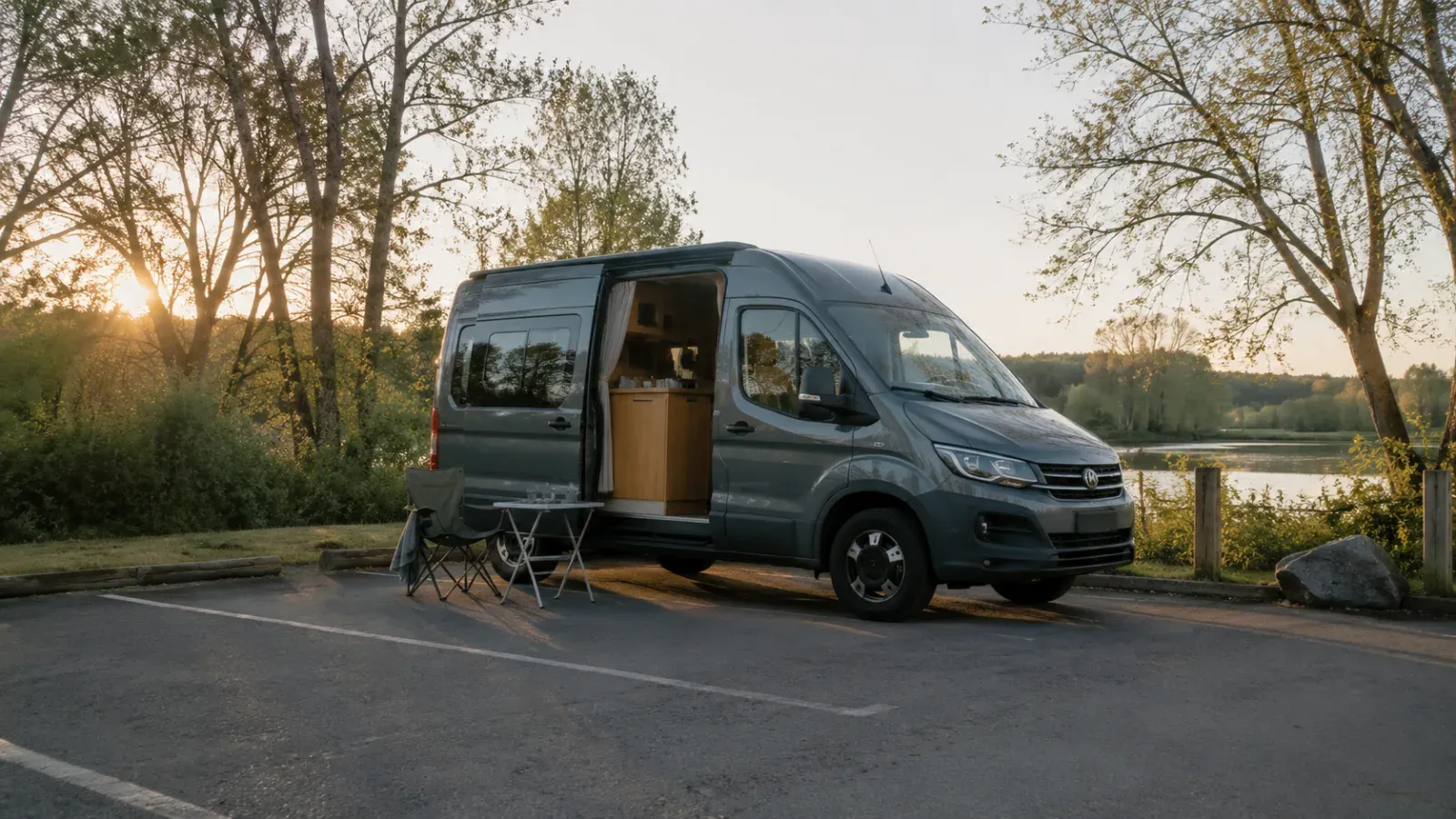
For vanlifers, this is one of the most important questions: when are you just parked, and when are you actually camping?
That line isn't always black and white. Yet, the distinction is important, because parking may be permitted in many places, while camping or staying overnight in the same spot can be prohibited by local rules, nature regulations, or police ordinances.
The short version: as long as you behave like a normally parked vehicle, you're usually on the safe side. As soon as you start setting up the spot as a dwelling, you give the impression that you are camping.
First: what is parking?
According to the Belgian Highway Code, a vehicle is parked when it remains stationary longer than necessary to allow people to get in or out or to load and unload. This distinction is not about sleeping, coziness, or how long you stay exactly, but about the use of your vehicle on public roads.
For a vanlifer, that means: if you are in a parking spot somewhere, stay within the lines, and don't take up extra space, then you are primarily just parked. Whether you are inside, eating, reading, working, or sleeping, does not automatically turn your vehicle into a campsite.
But that's just the beginning of the story.
Parking is vehicle behavior, camping is dwelling behavior
A parked van takes up the same space as any other vehicle. Everything stays inside. You don't put anything outside. You don't block anyone. You don't make noise. You don't leave anything behind. Your vehicle is just there.
Camping begins when you use the parking spot as a temporary living space outside your vehicle. Not one detail always makes the difference, but the combination of signals does. Putting a chair outside can be enough to give the impression that you are not just parked, but using the spot as a camping pitch.
This is especially important in car parks at beaches, nature reserves, village centers, squares, towpaths, forests, and tourist spots. There, municipalities and police often look more strictly at the difference between “just parking” and “setting up camp here”.
Clear signs of camping
There are a number of things that are very quickly seen as camping behavior.
Putting chairs outside is probably the best-known example. One folding chair next to your sliding door seems innocent, but to a passerby, local resident, or police officer, it immediately looks like you're using the parking lot as a terrace.
A table outside amplifies that effect even more. Especially if there is food, cooking equipment, glasses, plates, or personal belongings on it. Then you are no longer just present with your vehicle, but you are using the public space as a living area.
Opening an awning is even clearer. An awning visually transforms your parking space into a camping spot. You take up more space than the vehicle itself, and you turn the spot into a kind of temporary pitch.
Even blocks under the wheels can be misinterpreted. Technically, you might only use them to level your vehicle, but visually it looks like you intend to stay. For a normal parking action, leveling blocks are not necessary. At a campsite or campervan pitch, they are normal, but usually not in a regular car park.
Cooking outside your van is another such boundary. A gas stove next to your bus, a pot on the table, dishwater, smells, smoke, or open equipment: that's no longer parking. That's dwelling.
What about sleeping inside?
Sleeping in your vehicle is less visible than camping outside your vehicle. That's precisely the difference.
If you arrive late, park correctly, keep everything inside, make no noise, and leave again in the morning, you are much less likely to give the impression that you are camping. This does not mean it is allowed everywhere, as local rules may prohibit overnight stays in vehicles. In Bredene and De Haan, for example, overnight stays in campervans, motorhomes, and similar vehicles are prohibited on public roads, in forests, dunes, and on the beach.
But purely from a practical perspective: discreetly sleeping inside your vehicle looks much more like parking than camping. Living outside around your vehicle looks much more like camping than parking.
It's often about the impression you create
The law doesn't always use a nice vanlife definition for “camping behavior”. In practice, people often look at the situation as a whole.
Are you there as a vehicle, or as a dwelling?
A closed bus in a car park is just a bus. A bus with an open awning, chairs, table, cooking stove, shoes outside, wet towel on the door, and leveling blocks under the tires tells a completely different story.
Even if you only stay one night, it can look to others as if you are occupying the spot. And that's precisely what leads to complaints, inspections, and additional prohibitions.
Nature reserves are not free overnight spots
In nature reserves, you need to be even more careful. In Flanders, Natuur en Bos clearly states that wild camping or simply pitching a tent in nature is not allowed. Overnight stays are only permitted in bivouac zones, and these are intended for hikers who come on foot or by bicycle. You cannot get there by car.
For vanlife, that means: a forest car park, dirt road, dune car park, or nature reserve is not an automatic sleeping place. Even if you are allowed to park there during the day, that doesn't mean you can stay there overnight or exhibit camping behavior.
Campervan pitch is not always the same as a campsite
Even at official campervan pitches, you need to be careful. Some campervan pitches only allow parking and overnight stays, but no extensive camping behavior. Other places are set up as actual dwelling locations, where chairs, tables, or awnings are allowed, as long as you stay within the rules.
Toerisme Vlaanderen distinguishes between site-bound accommodation and campervan pitches in its accommodation rules, where tourists can sleep in their campervan for a maximum of 31 consecutive days at a campervan pitch. This primarily shows that a campervan pitch is a specific form of tourist accommodation, not just the same as any public car park.
Therefore, the best rule remains: always read the sign at the entrance. If it says “no camping behavior”, “parking only”, “max 24h”, or “prohibited to place chairs and awnings”, then you adhere to that.
Practical rule of thumb for vanlifers
Think of three zones.
Green zone: you are parked correctly, everything stays inside, you don't take up extra space, you don't make noise, and you leave without a trace. This is parking.
Orange zone: you stay for a long time, you open a window or sliding door, you dry something on your vehicle, you cook just inside with the door open, or you are conspicuously present. This might still be acceptable, but in sensitive areas, it can already raise questions.
Red zone: chairs outside, table outside, awning out, cooking equipment outside, leveling blocks, mat at the door, clothesline, barbecue, music, wastewater, or staying for multiple nights. This is camping behavior, even if you call it “just standing for a bit”.
Why this is important for the entire community
Every vanlifer knows the feeling: you find a quiet spot, you don't want to disturb anyone, you just want to sleep and travel on. But one bus behaving as if a public car park is a campsite can lead to the municipality later placing a prohibition sign.
That's why discreet travel is not only good for yourself, but also for everyone who comes after you.
Don't leave chairs outside in regular car parks. Don't use an awning unless you are in a place where it is clearly allowed. Cook inside or in an authorized place. Leave nothing behind. And leave if someone kindly asks you to do so.
Conclusion
The line between parking and camping lies not only in the law, but also in how your behavior appears.
If you are with your van like any other vehicle, you are parking. If you use the space around your van as a terrace, kitchen, bedroom extension, or dwelling, you give the impression that you are camping.
For vanlife in Belgium, that distinction is golden. Those who park correctly, remain discreet, and don't turn a car park into a camp, prevent problems for themselves and keep places accessible for others longer.
Source: https://www.wegcode.be/nl/regelgeving/1975120109~hra8v386pu
Source: https://toerismevlaanderen.be/nl/logies/uitbatingsnormen-terreingebonden-logies
Source: https://natuurenbos.be/activiteiten/bivakzone
Source: https://natuurenbos.vlaanderen.be/faq/mag-ik-kamperen-een-bos-natuurgebied
Source: https://www.politie.be/5450/vragen/parkeren/mag-ik-met-een-motorhome-parkeren-bredenede-haan