Two weeks along the Belgian coast in autumn
Out of season, the coast feels like its old self again
De Panne, West-Vlaanderen
By Elke Vermeulen · 14 June 2026
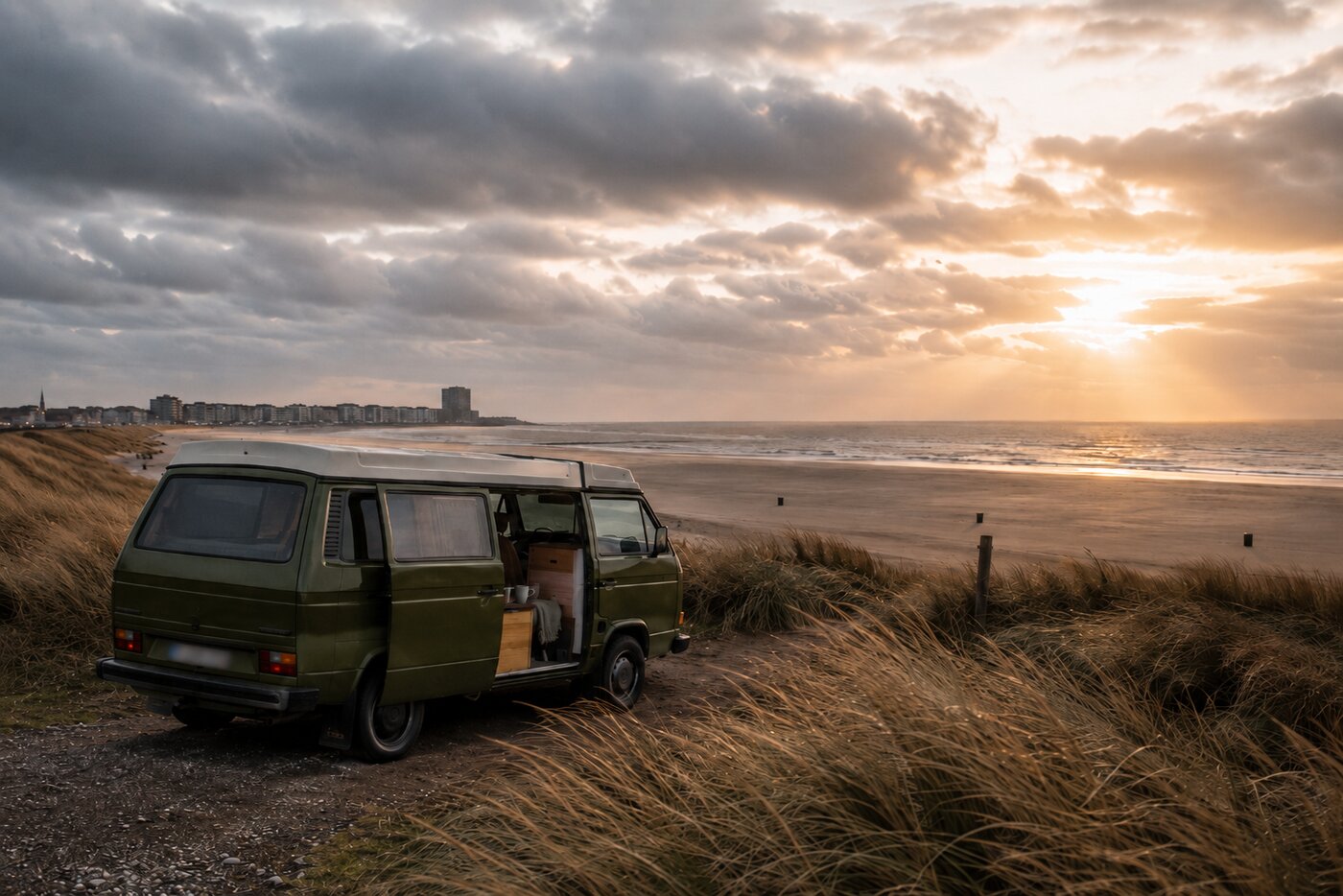
We left at the beginning of October, on a Monday when the sky above Flanders wasn't quite sure what it wanted to do. It had rained at home that morning, then the sun came out, and by midday, there was that grey haze over the fields again, typical of autumn. Not threatening, not really gloomy, just autumn. The kind of weather where you bring a sweater, put a rain jacket behind the seat, and still keep your sunglasses within reach, because you know anything can still happen.
Our van was ready in the driveway. Not perfectly tidy, it rarely is, but ready enough. The cupboards were filled, the water tank was full, the blankets were in the back, and somewhere between the cooking gear and the hiking maps, a bag of coffee was hidden, which I hoped we'd find soon enough. We had no grand plan. That was precisely the point. Two weeks along the Belgian coast, from De Panne to Knokke, without haste, without a list to check off.
We wanted to see the coast when it doesn't have to perform.
Not in July, when every beach cabin seems occupied, the promenade smells of sunscreen, and you have to navigate between ice creams, go-karts, and crowded terraces. Not in August, when everyone is looking for the same patch of sun. But in autumn, when the summer chairs are gone, the wind gets its space back, and the sea seems a little more honest.
Our first stop was De Panne.
We arrived in the late afternoon. The sky had cleared, and above the dunes hung that soft, golden light you only get in autumn. Not bright, not warm enough to take off your jacket, but warm enough to make everything more beautiful. We parked the van in an allowed spot, turned off the engine, and sat for a moment without saying anything.
That's always a special moment. You drive for a long time, talk about small things, follow the GPS, look for where you can park, check if you're not bothering anyone, and then suddenly everything goes quiet. The engine stops. The van still creaks a bit. Outside, you hear the wind. And in one second, you're no longer on your way, but you've arrived.
We put on our shoes and walked towards the beach.
De Panne in October felt almost unrecognizably calm. The wide beaches lay open and empty, as if someone had wiped away the summer crowds with one grand gesture. Here and there, a couple walked with a dog. Further on, someone walked alone along the waterline, deeply tucked into their coat. The beach cabins were still there in some places, but they looked like abandoned props from a season gone by.
We walked down through the marram grass, the wind directly in our faces. The sea lay wide before us, grey-blue, with whitecaps breaking and receding again and again. I don't know why, but the sea seems bigger in autumn. Perhaps because there are fewer people to make it smaller. Perhaps because you have more space to look.
That first evening, we ate simply in the van. Pasta with tomato sauce, some grated cheese, a glass of wine in cups meant for coffee. Outside, it quickly grew dark. The wind tugged at the van, and occasionally a short shower fell on the roof. We sat close together, with the lights on and the curtains drawn, and I immediately felt why we needed this.
Not to be far away.
Just to be close to home in a different way for a while.
The next morning, we woke up to condensation on the windows and cold noses. In summer, you can sometimes forget that a van remains a small space where everything lives with the weather. In autumn, you don't forget that. You feel it immediately. The air is fresher, the blankets are more important, and coffee is not a luxury but a necessary start to the day.
I pushed the curtain aside and saw the sun hanging low over the dunes. There was almost no one outside. The world still seemed wrapped in silence. While the water heated up, I wiped a piece of the window dry with a cloth. Not clean enough to impress, but enough to look outside.
That's where the real journey began for me.
Not at the moment we left home, but there, with a cup of coffee in my hands, sitting on the edge of the van, looking at an empty coast slowly waking up.
We stayed in and around De Panne for two days. We walked through the dunes, drove briefly to the Westhoek, bought bread and pastries at a bakery, and slowed down to a pace that would feel almost unnatural at home. In the afternoon, we sat on a bench with a thermos and watched the clouds drift over the sea. Sometimes the sun broke through, and everything suddenly seemed bright. Five minutes later, the sky was closed again.
Autumn by the sea demands that you hold your plans loosely.
We learned that quickly.
On the third day, we wanted to walk to Koksijde, but after twenty minutes, it started raining so hard that we returned with wet trousers and laughing bad moods. In the van, we hung everything to dry wherever there was space: jackets on the headrests, socks by the door, towels over the seats. It looked like a small storm had lingered inside. We made tea, waited for the shower to pass, and then went outside again anyway.
That's perhaps the most beautiful thing about traveling in the low season: you stop fighting the weather. In summer, you want every day to be beautiful. In autumn, you know better. Rain is part of it. Wind is part of it. Grey skies too. But precisely because of that, you appreciate every open moment twice as much. An hour of sun becomes a gift. A dry walk feels like a win. A cloud breaking open over the water can make your whole day.
From De Panne, we continued towards Koksijde and Oostduinkerke. We didn't take the fastest route, but drove short stretches, stopped often, and let the coastline dictate our pace. In Oostduinkerke, we walked along the beach while the wind chased the sand low over the ground. There was something raw about that place, something that suited October well. No beach chairs, no crowds, no summer decorations. Only sea, sand, sky, and the traces of people who had been there earlier that morning.
Along the way, we talked about the past. About seaside holidays as children. About buckets and spades, about ice creams on the promenade, about parents shouting not to go too far. The Belgian coast carries memories for many people. Even if you haven't been there for years, you recognize something. The smell of the sea. The sound of the tram. The wind that is always just a little stronger than you thought. The promenade with apartments that are not always beautiful, but by now almost belong to the landscape.
That's something I often thought about along the way: our coast isn't perfect, but it's ours.
It's sometimes messy, sometimes built-up, sometimes a bit loud, sometimes beautiful. There are places where you think it could have been softer, and places where you suddenly fall silent because the light lies so beautifully on the water. It's precisely that mix that makes it recognizable. The Belgian coast is not an untouched wilderness. It's a strip of memories, concrete, dunes, wind, fries, nature reserves, fishermen's tales, apartment blocks, sea air, and unexpected beauty.
With the van, you get to know that coast differently.
You're not just a visitor to one seaside town. You move between them. You see how De Panne feels different from Oostduinkerke, how Nieuwpoort feels more spacious and tidier, how Ostend is more of a city, how De Haan seems softer and slower, how Zeebrugge is rawer. Each place has its own rhythm. And because you have your home with you, you don't have to arrive anew each time. You carry your small base with you.
In Nieuwpoort, we found a quiet spot near the marina. Not romantically wild, but pleasant and practical. Sometimes that's what you need too. Refilling water, disposing of waste, a quick trip to a shop, arranging a warm shower, getting the van back in order. Vanlife isn't just waking up with a view of nature. It's also finding where you can legally and respectfully park, managing your amenities, and ensuring you're not bothering anyone.
I don't mind that. On the contrary.
That practical side keeps you grounded. It makes traveling more authentic. Freedom doesn't mean everything happens automatically. Freedom requires attention. For your own comfort, but also for the environment. Especially on the coast, where residents are not waiting for people who just park anywhere, leave trash, or act as if rules only apply to others.
That's why we consciously chose places where overnight stays were allowed or where it was clearly permitted according to local rules. Sometimes it was a campervan site, sometimes a small campsite, sometimes a simple car park where it was allowed. Not every place was charming. But it doesn't have to be. A good trip doesn't consist of fourteen perfect nights. It consists of variety.
In Nieuwpoort, we had one of the most beautiful mornings of the entire trip.
It was cold, but clear. The sky was almost steel blue, and the masts of the boats gently tapped against each other in the wind. We walked early along the marina, before most people were out. On a bench, we drank coffee from our thermos and watched the boats gently sway. There was a smell of salt, rope, and wet wood. Someone cycled past with a dog in a basket. Otherwise, little happened.
I noticed that it made me happy.
Not exuberantly happy. Just calm. As if my mind, after a few days, finally understood that it no longer had to rush ahead.
We lingered in Nieuwpoort that day, walked to the IJzermonding and took our time watching birds, even though I didn't know half their names. That didn't matter. Sometimes looking is enough. We had lunch in the van with soup and bread. The sun shone on the windshield, making the small space warm enough to take off our jackets. Outside it was chilly, inside it smelled of soup and wet shoes. It wasn't perfect, but it was ours.
After that, we drove on towards Middelkerke and Westende.
On paper, these aren't places that immediately sound adventurous. Yet, I found something there I hadn't expected. In the low season, space opens up between the buildings, the promenade, the squares, and the beaches. You get a better sense of how people live there. You see bakeries where locals pop in, cafes where regulars sit by the window, older couples who seem to walk the same round every day. The coast becomes less of a backdrop and more of a living environment.
I found that beautiful.
We learned to plan our days around the tides and the showers. Not overly precise, but enough not to be surprised every time. At low tide, we walked wide stretches of beach. In windy conditions, we sought out the dunes. In the rain, we read in the van, did groceries, or drove a short distance further. One afternoon, we simply stayed inside while the rain streamed down the windows. We played cards, made coffee, and listened to the tapping on the roof.
I used to call that lost time.
Not anymore.
A journey also needs indoor moments. Moments when you don't look at what you're missing, but feel where you are. The van swayed gently in the wind. Our jackets hung to dry. On the small table lay crumbs, a map, a half-read book, and a knife that urgently needed washing. Outside, autumn swept over the coast. Inside, it was warm enough.
That was all it needed to be.
Halfway through the trip, we arrived in Ostend.
Ostend is different. You feel it immediately. It's less well-behaved than some other seaside resorts. More city, more history, more edges. I like that. The sea isn't just a backdrop for holidaymakers, but part of daily life. People walk there not only because they're free, but also because they live, work, wait, and reflect there.
We parked the van where allowed and headed into the city. We ate shrimp croquettes, drank coffee in a cafe where the windows steamed up, and then walked along the galleries. The wind was strong. Waves crashed against the piers. Gulls hung almost still in the air, as if negotiating with the wind.
In the evening, we returned to the van with red cheeks and cold hands. We hadn't experienced a grand adventure, but a full day. That's a difference I've come to understand better along the way. A day doesn't have to be spectacular to feel well-spent. Sometimes a walk, a warm meal, a good conversation, and the sound of the sea in the background are enough.
After Ostend, it became softer.
De Haan was perhaps my favorite stop. Not because it was the most impressive place, but because everything there seemed a little slower. The houses, the avenues, the dunes, the walk to the sea. There's an atmosphere there that suits autumn well. Less busy, less sharp, almost a little old-fashioned in a pleasant way.
We were not far from the dunes and walked to the beach at dusk. The sky turned copper and pink. The wind had died down. For the first time in days, the sea didn't feel wild, but wide and calm. We sat in the sand, with our jackets zipped up, and said nothing for a long time.
Some moments don't need to be filled with words.
I thought about how close all of this actually was. We hadn't driven to Scotland, not to Norway, not to the Alps. We just drove along our own coast. And yet it felt like traveling. That's perhaps a lesson I'd like to remember: you don't always have to go far to feel a sense of distance. Sometimes it's enough to look differently at a place you thought you knew.
The next few days, we continued along Wenduine, Blankenberge, and Zeebrugge. Not every stop was equally pleasant. Blankenberge sometimes felt a bit harsher, a bit busier, even out of season. Zeebrugge, on the other hand, had an industrial side that isn't immediately romantic, but very real. Large ships, port area, windmills in the distance, freight traffic, a sea that also means work here.
I thought it was good that those parts were included.
An honest travelogue shouldn't pretend everything is always picturesque. The Belgian coast has beautiful parts and difficult parts. There are dunes that make you silent and promenades where you wonder how they were ever built that way. There are charming tram stops and ugly car parks. There are quiet mornings and evenings when you're glad you can just close the van door.
But precisely in that variety lies character.
One morning in Zeebrugge, we woke up to wind tugging at the van. Not dangerous, but enough to be wide awake immediately. The sky was low and dark. We decided not to be heroes and drove on calmly after breakfast. Along the way, we stopped for coffee and fresh pistolets. In the van, we ate them with cheese and mustard, while outside the rain ran down the side window.
That might not sound like a dream moment.
Yet, I remember it fondly.
Because we sat there without needing a plan B. Because the van sheltered us. Because bad weather on the road is less bad when you don't see it as a failure. Because a pistolet with cheese in a warm van sometimes tastes better than an expensive breakfast on a terrace where you're actually freezing.
Towards the end of the second week, we reached Knokke-Heist.
There, the coast felt different again. More spacious in some places, more chic too, with wide avenues and a different kind of public. We walked towards the Zwin, where nature gets more space again. That was a beautiful conclusion. After days of promenade, beach, city, and harbor, it felt good to end in a place where birds, mudflats, salt marshes, and wind played the main role.
The Zwin in autumn has something special. The colors are muted, but rich. Brown, green, grey, gold. The air is constantly moving. Birds migrate as if they know better than us when it's time to leave. We walked slowly, with our hands deep in our jacket pockets, and I felt a kind of completion.
Not sad. Not exuberant.
Just: this was good.
That last evening, we cooked in the van one more time. Nothing special, again. Rice, vegetables, some sauce. We had learned that simple meals on the road often work best. Outside, it quickly grew dark. Inside, the small light above the kitchenette was on. The van smelled of food, damp clothes, and the sea.
We talked about the trip. Not in grand conclusions, but in loose memories.
The empty beaches in De Panne. The rain in Koksijde. The coffee at the marina in Nieuwpoort. The wind in Ostend. The soft light in De Haan. The raw harbor side of Zeebrugge. The birds at the Zwin. The mornings we lingered too long. The evenings we were happy with dry socks. The small annoyances too: searching for an allowed spot, wet windows, sand everywhere, a cupboard that kept opening on the road.
All together, it became a journey.
Not a perfect journey. Fortunately not.
Perfect journeys are often boring to tell. It's the small inconveniences that make a story real. The shower that changes your plans. The place that's less beautiful than hoped, but where you still sleep well. The morning the sun unexpectedly breaks through. The walk that gets shorter because your feet are wet. The van that's messy, but warm. The coffee that's too strong, but welcome.
After two weeks, we returned home.
The drive inland felt strange. The sea disappeared from view, but lingered in our minds for a while. I noticed I was driving slower than usual. Not because I had to, but because I wasn't ready to fully conclude the trip yet. At home, there would be laundry baskets again, emails, groceries, appointments, ordinary days. That's okay. You can't always be on the road. But you can take something from that slower pace.
For me, that was the greatest gift of those two weeks.
Not just the coast itself, but the memory of what it feels like when days aren't fully planned. When the weather gets to decide. When drinking coffee on the edge of the van is an activity in itself. When you don't travel from highlight to highlight, but also count the ordinary moments.
The Belgian coast in autumn is not a place that imposes itself.
It doesn't shout. It whispers instead.
You have to be willing to walk through the wind, accept rain, not find empty promenades boring, and seek beauty in grey skies. But if you do, you get something back that is harder to find in summer: peace. Space. A feeling that the coast is breathing again.
I'm sure we'll go back.
Perhaps again in October. Perhaps even later, when the days are shorter and the sea darker. Perhaps only for a weekend. Perhaps for two weeks again. We'll see then.
Because that's perhaps the beauty of traveling by van: you don't have to fix everything.
You fill the tank, bring coffee, check the weather, choose a direction, and leave.
And sometimes that direction simply takes you to the Belgian coast.
Close by, familiar, a bit rough, sometimes wet, often windy, but incredibly beautiful in autumn.