How to keep your van mold-free in a humid climate
Belgian weather, small living spaces, and wet gear are not an ideal combination. Yet, with the right habits, you can perfectly live or travel in a van without everything starting to smell musty.
By Laurens De Leeuw · 15 June 2026
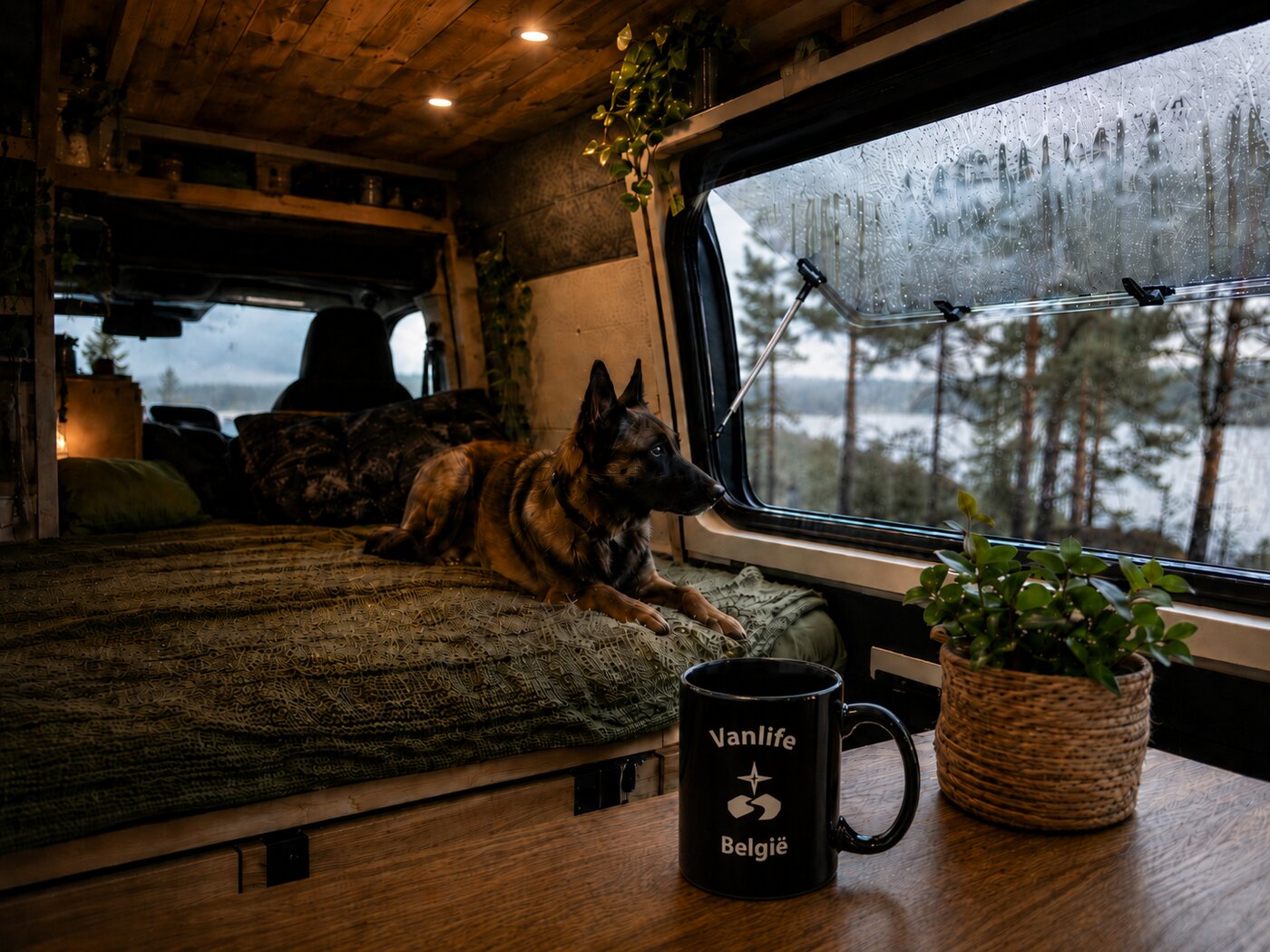
Moisture is probably one of the most underestimated problems in vanlife. Especially here in Belgium. We all love to dream of sunny mornings, sliding door open, coffee in hand, somewhere at a forest edge or by the water. But the reality is also often rain, fog, wet grass, soaking wet shoes, a dog jumping in, and a van that turns into a small humid box at night.
And yet, that doesn't mean mold is part of the deal. Mold in your van is not a normal part of vanlife. It's usually a sign that moisture is lingering somewhere, that air isn't circulating enough, or that certain cold spots in your van are constantly attracting condensation.
I've learned that you shouldn't see moisture as something you solve once with insulation or an expensive gadget. It's more something you have to manage a little every day. A van is small, and everything you do has an impact. Sleeping, breathing, cooking, bringing in wet clothes, hanging a wet towel, getting in with wet shoes, leaving a window closed because it's cold outside. Everything adds up.
The good news: with a few smart habits, you can prevent a lot of problems.
Why moisture quickly becomes a problem in a van
A regular home has much more air volume. There's more space, more ventilation, often central heating, and walls that react differently to moisture. A van is completely different. You live, sleep, and cook in a small metal space. Metal cools down quickly, and cold surfaces attract condensation.
When warm, moist air comes into contact with a cold surface, that moisture condenses. You often see this on windows, but the same thing happens in less visible places. Behind cabinets. Under your mattress. Against metal beams. In corners where no air reaches. Behind poorly fitted insulation. In cracks you never see.
That makes it treacherous. You might think everything is dry because your windows are clean, while behind your bed or under your floor, moisture quietly lingers.
And in Belgium, that's extra important. Our climate isn't extremely cold, but it's often humid. Long periods of rain, mild winters, little dry frosty air, and many cloudy days mean your van dries out less on its own. Especially if you're in forests, by water, or on grass.
Start with the basics: ventilate, even when it's cold
The biggest mistake many people make is keeping everything sealed tight because it's cold or wet outside. That feels logical, but usually, you make the problem worse. Moisture inside needs to get out. Otherwise, it just hangs around and seeks out the coldest spots.
Ventilating doesn't mean you have to sit in a draft all day. It does mean you consciously let air move. This is especially important after sleeping. A person breathes out a fair amount of moisture at night. If you sleep with two people in a van, or with a dog, you'll notice it even faster. The windows are fogged up, the air feels heavy, and your bedding can feel damp.
My simple rule: after sleeping, open everything up for a bit. Sliding door open, back doors open if possible, or at least two windows opposite each other. Five to ten minutes of fresh air can make a big difference. Even if it's cold. The van will warm up again afterward, but at least the moist air is gone.
It also helps to always leave a small opening somewhere. A roof hatch ajar, a window with a wind deflector, or a ventilation grille. Air needs to be able to move. Without air circulation, you get stagnant moist zones, and that's where the trouble begins.
Cooking without a moisture bomb
Cooking in a van is cozy, but it brings a lot of moisture inside. Especially pasta, rice, soup, coffee, tea, and anything where water evaporates. If you cook with all the windows closed, that steam just stays in your van.
Therefore, always use a lid on your pots. That sounds simple, but it really makes a big difference. Also, open a window or roof hatch while cooking, even if it's just a little bit. If you have a fan, turn it on for a moment. Not necessarily high, just enough to send the moist air outside.
If you cook with gas, ventilation is even more important. Not only for moisture, but also for safety. Gas combustion also produces water vapor. Many people underestimate that. You might only see the steam from your pot, but your stove also contributes to the moist air in your van.
After cooking, I prefer to ventilate for a while longer. Especially in winter. You often smell it immediately: fresh air makes the van more pleasant again, while moist cooking air quickly becomes heavy and musty.
Be careful with wet clothes, towels, and shoes
Wet items are the silent killers of a dry van. One wet jacket or towel seems harmless, but in such a small space, it really makes a difference. Everything that comes in wet has to dry somewhere. And if that happens indoors without ventilation, that moisture will just settle into your mattress, wood, cushions, and cabinets.
Try to keep wet items out of the living area as much as possible. A separate bin for wet shoes helps enormously. A designated spot for wet jackets or towels is also handy, preferably near a ventilation point. Don't hang a wet towel in a closed cabinet. That's asking for a musty smell.
If you travel with a dog, this becomes even more important. A wet dog is cozy, but also a walking source of moisture. A microfiber towel by the door is not a luxury. First dry off, then cozy up inside. That's better for your van, your seats, and your own mood.
And honestly: sometimes the best solution is simply a laundromat or dryer. Especially after several wet days. Trying to dry everything in your van sounds tough, but at some point, you're just collecting moisture.
Your mattress needs to breathe
Placing a mattress directly on a wooden board is one of the most common causes of mold in campers and vans. Your body releases heat and moisture at night. That moisture travels down through your mattress. If the underside doesn't get air, it remains trapped there. After a while, you'll get black spots, a musty smell, or even actual mold patches.
So, ensure ventilation under your mattress. This can be done with a slatted base, ventilation mat, Froli system, or another solution that allows air to circulate under the mattress. It doesn't always have to be expensive, but there must be space for air.
Also, lift your mattress regularly. Especially in winter or after wet periods. Does the underside feel damp? Then that's a warning. Let everything dry thoroughly. A mattress is too expensive and too important to let mold.
I really wouldn't skip this. A mold spot behind a cabinet is annoying, but a moldy mattress is just dirty, unhealthy, and expensive to replace.
Cold bridges are where moisture wins
A cold bridge is a place where cold from outside easily enters. In a van, these are often metal parts, beams, window frames, doors, floor areas, and places where insulation is missing or poorly fitted. These parts become colder than the rest of your interior. As a result, moisture condenses there more quickly.
You often recognize cold bridges by condensation, damp spots, or recurring musty smells. Sometimes you can just feel it with your hand. A spot that feels noticeably cold while the rest of the van is warmer deserves attention.
Perfect insulation is difficult in a van. You always have to deal with metal, curves, and gaps. But you can limit the biggest problems. Make sure large metal surfaces are well insulated. Neatly finish gaps. Don't leave large bare metal areas in living spaces. Also, consider doors and window frames.
Important: insulation alone does not solve moisture. Poorly placed insulation can even trap moisture. That's why ventilation is always necessary. A dry van is not just a well-insulated van, but above all, a van where moisture can escape.
Cabinets and closed corners deserve extra attention
Mold often starts not where you look, but where you never look. Behind cabinets, under benches, in storage bins, behind panels, in the corner next to the bed. Anywhere air doesn't move, moisture can linger.
Therefore, don't create completely sealed dead spaces when you build. Leave a little space for air behind cabinets. If necessary, drill ventilation holes in benches or storage compartments. Use slats or spacers so that items are not pressed tightly against the wall.
Preferably, do not store textiles in completely closed bins if they are not bone dry. Clothes, blankets, and sleeping bags absorb moisture. If you leave them in a sealed space for weeks, they can become musty. Opening them occasionally, airing them out, and checking if everything stays dry saves a lot of problems.
I find this typically one of those vanlife lessons you only learn when it's too late. You build everything beautifully tight and clean, and then you realize that air actually needs space too.
Heating helps, but only if moisture can escape
Heating makes your van more comfortable and can help dry materials. But heat alone is not a solution if you don't ventilate. Warm air can hold more moisture. If that warm, moist air then cools down, you get condensation again.
The best combination is therefore: heating and brief ventilation. That sounds contradictory, because you're letting warm air out, but you're mainly letting moist air out. Dry air heats up faster than moist air, and your interior feels more pleasant afterward.
If you use a diesel heater, you often have dry warm air, which helps a lot. But even then, air circulation must be maintained. If you use a small electric heater at a campsite or at home in the driveway, the same applies. Heat helps, but moisture must get out.
Be careful with devices that produce moisture or are dangerous in small spaces. Safety always comes first. Ensure ventilation, a good CO detector, and common sense.
Dehumidifiers and moisture absorbers: useful, but not a miracle cure
A small dehumidifier can be useful, especially if you're often hooked up to power. In winter or during wet weeks, it can really help keep the air drier. Moisture absorbers in cabinets can also be useful for small enclosed spaces.
But don't expect a container of moisture absorber to save a poorly ventilated van. That's like trying to fix a leak with a mop. It can help, but it should never be your only strategy.
For those who are often off-grid, an electric dehumidifier is not always practical. Then habits are even more important: ventilating, keeping wet items out, letting the mattress breathe, checking cabinets, and cooking with the window open.
I see moisture absorbers primarily as an extra aid. Handy in cabinets, under the seat, or during periods when the van is stationary. But the basis remains air and discipline.
Measure moisture, don't just rely on feeling
A small hygrometer costs little and provides a lot of insight. With it, you can see how humid it really is in your van. Your feeling isn't always right. Sometimes it feels fresh and okay, but the humidity is still high. Sometimes it seems wet because windows fog up, but the problem is mainly a cold window and not a disaster throughout the entire van.
If necessary, place one meter in your living area and one in a cabinet or under your bed. This way, you quickly discover where the problem areas are. Does a cabinet always remain more humid than the rest? Then more air needs to get in there. Is it often damp under your bed? Then your mattress needs better ventilation.
You don't have to make a science out of it, but measuring helps to avoid guessing. And vanlife is already enough improvisation, so anything that provides clarity is a bonus.
What if you already see mold?
First and foremost: don't panic, but also don't ignore it. Small mold spots almost never get better on their own. Find the cause. Is it due to condensation? Poor ventilation? A leak? Wet items? A cold bridge? Just cleaning without addressing the cause is of little use.
Wear gloves when cleaning mold and ensure ventilation. On hard surfaces, you can usually clean small spots well with a suitable cleaning agent. On porous materials such as fabric, mattress, untreated wood, or insulation, it's trickier. Mold can be deeper there. When in doubt, replacing is sometimes wiser than continuing to try.
Important: do not just use aggressive products in a small enclosed space. Read labels, ventilate well, and never mix cleaning agents. Especially do not combine products because you think it will make them stronger. That can create dangerous fumes.
After cleaning, the spot must dry completely. Then check if it returns. If it returns, the cause is still present.
Also check for leaks
Not every moisture problem is caused by condensation. Sometimes there's just a leak. Roof hatches, windows, cable entries, solar panels, taillights, doors, and old seals are classic places where water can enter.
You often recognize a leak by localized damp spots, discoloration, drips after rain, or a musty smell that is stronger in one place. Sometimes you only see it after heavy rain or when the van is tilted.
Take leaks seriously. Water running behind panels can remain hidden for a long time. And if you only smell it, it might have been going on for a while. So, regularly check around roof hatches, windows, and penetrations. Especially after storms, frost, or when you've installed something new.
Moisture is also a problem during downtime
Many people think about moisture while traveling, but downtime is at least as important. If your van is stationary for a few weeks or months, moisture can quietly build up. Especially outdoors, under trees, on grass, or in a shady street.
Don't leave the van completely closed if it's not necessary. Use ventilation mode where possible. Place moisture absorbers in cabinets. Remove wet or semi-dry items. Don't leave dirty towels, shoes, or sports clothes lying around. Stand cushions upright so air can reach them. If necessary, lift the mattress or remove it if the van is stationary for a long time.
Check on it occasionally. Airing it out on a dry day works wonders. A van is not a regular garage box. It's a small living space, and it needs to keep breathing.
My simple moisture routine
I like solutions that you can actually stick to. Not too complicated, no obsessive fuss, just habits that work.
After sleeping, I always air it out for a bit. When cooking, a window or roof hatch opens. Wet items get a fixed spot and don't just lie around. The mattress gets air. Cabinets are checked occasionally. If something smells musty, I immediately look for where it's coming from. And in wet weather, I try to be even more conscious, because then everything piles up faster.
That's actually the core: you have to be ahead of moisture. Don't wait until you see black spots. Don't think it will be fine. Small daily things make a big difference.
The short checklist
For those who just want to quickly know what's really important:
Ventilate every morning after sleeping. Always cook with a window or roof hatch open. Use lids on pots. Let your mattress breathe via a slatted base or ventilation mat. Regularly check under your mattress and behind cabinets. Keep wet shoes, towels, and jackets separate. Don't dry large amounts of laundry in your van without ventilation. Avoid cold bridges where possible. Use moisture absorbers or a dehumidifier as extra help. Check roof hatches, windows, and seals for leaks. Also, let your van breathe when it's stationary. Finally
A mold-free van isn't about one perfect purchase or one magical building technique. It's about conscious living in a small space. Your van is not a house. Everything is closer together. Everything has a faster effect. That's sometimes difficult, but also precisely the charm of vanlife. You learn to live simpler, to look better at your surroundings, and to feel faster when something isn't right.
For me, that's part of being on the road. Not just the beautiful sunsets, but also learning to deal with rain, mud, damp mornings, and wet dog paws. If you find a good routine for that, your van becomes a much more pleasant place. Drier, healthier, fresher, and simply nicer to be in.
And honestly: waking up in a fresh, dry van while it's Belgian gray and wet outside secretly feels like a small victory.