Converting a van into a campervan: when do you need type approval?
Converting a van into a campervan is a dream project for many vanlifers. You buy an empty bus, build in a bed, cupboard, kitchenette, and storage space, and suddenly it feels like your tiny home on wheels is ready. However, in Belgium, there's also an official side to it.
By Laurens De Leeuw · 23 June 2026
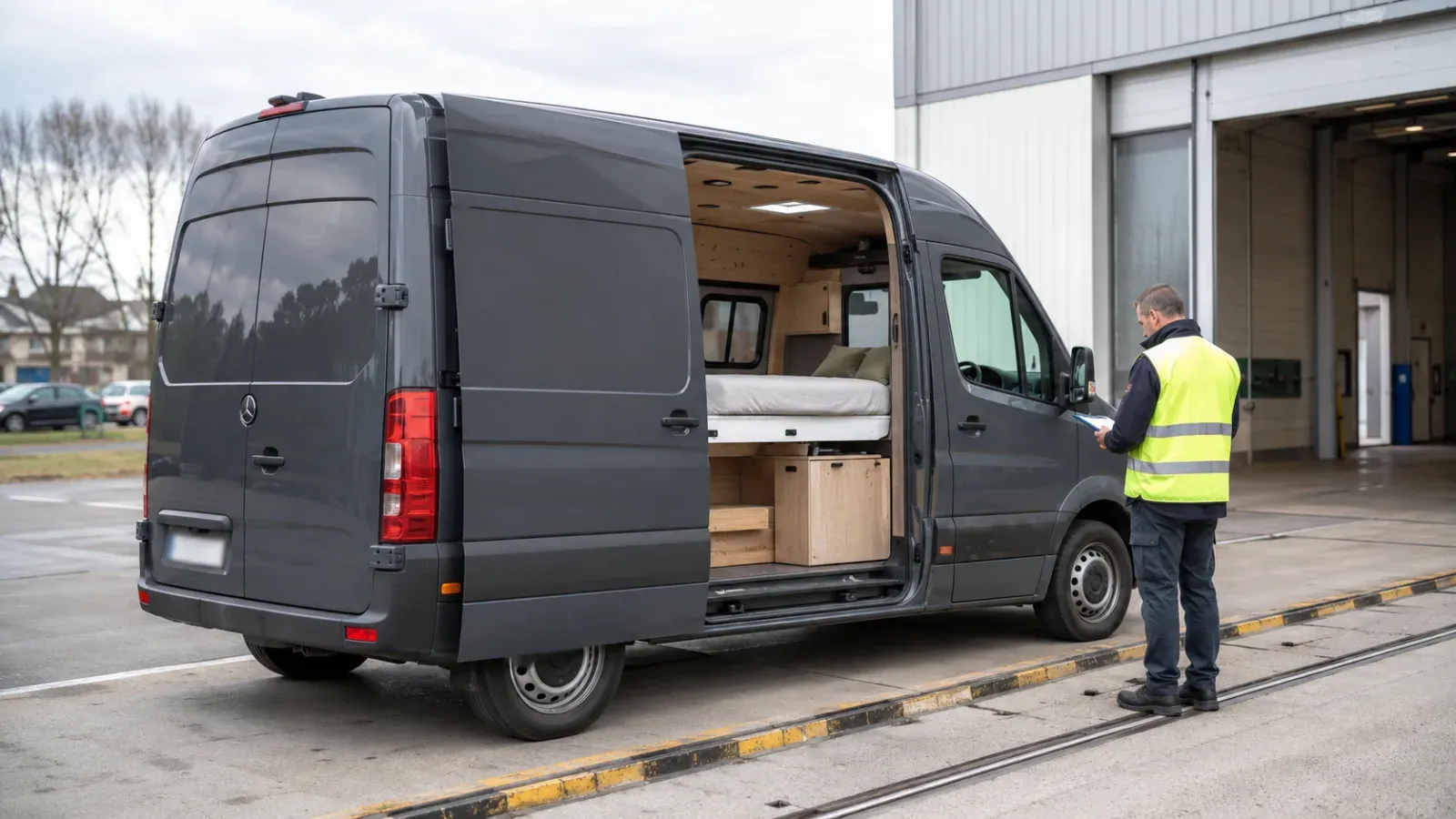
Converting a van into a campervan is a dream project for many vanlifers. You buy an empty bus, build in a bed, cupboard, kitchenette, and storage space, and suddenly it feels like your tiny home on wheels is ready.
However, in Belgium, there's also an official side to it.
Because when does your vehicle remain just a van with some camping gear in it? And when does it officially become a campervan for which you need type approval?
That difference is important. Not only for inspection, but also for your registration, insurance, driver's license, taxes, and especially your peace of mind when you finally want to hit the road.
What does type approval mean?
Type approval means that a vehicle or vehicle component is officially approved. The government then checks whether the vehicle still meets the technical and administrative requirements.
For a camper conversion, it's mainly about whether your vehicle still matches what's on paper after the conversion. A van is normally intended for goods transport. A campervan is a vehicle with a living area. That's not the same.
Therefore, for a true conversion to a campervan, you need an individual approval certificate. This certificate is issued by the Department of Mobility and Public Works.
When does a van officially become a campervan?
In Belgium, a campervan is a category M vehicle with a living area. This living area must have at least the following equipment:
- a table and chairs
- sleeping accommodation
- cooking facilities
- storage options
This equipment must be permanently fixed in the living area. The table may be designed so that it can be easily removed. Doors and drawers of storage compartments must remain securely closed during abrupt maneuvers.
So, a loose mattress, a camping stove, and some crates in the cargo area do not automatically make your van an officially type-approved campervan. But as soon as you build a permanent camper interior and want to register your vehicle as a campervan, you enter the type approval process.
When do you need type approval?
You need type approval when your vehicle is officially converted into a campervan. This is certainly the case when you install a permanent interior with cooking facilities, sleeping accommodation, storage space, a table and chairs, and you also want to register that van as a campervan.
Even when your vehicle changes category or type, new type approval is required. A light commercial vehicle that officially becomes an M1 campervan therefore changes not only practically, but also administratively.
That's the point where many people make a mistake. They think: I'll just build a bed and cabinets in my bus. But as soon as you want to officially register that bus as a campervan, the modifications must comply with the rules.
What if you want to keep the van as a light commercial vehicle?
Some commercial vehicles of category N1, N2, or N3 can also have a camping interior. A light commercial vehicle with a partition between the driver's compartment and the living area AND the required camping equipment can, in certain cases, remain registered as a light commercial vehicle.
But if you want to register that same light commercial vehicle as an M1 campervan, then there is a change of category and type. In that case, new type approval is required.
Without a partition, it becomes stricter. A light commercial vehicle without a partition, but with the required camping equipment, can, according to Flanders, be registered as an M1 campervan. Even then, new type approval is needed.
In short: if you want to remain a light commercial vehicle, make sure you are well informed beforehand. Especially the partition, the number of seats, the payload, and the interior must continue to match your registration.
Why you should think about your end goal beforehand
Before you start building, you should already know where you want to go.
Do you just want to occasionally sleep in your van with loose items? Then you are usually more in the realm of cargo. You have to secure everything safely, but you don't necessarily change the nature of the vehicle.
Do you want to build a permanent camper and officially register it as a campervan? Then you have to take type approval into account.
Do you want extra seats, swivel bases, windows, a pop-top roof, a sleeping roof, or structural modifications? Then it becomes even more sensitive, and you should definitely ask for advice beforehand.
I wouldn't gamble on this myself. As a vanlife enthusiast, I fully understand that you'd prefer to just build and go, but this is one of those topics where a mistake afterwards can cost a lot of money and frustration. Adjusting a cabinet is one thing. Having a roof, seat, or seatbelt point re-inspected or replaced is another.
Contact with the manufacturer of the base vehicle
When converting to a campervan, you must contact the manufacturer of your base vehicle. They can indicate which modifications are permitted and whether the vehicle may be converted into a campervan.
This agreement from the manufacturer is important. Without that agreement, you cannot get an approval certificate.
That may sound formal, but it's logical. The manufacturer originally had the vehicle approved as it was built. If you then structurally modify things, such as the roof, seats, or seatbelt anchorages, it must be clear that these modifications are safe and permitted.
Who submits the approval file?
That depends on the date on which your vehicle was first put into service or brought into traffic.
For vehicles from before April 29, 2013, in the case of a conversion by a private individual or an unapproved manufacturer, an approved technical service or a technical inspection station can submit the file.
For vehicles from April 29, 2013, in the case of a conversion by a private individual or an unapproved manufacturer, only an approved technical service can submit the approval file.
This is important for modern vans. Think of recent models such as a Ford Transit, Mercedes Sprinter, Volkswagen Crafter, Renault Master, Fiat Ducato, Peugeot Boxer, or Citroën Jumper. For these, it's best not to wait until the very end to go for inspection. Contact an approved technical service in good time.
What documents may be requested?
As a private individual or unapproved manufacturer, you apply for an individual approval certificate via an approved technical service of category A.
Such an application may require, among other things, the following documents:
- photos of all four sides of the vehicle
- photos of the interior
- detailed plans with dimensions
- completed forms
- test reports and checklists
- any partial approvals of components
- copy of the registration certificate
- agreement from the base manufacturer for conversion
This means that it's best to take photos during construction and keep your plans well. Don't wait until everything is boarded up, because some things are difficult to show or prove afterwards.
Extra attention to seats and seatbelts
Seats are one of the most sensitive components in a camper conversion. If you want to use seats while driving, they must be correctly approved. Headrests, seatbelts, and anchor points must also comply with the rules.
Side-facing seats may no longer be used while driving since October 20, 2007. They are therefore no longer granted as official seats for on the road.
Swivel bases are also a point of attention. If you modify an original seat by placing a swivel system underneath it, the original partial approval of the strength of that seat becomes invalid. You then have to demonstrate with a new partial approval or test report that the combination of seat and swivel system complies.
So, don't just buy the cheapest swivel console online because it fits mechanically. For type approval, it's not just whether something works, but also whether it is demonstrably approved.
Emergency exit, windows, and roof construction
A campervan must also remain safe if something goes wrong. The living area must have at least one easily accessible emergency exit that is not in the same wall as the service doors. This emergency exit must be at least 400 mm x 600 mm.
If the emergency exit can only be opened by breaking glass, an emergency hammer must be attached nearby.
Windows and transparent panels must also have a European marking. A pop-top roof or sleeping roof must comply with the conversion guidelines and the agreement of the base manufacturer.
These are typical things you should research beforehand. Installing a window seems simple, but if the wrong glass does not have a correct marking, it can cause problems later.
Weight is a major pitfall
For a camper conversion, you also have to take weight into account. After the conversion, the tare weight is determined by weighing. This involves looking at the converted vehicle with liquids, fuel, drinking water, and gas, among other things, according to the conditions.
For many self-builders, weight is one of the biggest pitfalls. Wood, insulation, batteries, solar panels, water, gas, furniture, tools, bicycles, clothes, food, and luggage all count.
And I haven't even included Grephar yet.
Especially if you want to stay under 3,500 kg with a B driver's license, you have to take this into account from the beginning. A bus that is well within the limit when empty can suddenly become much heavier than expected after a solid conversion and full travel equipment.
What happens after type approval?
After approval and registration, a campervan must go for an administrative inspection and weighing. You will then receive a new identification report.
According to GOCA Flanders, motorhomes must be inspected after re-registration and then annually. Please note: rules regarding inspection frequencies may change. So always check your inspection certificate and verify the current information with official sources.
Practical conclusion
You don't have to get type approval for every loose mattress or camping box immediately. But as soon as you officially want to convert a van into a campervan, with a permanent living interior and registration as a campervan, you need new approval.
If you only want to camp temporarily with loose items, it remains important that everything is securely fastened and that your vehicle still matches the registration.
If you want to build a real camper, you need to think beforehand about:
- registration as a light commercial vehicle or campervan
- the partition
- seats and seatbelts
- swivel bases
- windows and emergency exit
- pop-top roof or sleeping roof
- weight and payload
- documents and certificates
- agreement from the manufacturer
- contact with an approved technical service
My advice: first determine your end goal, then make your building plan. Not to take away your enthusiasm, but precisely to avoid having to start over later. A good camper conversion doesn't start with the first plank of wood, but with knowing what you officially want to do with your vehicle.
Source: https://www.gocavlaanderen.be/detail-page/data-en-frequentie
Source: https://www.autoveiligheid.be/autokeuring/kampeerwagen/keuring-na-inschrijving