Which documents should you have with you in your van?
When you're on the road with your van, you probably think first of water, sleeping gear, food, tools, charging cables, and maybe a good playlist. But there's something else that's at least as important: your documents.
By Laurens De Leeuw · 23 June 2026
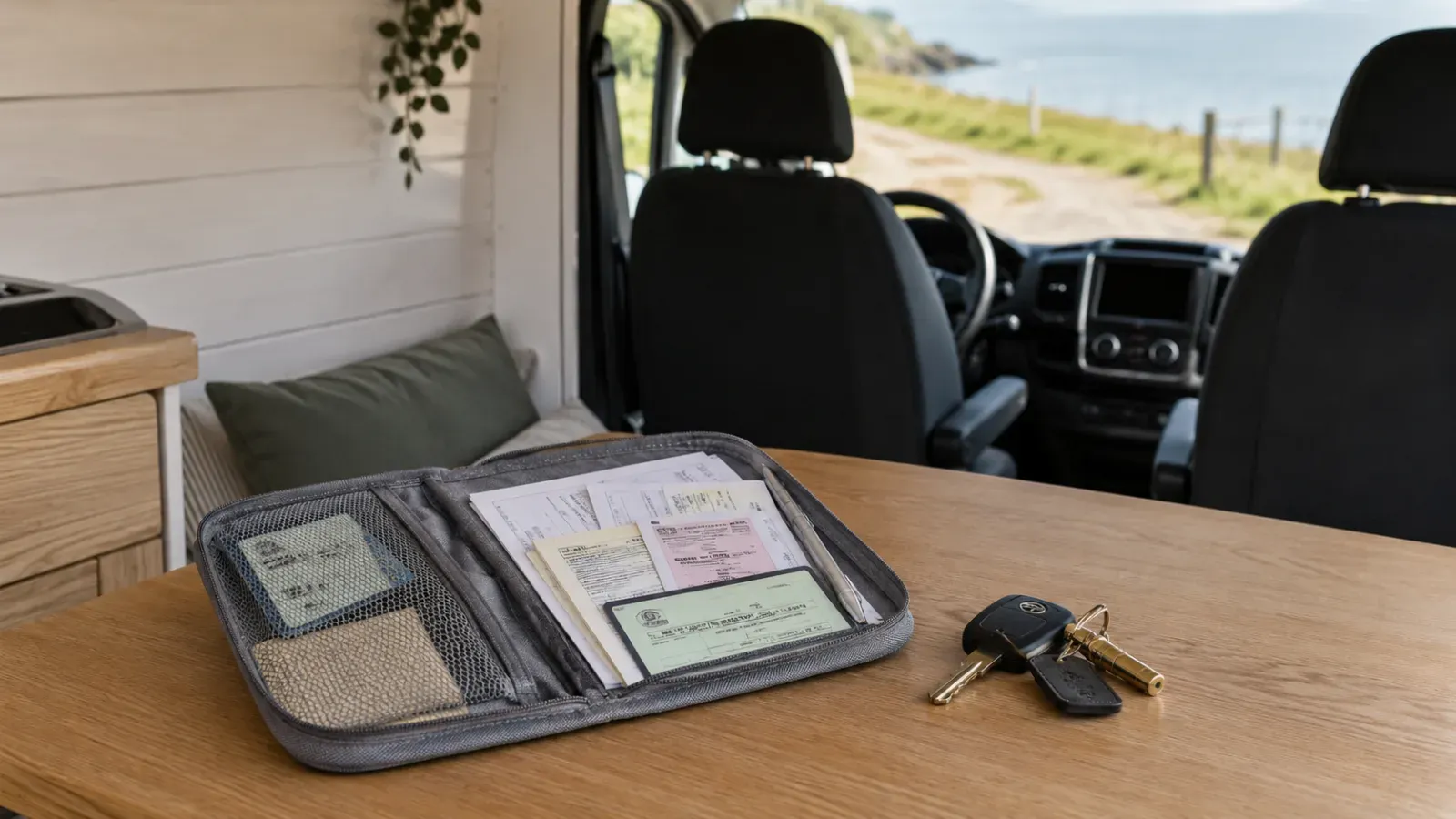
When you're on the road with your van, you probably think first of water, sleeping gear, food, tools, charging cables, and maybe a good playlist. But there's something else that's at least as important: your documents.
During a check, accident, inspection, border crossing, or insurance matter, you don't want to be searching. Especially not when your van is also your temporary home. A regular trip can quickly become much more stressful than necessary.
For me, this is a typical vanlife topic that doesn't sound exciting, but *does* provide peace of mind. I'd rather have one folder in the van where everything is neatly together, than having to think in a parking lot: "Where did I put that paper again?"
Why documents are important on the road
A van is not just a car. For many vanlifers, it's simultaneously a means of transport, a place to sleep, storage space, and sometimes even a piece of home.
This increases the chance that your papers get scattered among belongings, drawers, bags, dog supplies, tools, or travel gear. And precisely when you need them, you want to be able to show them quickly.
The basic principle is simple: during a check, you must be able to prove who you are, that you are allowed to drive, that your vehicle is correctly registered, insured, and technically sound.
For older vans, campers, and converted vans, this is extra important. Documents can sometimes be less straightforward there, especially if the vehicle has been imported, modified, or recently converted.
Driving license and identity card
As a driver, you must carry your driving license and identity card.
Your driving license must be valid for the vehicle you are driving. For most vans under 3,500 kg, this is a B driving license. But be careful with heavier campers, vehicles with higher maximum permissible mass, or combinations with a trailer. A different driving license may then be required.
You must also be able to show your identity card. That sounds obvious, but on the road, it quickly happens that your wallet is in a backpack, jacket, or other bag.
My own rule of thumb: when I leave with the van, I consciously check my driving license and ID. Not just when I'm already somewhere.
Registration certificate or vehicle registration certificate
The registration certificate, nowadays often called the vehicle registration certificate, confirms that your vehicle is registered with the DIV.
Since 2013, this vehicle registration certificate consists of two parts. One part must be kept in the vehicle. The other part you keep at home. These two parts together form one document.
This distinction is important. So, do not keep both parts in your van by default. If your vehicle is stolen and both parts are in it, you make it much more administratively difficult for yourself.
For vanlifers, this is extra relevant because a van sometimes stands fully loaded somewhere for a long time. The vehicle part belongs in the van, the home part safely at home.
Insurance certificate or “green card”
Many people still say “green card”, but in practice, the insurance certificate is no longer green. Since 2020, the international motor insurance card is white or electronic.
This document proves that your vehicle is insured for civil liability. You must be able to present it when you go on public roads.
A digital version is possible, but for vanlife, I would always keep a paper version as well. Especially if you are driving abroad. A smartphone can run out of battery, be stolen, have no reception, or break down at the wrong moment.
A simple printout in your document folder can prevent a lot of trouble.
Inspection certificate
Your inspection certificate shows that your vehicle has been technically inspected and until when that inspection is valid.
For a regular passenger car, light commercial vehicle, camper, or converted van, the inspection rules may differ. So, don't just look at what a friend with his car has to do, but at your vehicle category.
For vanlifers, this is important because a vehicle sometimes appears differently on paper than you might think. You might see a camper, but administratively it could still be a light commercial vehicle. Or vice versa. This affects inspection, insurance, taxation, and sometimes also rules on the road.
So always check the date on your inspection certificate and plan your inspection on time. Especially if you are planning a longer trip.
Certificate of conformity or COC
The certificate of conformity, also called COC, is the document that indicates that your vehicle complies with the approved type. It contains technical data such as vehicle type, mass, dimensions, engine, and other characteristics.
During checks and inspections, this document can be important. Especially for older vehicles, imported vehicles, modified vehicles, or vans that have been converted.
If you have a self-built camper or a van that was later modified, it is extra important that your papers match reality. Think of seating, mass, interior, tow bar, LPG, CNG, or other equipment.
A beautiful conversion is nice, but it must also be correct on paper.
Additional certificates for equipment or modifications
Some vehicles require additional documents. For example, certificates for LPG, CNG, ADR, tow bar, technical modifications, or an identification report.
Not every van needs this. But if your vehicle has such equipment, you need to know which documents belong with it.
During the technical inspection, you must be able to present certain certificates if they apply to your vehicle. So, don't keep them loosely in a drawer at home if you might need them on the road or during the inspection.
For older or modified vans, this is one of the things I would always check before you go on a trip.
European accident statement
A European accident statement may not be the first thing you think of, but it is very useful in case of an accident.
In case of damage, you want to be able to quickly note down data: license plate, insurer, circumstances, sketch, witnesses, and signatures. If you then have to search for everything or improvise on your phone, an annoying situation becomes even more chaotic.
Therefore, place at least one blank accident statement in your van. Preferably together with a pen that actually writes.
That sounds old-fashioned, but at such a moment, you'll be glad you have it.
Useful extra documents for vanlife
In addition to the mandatory onboard documents, there are also documents that are not always legally required, but are useful on the road.
Think of:
1. European accident statement
2. Paper version of your insurance certificate
3. Contact details of your insurer and breakdown assistance center
4. Breakdown assistance or travel assistance
5. Copy or scan of important documents
6. Manual or technical info of your vehicle
7. Documents of built-in appliances such as gas, electricity, or heating
8. Inspection appointments or maintenance history
9. Dog passport if you travel with your dog
10. Reserve list of emergency numbers
With Grephar in the van, for example, I would also keep his passport, chip data, and vaccination data at hand if I go abroad. That may not be a direct vehicle document, but for vanlife with a dog, for me, it belongs in your travel folder.
Store originals wisely
Not every document is treated the same way.
Some documents you must be able to show in original. Other documents can be useful digitally as a backup. And some things you better consciously not keep completely in the vehicle, such as the home part of your vehicle registration certificate.
Make scans or photos of your documents and store them securely digitally. But do not automatically see this as a replacement for the mandatory onboard documents. If you have to present an original document, a photo on your phone is not always enough.
A good approach is:
Keep the mandatory onboard documents neatly together in the van.
Keep the home part of your vehicle registration certificate at home.
Keep digital copies as a backup.
Store important phone numbers offline, not just in your email.
What if your documents are lost?
If you lose an onboard document or it is stolen, do not wait too long.
In case of loss or theft of important vehicle documents, you often have to report it to the police and then request a duplicate via the correct authority. For the vehicle registration certificate, for example, the DIV plays a role.
For vanlifers, this is especially important on the road. If your documents disappear during a trip, it can cause a lot of delay and stress. That's why a digital backup is useful: not to continue driving everywhere as if nothing happened, but to know faster what data you need and who to contact.
Abroad: rather take too much paper than too little
Within Belgium, you'll get quite far with the Belgian onboard documents. But as soon as you cross the border, paper sometimes becomes more important.
Not every country deals with digital documents equally smoothly. Not every officer speaks Dutch. And not every system immediately recognizes your Belgian situation.
That's why for foreign trips, I prefer to take a paper folder with the most important documents. Not excessively much, but enough to provide clarity quickly during a check, accident, or breakdown.
Especially the insurance certificate, registration certificate, inspection certificate, and possibly COC or extra certificates should then be neatly together.
Practical folder in the van
The simplest solution is a fixed document folder.
Not loose in the glove compartment between receipts, cables, and old parking tickets. Not somewhere under the bed. Not in a backpack that you sometimes take with you. Just one fixed place.
I would organize it like this:
1. Keep your driving license and ID with you
2. Vehicle part of the registration certificate in the document folder
3. Insurance certificate in the document folder
4. Inspection certificate in the document folder
5. Certificate of conformity or COC in the document folder
6. Extra certificates if necessary
7. Accident statement and pen
8. Breakdown assistance and emergency numbers
9. Copies or scans digitally as backup
That's not spectacular, but it works.
Why this is important for the community
Vanlife is often judged by behavior. Correct parking, leaving no waste, not causing nuisance, but also simply having your administration in order.
If you can calmly and correctly show your documents during a check, that gives a very different impression than someone who has lost everything, cannot show an inspection, or does not know how their vehicle is registered.
This is especially important for older vans and converted vehicles. We want to show that vanlife is not synonymous with “just driving around without rules”. Freedom and responsibility go hand in hand.
That is also the kind of community I want to help build with Vanlife Belgium: not preachy, but correct, practical, and with respect for the rules that matter.
Conclusion
Which documents should you have with you in your van?
At least your driving license, identity card, insurance certificate, registration certificate or vehicle registration certificate, inspection certificate, and usually also the certificate of conformity or COC. Depending on your vehicle, extra certificates may be required, for example for certain equipment or modifications.
For vanlife, it is smart to add practical documents: a European accident statement, breakdown assistance, emergency numbers, digital backups, and possibly documents for your dog or travel.
Keep it simple. One folder, one fixed place, everything up to date.
A good trip starts not only with a full tank and a beautiful route, but also with papers that are in order.
Source: https://mobilit.belgium.be/nl/weg/inschrijven/kentekenplaat-en-inschrijvingsbewijzen/kentekenbewijs