Using drones during vanlife in Belgium: what can you film?
Taking a drone in your van seems logical. You find a beautiful spot, the sun is just right, your van is perfectly framed, and with one short flight, you suddenly have professional-looking footage.
By Laurens De Leeuw · 23 June 2026
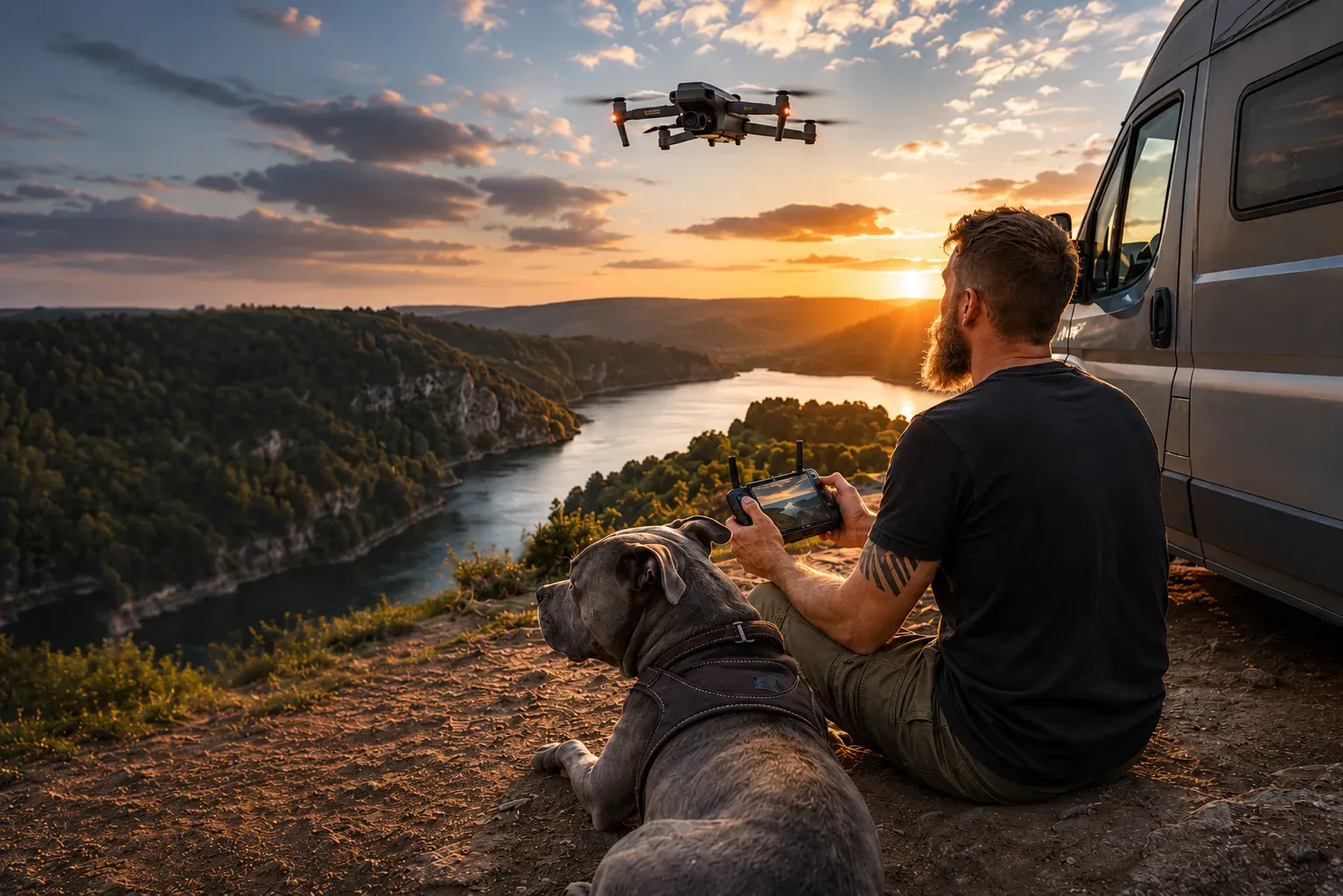
Taking a drone in your van seems logical. You find a beautiful spot, the sun is just right, your van is perfectly framed, and with one short flight, you suddenly have professional-looking footage.
For content creators, that's tempting. Especially when you're into vanlife. A drone shot can make a story much stronger: a deserted parking lot in the morning, a forest edge, a river, a coastline, a winding road, or your van looking tiny in a vast landscape.
But in Belgium, you can't just fly and film everywhere.
Drone use falls under aviation regulations, geozones, privacy rules, and sometimes local rules of the place where you are. That makes the topic a bit more complicated than "I'm just flying up for a bit."
For me, the basic principle is simple: a beautiful shot is never more important than safety, privacy, and respect for the place you are.
First: flying and filming are two different things
With drones, you should always ask two questions.
Can I fly here?
And can I film what I want to film?
These are not the same questions.
The first question is about aviation regulations. Think of registration, category, altitude, line of sight, geozones, and distance to people.
The second question is about privacy, respect, and what you do with the footage. Technically, you might be allowed to fly somewhere, but still get into trouble if you film identifiable people, private property, gardens, or windows and publish those images.
For vanlifers, this is important. You are often in public places, parking lots, nature reserves, campsites, motorhome pitches, or private spots. There are almost always other people, homes, animals, or local rules nearby.
The Open category: the basis for most vanlifers
Most recreational drone flights and many simple content flights fall under the Open category. This is the category for drone flights with the lowest risk.
In this category, some basic rules apply. You may not fly over an assembly of people. You may fly a maximum of 120 meters above the ground. You must keep your drone within line of sight. You may not drop goods. And you must respect the geozones.
That sounds quite simple, but each of those rules is important.
120 meters does not mean "as high as the drone technically can." It is a maximum height above the ground.
Keeping within line of sight means you must be able to see the drone with your own eyes. Not just via your screen.
Not flying over an assembly of people means staying away from crowded beaches, markets, events, festivals, terraces, busy campsites, or other places where people cannot easily disperse.
Geozones mean you must check in advance whether additional restrictions apply in that location.
Registration: often mandatory, even for small drones
Many people think that registration is only necessary for large or professional drones. That is not always true.
If you live in Belgium, in many cases you must register as a UAS operator via the Drone Portal of the Directorate General of Aviation. This applies, among other things, to drones weighing more than 250 grams. Even for drones under 250 grams, registration may be mandatory if it is not a toy drone and it is equipped with a camera or sensors.
Important: usually you register yourself as an operator, not the drone itself. You will receive an operator number, and this must be visibly affixed to your drones. If your drone supports Remote ID, your operator number must also be uploaded there.
For vanlifers with a small camera drone, this is definitely something to check. A small drone with a camera can still entail rules.
Training and certificate
What training or certificate you need depends on your drone and the subcategory in which you fly.
The Open category is divided into A1, A2, and A3. Simply put: the closer you want to fly to people and the heavier or riskier your drone is, the stricter the conditions become.
For many drone pilots, at least an online training or exam is involved. For certain flights closer to people, additional knowledge or an A2 certificate may be required.
So it's not enough to just know how much your drone weighs. You also need to know which subcategory your flight falls into.
When in doubt: check the official FOD Mobility info and the Drone Portal. Don't rely solely on what is said in a Facebook group or YouTube video.
Geozones: always check Droneguide
Belgium has geozones. These are geographical zones where additional rules apply to drones. They exist for reasons such as safety, security, privacy, or environment.
Think of zones around airports, military areas, port areas, prisons, cities, nature reserves, or other sensitive places.
The official map for Belgium is Droneguide. There you can look up an address or location and see which geozones apply. You must also check the access conditions, as sometimes flying is only allowed under certain conditions or after permission.
For vanlife, this is very important. A place may look quiet, but still be in or near a geozone. Especially around Brussels, Antwerp, Ghent, the coast, ports, military domains, and airports, you need to be extra careful.
I would look at it this way: before you take your drone out of your van, first check Droneguide. Not afterwards.
When do you fall outside the Open category?
Some drone flights are too risky for the Open category. Then you end up in the Specific category.
This can happen, for example, if you want to fly higher than 120 meters, fly beyond visual line of sight, fly over an assembly of people, transport dangerous goods, drop objects, or fly with a drone weighing more than 25 kg.
For the average vanlifer, this is usually not the intention. But it's good to know where the limit lies.
If you think "I'll just do something extra," that's precisely the moment to stop and recheck. Flying outside the Open category is not something you just do by feel.
What can you film?
You can film beautiful landscapes. You can film your own van. You can film a road, forest edge, field, river, beach, or parking lot if you are actually allowed to fly there and you don't disturb anyone.
But filming becomes more sensitive as soon as people become identifiable in the picture.
The Data Protection Authority explains that everyone has the right to their image. This means that people, in principle, decide for themselves whether images of them may be taken and used. There are exceptions, but for a vanlife content creator, the safest approach is simple: do not film identifiable people without permission.
This certainly applies to images you post online on YouTube, Instagram, TikTok, Facebook, or your website.
A wide landscape shot where people are not identifiable is different from a close shot of someone on a terrace, at a campsite, in a garden, or next to their camper.
Be careful with private property, gardens, and windows
Drones feel intrusive to many people. Even if you only want to film your van, someone else might feel like you're hovering over their garden, driveway, terrace, or window.
So, don't fly low over private property. Don't film through windows. Don't film gardens, courtyards, driveways, or terraces in a way that people are identifiable or might feel watched.
If you are on private property with the owner's permission, that does not automatically mean you can fly or film everywhere. Ask clearly if drone use is okay. Especially at farms, businesses, campsites, or private places where other people are present.
As a content creator, I fully understand that you sometimes think: "This shot would be perfect." But if that shot makes someone else uncomfortable, it's not a good shot.
Filming at campsites and motorhome pitches
A campsite or motorhome pitch is not a free film set.
People are there to relax, eat, shower, sleep, walk their dog, or just sit privately in front of their vehicle. Even if the place is beautiful, you need to be extra careful there.
Ask the operator for permission if you want to fly a drone. Do not film other guests identifiably. Avoid flying low over vehicles, tents, caravans, or motorhomes. Take into account noise, safety, and privacy.
A drone buzzing above a quiet motorhome pitch can quickly become annoying. Not everyone is waiting for your content moment.
Nature and animals: don't disturb for a shot
Vanlife and nature often go hand in hand. But nature is not a backdrop that only exists for our images.
Drones can disturb animals. Birds, horses, cows, dogs, and wild animals can be startled by the sound or movement. In nature reserves, additional rules may also apply, and some areas are in geozones or have restrictions due to management or accessibility.
If Grephar and I are quietly walking or sitting somewhere, I myself would not appreciate it if someone hovered their drone low above us. That perspective helps: do with your drone what you yourself would find respectful if someone else did it to you.
So, don't fly low over animals. Don't chase birds or wildlife. Don't create images for which you chase or disturb animals. And always check the local rules of the nature reserve.
Public space is not permission for everything
A square, beach, dike, parking lot, or dirt road may be publicly accessible, but that does not mean you can automatically do everything there.
You still have to take into account drone legislation, geozones, privacy, local rules, and the people around you.
On the coast, it can be extra sensitive due to crowds, nature, dunes, and many people in a small space. In cities, geozones, crowds, and privacy are more quickly a problem. In villages, a drone above houses can immediately arouse suspicion.
Public space therefore does not mean: free filming space.
What about license plates and faces?
If you publish images, be careful with identifiable faces, license plates, addresses, and private data.
For a vanlife website or social media channel, it is usually better to avoid or blur such details. Especially if a person or vehicle is clearly central in the image.
With your own van, that is of course different, but even then I prefer to blur license plates if it is not necessary for them to be visible. It looks neater and prevents misuse.
A good rule: only publish details that you are sure will not cause a problem for anyone else.
Practical checklist before you take off
Before you fly your drone, ask yourself these questions:
1. Am I registered if it is mandatory for my drone?
2. Do I have the right training or certificate?
3. Does my flight fall within the Open category?
4. Do I stay below 120 meters above the ground?
5. Do I keep my drone in sight with my own eyes?
6. Do I not fly over an assembly of people?
7. Have I checked Droneguide?
8. Do I respect the geozone conditions?
9. Do I not film people identifiably without good reason or permission?
10. Do I not disturb animals, residents, or other travelers?
If you are in doubt on multiple points, do not fly. No drone shot is mandatory.
Why this is important for the community
Drone footage can beautifully showcase vanlife. It shows the space, silence, and beauty of being on the road. But incorrect drone use can also cause a lot of irritation.
People feel watched. Animals get scared. Municipalities receive complaints. Nature managers become stricter. And other vanlifers get the reputation that "those vans with drones" cause nuisance.
That's exactly what I want to avoid with Vanlife Belgium. The community should not be about showing off or pushing rules to the limit. It should show that freedom and respect can perfectly coexist.
If we make drone footage, let it be beautiful because it is well made, not because we have disturbed others.
Conclusion
A drone can be fantastic for vanlife content in Belgium, but you need to know what you're doing.
Check if you need to be registered. See what training or certificates are required. In the Open category, only fly within the basic rules: a maximum of 120 meters, within line of sight, not over assemblies of people, and with respect for geozones. Use Droneguide before you take off.
Also, consider privacy. Do not film people, gardens, windows, vehicles, or private places in a way that is uncomfortable or identifiable without permission. Respect animals, nature, campsites, motorhome pitches, and other travelers.
For me, the rule is simple: if a shot only works by disturbing someone else, then it's not a shot I need.
Vanlife content can be beautiful, but it must also remain respectful.
Source: https://www.gegevensbeschermingsautoriteit.be/professioneel/thema-s/recht-op-afbeelding
Source: https://www.skeyes.be/nl/diensten/drone-home-page/you-and-your-drone/
Source: https://mobilit.belgium.be/nl/luchtvaart/vliegen-met/drones-uas/categorieen/categorie-specific
Source: https://mobilit.belgium.be/nl/luchtvaart/vliegen-met/drones-uas/categorieen/categorie-open