Dog in the van: animal welfare, heat, and travel
For many vanlifers, a dog is simply part of life on the road. Waking up together in nature, walking in new places, driving calmly from spot to spot, and snuggling up in the van together in the evening. It can be wonderful. But taking a dog in the van requires more planning than many people think.
By Laurens De Leeuw · 23 June 2026
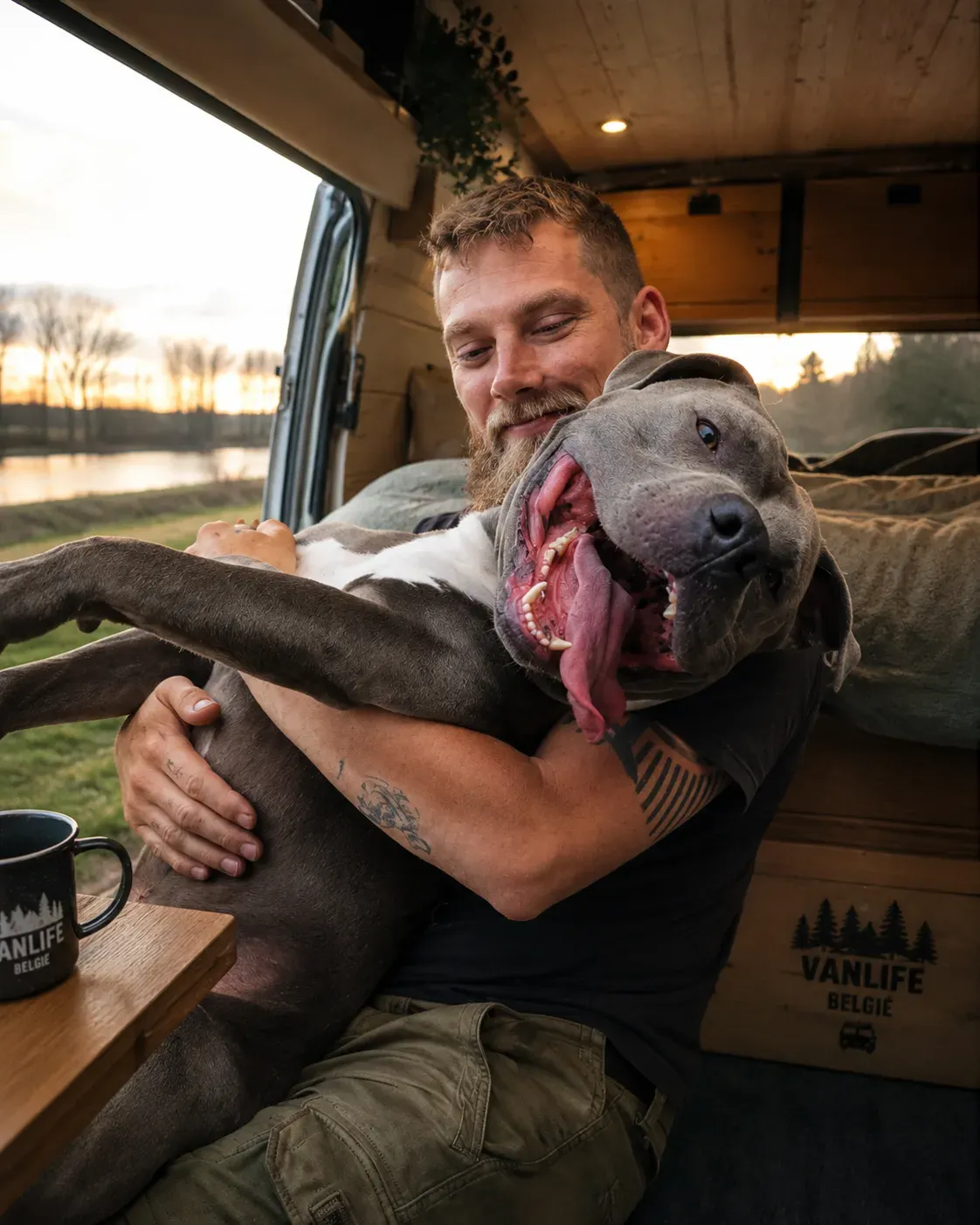
For many vanlifers, a dog is simply part of life on the road. Waking up together, discovering new walking spots, driving calmly from spot to spot, and snuggling up in the van together in the evening. For me, that's one of the most beautiful aspects of vanlife.
With Grephar, I feel that even more strongly. He's a big, grey American Staffordshire, but mostly just my buddy. Loving, enthusiastic, and completely dependent on the choices I make. Where I sometimes think about freedom, routes, and beautiful places, he mainly needs safety, peace, water, shade, and an owner who thinks ahead.
So, taking a dog in the van requires more planning than many people think.
A van is not a regular living room. In summer, it can quickly get too hot. In winter, it can get too cold. While driving, your dog must be safely secured. When traveling, your papers must be in order. And in public places, you need to consider other people, animals, and local rules.
For vanlife with a dog, the basic principle is simple: **your freedom should never come at the expense of your animal's well-being**.
Heat is the biggest risk
The most important rule comes first: do not leave your dog alone in the van in hot weather.
Flanders clearly warns that animals should never be left alone in a car in hot weather. Even at relatively mild outdoor temperatures or in a shady spot, the temperature inside a vehicle can quickly rise. The Pet Guide Dog is even more specific: never leave a dog alone in the car if it's 15°C or warmer outside.
That might seem strict, but it's logical. A vehicle heats up much faster than you think. A window slightly ajar, a curtain, a small fan, or "I'll only be gone for five minutes" is not reliable protection.
For a dog, heat can quickly become dangerous. Dogs have a much harder time dissipating heat than humans. They primarily cool down by panting and through their paw pads. In a warm, stationary van, this can quickly become insufficient.
With Grephar, I am extra aware of this. He is strong and cheerful, but he cannot say: "owner, it's getting too hot in here." I have to assess that for him. And then I prefer to take precautions too early rather than too late.
A van is not a climate-controlled kennel
Many vanlifers cleverly build out their vans. Insulation, a roof hatch, ventilation, screens, blackout curtains, and reflective screens can all help. But they don't make your van a safe kennel in hot weather.
A fan can fail. A battery can run out. The sun moves. Shade disappears. A window might not open far enough. It can be warmer inside than outside. And if your dog gets stressed, the risk increases even faster.
Therefore, you shouldn't think: "My van is well insulated, so it'll be fine."
The better question is: "What happens if I'm gone half an hour longer than planned?"
If the answer becomes dangerous for your dog, then the plan isn't good enough.
That can be difficult, because sometimes you want to quickly go see something or pop into a shop. But with a dog in the van, you have to plan around your dog, not the other way around.
Plan your day around your dog
With a dog in the van, you plan differently. Especially in summer.
Walk early in the morning or later in the evening. Avoid the hot midday hours. Park in the shade when possible, but don't rely on it blindly. Make sure your dog always has drinking water. Take breaks while driving. Look for places where your dog can lie down calmly without getting overstimulated.
Visiting a city on a hot day immediately becomes more difficult. You can't just leave your dog in the van while you go eat, shop, or visit a museum. Then you need to find an alternative: a dog-friendly place, a cooler day, a sitter, or simply skip the city.
That's sometimes a shame, but it's part of responsible travel with an animal.
I see it very simply myself: if Grephar cannot comfortably join the plan, then the plan is not good. Then I prefer a walk by the water, a quieter place, or another day. For me, vanlife is not about getting everywhere at all costs. It's about freedom, but with respect for those who travel with you.
Sleeping in the van with your dog
Sleeping with your dog in the van can be very pleasant, but here too, comfort and safety count.
Ensure sufficient ventilation without drafts. Provide a fixed spot where your dog can lie down calmly. Keep water accessible. Watch out for cold in winter and heat in summer. Also, don't forget that some dogs get stressed more easily by sounds outside the van: passers-by, other dogs, cars, rain, wind, or animals at night.
If you are in a busy parking lot or a residential street, your dog may bark or become agitated more quickly. This not only causes stress for your dog but also nuisance for others.
A quiet place is therefore not only pleasant for you but also for your dog.
With a dog, you actually never sleep completely alone. You feel more quickly if a place is good. If Grephar is calm, that is often a sign for me that the place feels okay. If he is restless, I take that seriously. Sometimes driving further is simply the best choice.
Safe driving with a dog
While driving, your dog must be safely secured. A loose dog in the van is not a good idea. In case of sudden braking or an accident, your dog can get injured or be thrown through the space. A loose dog can also hinder the driver.
Therefore, use a safe solution that suits your vehicle and dog: a securely fastened crate, a dog seat belt with a proper harness, or a partitioned area where your dog cannot come forward.
Also, think about breaks. A dog that has to lie still for a long time in a warm van will become restless. Stop regularly, let your dog drink, and give him a chance to move around.
This is even more important for larger dogs. They take up more space, need a comfortable resting place more quickly, and can shift a lot of weight during an emergency stop. Safety is therefore not only important for small dogs or nervous dogs. It applies to every dog.
Paperwork: chip, registration, and passport
In Flanders, every dog must be chipped and registered. A dog must also have a passport. Furthermore, check if the data in DogID is correct, especially your contact details. A chip helps little if the registration is incorrect.
For travel abroad, additional rules apply. Within the EU, your dog should normally have a European passport, be identified with a microchip, and be correctly vaccinated against rabies. Some countries have additional conditions, such as deworming against fox tapeworm for, among others, Ireland, Finland, Malta, and Northern Ireland.
If you travel outside Belgium with your dog, always check the rules of the country you are going to and the rules for returning to Belgium beforehand.
That paperwork may not be the most pleasant part of vanlife, but it's part of it. You don't want to discover at a border, at a campsite, or during a check that something is missing.
Dog-friendly is not the same everywhere
Not every place is suitable for dogs.
Some nature reserves have leash requirements. Beaches often have seasonal rules. Campsites and camper pitches may have separate rules regarding dogs. In some countries or regions, additional rules apply to certain dog breeds, muzzles, or public transport.
For vanlifers, this is important because you live a lot in shared spaces. Your dog may be the sweetest dog in the world to you, but other people or dogs don't always experience it that way.
I notice this myself with Grephar. He is a treasure of a dog to me, but I also know that not everyone is automatically relaxed around a large Stafford. Then it is my responsibility to guide him calmly, safely, and respectfully. Not because he does anything wrong, but because good coexistence on the road starts with considering others.
So keep your dog under control. Leash him where necessary. Don't let him run up to unknown dogs or people. Always clean up dog poop. And avoid your dog barking for extended periods in a parking lot or overnight spot.
What do you bring for your dog?
You don't need to put half a pet store in your van, but a good basic setup helps enormously.
Think of drinking water, food, a sturdy water bowl, a fixed sleeping place, leash, spare leash, poop bags, towel, tick remover, first aid basics, passport, medication if your dog needs it, and something that makes your dog feel safe.
In hot weather, extra water, shade, and cooler planning are more important than toys or accessories. In cold weather, you think of a warm sleeping place, dry blankets, and protection against moisture.
The most important thing is not how many items you bring, but whether your dog stays healthy, safe, and calm on the road.
For me, there's also a simplicity to that. You don't have to have everything perfect to take good care of your dog. But water, rest, safety, and attention are not optional. Those are the basics.
What if your dog doesn't like to travel?
Not every dog is made for vanlife.
Some dogs get car sick. Others get stressed by new places, sounds, or strange dogs. Some dogs find it difficult to find peace in a small space. An older dog or a dog with medical problems may need more comfort and routine than a young adventurous dog.
Therefore, start small. First, take short trips. Sleep one night close to home. See how your dog reacts to parking, sleeping, walking, rain, heat, sounds, and unfamiliar places.
Vanlife with a dog should also be fun for your dog. Not just for you.
I personally find that an important thought. We choose vanlife. Our dogs don't consciously choose that. They come along because they trust us. Then we also have to honestly see if they can really handle it and enjoy it.
Practical checklist before departure
Before you leave with your dog, check this:
1. Is your dog chipped and correctly registered?
2. Do you have the passport with you?
3. Is rabies vaccination required for your trip?
4. Do you have enough water and food?
5. Can your dog ride safely?
6. Do you have a plan for hot days?
7. Do you know where dogs are allowed?
8. Do you have poop bags and basic care items?
9. Can you adjust your plans if your dog is struggling?
With a dog, you always have to travel a bit more flexibly. Sometimes the best choice is simply a different place, a shorter walk, or a quieter day.
Why this is important for the community
A dog in the van attracts attention. People quickly see if an animal is comfortable, or just confined, stressed, overheated, or neglected.
If vanlifers take good care of their dogs, it creates a positive image. It shows that vanlife is not just about freedom, but also responsibility. If people see dogs left alone in hot vehicles, find dog poop in parking lots, or are bothered by barking, it harms the image of the entire community.
Therefore, animal welfare is not just a private matter. It also influences how vanlife is viewed in Belgium.
Those who take good care of their dog on the road help show that vanlife can be respectful. And honestly: that's the kind of community I want to help build with Vanlife Belgium. Not just beautiful photos of vans, but also people who care for their animals, their environment, and each other.
Conclusion
Taking your dog in the van can be fantastic, but it requires responsibility.
Never leave your dog alone in the van in hot weather. Plan your days around temperature, rest, and water. Make sure your dog rides safely. Keep chip, registration, passport, and vaccinations in order. Respect local rules, nature reserves, and other people.
Vanlife with a dog only truly works if it feels good for both of you.
For me, that's the core. Grephar is not an accessory to the adventure. He is part of the adventure. And if he comes along, then I have to make sure the journey is safe, calm, and good for him too.
Freedom is beautiful, but your dog counts on you.
Source: https://www.vlaanderen.be/dieren-transporteren
Source: https://www.vlaanderen.be/huisdierinfo/huisdierwijzers/zoogdieren/hond
Source: https://www.vlaanderen.be/huisdierinfo/verzorging-van-huisdieren/dieren-en-warm-weer