Making fire, cooking and barbecuing in forests or nature reserves
A small fire next to your van, a gas stove in a forest car park, a barbecue on the edge of a nature reserve or a cosy fire pit at a bivouac site. For many people, this feels innocent. Especially if you are careful, have water with you and leave everything tidy. But in Flanders, the basic rule is much stricter than many people think
By Laurens De Leeuw · 23 June 2026
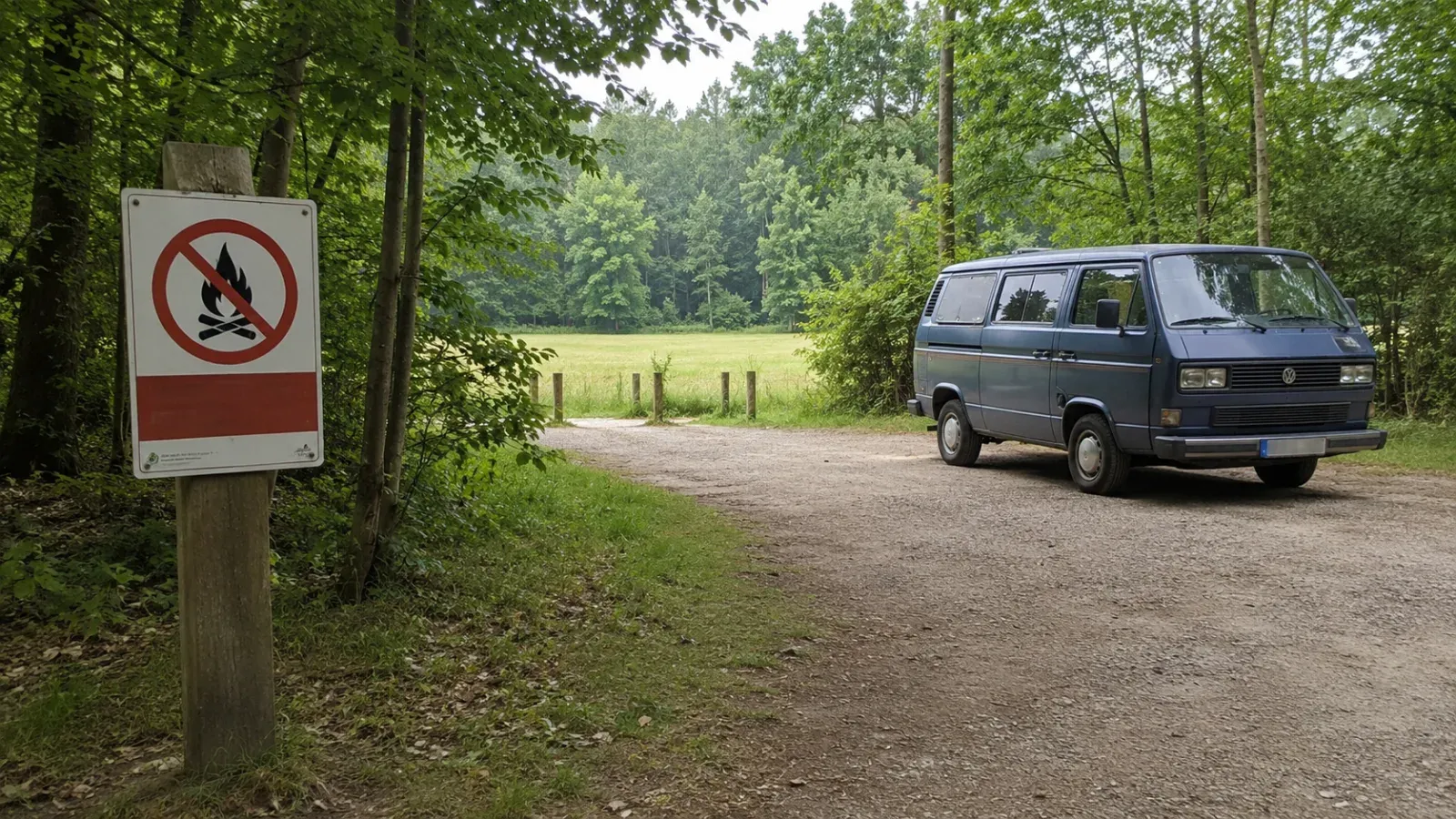
A small fire next to your van, a gas stove in a forest car park, a barbecue on the edge of a nature reserve or a cosy fire pit at a bivouac site. For many people, this feels innocent. Especially if you are careful, have water with you and leave everything tidy.
But in Flanders, the basic rule is much stricter than many people think: **in forests and nature reserves, you are generally not allowed to make fire**.
This doesn't just apply to large campfires. Cooking over an open fire, barbecuing, using a fire bowl or making a small fire can also cause problems if you are in a place where it is not permitted.
This is important for vanlifers. Not only to avoid fines or fire hazards, but also because one poorly chosen fire can be enough to spoil a spot for everyone.
The basic rule: no fire in forests or nature reserves
In Flemish forests and nature reserves, you are not simply allowed to make fire. Flanders clearly states that a campfire or cooking fire in a forest or nature reserve is prohibited, except in places where a permanent campfire circle is provided in the nature management plan or accessibility regulations.
This means you cannot decide for yourself: “It seems safe here, so it must be allowed.”
The spot must be officially designated for it. If in doubt, you should inquire with the manager, owner or forest ranger. An open spot between the trees, a sandy strip, an old fire pit from someone else or a quiet forest car park is not automatic permission.
“But it's just a small fire”
A small fire remains fire.
That sounds logical, but on the road, it is often forgotten. A few twigs in a hollow, a disposable barbecue, a charcoal barbecue, a fire bowl, a gas stove, a torch or a small cooking fire can all pose a risk.
Especially in forests, heathlands, dunes, dry verges and nature reserves, fire can spread faster than you think. Dry grass, leaves, pine needles, roots, peat, branches and wind can quickly make a small fire larger.
The argument “we had everything under control” is of little help if it wasn't actually allowed.
Cooking is not the same as just eating
Eating a sandwich in your van or on a bench is not a problem. But cooking with fire or heat is different.
A gas stove on a table, a barbecue next to your bus, a pan on a burner or charcoal on the ground is no longer a neutral picnic. In or near nature, this can be seen as making fire or a cooking fire.
The safe rule is simple: **do not cook with fire in a forest or nature reserve, unless you are sure it is explicitly permitted in that location.**
If you still want a warm meal, choose a campsite, camper place, private property with permission or an official picnic area where barbecuing or cooking is clearly allowed. Otherwise, it's better to eat something cold or cook in an allowed place before heading into nature.
Barbecuing in nature: usually not a good idea
Barbecuing often feels cosy and innocent, but in a natural context, it is one of the worst ideas.
A barbecue produces heat, smoke, smell, sparks, grease residue, ash and waste. A disposable barbecue can also damage the surface and remains hot for a long time. Charcoal and ashes are often left behind incorrectly, even if they appear extinguished.
In a forest or nature reserve, you should therefore assume that barbecuing is not allowed, unless it is very clearly stated that it is allowed and where it is allowed.
Caution is also needed in car parks near nature reserves. A car park next to a forest is not a free barbecue zone just because it's asphalt. If you are close to a forest or nature, risk, local rules and nature rules still play a role.
What about bivouac zones?
Bivouac zones are official places where you can spend the night briefly and simply in nature. But even there, you are not automatically allowed to make fire.
Natuur en Bos (Nature and Forest Agency) states that a campfire in a bivouac zone is only allowed if the manager has provided a fire pit. Only in that fire pit are you then allowed to make a fire. If there is no fire pit, then making fire in that bivouac zone is prohibited.
Also important: in case of increased fire risk, such as code orange or red, the fire pit can be closed and making fire is prohibited anyway.
A bivouac zone is therefore not a free pass. It remains a simple natural place with clear rules.
Fire risk codes: extra caution
During dry periods, Natuur en Bos uses colour codes for fire risk. The fire-prone season normally runs from March 1 to September 30, but drought and risk can of course vary per period.
With code yellow, orange and red, smoking is not allowed in nature and forest areas. Making fire is also prohibited then.
This means that even a place where a fire pit is normally present may temporarily not be usable for fire. So always check the current warnings if you want to spend the night, hike, bivouac or cook in or near nature.
Limits also apply outside forests or nature reserves
Outside forests and nature reserves, fire is sometimes allowed, but there are also rules and distances there.
Natuur en Bos states that outside a forest or nature reserve, you must keep at least 25 metres away from forest edges. From heathland, you must keep 100 metres away, because heathland is very flammable.
This is especially important for vanlifers who think that a verge, field road, car park or fringe zone “just outside the forest” is safe. Close to nature, fire remains risky and often not allowed.
In addition, municipalities may have their own rules regarding fire pits, barbecues, open fires, smoke nuisance and drought. On private property, you also need the owner's permission, but permission alone does not make fire safety and local rules unimportant.
Smoking is also part of this
Smoking in nature reserves is also sensitive, especially during dry periods. A cigarette or butt seems small, but can cause a fire. So never throw butts on the ground, not even in a car park, forest edge or hiking trail.
With fire risk codes yellow, orange and red, smoking is prohibited in nature and forest areas. Apart from that, leaving a butt behind is simply litter.
For the community, this is simple: do not smoke in nature reserves and always take butts with you in a sealable container or waste bag.
What do you do then as a vanlifer?
The practical approach is simple.
In a forest or nature reserve, you do not make fire, unless it is officially and clearly permitted. In a bivouac zone, you only use a fire pit if it is present and if the current fire code allows it. In regular car parks near nature reserves, you do not set up a barbecue or gas stove outside. During dry periods, you are extra careful, even outside the nature reserve.
If you want to cook, do so in a place where it is possible: a campsite, camper place, official barbecue zone, private property with permission or your own safe cooking place outside vulnerable nature. And even then, keep water or an extinguishing agent at hand, do not leave anything unattended and dispose of ash, waste and food scraps correctly.
Practical checklist
Before making fire, ask yourself these questions:
1. Am I in a forest or nature reserve?
2. Am I close to a forest edge, heathland, dunes or dry vegetation?
3. Is making fire explicitly permitted here?
4. Is there an official campfire circle, fire pit or barbecue zone?
5. What is the current fire risk code?
6. Is there wind?
7. Can I extinguish safely if something goes wrong?
8. Will I leave no ash, charcoal, waste or burn marks behind?
9. Would I still be okay with this if a hundred people did the same after me?
If you are in doubt about any of these questions, do not make fire.
Why this is important for the community
Vanlife is often judged by visible behaviour. A quietly parked van usually causes little disturbance. A van with smoke, barbecue, chairs, waste and burn marks gives a completely different impression.
Nature managers and municipalities primarily want to prevent nature from being damaged or fires from starting. If vanlifers make fire where it is not allowed, complaints, inspections and prohibition signs will appear more quickly.
Therefore, being careful with fire is not a detail. It is respect for nature, residents, managers and other travellers.
Those who do not make fire where it does not belong help keep places accessible and peaceful.
Conclusion
In Flemish forests and nature reserves, you are generally not allowed to make fire. A campfire, cooking fire, barbecue, fire bowl or small gas stove is therefore not simply permitted because it seems cosy or careful.
Fire is only allowed in places where it is officially provided and permitted, such as a permanent campfire circle or an allowed fire pit in a bivouac zone. In case of increased fire risk, even that may be temporarily prohibited.
For vanlifers, the best rule is simple: do not make fire in or near nature unless you are sure it is allowed there. Only cook and barbecue in permitted places. Do not leave ash, waste or burn marks behind.
Freedom on the road remains possible only if we do not treat nature as a free campfire spot.
Source: https://natuurenbos.be/brandpreventie-natuur-en-bosgebieden-op-basis-van-kleurcodes
Source: https://natuurenbos.vlaanderen.be/faq/waar-vind-ik-brandwaarschuwingen-voor-onze-natuurgebieden