Staying with friends or family with your van: what should you pay attention to?
Staying with friends or family with your van sounds like one of the most logical solutions for vanlifers. You're safe, you know the people, you might be able to fill up water, take a shower, pick up mail, do laundry, or just relax for a few days.
By Laurens De Leeuw · 24 June 2026
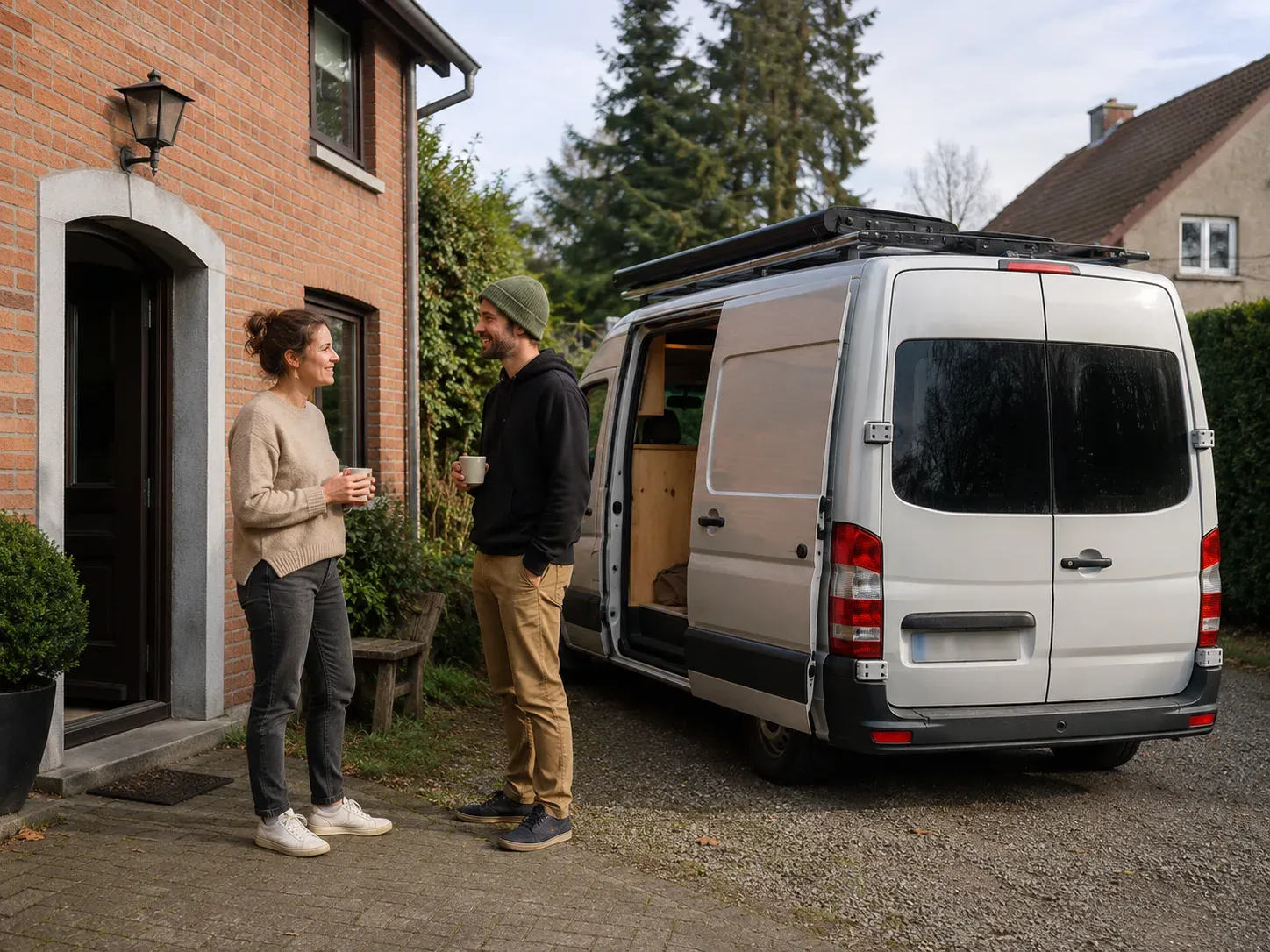
Staying with friends or family with your van sounds like one of the most logical solutions for vanlifers. You're safe, you know the people, you might be able to fill up water, take a shower, pick up mail, do laundry, or just relax for a few days.
But here too, what's practically convenient isn't automatically administratively or legally simple.
Occasionally parking in a friend's or family member's driveway is different from living there for months. Staying a few nights is different from having your main residence there. And taking a reference address with someone is still different from actually staying there permanently.
For vanlifers, this is therefore an important topic. Especially if you're full-time on the road and friends or family become a kind of permanent base.
First this: parking, staying, and living are three different things
The biggest confusion arises because people lump everything together.
You can park your van somewhere.
You can temporarily stay with friends or family.
You can actually live somewhere.
These are three different situations.
A van parked in a driveway for a weekend because you're visiting is not the same as a bus parked at the same address for months, with a cable running inside, a water tank, wastewater, mail, daily routines, and someone actually living there.
The government doesn't just look at what you call it. It looks at the facts. Are you there temporarily or structurally? Do you sleep there occasionally or permanently? Do you use the address administratively? Is there nuisance? Has an extra residential function arisen?
That difference determines a lot.
Occasionally staying with friends or family
Occasionally staying a night or weekend with friends or family is usually primarily a practical matter. You ask permission, you park neatly in the driveway or private parking, and you make sure you don't bother anyone.
In such a situation, you generally remain just a visitor.
Still, there are a few things to pay attention to. Don't park on the sidewalk or partly on the public road. Don't block a view, entrance, or access. Make sure your vehicle is insured, registered, and technically in order. Don't leave behind any waste, water, or mess. And make clear agreements with the people you're staying with.
This all sounds logical, but it's precisely those small things that determine whether you remain welcome.
When does it become more sensitive?
It becomes more sensitive when you are no longer just "visiting."
For example, if:
- you stay there for weeks or months
- you sleep there almost every night
- you permanently use a power cable or water hose
- your mail arrives there
- you do your laundry, administration, and daily routine there
- you actually live there, but not in the house
- neighbors see that someone is structurally living in a vehicle
- you use the place as a permanent base between trips
- a fee is paid
- multiple vans are on the same property
Then the situation can more quickly resemble living in a vehicle on private land. And that is much less self-evident.
Main residence: where do you really live?
In Belgium, your main residence must correspond to the place where you usually live. This is a factual situation, not a free choice on paper.
If you live full-time in your van, but you are almost always in the driveway of the same friend or family member, the question may arise whether that address has actually become your main residence.
That has consequences. Not only for you, but sometimes also for the person you are staying with.
Think of family composition, official mail, social benefits, allowances, taxes, insurance, and municipal control.
Therefore, you need to look honestly at your situation. A few nights visiting is one thing. Structurally living in someone's driveway is another.
Reference address with friends or family
A reference address can be a solution for vanlifers without a fixed abode. It is an administrative address where official mail arrives, without you living there.
But that's precisely the important point: a reference address may not be your place of residence. You may not stay there permanently.
So if you take a reference address with a friend or family member and then you are almost permanently parked with your van in their driveway, that can conflict with the principle of a reference address.
A reference address is intended to remain administratively accessible. It is not a hidden domicile and not a way to permanently live at an address without officially living there.
If you are considering this, discuss it with the municipality beforehand. Honestly explain how you live and where you actually stay. That is much better than having to explain afterwards why your "reference address" turned out to be your permanent place of residence.
Temporary absence if you still have a real home base
If you still have a real main residence yourself, but are temporarily traveling for a longer period with your van or occasionally staying with family, temporary absence may be relevant.
In case of temporary absence, you retain your main residence, but you inform the municipality that you are temporarily absent. This can help to prevent you from being removed from the population register when you are away from home for a longer period.
This only works if you still genuinely have a main residence. It is not a solution for someone who cancels their home and then lives permanently in a van.
So: do you still have a home, room, or real base? See if temporary absence fits. Do you no longer have a real home base? Then you should rather look at a reference address or another correct administrative solution.
Parking in the driveway: is that allowed just like that?
Parking a vehicle in a private driveway or private property is possible in many cases, but as soon as the vehicle serves as a dwelling, it becomes more sensitive.
Flanders states that for placing caravans, campers, or tents, an environmental permit may in principle be required, unless you meet the conditions for an exemption. For one movable installation, an exemption may exist under certain conditions, but then there may be no residential function. If a structure is inhabited, a permit is required.
That is important for anyone who thinks: "I'll just park my bus in my parents' garden."
If your bus is just temporarily parked there, that's different from when you live in it permanently.
When in doubt: ask the municipality of the person you want to stay with. Municipalities can also have local rules and assess the concrete situation.
Neighbors can make a difference
Even if your friend or family member agrees, neighbors can react.
A van in a driveway usually doesn't stand out much. But an inhabited van can stand out, especially if curtains are closed, lights are on every evening, a power cable is running, you cook outside, discharge water, or often sit outside.
Neighbors can complain about:
- sight or mess
- noise
- smoke or smell
- parking pressure
- privacy
- waste
- extra residents
- suspicion of illegal habitation
- use of garden or driveway as a camper spot
Therefore, discreet and clean parking is important. Not because you have to hide, but because you don't want to cause unnecessary problems for the people who are helping you.
My personal rule would be: make sure your presence doesn't become a burden for the people who offer you hospitality. You don't want to damage a friendship because your vanlife causes administrative or practical mess.
Using electricity at friends' or family's place
Using electricity seems simple: plug in the cable and you're done.
However, you need to be careful.
Only use proper equipment, especially if the cable is outside. Make sure the cable is suitable for outdoor use, is not damaged, and is not lying across a sidewalk or driveway where someone could trip or drive over it.
Also agree on who pays for the electricity. A refrigerator, heating, chargers, or electric hob can consume more than you think.
Do not use creative extension cord constructions through windows, doors, or wet grass. And certainly do not install a permanent setup unless it is safe and permitted.
What for you is "just grabbing some power" can mean fire risk, liability, or insurance discussions for the homeowner.
Water, toilet, and wastewater
Filling up water at friends' or family's place is usually not a problem if you ask nicely. But wastewater and toilet contents are more sensitive.
Grey water from your sink or shower does not just belong in the garden, gutter, or street. Chemical toilets or toilet contents must be emptied correctly in a suitable place.
Make clear agreements about this.
A friend or family member who lets you stay probably doesn't want to discover dirty water running into the hedge or odors developing around the driveway.
For me, this is really basic respect. As a vanlifer, you are a guest. Leave the place cleaner than you found it.
Showering, washing, and using the house
Often, staying with friends or family isn't just about parking. You might also use their shower, toilet, washing machine, kitchen, or internet.
That can be pleasant and convenient, but it needs to remain clear.
Agree on:
- when you can come inside
- whether you get a key
- how often you use the shower or washing machine
- whether you contribute to costs
- where you leave your belongings
- what remains private
- how long you'll stay
- when it becomes too much
Friends and family often quickly say "no problem," but after a few weeks, it can feel different. Especially if you are present a lot, often come inside, or change their routine.
Clear agreements are not aloofness. They protect the relationship.
Paying friends or family
Paying a fee can feel fair. You use electricity, water, shower, driveway, or washing machine. Then you want to contribute something.
But as soon as payment is made structurally for accommodation, you need to be careful.
A small contribution to costs between friends or family is different from offering a place as a camper spot or accommodation. If someone structurally offers accommodation for a fee to tourists or strangers, rules regarding tourist accommodation, registration, safety, insurance, and spatial planning may come into play.
For simply staying with friends or family, that is usually not the intention. But don't turn it into a semi-commercial camper spot without knowing the rules.
Keep it clear: are you there as a guest, as a family member, as a friend, temporarily and privately? Or does it become a structural paid accommodation? These are different situations.
What if you stay for several weeks?
Staying for several weeks can still be temporary, for example during a renovation, recovery period, between two trips, or because you need some rest.
But the longer you stay, the more important agreements become.
Think about:
- start date and end date
- where the van is exactly parked
- use of electricity and water
- waste and toilet
- mail and packages
- contact with neighbors
- insurance
- what if the municipality asks questions
- what if it becomes too much for the host
Especially with family, this is important. Family ties make it easier to say "yes," but sometimes harder to say "enough is enough."
What if you actually live there?
If you actually live there, don't just call it "parking."
Then you need to look administratively for the correct solution. Do you live in the house? Do you live in the van on the property? Is that your main residence? Is it a reference address? Is a permit required for living in the vehicle?
This is the point where it's best not to improvise.
Go to the municipality and explain the situation. Not with a vague story, but concretely:
- I live in my van
- I am often or permanently at this address
- the owner gives permission
- I want to know what is administratively and spatially correct
- I want to avoid problems for my family or friends
That conversation may be tense, but it's better than waiting until a complaint or inspection comes.
Consequences for the person you are staying with
Don't just think about yourself.
If you are structurally staying with someone or arranging something administratively there, it can have consequences for the resident or owner.
Possible consequences:
- family composition
- benefits or social advantages
- rental situation
- social housing conditions
- fire insurance
- liability
- neighbor complaints
- municipal control
- extra costs
- privacy
- taxes or administrative questions
Not every risk applies in every situation, but you need to discuss it.
Especially if the person you are staying with has benefits, social housing, rent subsidy, welfare, or other support themselves, you need to be extra careful. An extra person at the address or actual cohabitation can have consequences.
Rental property or social housing: extra caution
If your friends or family rent, they need to pay attention to what is in their rental agreement. Not every landlord allows a camper or extra resident to be on the property for an extended period.
With social housing or other regulated forms of housing, it becomes even more sensitive. Rules may apply there regarding main residence, cohabitation, family composition, income, and permission.
Even if you don't sleep in the house but are parked in the van in the driveway, that can raise questions.
So don't just ask "can I park here?" but also "are you allowed to let me park here according to your lease, insurance, and situation?"
Fire insurance and liability
A van next to a house also brings risks.
Think of fire, short circuit, gas leak, diesel heater, LPG, falling cables, damage to the driveway, damage from oil, or collision with a wall, gate, or carport.
Your car insurance does not automatically cover everything that happens on private property, and the house's fire insurance does not simply cover your bus or your setup.
So make it clear who is insured for what.
Especially if you use electricity, cook with gas, or run a diesel heater in someone's driveway, you need to be extra careful. Nobody wants a friendly overnight stay to end in an insurance discussion.
Safety and privacy
Staying with friends or family feels safe, but also think about privacy.
You live in a small space, often right next to a house. You need privacy, but so do the people in the house.
Agree on where you sit, when you come inside, where you cook, where you leave your belongings, and how you deal with visitors.
Especially if your partner, dog, or children are with you, this becomes more important. A dog barking in the driveway, children running through the garden, or friends visiting your bus can become more burdensome for the residents than you think.
With Grephar, for example, I would always first want to know if the dog is welcome, where he can go, and if the neighbors have no problem with a large American Staffordshire Terrier on or around the driveway. Not because he isn't a sweetheart, but because you consider others.
Receiving mail at that address
If you are staying with friends or family, it is tempting to have your mail delivered there as well.
That can be practical, but distinguish between regular mail, mail forwarding, reference address, and domicile.
Having a few packages or letters delivered is different from changing your official address. A reference address must be applied for correctly. A domicile must correspond to your actual main residence.
So do not simply use the address of friends or family for banking, insurance, vehicle, health insurance, or government without the administrative basis being correct.
And make agreements about who can open, scan, or store mail.
House rules for a good understanding
A vanlifer who temporarily stays with someone remains welcome more easily if the agreements are clear.
Think of simple house rules:
- agree on how long you will stay
- ask permission for electricity and water
- contribute fairly to costs
- don't make a mess
- don't discharge anything on the property
- respect silence and privacy
- don't block a driveway or access
- consider neighbors
- don't let pets run loose just like that
- don't use installations that are unsafe
- put agreements in writing if you stay longer
The latter doesn't have to be serious. A short message with agreements can be enough. Then everyone knows where they stand.
When should you ask the municipality for information beforehand?
Ask the municipality for information beforehand if:
- you want to stay longer than a few days or weeks
- you regularly return there as a permanent base
- you want to live there permanently
- you want to use the address administratively
- you want to use electricity, water, or other connections structurally
- the van is visible from the public road
- neighbors might react sensitively
- payment is made for accommodation
- the plot is not just a driveway next to a house
- it concerns agricultural land, recreational land, or a garden
- multiple vehicles are present
You don't have to go to the municipality for every weekend visit. But as soon as it becomes structural, asking beforehand is much smarter than defending yourself afterwards.
Common mistakes
A first mistake is thinking that the owner's permission is always enough. Permission is important, but spatial planning, municipality, and administration also count.
A second mistake is taking a reference address and still permanently staying in the van there.
A third mistake is living in a driveway for months and continuing to say you are "just visiting."
A fourth mistake is not properly arranging electricity, water, and waste.
A fifth mistake is underestimating neighbors.
A sixth mistake is not discussing the consequences for the friend or family member.
A seventh mistake is paying for a spot without considering whether it becomes tourist accommodation or structural rental.
An eighth mistake is not making agreements because "it's family anyway."
Practical checklist
Before you park your van with friends or family, it's best to check:
- Is it temporary or structural?
- Do you sleep there occasionally or almost permanently?
- Is the van on private property?
- Is it visible from the public road?
- Is the resident or tenant allowed to let you park there?
- Are neighbors potentially sensitive?
- Do you use electricity or water?
- How do you arrange toilet and wastewater?
- Do you pay a contribution?
- Does it not become a commercial camper spot?
- Do you use the address for mail, reference address, or domicile?
- Does your official address match reality?
- Does this have consequences for family composition or benefits?
- Is your insurance in order?
- Are gas, diesel heater, and electricity safe?
- Are pets welcome?
- How long will you stay at most?
- What if the municipality asks questions?
This checklist may sound serious for "just staying with family," but it mainly helps when that "just" starts to last longer.
Conclusion
Staying with friends or family with your van can be a fantastic solution. It offers peace, safety, companionship, and practical support. For short visits, it's usually just a matter of permission, respect, and common sense.
But as soon as it becomes structural, the story changes. Then you need to think about main residence, reference address, environmental rules, neighbors, electricity, water, waste, insurance, and the consequences for the person you are staying with.
The most important rule is simple: call temporary temporary, and call living living. Don't try to sell a permanent situation as "just parking for a bit."
My advice: make clear agreements, keep it tidy, be honest about your administration, and protect the people who help you. Vanlife is about freedom, but also about respect for the places and people where you are allowed to land for a while.
Source: https://www.vlaanderen.be/omgevingsvergunning/stedenbouwkundige-handelingen/opslag
Source: https://www.belgium.be/nl/huisvesting/verhuizen/hoofdverblijfplaats
Source: https://www.vlaanderen.be/referentieadres
Source: https://www.vlaanderen.be/melding-van-tijdelijke-afwezigheid
Source: https://www.vlaanderen.be/aanmelding-en-erkenning-van-een-toeristisch-logies