Living in a vehicle on your own land: is that allowed just like that?
It sounds logical: you own a piece of land, you have a van, camper, caravan, or mobile home, so why shouldn't you be allowed to live there? Your own land, your own rules. Right?
By Laurens De Leeuw · 24 June 2026
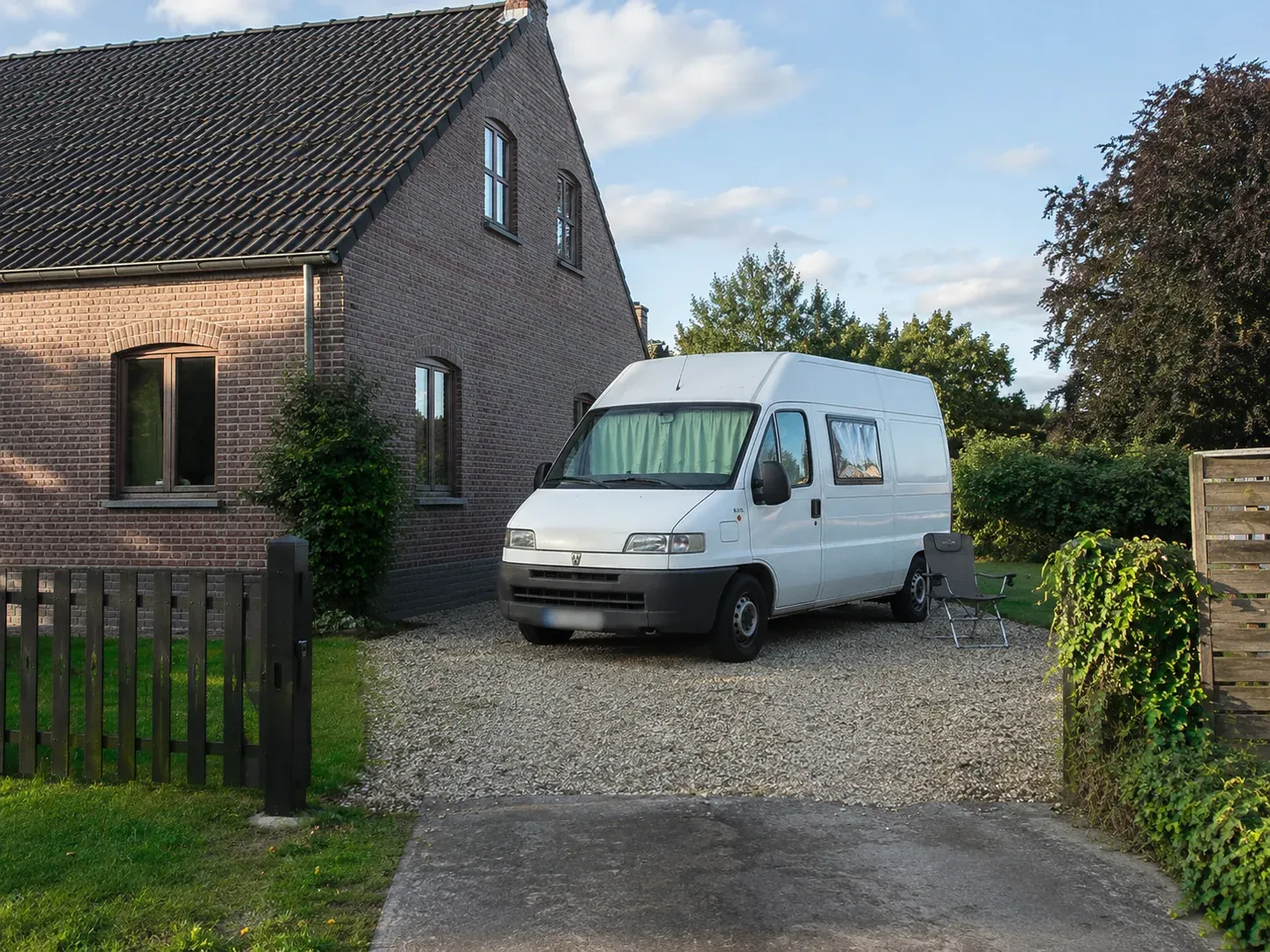
It sounds logical: you own a piece of land, you have a van, camper, caravan, or mobile home, so why shouldn't you be allowed to live there?
Your own land, your own rules. Right?
Unfortunately, it's not that simple in Flanders. Whether you can live in a vehicle on your own land doesn't just depend on who owns the land. You also need to consider spatial planning, permits, the designation of the plot, housing quality, the municipality, visibility, connections, wastewater, neighbors, and your official domicile.
For vanlifers, this is an important topic. Especially for those who think: I'll buy a small piece of land later, put my bus there, install a well, and I'm done. In practice, this can conflict with regulations much faster than you expect.
Owning land doesn't mean anything goes
The biggest misconception is that you can do whatever you want on your own land.
You may own a piece of land, but that doesn't automatically mean you can live there, build, pave, camp, permanently place a camper, or create a residential function.
In Flanders, land has a designation. A plot can, for example, be residential area, agricultural area, nature reserve, recreational area, industrial area, or have another designation. Additionally, municipal regulations, subdivision regulations, spatial implementation plans, heritage rules, or other restrictions may apply.
Placing a vehicle on your land might seem less intrusive than building a house. But as soon as the vehicle serves as a permanent or long-term dwelling, the authorities don't just look at the wheels. They look at the actual use.
Parking is different from living
There is an important difference between parking a vehicle and actually living in it.
Temporarily parking a motorhome or camper in your driveway because you're not using it is not the same as permanently sleeping, cooking, showering, and organizing your life in it.
Flanders states that, in principle, an environmental permit is required for placing caravans, campers, or tents, unless you meet the conditions for an exemption. One of those conditions for a movable installation is precisely that you do not actually live in it.
That is the core of the article.
Leaving a camper on your land can sometimes be done without a permit under certain conditions. Living in that camper is another story.
The exemption for one movable installation
There is an exemption for placing one movable installation that can serve as a dwelling, such as a mobile home, camper van, or tent. But that exemption has clear conditions.
Important conditions include:
- it concerns one movable installation
- it must not be visible from the public road
- it must be within a 30-meter radius of the dwelling
- there must be no residential function
- so you are not allowed to actually live in it
- the project must not conflict with local regulations
- it must not be located in a spatially vulnerable area
- the municipality may impose stricter rules
For vanlifers, that one point is particularly crucial: without a residential function.
In other words: placing your camper in the garden for storage, as a hobby space, or as a temporarily stationary vehicle can, in certain cases, fall under an exemption. Using your camper as an actual home does not automatically fall under that.
Occupancy almost always requires a permit
Flanders is quite clear: if a structure is occupied, a permit is always required.
This applies not only to traditional homes. Container homes, yurts, tiny houses, mobile homes, and other structures can also fall under this. A vehicle or camper van that stands in one place for a long time and is effectively used as a dwelling cannot simply be treated as a regular parked camper.
The argument "but it has wheels" is therefore not always enough.
If your bus effectively becomes a permanent living unit, people look at the reality: do you use that place as a residence? Does it stay there for a long time? Are there connections? Is there an interior? Do you receive mail there? Do you want to establish your main residence there? Then you quickly enter the realm of living and spatial planning.
What if the vehicle remains movable?
That the vehicle moves as a residence? Does it stay there for a long time? Are there connections? Is there an interior? Do you receive mail there? Do you want to establish your main residence there? Then it remains movable, does not automatically help.
For example, a tiny house on wheels is viewed differently depending on whether it is truly used nomadically or remains in one place for a long time. If such a movable dwelling remains in a place for a longer period with the intention of living there, it can be considered as real estate or an independent dwelling.
For a van or camper, the same logic applies in a practical sense. If you drive it around and stay temporarily in different places, it is a vehicle. If you leave it on the same plot for months or years and live there, it becomes much more than just parking.
I completely understand the appeal. A piece of land, some peace and quiet, your bus, maybe a dog, and no more rent. That sounds wonderful. But administratively, that's precisely the kind of situation where Flanders doesn't just say: go ahead.
Living on building land
Suppose you have building land in a residential area. Are you allowed to live in your van there temporarily?
That is also not automatically permitted.
Building land means that a dwelling can be built there under certain conditions. It does not mean that you can place a vehicle there without a permit and use it as a dwelling.
Sometimes temporary living in a caravan, living unit, or camper is tolerated during a renovation or construction, but that depends heavily on the municipality and the specific situation. Often, at least consultation or a temporary permit is required. Sometimes it's not possible.
The municipality then looks at, for example:
- duration of the stay
- reason for the stay
- sanitary facilities
- safety
- nuisance to neighbors
- visibility
- connection to utilities
- designation of the plot
- ongoing building permit or renovation
- local regulations
So, don't just assume that building land equals the right to live in a vehicle.
Living on agricultural land
Agricultural land is even more sensitive.
Buying a piece of agricultural land and putting a camper there to live in is usually not a realistic solution. Agricultural land is intended for agriculture, not for ordinary residential living.
Even if you own the plot, you are not allowed to simply place and occupy a camper, caravan, tiny house, or living unit there. The designation of the land remains decisive.
A temporary overnight stay during work on the land is not the same as making it your main residence. Especially if there is no agricultural activity, this quickly becomes problematic.
For vanlifers, this is important because cheap land often does not have a residential designation. So, cheap does not automatically mean usable.
Living in a recreational area or on camping grounds
Recreational area sounds more logical at first glance. A camper, caravan, or mobile home fits better there than on agricultural land.
But even there, you need to be careful. Recreation is not the same as permanent residency.
Permanent living on campsites, weekend residences, or recreational grounds has long been a known problem in Flanders. It can conflict with spatial planning, housing quality, municipal policy, and the designation of the terrain.
A recreational stay is intended for temporary stays, not automatically for making it your main residence.
If you really want to live permanently on such a site, you must check very carefully beforehand whether that is legally possible. Often the answer is not simple, and sometimes simply no.
What if you temporarily live in your bus during a renovation?
This is one of the more understandable situations.
You are renovating your house, your bathroom is open, your kitchen is out, and you want to temporarily sleep in your camper or bus on your own land. In practice, this often happens.
But even temporary does not automatically mean permit-free.
If you effectively occupy a camper or living unit, a permit may be required. Some municipalities deal with this pragmatically, especially if it is temporary, limited, and linked to a real renovation. Other municipalities are stricter.
My advice: ask your municipality about this beforehand. Clearly explain:
- why you want to stay temporarily in the vehicle
- how long it would take
- where the vehicle is located
- how sanitation, water, and electricity are arranged
- whether there is nuisance to neighbors
- whether there is an ongoing permit or renovation
A short conversation beforehand is better than a complaint or inspection afterward.
What about a driveway next to your home?
Parking a camper in the driveway is normal for many people. But here too, the difference between parking and living remains important.
If you place a camper next to your home and simply use it as a vehicle or for storage, this can, in certain cases, fall within the exemption. But there are conditions, such as visibility from the public road, distance to the dwelling, no residential function, and local rules.
If you let someone live in it permanently, it becomes a different story.
For example: your adult child lives in the camper in the driveway. Or your partner sleeps there structurally. Or you use the camper as an extra room for long-term occupancy.
Then you are no longer in the story of a parked vehicle. Then you are effectively creating an extra residential function.
Can someone else live in your camper on your land?
That is also not simply allowed.
If someone else lives in your camper on your land, this can be seen as providing accommodation. Then questions arise about permits, housing quality, domicile, rent, insurance, liability, and possibly tourist accommodation if it is offered for a fee and on the market.
Letting friends or family stay for a few nights for free is different from letting someone live permanently in a camper on your plot.
If you rent out a camper pitch or let people stay overnight on your property for a fee, rules regarding tourist accommodation may also apply. Toerisme Vlaanderen indicates that accommodation offered to guests for a fee must be registered and meet basic standards regarding safety, quality, insurance, and hygiene.
A camper on your own land is therefore not automatically a mini-campsite.
Utilities make it more sensitive
As soon as you start providing connections, it becomes less credible that it's just about parking.
Think of:
- fixed electricity connection
- water pipe
- wastewater discharge
- sewerage
- septic tank
- rainwater harvesting
- fixed gas installation
- wooden terrace
- fencing
- outbuilding
- canopy
- mailbox
- fixed stairs or platform
By itself, not every element may be immediately prohibited. But together, they show that the vehicle is no longer just parked. It then becomes a living arrangement.
Wastewater, in particular, is important. A bus that is lived in produces dirty water, toilet contents, waste, and household use. This must be processed correctly. Emptying a jerrycan in the garden or laying a greywater pipe to a ditch is not a solution.
Domicile in a vehicle on your own land
Can you establish your domicile in a vehicle on your own land?
That depends on the specific situation and the municipality, but it is certainly not something you should just expect.
Your main residence is where you actually live. But if that residence is not spatially permitted or not acceptable, it can cause problems. The municipality can investigate whether you actually live there, but also whether the situation is legally and administratively correct.
A domicile does not solve a permit problem. And conversely, a permit does not automatically make everything in order for domicile.
These are two different questions:
- Am I spatially allowed to live here?
- Can I administratively have my main residence here?
Both must be correct.
Housing quality: a vehicle is not automatically a home
Every home in Flanders must meet minimum requirements regarding safety, health, and housing quality.
A regular delivery van or camper is not automatically built for that. Think of minimum surface area, ventilation, sanitary facilities, safety, stability, moisture, electricity, heating, and general habitability.
For nomadic use as a vehicle, that's one story. For long-term fixed occupancy on one plot, the assessment is different.
A bus can be comfortable for travel and temporary living, but that does not automatically mean it is accepted as an independent dwelling.
That may be frustrating, but it is logical. A camper is designed as a vehicle and temporary accommodation on the road, not necessarily as a permanent home on a plot.
Care housing is a separate regulation
Sometimes people think of a camper or mobile unit in the garden as a solution for parents, people in need of care, or family.
For this, there is a separate regulation in Flanders regarding care housing and mobile care units. But that is not the same as arbitrarily living in a camper on someone's land.
Care housing has conditions, procedures, and limitations. In certain cases, a notification is sufficient; in other cases, a permit is required. It also concerns a specific care situation, not ordinary vanlife.
If this is your situation, specifically look at the rules regarding care housing and contact your municipality.
What if you only sleep in it on weekends?
Sleeping in your camper on your own land occasionally is less serious than permanent living, but even here, caution is needed.
Camping a few nights in your own garden will, in practice, often cause fewer problems than permanent occupancy. But as soon as it becomes structural, visible, causes nuisance, or resembles an extra living unit, the municipality can ask questions.
Local rules can also be stricter.
The difference between temporary use and occupancy is not always one exact boundary. It depends on duration, regularity, furnishing, connections, and the actual situation.
Neighbors and complaints
Even if you think no one is bothered, neighbors can play a role.
Complaints often arise from:
- visibility from the street or neighbors
- noise
- smoke or odor
- parking
- privacy
- waste
- extra residents
- light
- messy arrangement
- use of garden or driveway
- suspected illegal occupancy
A complaint can be enough to make the municipality investigate. And if the situation is not correct, it can become difficult.
Therefore, it is smart to work not only legally but also practically neatly. A bus that is discreet, clean, and temporarily placed attracts less attention than a messy permanent living space with cables, barrels, and waste next to it.
Enforcement: what can happen?
If you live in a vehicle on your own land without a permit, the municipality or government can take action.
This can start with a warning or a request for explanation. But it can also lead to a regularization request, refusal, remedial measures, fines, or an obligation to cease the situation.
The exact consequences depend on the municipality, the seriousness, the location, and the regulations being violated.
So, don't wait until enforcement comes. Ask beforehand what is allowed and what is not.
What is usually more realistic?
For vanlifers who want a fixed base, there are often safer options than permanently living in a vehicle on arbitrary land.
Think of:
- maintaining a real home or room as your main residence
- traveling temporarily with notification of temporary absence
- a reference address if you do not have a fixed residence and meet the conditions
- staying at official camper pitches or campsites for temporary stays
- finding a permitted dwelling or small-scale dwelling
- a recognized mobile home site if that suits your situation
- consulting with the municipality about a temporary solution during renovation
- nomadic use of your vehicle without a fixed residential pitch
No solution is perfect. But some solutions are much less risky than permanently placing a camper on a piece of land and hoping no one says anything.
Common mistakes
A first mistake is thinking that owning land automatically grants the right to live there. That is not correct.
A second mistake is ignoring the difference between parking and living. Storing a camper is different from living in it permanently.
A third mistake is relying on the exemption for one movable installation, while that exemption precisely does not allow a residential function.
A fourth mistake is buying cheap agricultural land and thinking you can live there because there is a camper on wheels.
A fifth mistake is installing connections, a terrace, drainage, and a mailbox and still claiming it's temporary parking.
A sixth mistake is offering a camper pitch for a fee without considering accommodation rules, insurance, and spatial planning.
A seventh mistake is waiting until neighbors complain instead of talking to the municipality beforehand.
Practical checklist
Before you want to live in a vehicle on your own land, it is best to check:
- What is the designation of the plot?
- Is it in a residential area, agricultural area, recreational area, or vulnerable area?
- Are there RUP, BPA, or subdivision regulations?
- Is there already a permitted dwelling on the plot?
- Is the camper visible from the public road?
- Is it within 30 meters of the dwelling?
- Is it about storage, temporary use, or actual occupancy?
- Are there utilities or fixed connections?
- How is wastewater processed?
- Do you want to establish your main residence there?
- Is an environmental permit required?
- Are there municipal rules that are stricter?
- Are there neighbors who might experience nuisance?
- Is it for private use or rental to others?
- Does Toerisme Vlaanderen need to be involved for paid accommodation?
- Does the living solution meet safety and quality requirements?
This checklist does not replace advice from your municipality, but it does help you ask the right questions.
Conclusion
Living in a vehicle on your own land is not simply allowed in Flanders.
Placing a camper, caravan, mobile home, or van on your own property is often permit-sensitive. Under certain conditions, there is an exemption for one movable installation, but this applies without a residential function. As soon as you actually live in it, it becomes a different story, and a permit is, in principle, required.
Owning the land is therefore not enough. You need to look at the designation of the plot, local rules, spatial planning, housing quality, utilities, wastewater, visibility, and your official domicile.
My advice: never buy land with the idea "I'll just put my bus on it" without first talking to the municipality. A good van gives freedom, but a wrong plot can trap you in administrative misery. First arrange the land, permit, and official basis. Only then pursue the dream of your own peaceful place.
Source: https://www.vlaanderen.be/omgevingsvergunning/stedenbouwkundige-handelingen/opslag
Source: https://www.vlaanderen.be/omgevingsvergunning/stedenbouwkundige-handelingen
Source: https://www.vlaanderen.be/bouwen-wonen-en-energie/bijzondere-woonvormen/kleinschalig-wonen
Source: https://www.vlaanderen.be/aanmelding-en-erkenning-van-een-toeristisch-logies