Full-time vanlife as a couple: what if one person has a fixed address and the other does not?
Full-time vanlife as a couple sounds simple as long as you only think about everyday life. You drive together, sleep together, share costs, make plans together and live mostly within the same few square metres. Administratively, it is less simple.
By Laurens De Leeuw · 24 June 2026
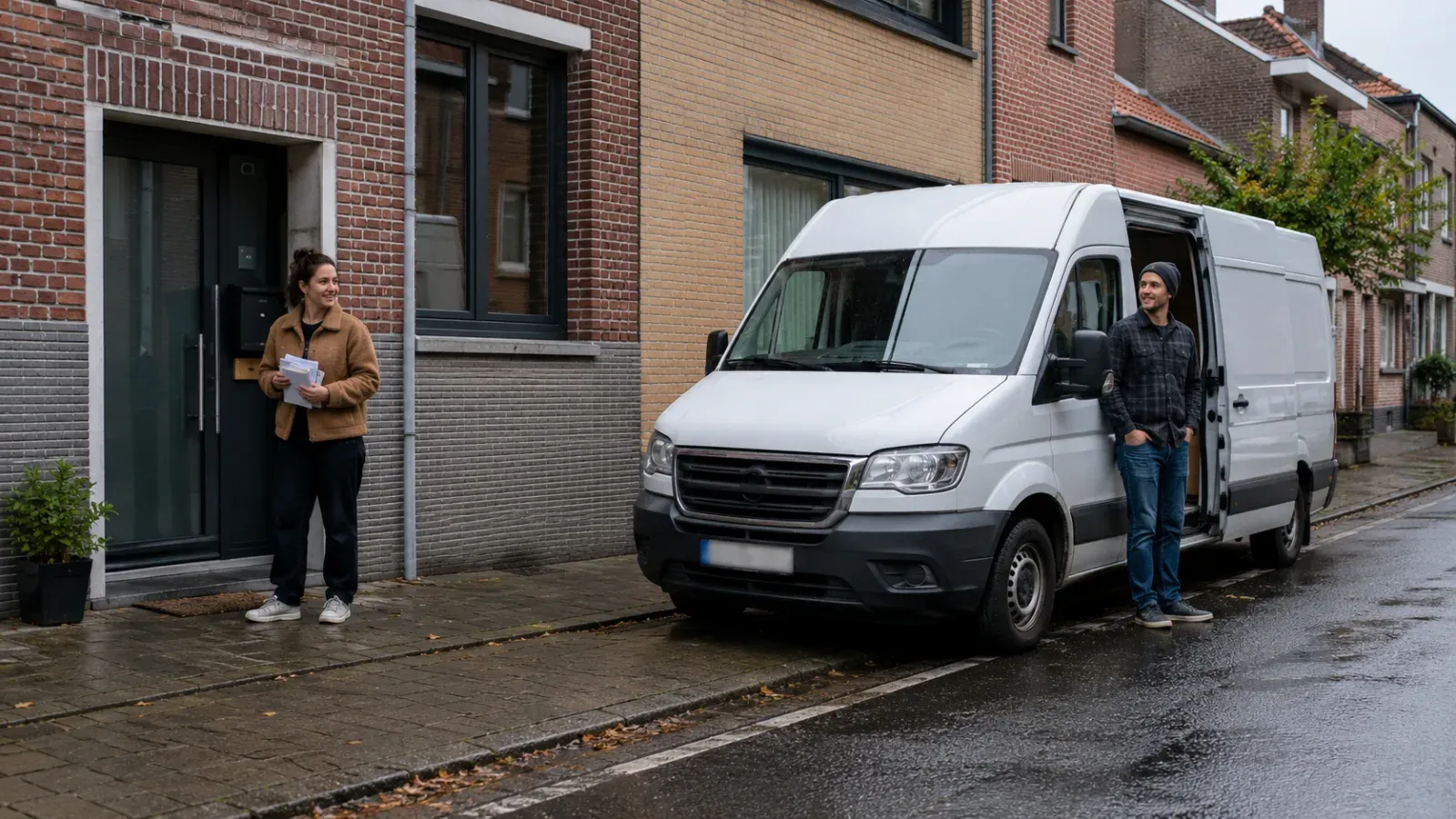
Full-time vanlife as a couple sounds simple as long as you only think about everyday life. You drive together, sleep together, share costs, make plans together and live mostly within the same few square metres.
Administratively, it is less simple.
Because as soon as one partner still has a fixed address and the other does not, you run into questions about domicile, main residence, reference address, household composition, taxes, insurance, health insurance fund, benefits and official letters.
The key question is really this: what officially reflects reality?
And in Belgium, that matters more than many people think.
First things first: your main residence must reflect reality
In Belgium, everyone must be registered in the municipality where they have their main residence. That main residence is the place where you usually live and where you actually stay for most of the year.
That means your address is not simply a practical choice. It must match your real situation.
For a couple living full-time in a van, that is precisely the difficult point. If in practice you live together in the van, but one person remains officially registered at a conventional address and the other does not, you need to ask yourselves whether that still matches the facts.
An administrative solution is only a good one if it is not just convenient, but also defensible.
Can one partner have a fixed address while the other does not?
Yes, that is possible in some situations. But it depends entirely on the facts.
If one partner genuinely still has a fixed main residence, actually lives there and bases their life there, while the other partner has a different administrative arrangement, then that can work.
But if, as a couple, you mainly live and spend your lives together in the van in reality, it becomes harder to say that only one of you lives there and the other does not.
The authorities do not only look at what is on paper, but also at the real situation. Where do you actually live? Where do you usually sleep? Where can you be reached? Where are your day-to-day interests located?
That is why this is not something you should solve by saying, "we'll just register it that way". You need to start from your actual living situation.
The difference between being in a relationship and having a residential address
Being in a relationship is not the same as living at the same address.
You can be a couple without being domiciled at the same address. That is not prohibited in itself. But as soon as you do live together in practice, it becomes more sensitive administratively.
Especially when it comes to:
- legal cohabitation
- marriage
- de facto cohabitation
- benefits
- health insurance fund
- household composition
- tax returns
- children
- social benefits
So it is entirely possible for you to be a couple emotionally and practically, while having a different administrative status. It just has to match reality.
Scenario 1: one partner genuinely keeps a regular home base
This is usually the simplest scenario.
For example: one partner still has an apartment, room or home where they actually live, stay regularly, receive mail and rely on administratively. The other partner travels along more often or has a separate arrangement, such as a reference address.
In that case, it can be perfectly possible for one partner to have a regular main residence while the other is not registered at exactly the same address.
But even then, you need to look carefully at reality. If you ultimately end up living together in the van almost permanently and that home becomes mainly a paper address, then things start to become problematic.
Scenario 2: one partner remains officially registered with family or at their own home, but in reality you live together in the van
This is probably the most common scenario, and also the one with the greatest risks.
On paper, it seems convenient. One partner keeps a fixed address. The other partner joins them or has another temporary arrangement. But if in reality you live together full-time in the van, things can go wrong administratively.
Why?
Because your main residence must be the place where you usually live. If the partner with the fixed address barely stays there anymore, their registration at that address may be called into question.
That can have consequences for:
- the municipality and population register
- household composition
- taxes
- benefits
- health insurance fund
- social benefits
- insurance
- official documents
I completely understand why couples try to arrange things this way. But this is exactly the kind of arrangement that seems simple at first glance and can cause problems later on.
Scenario 3: one partner has a main residence, the other has a reference address
That can happen too.
A reference address is intended for people who do not have an official residence but still need to remain administratively reachable. The person whose address you use as a reference address must give permission and must have their own main residence there.
For a vanlife couple, this can mean that one partner has a regular domicile and the other officially uses a reference address.
But here too, the same basic principle applies: it must fit the facts and the conditions for a reference address. A reference address is not a regular residence, nor is it a trick to hide cohabitation administratively.
If you are in fact living together as a couple, it is wise to check with the municipality in advance how they assess your situation.
Legal cohabitation: is it possible if you do not live at the same address?
Legal cohabitation is linked to sharing a home. To establish it, you make a declaration at the municipality where you live.
In practice, that means that if you want to be legally cohabiting, the administration expects you to have a shared home base.
So if one partner has a fixed address and the other does not, legal cohabitation is not straightforward. Put differently: it becomes difficult to be legally cohabiting if you do not administratively have a shared home base.
For couples who are already legally cohabiting and then find themselves in a more complex vanlife situation, it is even more important to check whether their administrative status still matches the facts.
De facto cohabitation: why this matters too
FOD Financiën distinguishes between de facto cohabitants and legal cohabitants for personal income tax purposes. De facto cohabitants are people who live at the same address without being married or legally cohabiting. For tax purposes, they are still considered single.
That may seem like a detail, but it shows how important the address remains. Without a shared domicile, you are not automatically considered "cohabiting" in that sense for tax purposes.
For full-time vanlife couples, this is an important insight: a relationship and an address are not automatically the same thing. But as soon as you are or are not registered at the same address somewhere, it does have consequences.
Household composition: not unimportant
Household composition is an extract from the population register listing all people who live at the same domicile.
If one partner has a fixed address and the other is not registered at that address, you will not appear together on the same household composition certificate.
That can matter for:
- school and children
- Groeipakket
- social benefits
- health insurance fund
- benefits
- certain administrative files
- rental or housing-related files
Sometimes that may seem convenient, but it can also show that the paperwork does not match the actual situation.
What about taxes?
Taxes are sensitive, but the basis is fairly clear: your tax treatment depends in part on your civil status and your domicile.
De facto cohabitants are taxed separately for personal income tax. Legal cohabitants and married couples fall under a different tax framework.
For vanlife couples, this means you should not only look at "where does my mail go?", but also at the broader tax consequences of your official situation.
Personally, I would never rely too much on gut feeling here. If your situation differs from that of a conventional cohabiting couple, consult an accountant or FOD Financiën. Especially if one partner still has a home, the other uses a reference address, or children are involved.
What about health insurance and benefits?
This is where it becomes especially important.
With the health insurance fund, incapacity for work, unemployment, living wage or other benefits, your address and household situation can directly affect your entitlements, categories and amounts.
The administration looks at, among other things:
- where you officially live
- who you live with
- whether you are single or cohabiting
- whether you have dependants
- whether you can be reached
- whether your situation is factually correct
So if one partner remains officially registered elsewhere while you actually live together full-time in the van, that can have consequences.
It is not just a technical detail. It can also have a financial impact.
Insurance and vehicle administration
Your address also remains important for your vehicle and insurance.
Think about:
- car insurance
- roadside assistance
- vehicle registration
- road tax
- vehicle inspection
- possible camper insurance
- travel assistance
- mail from the insurer
If one partner is the registered keeper of the vehicle and is registered at a fixed address while you both live full-time in the van, that is not automatically wrong in itself. But the insurer does need to know the reality, especially if the van has become your real home base.
In the event of damage, you do not want a dispute about an address or use that does not match the policy.
Temporary absence can sometimes help
If one partner genuinely keeps a fixed main residence and is away for a longer period temporarily, temporary absence may be relevant.
Vlaanderen states that you can report a temporary absence to avoid being removed from the population register.
But temporary absence is not a miracle solution for permanent vanlife. It mainly helps when you genuinely still have a main residence and are temporarily away. Not when, in practice, you have moved your entire life into the van.
That distinction is important.
What if you later want to be registered together at one address again?
That is usually easier than trying to live in a grey area.
If at some point you take up a regular home base again, such as a studio, home or fixed place of residence, you can report your change of address and possibly build a shared administrative situation again.
So if you see full-time vanlife as an interim phase, it is best to keep everything as clear and correct as possible along the way. That will also make returning to a conventional administrative situation easier later on.
Children make everything more sensitive
If children are involved, this topic becomes even more important.
Then it is not only the adults' addresses that matter, but also:
- the child's domicile
- school or home education
- Groeipakket
- health insurance fund
- parental authority
- household composition
- official letters
- compulsory education
With children, I would be even less inclined to use "creative" address arrangements. A child's file needs stability on paper, even if you live a mobile life.
What is usually the safest approach?
The safest approach is usually the simplest one: make sure your administrative situation matches reality as closely as possible.
In practice, that often means one of these options:
- one partner genuinely still has a fixed main residence, and that is also factually correct
- both partners have an arrangement that correctly fits their real situation
- you discuss with the municipality in advance how your specific vanlife situation should be assessed
- you only use a reference address if it genuinely meets the conditions
- you avoid arrangements that are only convenient on paper
I know that sounds less romantic than "we'll just hit the road together". But in the long run, it brings much more peace of mind.
Common mistakes
A first mistake is thinking that one partner can simply keep a fixed address "for administrative purposes", even if that address is no longer their actual main residence.
A second mistake is thinking that being in a relationship automatically means you are also administratively cohabiting. That is not the case.
A third mistake is using a reference address as if it were simply a second domicile.
A fourth mistake is not taking household composition, taxes or benefits into account.
A fifth mistake is assuming that the municipality only looks at paperwork and not at reality.
A sixth mistake is not clearly explaining to the insurer how you really live and travel.
Practical checklist for couples
Before you start full-time vanlife as a couple while one partner still has a fixed address, it is best to check:
- Where does each partner actually live for most of the year?
- Is the fixed address genuinely still a main residence?
- Are you officially married, legally cohabiting or de facto partners?
- Does that official status still fit your actual living situation?
- Does one partner use a reference address, and does it meet the conditions?
- Does the household composition match the facts?
- Are the tax authorities, health insurance fund and insurer aware of the correct situation?
- Are there benefits or social advantages that may be affected by cohabitation?
- Is temporary absence relevant or not?
- Can you be reached for official mail?
- Are children involved?
- Have you already discussed this situation specifically with the municipality, an accountant or the competent authority?
Conclusion
Yes, full-time vanlife as a couple where one person has a fixed address and the other does not can work in certain situations. But it only works if that administrative situation genuinely matches reality.
In Belgium, a main residence is not just a piece of paperwork, but the place where you usually live. If in reality you mainly live together in the van as a couple, you need to look at that honestly. Keeping a fixed address "for convenience" may seem useful, but it can cause problems if that address is no longer the real main residence.
For couples, it is therefore wise to think not only in terms of practical solutions, but correct ones. Better to be a little less creative on paper and much more at ease in practice.
Source: https://www.belgium.be/nl/huisvesting/verhuizen/hoofdverblijfplaats
Source: https://www.vlaanderen.be/referentieadres
Source: https://www.belgium.be/nl/familie/koppel/samenwonen/wettelijk_samenwonen
Source: https://fin.belgium.be/nl/particulieren/belastingaangifte/persoonlijke-situatie/huwelijk-samenwonen
Source: https://www.vlaanderen.be/attest-van-gezinssamenstelling