Vanlife with children: domicile, compulsory education and practical administration
Vanlife with children sounds like a dream to many people: more time outdoors together, fewer possessions, more freedom, seeing different places and living more consciously as a family. No rushed mornings, no packed schedule, no house that always demands attention.
By Laurens De Leeuw · 24 June 2026
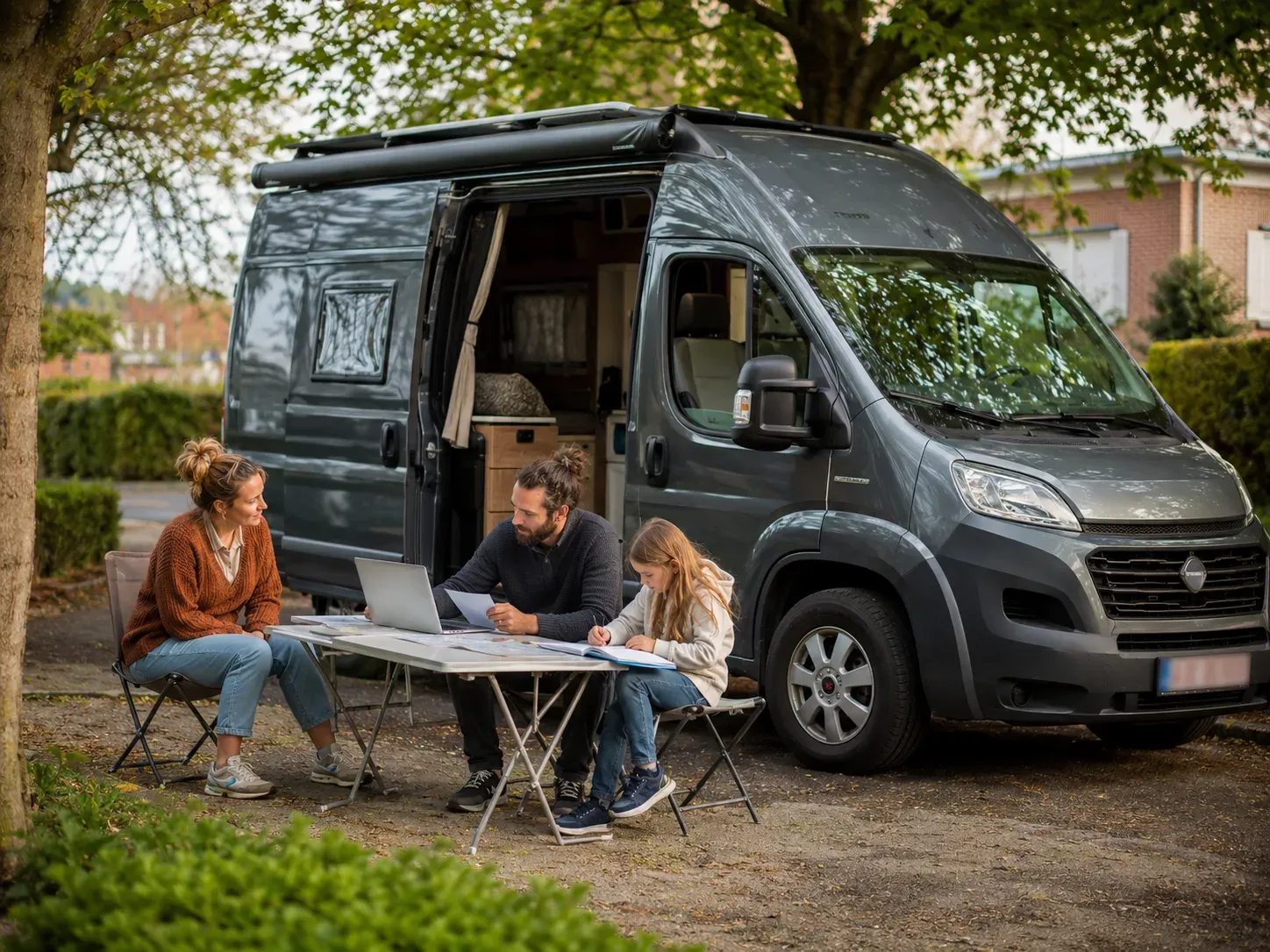
Vanlife with children sounds like a dream to many people: more time outdoors together, fewer possessions, more freedom, seeing different places and living more consciously as a family. No rushed mornings, no packed schedule, no house that always demands attention.
But as soon as children are involved, vanlife becomes a lot more serious administratively.
You don't just have to think about where you sleep, how to drive safely, and where to find water. You also need to think about domicile, compulsory education, school, homeschooling, health insurance, Groeipakket (Child Benefit), mail, official letters, parental authority, and accessibility.
Because children don't make vanlife impossible, but they do ensure that you have to arrange everything much better.
First this: in Belgium, there is compulsory education, not compulsory schooling
An important distinction: in Belgium, there is compulsory education, not compulsory schooling.
This means that children must learn, but not necessarily always attend classes in a traditional school. Most children go to an accredited school, but homeschooling is also possible.
For vanlife families, this distinction is important. In certain cases, your child may therefore receive education outside the traditional school walls. But that doesn't mean you can just travel around without reporting anything, without a plan, without follow-up, and without documents.
Compulsory education remains compulsory education. Even if your child lives in a bus, travels, or does not have a traditional fixed place of residence.
From when does compulsory education apply?
In Belgium, compulsory education applies to children aged 5 to 18.
For 5-year-old children, this means 290 half-days of lessons. This is not the same as being obliged to attend full-time every day, as with older children, but it is still compulsory education.
From the age of 6, it becomes stricter. Then, in principle, a child must go to school every school day, except in cases of justified absence, or must comply with compulsory education in another valid way, for example, through homeschooling.
Compulsory education normally continues until the age of 18. Anyone who already obtains a secondary education diploma is no longer subject to compulsory education.
For vanlife, this means: traveling with a baby, toddler, or young preschooler is administratively different from traveling with a child subject to compulsory education. From the age of 5, you really need to include education in your plan.
Children without a fixed place of residence are also subject to compulsory education
Flanders explicitly states that children of inland waterway skippers, fairground and circus operators, artists, and caravan dwellers are subject to compulsory education just like everyone else.
Students with a reference address in Belgium are also subject to Belgian compulsory education and are monitored.
This is very important for vanlife families. So you cannot say: “We live mobile, so the normal rules do not apply.” The government still looks at compulsory education.
Only those who are deregistered in Belgium and have their official residence abroad are no longer subject to Belgian compulsory education. Then the rules of the country where you officially live apply.
Domicile remains important
As a family, you need an administrative base. This is even more true with children.
Your official address affects:
- identity card and Kids-ID
- registration in the population register
- school and compulsory education control
- Groeipakket and school allowance
- health insurance fund
- official letters
- bank and insurance
- municipality
- parental authority and family administration
- registration of your vehicle
- tax and official communication
If, as a parent, you give up your home and live full-time in a van with children, you must know in advance what will happen administratively.
Will you officially continue to live somewhere? Do you use a reference address? Are you leaving temporarily and maintaining a main residence? Are you officially moving abroad? These are very different situations.
A reference address can help, but it doesn't solve everything
A reference address can be useful if you are staying in Belgium but do not have an official address. Flanders mentions, among others, homeless people, people on a ship, or caravan dwellers as examples of situations in which a reference address may be possible.
With a reference address, you remain administratively accessible to official bodies. You can also receive benefits from bodies that require an official address as a condition.
But a reference address is not a place of residence. You are not allowed to stay overnight permanently. It is an administrative address.
For children, it is extra important to realize that a reference address does not make compulsory education disappear. Children with a reference address in Belgium remain subject to Belgian compulsory education.
Fake domicile is not a solution
Some people think: we'll just put our address with family or friends, and then we'll travel on.
This can only be correct if it corresponds to reality.
A domicile is your main residence. That is the place where you actually live. If you don't live there, but are only on paper, that can cause problems. Especially with children, benefits, school, Groeipakket, or social controls.
A fake domicile can have consequences for you, but also for the person with whom you supposedly live. Think of family composition, benefits, social advantages, debts, bailiffs, taxes, and official controls.
With children, I would be even more careful with this. You don't want to lay an administratively shaky foundation under your family.
Can you continue school and travel: is that possible?
Yes, but not just like that.
If your child is enrolled in an accredited school, they must, in principle, be present at school. Traveling outside school holidays is normally not a valid reason for absence. Flanders calls this luxury truancy, and then you are not in order with compulsory education.
There are specific situations where children in primary education can go on trips under certain conditions, for example, with parents without a fixed place of residence, such as itinerant professional groups. The school then provides distance education, and agreements must be made in advance in an agreement with the school.
But that is not a general free pass for every family that wants to travel with a van. You must discuss this with the school in advance and follow the rules.
Homeschooling as an option for vanlife families
Because Belgium has compulsory education and not compulsory schooling, homeschooling can be an option.
Homeschooling can be individual, where you, as a parent, teach yourself or hire a private tutor. It can also be collective, for example, through a private school or together with other parents.
For vanlife families, homeschooling often sounds logical. Your child learns on the road, sees different places, works at their own pace, and education can be intertwined with travel.
But homeschooling is not a “we'll see on the way” story. You must officially report it, organize it, follow it up, and be able to demonstrate that your child complies with compulsory education.
You must officially report homeschooling
If you want to organize homeschooling, you must submit a declaration of rights and obligations regarding homeschooling.
This declaration must be submitted no later than the third school day of the school year. It is valid for one school year, until August 31. Every school year that you organize homeschooling, you must re-register.
Your child cannot be enrolled in an accredited school and follow homeschooling at the same time. So you have to choose.
Switching during the school year is not possible just like that, except in exceptional situations. If your child is enrolled in an accredited Flemish school and you want to switch to homeschooling during the school year, you must inform the CLB (Centre for Pupil Guidance). Homeschooling can then only start if the CLB does not submit a motivated objection within the foreseen period.
Homeschooling means taking responsibility yourself
With homeschooling, you can determine the daily schedule and holiday periods yourself. The Flemish government does not impose diploma requirements on the teacher. So you, as a parent, can teach yourself.
But you are responsible for the content and follow-up.
The education must be aimed at your child's development and preparation for an active life as an adult. The government does not impose fixed subjects, books, or curricula for homeschooling, but if your child wants to obtain diplomas or certificates, they must ultimately achieve the necessary educational goals.
For vanlife, that is both beautiful and difficult. You get freedom, but you also get responsibility.
CLB remains important
Children who follow homeschooling must also participate in the systematic contacts of the CLB, the former medical examinations.
With the declaration for homeschooling, you must choose a CLB from the province where your child lives at the start of the school year. That CLB creates or manages your child's multidisciplinary file.
For a mobile family, this means that you not only have to think about teaching, but also about medical and pedagogical follow-up. Where do you plan CLB contacts? How do you remain accessible? How do you store documents? What if you are abroad?
These are things you need to arrange in advance, not just when a call comes.
Exams for homeschooling
Homeschooling does not mean that there is never control or evaluation.
Children in homeschooling must participate at fixed times in exams of the examination boards for primary and secondary education.
For primary education, you must enroll your child during the school year in which they turn 11 before January 1. If you enroll too late, you must enroll your child in an accredited school.
Your child must also obtain the primary education certificate within the foreseen period. If that does not work or if the child does not succeed after two attempts, they must go to school.
For secondary education, fixed enrollment times and expectations at the examination board also apply.
Practically, this means: homeschooling on the road is possible, but you have to plan ahead. You cannot vaguely “learn on the road” for years without taking into account exams, deadlines, and evidence.
Children and traveling abroad
Many vanlife families want to go to France, Spain, Portugal, Scandinavia, or further. This is possible, but compulsory education depends on your official place of residence.
If your child remains domiciled in Belgium, they also remain subject to Belgian compulsory education. Then you must demonstrate how your child complies with compulsory education, for example, through education abroad or through homeschooling.
If your child attends school abroad while officially remaining domiciled in Belgium, you must be able to demonstrate this with a certificate of enrollment from the foreign school and provide the necessary information to the Compulsory Education Control unit.
If you provide homeschooling to your child abroad while they remain domiciled in Belgium, you must submit a declaration for homeschooling each school year.
If you are deregistered in Belgium and your child has their official residence abroad, the compulsory education of that country applies. Then you must check in advance what rules apply there.
A long trip is different from emigrating
Traveling for a few months while maintaining a Belgian residential base is different from officially moving abroad.
If you officially continue to live in Belgium, you remain in the Belgian system. That means Belgian administration, Belgian compulsory education, and Belgian follow-up.
If you actually move abroad, that changes. Then you enter the education system and compulsory education rules of your new country of residence.
That sounds simple, but many families are somewhere in between: they want to travel around, not really emigrate, but also not maintain a traditional place of residence. That's when you need to be extra careful.
School allowance and Groeipakket
Children may be entitled to Groeipakket and possibly school allowance, but enrollment, attendance, income, and official data also play a role there.
For the school allowance, conditions include school enrollment, sufficient attendance, and family income. With homeschooling, you are not entitled to school allowance.
This is important if you are financially counting on certain amounts. Anyone who switches to homeschooling or is on the road for a long time must therefore not only look at compulsory education, but also at possible consequences for allowances.
Always check this with your Groeipakket payer, especially if your address, family situation, or type of education changes.
Mail and official letters
With children, mail becomes even more important.
You can receive letters from:
- school
- CLB
- AGODI or compulsory education control
- municipality
- health insurance fund
- Groeipakket
- court or lawyer for parental authority
- insurer
- bank
- childcare
- youth work
- sports club
- mutual insurance company
If you live full-time in a van, you therefore need a reliable mail system.
Activate My eBox where possible, but don't rely solely on digital. Have physical mail followed up by someone you trust. Make clear agreements about registered letters, official letters, and documents from school or government.
A child's file should not remain unopened in a mailbox for weeks.
Kids-ID, identity card and travel
For traveling with children, you also need to think about identity documents.
Within Europe, you often need a Kids-ID or identity card, depending on age and destination. Outside Europe, a passport may be required. Some countries require additional documents when one parent travels alone with a child, especially for divorced parents or shared parental authority.
Check before departure:
- validity of Kids-ID
- passport if necessary
- consent of the other parent if relevant
- travel insurance
- European Health Insurance Card
- medical documents
- vaccinations if necessary
- contact details of doctor or specialist
- documents regarding parental authority if sensitive
This is not a luxury. At a border, airport, hospital, or police service, you don't want a discussion about missing documents.
Divorced parents and parental authority
Vanlife with children becomes even more sensitive if parents are divorced or do not travel together.
Then you have to take into account:
- parental authority
- residence arrangement
- contact arrangement
- permission to travel
- school choice
- homeschooling
- address registration
- medical decisions
- communication with the other parent
- judicial agreements
You cannot just travel around with a child for a long time if that conflicts with agreements or rights of the other parent.
When in doubt: arrange this in writing in advance and seek legal advice. Not to be difficult, but to protect your child and yourself.
Health insurance and medical follow-up
Children also need medical follow-up.
Think of:
- health insurance fund
- general practitioner
- dentist
- vaccinations
- CLB contacts
- medication
- glasses or contact lenses
- allergies
- medical certificates
- European Health Insurance Card
- travel assistance
- hospitalization insurance
- medical documents in digital form
When you are on the road, you need to know where to go. Especially with children, you don't want to improvise when something happens.
Store important medical information securely digitally and possibly also on paper in your bus.
Practical administration on the road
Vanlife with children requires structure.
Not extremely, but enough not to end up in chaos.
Think of:
- digital folder with school documents
- planning for lessons or schoolwork
- overview of learning objectives
- copies of identity documents
- contact details of school or CLB
- proof of homeschooling or school enrollment
- Groeipakket documents
- health insurance data
- insurance documents
- emergency contacts
- calendar with deadlines
- backup of documents
- fixed times for administration
If your child continues to go to school, your planning revolves around school days and holidays. If you homeschool, you have to create your own rhythm.
A bus gives freedom, but children also need predictability.
Learning on the road: beautiful, but not enough on its own
Learning on the road can be fantastic.
A child can learn about nature, history, language, money, reading maps, technology, cooking, animals, countries, and people. That is valuable. Much more than some people realize.
But spontaneous learning on the road does not automatically replace a solid education plan.
For homeschooling, you must be able to demonstrate that your child is actually receiving education. You need a rhythm, material, follow-up, and preparation. Especially if your child later has to take exams.
Vanlife can enrich education, but it should not become an excuse to leave education vague.
Social contacts
Children also need other children. Not every child equally, but social contact remains important.
On the road, this can be through:
- school
- sports club
- youth movement
- family
- friends
- other traveling families
- campsites
- workshops
- local activities
- online contact with classmates
- meetups
With full-time vanlife, you need to think about this more consciously. As an adult, you may enjoy peace and freedom, but your child must also be able to experience connection, play, and friendships.
That sometimes makes planning less free, but also richer.
Safety and space in the bus
With children, your bus is not only your home, but also their living space.
Think of:
- official seats and seatbelts
- child seats
- sleeping place
- ventilation
- heating
- gas safety
- carbon monoxide detector
- fire extinguisher
- first aid kit
- storage space for school supplies
- safe place for laptop or tablet
- privacy
- sufficient clothing and washing facilities
- routine for sleeping and eating
A bus that is perfect for one adult is not automatically suitable for a family.
I myself am quickly concerned with the practical side of a bus. But with children, I would be ten times more critical. Not because vanlife with children is impossible, but because your margin becomes smaller. Everything that is chaotic for one person becomes twice as chaotic with children.
When is vanlife with children realistic?
Vanlife with children can be realistic if:
- your administration is correctly arranged
- you have a clear address or reference address
- you know how to comply with compulsory education
- school or homeschooling is arranged in advance
- your documents are in order
- you have sufficient income or buffer
- your bus is safely equipped
- your child gets enough rest and structure
- your medical follow-up is arranged
- you have agreements about mail and official letters
- both parents or guardians agree
- you do not blindly rely on improvisation
It becomes risky if you leave without an address plan, without an education plan, without documents, without a mail system, and without clarity about rights and obligations.
Common mistakes
A first mistake is thinking that compulsory education does not apply because you live mobile. That is not correct.
A second mistake is thinking that Belgium has compulsory schooling and that homeschooling is therefore impossible. Homeschooling is possible, but it must be correctly reported and followed up.
A third mistake is deregistering a child from school without arranging homeschooling in time.
A fourth mistake is traveling outside school holidays while your child remains enrolled in school, without valid absence or agreements.
A fifth mistake is thinking that a reference address solves compulsory education. Children with a reference address in Belgium remain subject to compulsory education.
A sixth mistake is not taking into account CLB, exams, school allowance, and Groeipakket.
A seventh mistake is not following up on official mail.
An eighth mistake is planning foreign trips without identity documents, permission, or medical preparation.
A ninth mistake is underestimating social contacts and structure.
Practical checklist for parents
Before you start living in a van with children for a long time or full-time, it is best to check:
- Where are the parent and child officially domiciled?
- Is there a correct main residence or reference address?
- Is temporary absence necessary?
- Is the child subject to Belgian compulsory education?
- Does the child remain enrolled in an accredited school?
- Is homeschooling necessary?
- Has the declaration for homeschooling been submitted in time?
- Is the CLB arranged?
- Are exams or deadlines at the examination board in view?
- Is the school informed if the child remains enrolled?
- Are absences correctly arranged?
- Have Groeipakket and any school allowance been checked?
- Is physical and digital mail being followed up?
- Are Kids-ID, passport, and travel documents in order?
- Is consent from the other parent necessary?
- Are health insurance and medical documents in order?
- Is the bus safely equipped for children?
- Are official seats and child seats correct?
- Is there a realistic education and daily rhythm?
- Does the child have sufficient social contact?
This checklist is not intended to scare you off. It is intended to ensure that vanlife with children is not done haphazardly.
Conclusion
Vanlife with children can be wonderful, but it requires much more preparation than just building a bus.
In Belgium, compulsory education applies to children aged 5 to 18. There is no traditional compulsory schooling, so homeschooling can be an option, but it must be officially reported, organized, and followed up. Children without a fixed place of residence or with a reference address in Belgium remain subject to Belgian compulsory education.
Domicile remains important for school, compulsory education control, Groeipakket, health insurance, official letters, and general family administration. A fake address, forgotten mail, or vague education plan is not a good basis for a child.
My advice: first arrange the administration, then the route. If the address, education, documents, safety, and mail are correct, vanlife with children can become much calmer and richer. Freedom is beautiful, but with children, that freedom must be strong enough to build on.
Source: https://www.vlaanderen.be/onderwijs-en-vorming/leerplicht/leerplicht-van-5-tot-18-jaar/huisonderwijs