Working from your van as a freelancer: business address, VAT and administration
Working from your van sounds like the perfect combination of freedom and independence. Laptop open, coffee at hand, a view of a forest edge, parking lot or quiet street, and simply doing your work wherever you are at that moment. But mobile working doesn't mean your administration automatically becomes mobile too.
By Laurens De Leeuw · 24 June 2026
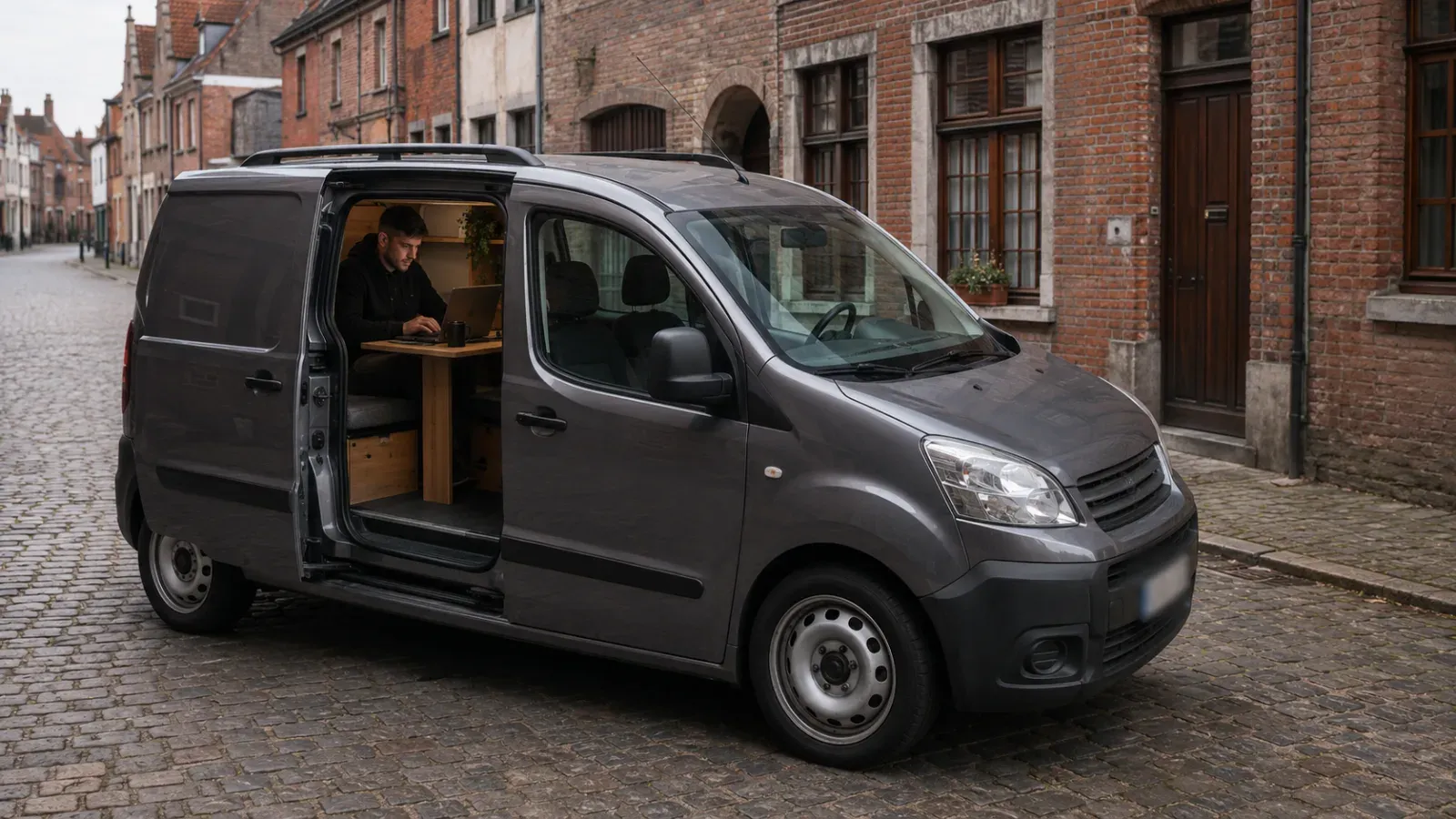
Working from your van sounds like the perfect combination of freedom and independence. Laptop open, coffee at hand, a view of a forest edge, parking lot or quiet street, and simply doing your work wherever you are at that moment.
For some vanlifers, that's a reality. Web design, copywriting, photography, online coaching, administration, marketing, support, consultancy, content creation or another digital activity: much work can be done perfectly remotely today.
But mobile working doesn't mean your administration automatically becomes mobile too. As a freelancer, you still need an official business number, correct KBO data, VAT administration, accounting, invoices, insurance, and an address where your business is administratively based.
Your van can be your workplace. But that doesn't automatically mean your van is also your business address.
Mobile working is allowed, but your business must be registered somewhere
In Belgium, every business must be registered in the Crossroads Bank for Enterprises (KBO). This registration is done through an accredited business counter. You then receive a business number and your business is included in the official database.
This also applies if you primarily work online. A self-employed web developer, designer, copywriter, consultant or content creator needs an official business just as much as someone with a shop or workshop.
The main difference lies in where you carry out your activity. A baker has a bakery. A mechanic has a workshop. But someone who works online can sometimes work from home, a coworking space, at clients' premises, on the road, or from a van.
Nevertheless, your business must remain administratively clear. The government, VAT administration, customers, banks, insurers, and accountant need to know who you are, where your business is registered, and how they can reach you.
What is a business address?
In common language, people often mean "the address of my business" when they say business address. But administratively, different concepts can apply.
For a sole proprietorship, it often refers to the address with which you, as a freelancer, are registered in the KBO and with the VAT administration. For a company, you have a registered office. In addition, a company can have one or more establishments, depending on where activities are actually carried out.
For a traditional business, this is often straightforward. Your office, shop, or workshop is where you work. For vanlifers, it's less clear because your workplace changes.
Therefore, it's important to discuss this thoroughly with your business counter or accountant. Not every "address" is automatically suitable as a business address. A PO box, mailbox service, or simple forwarding address is not the same as a real registered office or establishment.
Can you use your van as a business address?
In practice, your van is primarily a mobile workplace, not a stable business address.
You can perfectly work from your van. You can open your laptop there, answer customers, build websites, create invoices, edit photos, or write quotes. But for the KBO, VAT, bank, and official communication, you need a reliable administrative address.
A vehicle moves. It has no fixed mailbox, no fixed premises, no clear place where official documents can arrive, and no stable location where authorities can locate your business.
Therefore, you should be careful with the idea "I'll just register my business at my van." That is usually not the right way to manage your administration.
What options do you have then?
For mobile freelancers, there are usually a few practical options.
The simplest option is to register your business at your actual main residence. This can be logical if you still have a home, room, or administrative base and also manage your self-employed activity from there.
Another option is to use an office, coworking space, or professional address, provided this is correct and accepted for your situation. This must be more than just an empty PO box. You must have the right to use that address, and it must align with the actual organization of your business.
If you have a company, the registered office must be correctly arranged. This is not just a detail, as this office is stated in official documents and can have consequences for administration, jurisprudence, mail, accounting, and publication.
If you have no fixed abode and work from your van, it becomes more sensitive. Then you first need to resolve your private administration, for example, through a correct main residence or reference address if you are eligible for one. After that, you need to consider what that means for your self-employed activity.
A reference address is not automatically a business address
A reference address can be important for your private administration if you don't have a fixed residence. But that doesn't automatically mean your business is correctly established there.
A reference address is primarily intended to ensure you remain administratively accessible as a person. A business address or registered office has a different function. It's about where your business is officially registered and how it is administratively accessible.
If you, as a vanlifer, have a reference address and are also self-employed, always ask your business counter or accountant how your business should be correctly registered. Don't just assume that one solution solves everything.
This is typically one of those points where it's better to call your accountant for fifteen minutes beforehand than to have to untangle an administrative problem afterward.
KBO data must remain correct
The KBO is the official database with data about businesses. This data must be correct and up-to-date.
If your address, activity, name, establishment, or other data changes, you must have it adjusted. This usually happens through a business counter or through the appropriate official application, depending on the type of change.
For vanlifers, this is important because your situation can change more quickly. You give up a home, temporarily stay with someone, rent an office address, change activity, or switch from a secondary occupation to a main occupation.
If your business is still at an old address with which you no longer have any connection, this can cause problems. Official letters can arrive incorrectly. Customers can see a wrong address. The government can dispute your data. And in some cases, an address can even be struck off if your business is no longer located there.
Privacy: your address may be visible
KBO data is partly publicly accessible. This means that customers, suppliers, or other people can look up certain data about your business.
For a freelancer working from home, this can be sensitive. You might not want your private address to be visible everywhere. For vanlifers, this can be even more sensitive, as your administrative base sometimes lies with family, a partner, or another person.
Think about this in advance.
If privacy is important, discuss with your business counter or accountant what options are available. A coworking address, office address, or other solution can sometimes be useful, but it must be correct. Don't just use a random address because it looks better on paper.
VAT: you must correctly activate your activity
If you start, change, or cease a VAT activity, you must report this to the VAT administration. For this, forms 604A, 604B, and 604C exist, which must be submitted online via e604.
For a self-employed vanlifer, this means: it's not enough to "just do some online work somewhere" and see later. As soon as you carry out a real self-employed activity, your business must be correctly registered, and your VAT situation must be correct.
Depending on your activity and turnover, you may fall under the normal VAT regime, or possibly under the VAT exemption scheme for small businesses. This exemption is not the same as "not needing a VAT number." Even with the exemption scheme, you need to know what you should and shouldn't do.
Discuss this with your accountant. Especially if you have customers abroad, provide digital services, sell software, receive affiliate income, or work with platforms.
VAT exemption for small businesses
For small businesses, there is a VAT exemption scheme. According to the FPS Finance, you can claim this if your annual turnover does not exceed 25,000 euros excluding VAT, provided you comply with the rules.
That sounds attractive, especially for those starting a secondary occupation. You then do not charge VAT on your invoices and do not have to submit periodic VAT declarations. But you also cannot deduct VAT on your purchases.
This last point is important for vanlife. For example, if you have expensive equipment, a laptop, camera, software, internet, battery, solar panels, or other costs, deducting VAT can sometimes be interesting. But that depends entirely on your activity, your customers, and your turnover.
Again: don't be guided by what sounds easiest. Choose your VAT status consciously.
Working for foreign clients
Many digital freelancers work for clients outside Belgium. That's perfectly fine, but VAT then quickly becomes complicated.
If you work for a Belgian client, it's often quite clear. If you work for a company in the Netherlands, France, Germany, or another EU country, rules regarding intra-community services, VAT reverse charge, and listings may apply.
If you work for clients outside the EU, other rules apply again.
For a vanlifer, this is extra relevant because the line between travel and work sometimes blurs. You might be in Belgium, the Netherlands, France, or Spain while invoicing a Belgian client or helping a Dutch client.
The place where you are physically sitting with your laptop is not always the only factor. Your establishment, client type, service, invoicing, and VAT rules play a role. So don't use a standard invoice template without knowing if it's correct.
Working abroad for a long time? Pay extra attention
Working from your van in France or Spain for a few weeks is one thing. Working from abroad for months or structurally is another.
Then questions may arise regarding:
- tax residence
- social security
- VAT place of supply
- foreign registration
- local rules
- insurance
- right of residence
- permanent establishment
- professional liability
- vehicle insurance
For most Belgian vanlifers who travel temporarily and keep their business in Belgium, this will not immediately be a major problem. But with long-term stays abroad, you need to be careful.
If you combine vanlife with professional online work, it's smart to discuss this with your accountant before you're away for months.
Invoices: what should be on them?
As a freelancer, you must create correct invoices. An invoice is not just a payment request. It is an official document.
An invoice normally contains at least:
- your name or business name
- your business number
- your VAT number if applicable
- your address details
- customer details
- invoice number
- invoice date
- description of services
- amount excluding VAT
- VAT rate or reason why no VAT is charged
- total amount
- payment terms
If your data in the KBO, with VAT, or on your invoices do not match, it looks sloppy and can lead to administrative errors.
For vanlifers, the address is particularly important. Don't just put an old address on your invoices because your template hasn't been updated yet.
Accounting on the road
Working from your van means you need to be able to keep your administration mobile.
That doesn't have to be complicated, but you need to have a system.
Consider:
- digital invoicing software
- digital storage of purchase invoices
- cloud backup
- separate folder for receipts
- clear naming of documents
- regular export to your accountant
- photos or scans of paper documents
- overview of income and expenses
- calendar with VAT and tax deadlines
I would keep this as simple as possible myself. Not everything has to be in ten apps. But you do need to be able to quickly find what you've bought, what you've invoiced, and what still needs to be paid.
A van is small. You don't want administration in loose envelopes among your tools, socks, and dog leash.
Business expenses from your van
If you work from your van, you may be able to claim certain expenses as business expenses. But not everything in your van is automatically a business expense.
A laptop for your work is obvious. Software, hosting, internet, phone, accountant, and certain equipment can also be logical.
But with your van itself, it becomes more sensitive. Do you also use the van privately? Do you use it for travel? Is it primarily your home on wheels? Or is it truly necessary for your self-employed activity?
Expenses must be professionally justifiable. For mixed use, you often have to split between private and business use. This also applies to fuel, maintenance, insurance, depreciation, parking, internet, electricity, appliances, or furnishings.
For vanlife, this is important because private and work often intertwine. You sleep in the same van you work in. You charge your laptop with the same battery that also powers your lights. You drive to a beautiful spot and work there for half a day.
That's nice, but fiscally you have to remain honest. Ask your accountant how to correctly prove mixed use.
Using your van professionally: inform your insurer
If you also use your vehicle professionally, your insurer needs to know.
A delivery van or self-built camper used only privately for travel is different from a vehicle you use to visit clients, transport materials, carry out assignments, or as a mobile workplace.
Especially if your self-employed activity is linked to your vehicle, you should discuss this.
Consider:
- professional use of the vehicle
- client visits
- transport of materials
- expensive equipment in the van
- laptop, camera, or tools
- conversion as a mobile workplace
- theft of professional equipment
- civil liability
- legal assistance
- professional liability
A third-party car insurance does not automatically cover everything related to your business. And camper insurance is not necessarily designed for professional use.
Professional liability and other insurances
As a freelancer, you often think of your vehicle insurance first. But depending on your activity, other insurances can also be useful or necessary.
Consider:
- professional liability
- civil liability for operations
- legal assistance
- cyber insurance
- insurance for laptop, camera, or equipment
- guaranteed income
- hospitalization insurance
- insurance for client materials
- insurance for data loss or errors in advice
For a web developer, consultant, or online service provider, professional liability is particularly interesting to consider. An error in code, advice, planning, or delivery can have financial consequences.
For someone working from a van with expensive cameras or equipment, theft and damage are important.
Activate e-Box Enterprise
In addition to your personal My eBox, there is also e-Box Enterprise. This is the secure digital mailbox for official communication between businesses and government institutions.
For mobile freelancers, this is very useful. You don't want to be dependent on paper mail that remains somewhere at an address while you are on the road.
Note: My eBox and e-Box Enterprise are not the same. My eBox is for you as a citizen. e-Box Enterprise is for your business.
Activate e-Box Enterprise, set up notifications, and make sure you know who has access. Download important documents, as documents do not necessarily remain available indefinitely.
Digital administration is not a luxury
If you work from your van, your administration must be digitally robust.
At least ensure:
- secure password manager
- two-factor authentication
- cloud backup
- offline backup of important documents
- digital copy of ID card, driver's license, and vehicle documents
- digital copy of business documents
- access to eBox and e-Box Enterprise
- access to Intervat or accounting software
- invoicing software
- accountant who can work digitally
- good internet solution
- emergency plan if your laptop or phone is stolen
A mobile freelancer is vulnerable if everything is on one laptop or phone. One theft or defect should not mean you lose your administration.
Internet and accessibility
Working from your van stands or falls with accessibility.
You not only need internet for your work, but also for VAT, banking, accounting, eBox, customer communication, invoices, calendar, and government access.
Consider:
- mobile internet subscription
- second SIM card or backup provider
- hotspot
- power bank or backup power
- offline access to documents
- calendar with deadlines
- emergency contact for mail
- clear working hours for clients
For clients, it doesn't matter if you're in an office or a van. They expect you to be accessible and deliver your work.
That may be less romantic than the Instagram version of vanlife, but it is the reality of mobile self-employed work.
Receiving clients in your van?
Some freelancers work entirely online. Others want to meet clients.
Receiving clients in your van can seem practical or cozy, but think carefully about safety, insurance, privacy, and professionalism.
A client meeting in a parking lot is not always ideal. For coaching, advice, sensitive data, or business discussions, a coworking space, meeting room, or cafe can sometimes be better.
If you physically receive clients, questions can also arise regarding professional liability, insurance, and place of activity. Discuss this with your insurer if it happens regularly.
Business address and mail
A business address is also important for mail.
Consider:
- letters from the FPS Finance
- VAT documents
- social contributions
- business counter
- accountant
- bank
- insurer
- clients
- registered letters
- contracts
- legal documents
If you are on the road a lot, you must ensure that business mail is followed up.
Use e-Box Enterprise where possible, but don't rely solely on digital. Some documents can still arrive physically. Make clear agreements with the person or service that receives your mail.
Freelancer in a secondary occupation from the van
For many vanlifers, being a freelancer in a secondary occupation is a logical intermediate step. You have a main job, but also earn something with web design, photography, content, advice, sales, or another service.
Even then, administrative obligations apply. Secondary occupation does not mean "less strictly regulated." You still need to register, arrange your VAT situation, consider social contributions, create invoices, and keep accounts.
The advantage is that you can often grow more calmly. You don't immediately have to live entirely from your mobile work. But the administration must be correct from day one.
As a web developer in a secondary occupation, I recognize this well: the work can be digital and flexible, but your clients, invoices, and administration must remain professional. Your laptop can be in the van, but your accounting should not feel like it's somewhere under the bed.
Freelancer in a main occupation from the van
If you live entirely from your self-employed activity, it becomes even more important.
Then you need to think about:
- stable income
- social contributions
- health insurance
- pension accrual
- VAT
- cash flow
- insurances
- accounting
- reserve for taxes
- professional address
- client communication
- foreign travel
- internet and power
- emergency plan in case of a breakdown with the van
A van breakdown is then not only annoying for your trip. It can also affect your work. No power, no internet, or no safe workplace means you might miss assignments.
Working full-time from your van is possible, but treat it as a real business. Not as a vacation with a few invoices thrown in.
What about a company?
If you work with a company, it becomes even more formal.
A company has a registered office. This office is stated in official documents and cannot just be "anywhere." Changes to the registered office must be done correctly and may entail additional formalities.
In addition, there may be establishments, depending on where activities take place.
For a mobile entrepreneur, a company can be interesting, but it doesn't diminish your address question. On the contrary: you need to regulate even more clearly where the official registered office is, where mail arrives, and who follows up on documents.
Get good guidance on this from an accountant or business counter.
Common mistakes
A first mistake is thinking that mobile working means you don't need a business address. Your workplace can be mobile, but your business must be administratively correctly registered.
A second mistake is using a PO box or mailbox service as if that automatically constitutes an official registered office or establishment. That is not always correct.
A third mistake is not updating your KBO data when your address or activity changes.
A fourth mistake is forgetting VAT because you "only work online." Digital services can also be subject to VAT.
A fifth mistake is using the VAT exemption scheme without understanding that you then also cannot deduct VAT.
A sixth mistake is invoicing foreign clients as if they were Belgian clients.
A seventh mistake is mixing private and business expenses without proof.
An eighth mistake is not informing your insurer that your vehicle is also used professionally.
A ninth mistake is not activating e-Box Enterprise and missing important business mail.
A tenth mistake is not having a backup of administration, invoices, and documents.
Practical checklist for freelancers in a van
Before you seriously work from your van, it's best to check:
- is my business correctly registered in the KBO?
- is my business address correct?
- is my establishment or registered office correct?
- are my activities correctly registered?
- is my VAT number correctly activated?
- do I know if I fall under the normal VAT or exemption scheme?
- are my invoices correctly drawn up?
- do I have a business account or a clear separation between private and work?
- do I have an accountant who understands my mobile situation?
- is my KBO data up to date?
- is e-Box Enterprise activated?
- is business mail being followed up?
- do I have digital backups of all documents?
- does my insurer know that I use my van professionally?
- are my laptop and work equipment insured?
- do I need professional liability?
- can I still work if internet or power temporarily fails?
- do I know what to do if my laptop or phone is stolen?
- are foreign clients correctly arranged for VAT?
This checklist may seem like a lot, but it saves a lot of stress afterward.
Conclusion
Working from your van as a freelancer is perfectly possible, especially for digital professions. But your mobile workplace does not replace your administrative base.
Your business must be correctly registered in the KBO. Your VAT situation must be correct. Your invoices must contain the correct data. Your business mail must be followed up. Your insurer must know how you use your vehicle. And your accounting must remain tidy, even if you work somewhere in a parking lot or at a forest edge.
The most important rule is simple: you can work mobile, but your administration must not wander.
So first arrange your business address, VAT, KBO data, insurance, and digital administration. Then you can work much more freely from your van, without an administrative knot forming behind your back.
Source: https://economie.fgov.be/nl/themas/ondernemingen/kruispuntbank-van/wijzigingen-de-kruispuntbank
Source: https://financien.belgium.be/nl/ondernemingen/btw/aangifte/aanvang-wijziging-einde-activiteit
Source: https://financien.belgium.be/nl/ondernemingen/btw/btw-plicht/vrijstellingsregeling