Vanlife and health insurance, benefits or unemployment: why your address remains important
Full-time vanlife sounds like you're finally breaking free from fixed locations. No rented house, no traditional mailbox, no fixed street to return to every evening. Just you, your van, and the freedom to go wherever you want. But administratively, Belgium isn't that mobile.
By Laurens De Leeuw · 24 June 2026
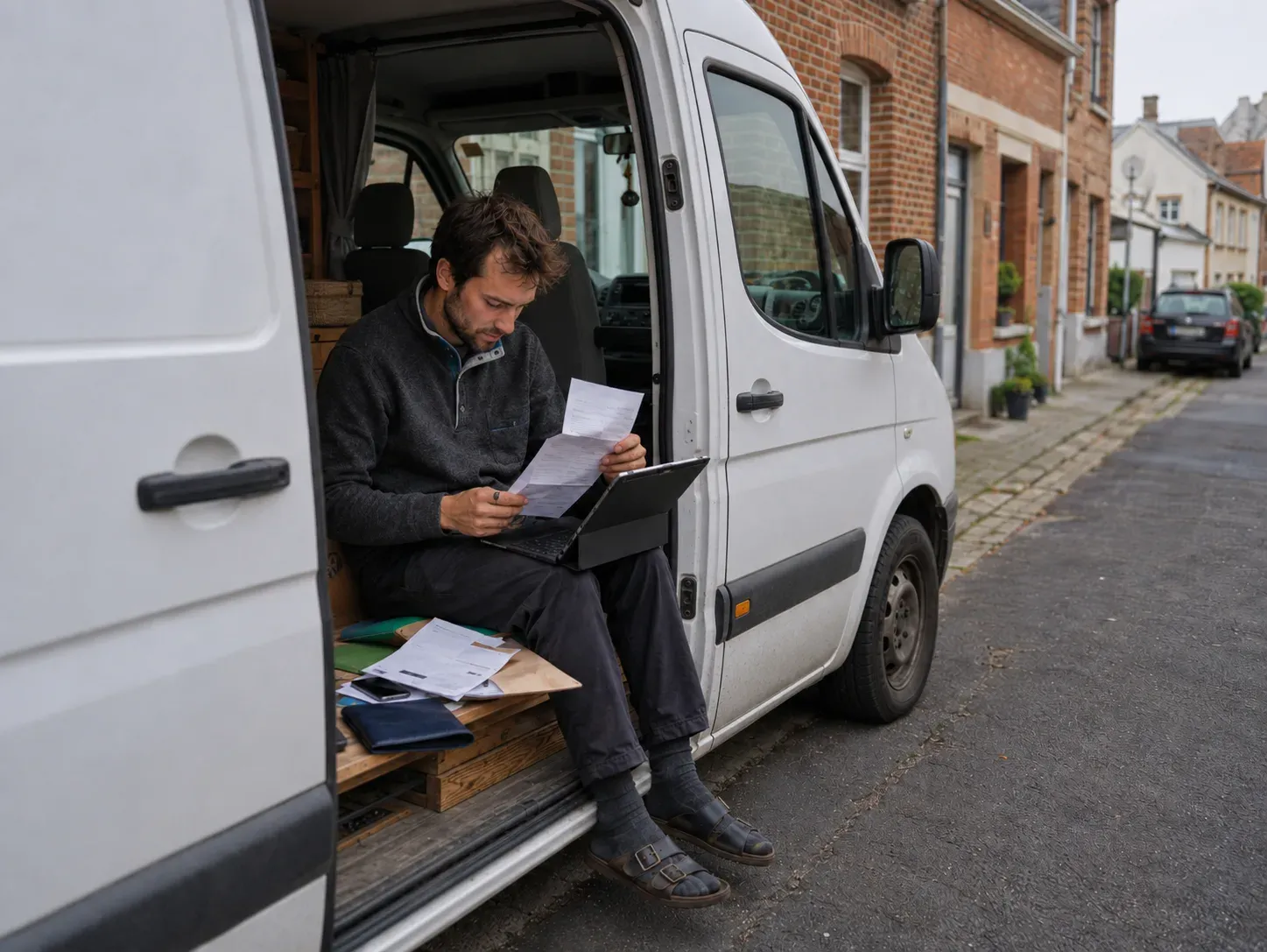
Full-time vanlife sounds like you're finally breaking free from fixed locations. No rented house, no traditional mailbox, no fixed street to return to every evening. Just you, your van, and the freedom to go wherever you want.
But administratively, Belgium isn't that mobile.
As soon as you deal with health insurance, incapacity for work, unemployment, benefits, VDAB, RVA, OCMW, banks, insurance, or official bodies, your address remains important. Not because someone wants to take away your freedom, but because many rights and obligations are linked to your official place of residence, family situation, and accessibility.
For vanlifers, this is therefore an important topic. Especially if you live full-time in your van, are temporarily without a home, or are considering giving up your domicile.
Your address is more than just receiving mail
Many people primarily associate an address with mail. Where do letters arrive? Where does the government send documents? Where are your bank cards, health insurance letters, and insurance papers?
But your address does much more than that.
Your official address determines or confirms, among other things:
- where your main residence is
- in which municipality you administratively belong
- how official bodies reach you
- which family situation may be assumed
- where checks or summonses are sent
- which employment service is competent
- whether you reside in Belgium
- whether your right to certain benefits can be correctly assessed
For vanlife, this can sometimes be difficult, because your real life is mobile. But your administration still needs an anchor point.
Main residence, reference address, or something else?
In Belgium, one normally starts from your main residence. This is the place where you actually live for the majority of the year.
If you do not have a fixed place of residence, a reference address can be a solution in certain situations. A reference address is not a place where you live, but an administrative address where official bodies can reach you.
Flanders states that a reference address can be specifically intended for people who reside in Belgium but do not have an official address, such as homeless people, people living on a boat, or caravan dwellers. With a reference address, you can also receive benefits from bodies that require an official address as a condition.
This is important for vanlifers. A reference address is not a luxury or a trick. It may be necessary to remain administratively accessible and not lose your rights.
Health insurance: you must remain reachable
Your health insurance fund needs to know where and how it can reach you. This applies to regular reimbursements, but certainly if you receive benefits through the health insurance fund, for example, in case of incapacity for work or invalidity.
In case of incapacity for work, your family situation plays a role in certain amounts and categories. RIZIV states that the health insurance fund can determine the amount of an incapacity for work benefit based on your family situation, such as dependent person, single, or cohabiting.
This means that your address and actual living situation can be important. Not only where your mail arrives, but also with whom you officially or factually cohabit.
For example, if you, as a vanlifer, register your address with someone, this can have administrative consequences. For you, but sometimes also for the person with whom you are registered. Therefore, you should not simply solve this with “I'll just put my domicile somewhere”. You need to look at what is factually correct.
Incapacitated for work and traveling with your van
If you are incapacitated for work and receive benefits, traveling becomes more sensitive.
RIZIV states that for holidays within the EU or EEA, you do not need permission from the advising doctor, but you must inform the Benefits Department of your health insurance fund of the period you are on holiday abroad. If you travel outside the EU or EEA, you need prior permission from the advising doctor.
For Belgian vanlifers, this is important. A trip through Belgium is not the same as traveling for months through Spain, Morocco, or Turkey while receiving benefits.
So, do not simply assume that “I'm just on the road” makes no administrative difference. Contact your health insurance fund before you leave if you are incapacitated for work and receive benefits.
Unemployment: residence in Belgium is a basic condition
With unemployment benefits, your address is even more sensitive.
RVA states that to receive benefits, you must have your main residence or usual place of residence in Belgium and actually reside there. During holidays, as an unemployed person, you may stay abroad for a maximum of 24 days per year, and you must correctly indicate these holiday days on your control card.
This is a big difference from someone who simply works remotely or uses savings to travel around. If you receive unemployment benefits, you are not simply free to travel across Europe for months as if your administration doesn't have to come along.
You must remain available for the labor market, be reachable, and comply with your obligations. A van makes you mobile, but your benefits come with rules.
VDAB: you must be reachable and traceable
If you live in Flanders and want to apply for unemployment benefits, you must register with VDAB as a job seeker. VDAB communicates via your account, digitally or by post, and uses the address from the National Register if necessary.
VDAB states that digital communication can have the same legal value as registered letters by post when you choose “digital only”. They assume that you have received the communication as soon as it is available in your VDAB account.
For vanlifers, this is a serious warning. You cannot say: “I didn't see a letter” if your digital communication is officially considered received. You must monitor your account, set up notifications correctly, and remain reachable.
If you are on the road a lot, VDAB communication must become part of your routine. Just like refueling, filling water, and checking your battery.
Family situation: single, cohabiting, or with family responsibilities
Many benefits take your family situation into account.
This applies, among other things, to unemployment and incapacity for work. The precise rules differ per benefit, but the basic idea is the same: living alone, cohabiting, or having a dependent can affect the amount or assessment.
For vanlifers, this is extra important when it comes to addresses with family, friends, or partners.
Suppose you register your domicile with someone. Then the administration may ask questions about your factual situation. Do you really live there? Are you cohabiting? Do others have income? Is there a question of family responsibilities? Or is it just an administrative address?
With a correct reference address, this is different from a real domicile, but even there you must meet conditions.
In short: your address is not neutral. It can influence how authorities view your situation.
Fake domicile is risky
Taking a domicile with someone where you don't actually live sometimes seems like an easy solution. In reality, it is risky.
Your main residence must correspond to the factual situation. If you are registered somewhere but do not actually live there, this can cause problems during checks.
This can have consequences for:
- your benefits
- someone else's benefits
- social benefits
- taxes
- family composition
- bailiffs or debts
- municipal administration
- health insurance
- unemployment file
- insurance
An address is therefore not a formality that you simply borrow. As a vanlifer, you must choose a solution that is correct: real main residence, temporary absence, reference address, or official relocation abroad, depending on your situation.
Avoiding ex officio deregistration
If the municipality determines that you no longer live at your address and your new place of residence is unknown, you can be ex officio deregistered from the population register.
You want to avoid that.
A deregistration can seriously disrupt your administration. Think of identity card, health insurance, benefits, bank, insurance, vehicle registration, and official communication.
If you are going to live full-time in your van and cancel your old home, arrange beforehand what your official address will be. Do not wait until the municipality, your health insurance fund, or your payment institution discovers that you are no longer correctly registered anywhere.
Temporary absence can sometimes help
If you still have a real main residence and are temporarily traveling with your van, temporary absence can be useful.
Flanders states that you can report temporary absence to the Civil Affairs department of your municipality. To avoid deregistration from the population register, there is the possibility to declare a temporary absence of more than three months.
This does not mean that you can live anywhere indefinitely while your address remains the same. But for those who maintain a real home base and travel temporarily, it can help to remain administratively clear.
For vanlifers who travel for a few months, this is often a better solution than simply leaving and hoping no one asks questions.
What if you receive a living wage or OCMW assistance?
With OCMW assistance, living wage, or other social support, your place of residence and factual situation are very important.
The OCMW looks at your concrete social and financial situation. Where do you reside? Do you have income? With whom do you live? Are you entitled to help? Which municipality is competent? Are you reachable? Do you need a reference address?
If you do not have an official place of residence, a reference address via the OCMW may be possible in certain situations, for example for homeless people. But that is not an automatic formality. You must explain your situation and meet the conditions.
If you live in a van and need OCMW assistance, do not try to hide your situation. Clearly explain how you live, where you reside, and what administrative solution you need.
What about working on the road?
If you work, the situation is often simpler than with unemployment or incapacity for work, but your address remains important.
Your employer, social secretariat, health insurance fund, bank, insurance, and tax administration must be able to reach you. Your official address is on pay slips, tax documents, and social administration.
If you work as a self-employed person or in a secondary occupation, other things are added: business address, accounting, VAT, customers, invoices, and social contributions.
I recognize that myself. As a web developer, much can be done digitally, but that does not mean that administration disappears. You can work perfectly mobile, but you must have your official base well organized.
Abroad: extra caution
Many vanlifers do not only want to drive in Belgium. France, Spain, Portugal, Italy, Scandinavia, the Balkans, it all sounds attractive.
But with benefits, abroad quickly becomes important.
With unemployment benefits, you must reside in Belgium, with limited holidays or specific exemptions. With incapacity for work, depending on the destination and situation, you must inform your health insurance fund or ask for permission.
Even for regular health insurance, long-term living or staying abroad can have consequences. If you actually move abroad, other rules apply to social security and medical care.
A few weeks of travel is therefore not the same as moving your factual life abroad while wanting to retain your Belgian rights and benefits.
Digital accessibility is not a luxury
As a vanlifer, your digital administration must be tight.
Think of:
- My eBox
- MyMinfin
- VDAB account
- health insurance app or online file
- RVA or payment institution
- banking app
- insurance app
- itsme
- eID access
- secure email
- cloud folder with documents
But digital is only useful if you also follow it up. Turn on notifications, check your accounts regularly, and make sure you also have access if your mobile phone breaks or is stolen.
A good digital system is almost as important for full-time vanlife as a good house battery.
Keeping important documents
If you have a benefit, unemployment, or health insurance file, it is best to keep everything well.
Think of:
- proof of registration as a job seeker
- messages from VDAB
- control cards or digital equivalents
- letters from RVA or payment institution
- health insurance documents
- proof of incapacity for work
- communication with advising doctor
- permission or notification for stay abroad
- official address documents
- reference address documents
- eBox documents
- bank details
- insurance documents
Make digital copies and store them securely. Not everything has to be on paper in your van, but you must be able to access it when someone asks for it.
Don't just say “I live nowhere”
Administratively, “I live nowhere” is rarely a good sentence.
Better is: explain your situation correctly.
For example:
- I have a main residence and am traveling temporarily
- I have a reference address because I have no fixed place of residence
- I am temporarily staying in my vehicle and am seeking administrative guidance
- I am temporarily absent and have reported this
- I am officially moving abroad
- I am mobile but remain in Belgium and am reachable
That sounds less romantic than “I live freely”, but authorities simply work with categories. The clearer you correctly name your situation, the less chance of misunderstandings.
Common mistakes
A first mistake is thinking that without an address, you simply retain all rights. In practice, a missing or incorrect address can have major consequences.
A second mistake is using a fake domicile with family or friends without actually living there.
A third mistake is going abroad for months with unemployment benefits without following the rules regarding residence, holidays, or exemption.
A fourth mistake is being incapacitated for work and traveling without informing your health insurance fund or asking for permission when necessary.
A fifth mistake is not following up on VDAB messages because you are on the road.
A sixth mistake is not realizing that cohabitation, reference address, and main residence are administratively different things.
A seventh mistake is waiting until there is a problem, instead of speaking with the municipality, health insurance fund, or payment institution beforehand.
Practical checklist for vanlifers with benefits or health insurance file
Before you live full-time or long-term in your van, it is best to check:
- do I have a correct main residence or reference address?
- does my municipality know my situation?
- do I need to report temporary absence?
- am I reachable by post and digitally?
- is My eBox active?
- do I monitor my VDAB account if necessary?
- does my health insurance fund know how to reach me?
- do I receive an incapacity for work benefit?
- do I need to inform my health insurance fund about travel?
- do I need to ask for permission to stay outside the EU or EEA?
- do I receive unemployment benefits?
- do I continue to reside in Belgium as required?
- have I correctly indicated holiday days?
- is my family situation correct?
- is my address correct with the bank, insurance, and payment institution?
- have I saved everything in writing or digitally?
This checklist does not replace advice from your health insurance fund, RVA, VDAB, or OCMW, but it does help you ask the right questions.
Conclusion
Vanlife can offer a lot of freedom, but your address remains important. Especially when you are dealing with health insurance, incapacity for work, unemployment, OCMW, or other benefits.
Your official address not only determines where mail arrives. It is linked to your main residence, residence in Belgium, family situation, accessibility, rights, and obligations.
Those who work and simply travel a lot mainly need a good administrative system. Those who receive benefits must be much more careful. With unemployment, you must reside in Belgium and remain available, except within the allowed holidays or specific exemptions. With incapacity for work, your health insurance fund must know when you are staying abroad, and outside the EU or EEA, prior permission may be required.
My advice: arrange your address before you leave. Not afterwards, not halfway, not by chance. A van gives freedom, but your administration must be strong enough to support that freedom.
Source: https://www.vlaanderen.be/referentieadres
Source: https://www.vlaanderen.be/melding-van-tijdelijke-afwezigheid
Source: https://www.riziv.fgov.be/nl/thema-s/arbeidsongeschiktheid/werknemers-en-werklozen/medische-controle