Receiving mail as a vanlifer: bank, government, insurance, and official letters
Living full-time or almost full-time in your van sounds free. You drive where you want, sleep where you can, and your home is on wheels. But one thing doesn't just come along for the ride: your administration. Official letters, bank mail, insurance documents, fines, tax letters, inspection invitations, health insurance, invoices, and registered mail need to go somewhere.
By Laurens De Leeuw · 24 June 2026
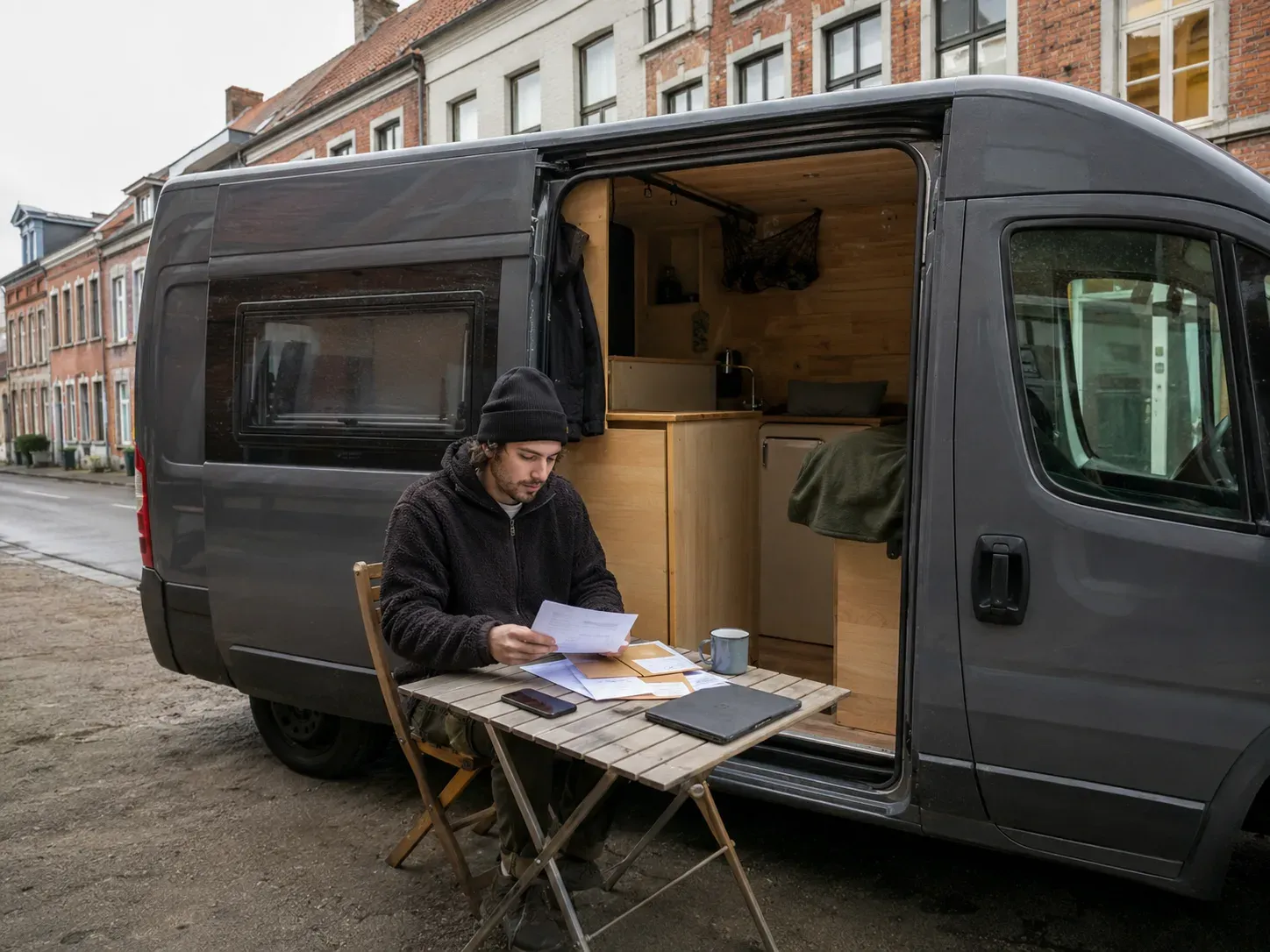
Living full-time or almost full-time in your van sounds free. You drive where you want, sleep where you can, and your home is on wheels. But one thing doesn't just come along for the ride: your administration.
Official letters, bank mail, insurance documents, fines, tax letters, inspection invitations, health insurance, invoices, and registered mail need to go somewhere. And if you're on the road a lot, you don't want to discover that an important letter has been sitting at home for three weeks without you knowing about it.
So, receiving mail as a vanlifer isn't just practical. It's also a piece of mind. You need to remain accessible to the government, banks, insurance companies, and other institutions.
First this: a postal address is not the same as an official address
A postal address, PO box, or forwarding service can be useful, but it doesn't automatically replace your official address.
In Belgium, administration revolves around your main residence, reference address, or another correct official registration. Your official address is the place where you are registered in the population registers. This address is used by the government and often also by banks, insurers, health insurance funds, and other institutions.
A PO box can therefore be useful for receiving letters, but it doesn't make you officially registered. The same applies to a mailbox service or virtual office. That can be practical, but it doesn't solve your domicile or reference address issue.
For vanlifers, this is an important distinction. On the one hand, you need your official administrative base. On the other hand, you need a practical system to actually follow up on your mail.
Why mail remains so important
Many things have become digital, but not everything.
You can arrange a lot via email, apps, online banking, My eBox, and digital counters. Nevertheless, some things still come on paper. Think of registered letters, insurance documents, bank cards, official letters, fines, inspection documents, documents from lawyers, bailiffs, or papers that are not yet digitally available.
If you don't follow up on your mail, it can have consequences.
An invoice can be paid late. A registered letter can be missed. A fine can increase. An insurance company can request documents. A bank may want to confirm your customer data. An inspection invitation can be overlooked. An official letter can contain deadlines.
That's precisely why I consider this topic important. Vanlife may feel simple, but you shouldn't let your official life gather dust in a mailbox that no one looks at.
Activate My eBox
My eBox is the government's digital mailbox. Through My eBox, you can consult documents that government institutions and organizations with a public task make digitally available.
For vanlifers, this is almost indispensable. You can view official documents remotely, without waiting for someone to open or forward your paper mail.
Make sure you set up your My eBox correctly:
- activate your eBox
- link an email address you actually use
- turn on notifications
- regularly check for new messages
- log in with itsme, eID, or another digital key
- download important documents immediately
- save documents outside eBox if they are important
That last point is important. Documents do not always remain available forever in My eBox. Depending on the document, the availability period may vary. Some documents remain available longer, but it's better not to rely on that blindly.
My advice: treat My eBox like a real mailbox. Don't just activate it once and then forget about it, but check it regularly.
My eBox doesn't replace everything
My eBox is handy, but it's not a magic solution for all mail.
Not every organization sends everything via eBox. Not every official letter comes digitally. Not every insurer, bank, or private party uses eBox. And registered mail or important papers can still arrive physically.
That's why, in addition to My eBox, you still need a system for physical mail.
So, see My eBox as a strong digital layer on top of your administration, not as a complete replacement for your official address or mailbox.
Make sure your official address is correct
If you change your address, you must report it officially. Within Belgium, you must report your address change to the municipality of your new place of residence within eight working days.
For vanlifers, this is linked to the question from the previous article: do you still have a real main residence, a reference address, a temporary absence, or another correct administrative solution?
Whatever you choose, your address must match your situation. Using an incorrect address because it's easy can cause problems later.
Your official address is the basis for:
- identity card
- national register
- taxes
- health insurance fund
- vehicle registration
- insurance
- official communication
- municipal administration
- bank details
- fines and judicial communication
Without a correct official address, receiving mail is only a partial solution.
Use bpost Relocation Service as a temporary bridge
If you are moving or temporarily want your mail to arrive elsewhere, bpost's Relocation Service can be useful.
With the Relocation Service, bpost can automatically forward addressed mail from your old address in Belgium to a new address in Belgium or abroad. According to bpost, this can be for at least 3 months and a maximum of 24 months.
This can be handy if you:
- cancel your tenancy
- temporarily want to receive mail at family's place
- are on the road for a longer period
- move to a different address
- have a transition period between two administrative situations
- want to avoid important letters being left in an old mailbox
But again: this is not a substitute for a correct official address. It is a practical forwarding service, not a domicile solution.
What mail is forwarded?
According to bpost, addressed letters are forwarded, such as letters, registered mail, and invoices. Parcels, newspapers, and postal subscriptions are not forwarded in the same way.
That difference is important. If you order a lot of parcels for your van, such as parts, electronics, or camping equipment, you need to think about that separately.
For parcels, it's better to use:
- a collection point
- a parcel locker
- delivery to family or friends
- delivery to a campsite or accommodation if allowed
- a store where you pick up the part
- clear planning of when you will be somewhere
Don't send expensive parts to an address where no one will look for weeks.
Arrange for someone to follow up on your physical mail
Even with My eBox and bpost, it's smart to have someone keep an eye on your physical mail.
This can be a family member, friend, partner, or trusted person. This person doesn't have to do your entire administration, but can report when something urgent arrives.
Make clear agreements:
- how often the mailbox is checked
- which mail may be opened
- which mail may only be photographed
- which mail needs to be forwarded
- what should happen with registered letters
- how quickly you want to be notified
- where documents are temporarily stored
You can also work with a shared folder in the cloud. Your trusted person takes a photo or scan of the letter and puts it in the folder. That way, you can decide what to do with it while on the road.
Make good agreements about privacy. Not everyone needs to read everything.
Registered letters: extra caution
Registered letters are important because they often have deadlines attached to them. Think of legal documents, cancellations, official notifications, insurance letters, or documents with evidential value.
If you are often on the road, you need to know in advance what happens to registered mail at your address.
Are they forwarded? Who can accept them? Will there be a collection notice? Who can go to the post office? Do you need a power of attorney? How quickly will you be notified?
This is typically one of those details you only miss when it's too late.
Bank mail: keep your customer data up to date
Your bank needs to be able to reach you. Even though much happens digitally, your address remains important.
Banks can send documents about:
- bank cards
- credit cards
- accounts
- customer data
- tax documents
- security warnings
- changes in terms and conditions
- investments
- credits
- mortgages
- identification or updating of data
Provide your correct address to your bank. If your official address changes, also update it in your banking app or through your branch. Some data may be automatically updated via official channels, but don't rely on that blindly for everything.
For vanlifers, it's extra important that your bank understands that you live mobile, but remain accessible. Turn on notifications in your banking app and regularly check messages in your online banking.
Insurance: your address and usage must match
Your insurer needs to know where you officially live and how your vehicle is used.
This certainly applies to a self-built camper or converted van. Your address can affect communication, policy documents, green card or insurance certificate, claims handling, and risk assessment.
But your usage is also important. If you live full-time or almost full-time in your van, that's different from a van used only for weekend trips. If your vehicle is officially a light commercial vehicle but is used as a camper, you need to discuss that. If your van is expensively equipped with solar panels, a household battery, a diesel heater, or camper furniture, your insurer needs to know.
In case of relocation or changed situation, your insurer must be informed. A change of situation can be important for an insurance policy, especially if the risk changes.
In short: make sure your insurance papers, address, and actual use match. In case of damage, you don't want a discussion about an old address or an unreported situation.
Government mail: activate as much as possible digitally
For government mail, it's smart to activate as much as possible digitally.
Think of:
- My eBox
- MyMinfin
- eBox notifications
- digital counters of your municipality
- online file with health insurance fund
- digital communication with Flemish or federal services
- itsme or eID access
- Doccle or other platforms if you use them
MyMinfin and My eBox are particularly important for tax documents. But your municipality, health insurance fund, and other institutions can also offer digital communication.
Make sure your access doesn't depend on one device. If your phone is stolen or broken, you still need to be able to access your administration. So, think about recovery codes, strong passwords, and access to your email.
Inspection, vehicle, and road tax
For vanlifers, vehicle mail is extra important.
Think of:
- inspection invitation
- insurance documents
- road tax
- fines
- registration documents
- documents from DIV
- documents regarding homologation
- reminders from garage or breakdown assistance
Not every important vehicle letter arrives when you are home. And if you are driving abroad, you certainly want to know that someone will warn you about urgent mail.
Therefore, also put important vehicle dates in your calendar yourself:
- inspection expiry date
- insurance expiry date
- road tax payment
- driving license expiry date if applicable
- maintenance moments
- travel insurance or breakdown assistance
Don't wait for a letter to know something.
Invoices and subscriptions
In addition to official mail, you also have regular invoices and subscriptions.
Think of:
- mobile phone
- internet
- insurance
- streaming services
- software
- domain names
- hosting
- breakdown assistance
- garage invoices
- medical invoices
- energy or water if you still have a home
- magazine or service subscriptions
Put as much as possible on digital invoice. Not because digital is always nicer, but because paper on the road is simply vulnerable.
Also check direct debits and payment reminders. A missed invoice can quickly lead to extra costs.
Parcels as a vanlifer
Parcels are a separate story.
For regular letters, a postal address, forwarding service, or trusted person can help. For parcels, you often have to plan.
Useful options are:
- bpost collection point
- parcel locker
- delivery to family or friends
- pick up in store
- delivery to a campsite, hotel, or accommodation
- order when you know where you will be
- avoid expensive items lying unattended for a long time
For bus parts, picking them up is often smarter. Especially for large or expensive parts such as solar panels, batteries, roof hatches, tires, or technical installations.
Create a digital archive
If you are on the road a lot, a digital archive is worth gold.
Save scans or photos of:
- identity card
- driving license
- registration certificate
- inspection certificate
- insurance certificate
- breakdown assistance
- medical data you may need
- documents of your van
- conversion invoices
- homologation documents
- insurance policy
- tax documents
- important contracts
Don't just save everything unprotected in your photo gallery. Use secure cloud storage, a password manager, or an encrypted folder. Also, make sure you have a backup.
I wouldn't make this more complicated than necessary myself. A clear folder structure with "Vehicle", "Insurance", "Taxes", "Health", "Bank", and "Conversion" can be enough.
Don't let everything depend on one phone
For digital administration, you often need your smartphone. itsme, banking app, email, eBox notifications, insurance app, cloud storage, everything is on that one device.
That's handy, but also vulnerable.
Therefore, ensure:
- strong PIN code
- password manager
- backup of important documents
- correct recovery email address
- second device or laptop if possible
- offline copy of crucial documents
- emergency contact who knows what to do
- SIM card security
- access to eID or alternative digital key
If your phone disappears during a trip, you don't want to lose your entire administration as well.
What do you pass on to whom?
Make a list of institutions that need to know your address and contact details.
Think of:
- municipality
- FPS Finance
- health insurance fund
- bank
- insurer
- employer or clients
- social insurance fund as a self-employed person
- accountant
- DIV and vehicle administration via official address change
- telecom provider
- general practitioner and dentist
- pension institution if applicable
- school or training if relevant
- associations or subscriptions
Some institutions automatically receive your new address via the National Register once your official address change has been processed. But others you have to notify yourself. According to Wikifin, you must notify your bank and insurance companies yourself, among others.
For vanlifers, it's smart to make that list well once and then keep it updated.
What about a reference address?
If you have a reference address, your official mail will go there. But even then, you need to make practical arrangements.
A reference address is an administrative address. It does not mean that you live there. It does mean that official communication can arrive there.
So, make good agreements with the person or institution of the reference address:
- how often mail is checked
- how you are notified
- what may be opened
- what needs to be forwarded
- how registered letters are handled
- what happens if you are abroad for a long time
A reference address without a good mail agreement is only half the job.
What about a PO box or mailbox service?
A PO box or mailbox service can be useful for certain mail, but it is not a substitute for your official address.
Use it possibly for less sensitive mail, business mail, or practical receipt. But be careful with official documents, bank mail, insurance mail, and registered letters. Not every institution accepts a PO box as a contact address. And some documents must go to your official address.
For vanlife, a PO box can therefore be supplementary, but not your administrative foundation.
Privacy: don't just let anyone open your mail
If someone else follows up on your mail, you need to have trust. Official letters can contain sensitive data: medical info, financial data, tax documents, insurance data, or personal matters.
Therefore, make clear agreements.
For example, you can say:
- envelopes with advertisements can be thrown away
- invoices may be opened and photographed
- bank letters only keep closed or send photo of envelope
- report registered letters immediately
- do not open medical mail without permission
- scan official letters and upload them to a secure folder
This way you avoid misunderstandings.
Common mistakes
A first mistake is thinking that everything comes digitally. That's not true. Physical mail remains important.
A second mistake is activating My eBox but not setting up notifications or never logging in.
A third mistake is relying on an old mailbox that no one looks at.
A fourth mistake is thinking that a PO box is the same as an official address.
A fifth mistake is not notifying your bank and insurance company yourself of changes.
A sixth mistake is not having a system for registered letters.
A seventh mistake is not keeping digital copies of important documents.
An eighth mistake is letting all your administration depend on one smartphone without a backup.
Practical checklist for vanlifers
Before you go on a long trip, it's best to check:
- is my official address correct?
- do I have a main residence or reference address that is administratively correct?
- is My eBox activated?
- are eBox notifications on?
- do I have access to MyMinfin and other digital counters?
- does someone check my physical mail?
- are agreements about mail clear?
- do I know what happens with registered letters?
- do I use bpost Relocation Service as a temporary solution if necessary?
- are the bank and insurer aware of my correct address?
- are my vehicle documents stored digitally?
- are inspection, insurance, and road tax in my calendar?
- do I have backups of important documents?
- can I still access my administration if my phone is gone?
This checklist is not exciting, but it brings peace of mind. And peace of mind on the road is worth a lot.
Conclusion
Receiving mail as a vanlifer is about more than a mailbox. You need a correct official address, a digital system for government mail, and a practical solution for physical letters.
My eBox is a strong basis for digital government mail, but it doesn't replace everything. bpost Relocation Service can temporarily help to forward mail, but it is not a domicile or reference address. Banks, insurers, and other important services must have your correct data. And for physical mail, it's best to have someone reliable follow up on what comes in.
My advice: build a simple but solid administrative system before you leave. Not because paperwork belongs to vanlife, but because you are much freer on the road if you know that your official letters, banking matters, and insurance are not lying unopened somewhere.
Source: https://www.belgium.be/nl/huisvesting/verhuizen/adreswijziging
Source: https://myebox.be/nl/faq/wat-is-my-ebox
Source: https://myebox.be/nl/faq/hoe-beheer-ik-my-ebox
Source: https://www.bpost.be/nl/faq/ik-verhuis-hoe-laat-ik-mijn-post-doorsturen-naar-mijn-nieuwe-adres