No fixed abode: what options do you have besides a reference address?
Anyone living full-time in a van will sooner or later encounter a simple but tricky question: where do you officially live? Not where you sleep tonight. Not where your van is parked. But where you are officially registered, where your mail arrives, where government services can reach you, and where your administration is tied to.
By Laurens De Leeuw · 24 June 2026
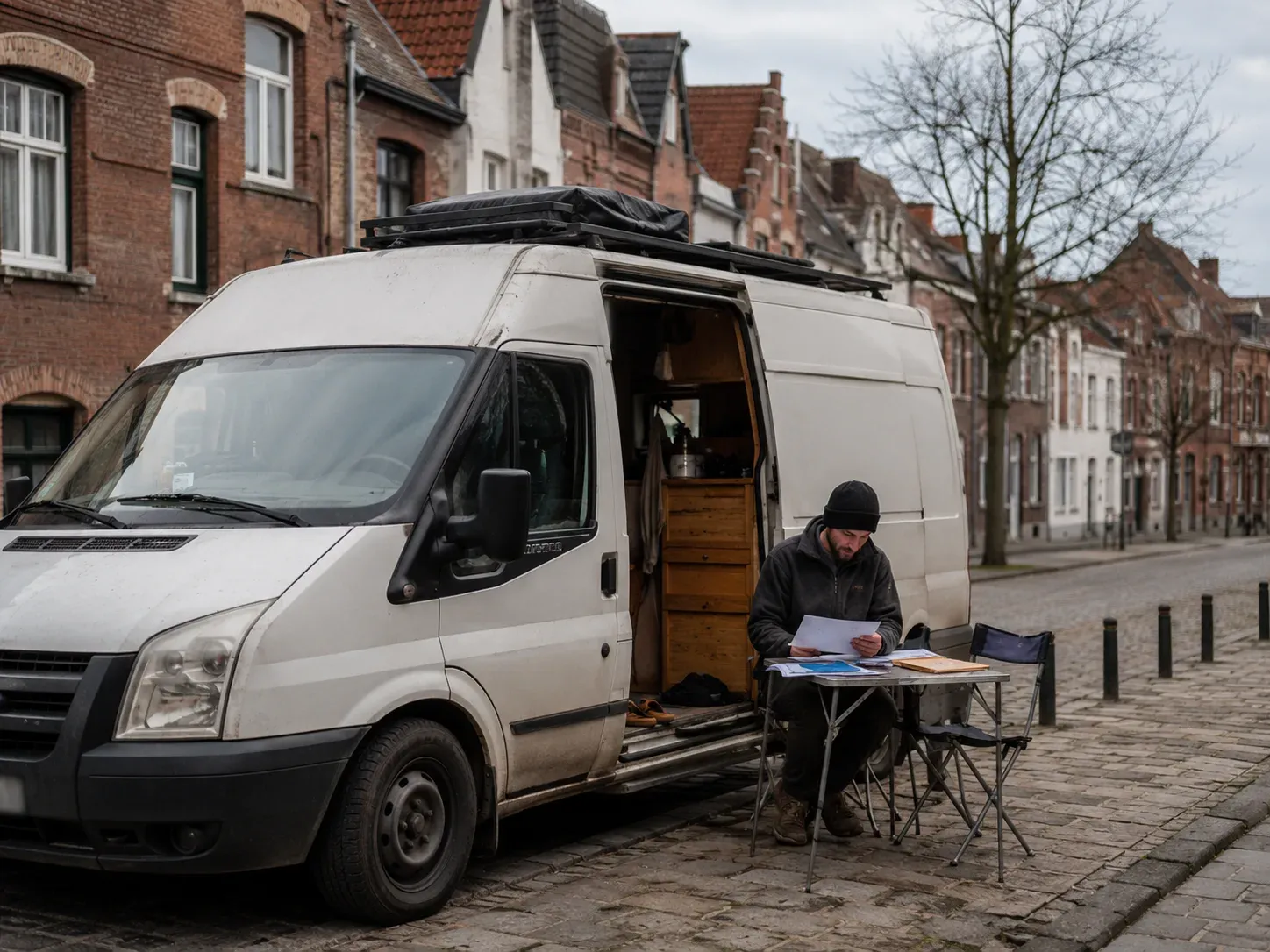
Anyone living full-time in a van will sooner or later encounter a simple but tricky question: where do you officially live?
Not where you sleep tonight. Not where your van is parked. But where you are officially registered, where your mail arrives, where government services can reach you, and where your administration is tied to.
In Belgium, this is important. Your address is not just a formality. It is linked to your identity card, health insurance, taxes, vehicle registration, insurance, benefits, banking, municipality, family situation, and sometimes even your rights.
In a previous article, we already discussed the reference address. But what if that's not possible, not desirable, or doesn't suit your situation? What options do you have as a vanlifer without a classic fixed abode?
First this: Belgium works with a main residence
In Belgium, administration starts from your main residence. This is the place where you, as a single person or family, actually reside for the majority of the year.
So, it's not purely a paper choice. The main residence is determined based on the factual situation. Where do you usually sleep? Where do you live? Where are your belongings? Where can you be reached? Where is your social and administrative base located?
That's precisely the difficulty with full-time vanlife. Your life is mobile, while the administration prefers a fixed place.
Why “no address” is not a good solution
Some people think: I'll just deregister everywhere. I'll live in my van and see what happens.
That sounds free, but administratively it's risky.
Without an official address, you can encounter problems with:
- your identity card
- official letters
- health insurance
- taxes
- vehicle registration
- insurance
- bank
- salary or benefits
- social rights
- fines or court letters
- municipal administration
If the municipality determines that you no longer live at the address where you are registered and your new place of residence is unknown, you can be officially removed from the population register. You want to avoid that.
Full-time vanlife does not mean that administration disappears. You just need to think more consciously about your official base.
Option 1: maintaining your real domicile and traveling temporarily
The simplest solution is often: you maintain a real main residence and travel temporarily with your van.
This can be the case, for example, if you still have a house, studio, room, or part of a house where you effectively maintain your main residence. You then leave for longer periods of travel, but your official residential base remains.
In some situations, you can report a temporary absence to the municipality. This can be relevant when you are temporarily and briefly staying outside the municipality of your main residence. Your main residence does not change as a result, and you remain registered in your municipality.
For regular trips, holiday stays, or certain absences of less than one year, temporary absence can be a solution, provided you meet the conditions.
This is probably the cleanest solution for those who don't really want to live “without a home,” but mainly want to be on the road a lot.
When is this interesting?
This option fits well if you:
- still have your own rental or owned home
- have a room where you actually live
- travel often but return regularly
- want to keep your administration simple
- don't want any discussion about your official address
- mainly use your van as a travel vehicle
For many people, this is the most feasible interim solution. You live a lot on the road, but you maintain an official fixed base.
The disadvantage is clear: a house or room costs money. And for those who truly want to live full-time in the van to reduce fixed costs, that sometimes feels contradictory.
Option 2: registering where you actually live with someone
Another option is to register with someone you actually live with or co-habit with. Think of a partner, parents, family, friend, or housemate.
But this is only correct if you actually have your main residence there. You cannot simply register your domicile with someone if you never stay there.
After a move, you normally have to report your new address to the municipality within eight working days. The municipality then investigates whether you actually live there. This often happens via the neighborhood police officer.
For vanlifers, this can work if, for example, you regularly stay with family, have your room there, keep your administration there, and depart from there. Then it is not the same as a reference address, but a real main residence.
Beware of fake domicile
Using an address where you don't actually live is not a safe solution.
This can have consequences for you and for the person with whom you supposedly live. It can affect family status, benefits, taxes, social benefits, debts, bailiffs, municipal controls, and administrative obligations.
A domicile is not a postal trick. It must correspond to reality.
I fully understand that vanlife sometimes clashes with the system. But “borrowing” an address when you're never there is not a smart foundation to build on.
Option 3: a small room or studio as an administrative base
Some vanlifers choose to rent a small room, studio, or shared living space as an official base.
This can be interesting if you mainly live on the road, but still want a place where you can legally and practically fall back on. Think of a room with family, co-housing, a small studio, or a shared home.
Again, it must be your actual main residence. If you only pay for a room but never actually stay there, it becomes difficult again.
This option is especially practical if you:
- return regularly
- want to store belongings
- want to receive mail securely
- want an administrative base
- don't want to depend on a reference address
- don't want your van to be considered your only “home”
The disadvantage, of course, is the cost. But sometimes a small room is cheaper than the problems that arise if you have no correct administrative base at all.
Option 4: living on a campsite, caravan site, or in a mobile home
Some people think: if I live in my van, can I just register at a campsite, camper place, caravan site, or plot of land?
It's not that simple.
Permanent living on campsites and in weekend residences is a known problem in Flanders. It can clash with spatial planning, permits, housing quality, municipal rules, and the designation of the site.
You also need to be careful with mobile structures. Flanders states that placing a movable facility that can serve as a dwelling, such as a caravan, motorhome, or tent, can be done under certain conditions without actually living in it. But if such a structure is inhabited, a permit is always required.
In other words: placing a van, motorhome, tiny house, or caravan on a plot of land and living there permanently is not automatically permitted.
Can you never officially live in such a place?
Sometimes there can be a solution, for example, on a recognized caravan site or in a place where permanent residence is properly regulated. But that strongly depends on the municipality, the permit, the designation of the site, and the specific situation.
So, don't just assume that “I'm on a campsite” is equivalent to “I can register my domicile there.”
Always ask for information from the municipality beforehand. Not after you're already living there.
Option 5: reporting temporary absence for longer trips
If you have a main residence but are traveling for a longer period, reporting a temporary absence can be important.
Flanders states that you must report your temporary absence to the Civil Affairs department of your municipality. To avoid removal from the population register, there is the possibility to declare any temporary absence of more than three months.
This does not mean that you can simply stay away indefinitely while your address remains the same. It does mean that you can officially report your situation, so the municipality knows that you are temporarily absent and have not simply disappeared.
For vanlifers who are going on a trip for a few months, this is useful to check beforehand.
Option 6: officially moving abroad
Some full-time travelers choose to truly leave Belgium and establish their main residence abroad.
If you move abroad, you must report it to the population service of the municipality where you are registered. This must be done no later than the day before your departure. Once abroad, it is best to register with the Belgian embassy or consulate.
But this is not a simple solution for “I don't want an address in Belgium.” You are then administratively truly moving abroad. This can have consequences for taxes, social security, health insurance, insurance, driving license, vehicle registration, and your general administration.
For those who simply want to travel through Europe with a Belgian van, this is usually not the first solution. For those who truly settle in another country, it can be logical.
Option 7: still a reference address as a safety net
Even though this article is about options besides a reference address, it remains important to mention it briefly.
A reference address exists precisely for people who reside in Belgium but have no official place of residence, for example, homeless people, people on a ship, or caravan dwellers. It allows them to remain administratively reachable.
A reference address can be with a private individual, if that person gives permission and has their main residence there themselves. For homeless people, a reference address can also be via the OCMW (Public Centre for Social Welfare), if the conditions are met.
Important: a reference address is not a place of residence. You are not allowed to stay there permanently overnight. It is an administrative address, not a domicile.
If you have no real residential base, this often remains the most logical official route. But it is not always easy to find someone willing to do this, and not everyone automatically meets the conditions.
What is not a real solution?
A PO box is not a domicile. You can receive mail there, but you don't live there, and you cannot register it as your main residence.
A mailbox service or virtual office is also not a main residence. This can be useful for mail or administration, but it does not replace registration in the population register.
Using someone else's address without living there is risky.
Using a campsite address where permanent residence is not permitted can cause problems.
Using a business address as a private residential address when you don't live there is also not a safe solution.
In short: receiving mail is not the same as officially living somewhere.
Why this is important for your van
Your official address also has consequences for your vehicle.
Think of:
- registration with DIV
- insurance policy
- road tax
- fines
- inspection invitations
- official letters
- driving license
- parking permits or licenses
- environmental zones and communication
- breakdown assistance and insurance
If your address is incorrect, important letters can miss you. A fine, insurance, tax letter, or inspection document that gets lost somewhere can later become much more expensive than the problem you tried to avoid.
For me, this is typically one of those topics where vanlife clashes with ordinary administration. You want freedom, but you still need a few anchor points. Otherwise, freedom quickly turns into chaos.
What about your health insurance, bank, and insurance?
Private institutions also look at your official address.
Your health insurance fund, bank, insurer, employer, accountant, pension institution, or benefits agency must be able to reach you. Some services link rights or communication to your official address.
So, if you live full-time in your van, you need to ensure that your official and practical accessibility are well arranged.
Practically, this means:
- keep an eye on your eBox and digital government mail
- activate digital communication where possible
- don't let important mail sit for months
- report address changes in time
- ensure someone notifies you of urgent letters
- discuss your situation honestly with your insurer or benefits agency
Digital administration helps, but it doesn't replace everything. Some documents still arrive on paper.
What if you have children?
With children, the story becomes more sensitive.
Children of parents without a fixed abode remain subject to compulsory education. Flanders states that children of inland waterway boatmen, fairground and circus operators, artists, and caravan dwellers are subject to compulsory education just like everyone else. Students with a reference address in Belgium are also monitored.
Full-time vanlife with children therefore requires extra preparation. You need to think about compulsory education, school, homeschooling, address, municipality, and follow-up.
For families, it is even more important to arrange this well in advance and not improvise.
Which option suits which type of vanlifer?
If you mainly do weekend and holiday vanlife, there is usually no problem. You simply maintain your regular domicile.
If you want to travel for a few months but keep a home, look into temporary absence and make sure your municipality and postal arrangements are correct.
If you are on the road a lot but regularly return to a room, studio, or family address where you actually live, that can remain your main residence.
If you no longer have a home and no real place of residence, you will probably end up back at the reference address.
If you are truly going to live abroad, you must officially arrange that as a move abroad.
If you want to live on a campsite, plot of land, or caravan site, you must check with the municipality beforehand whether that is legally and spatially possible.
Common mistakes
A first mistake is thinking that a PO box is enough. It is not. A PO box can be useful for mail, but it is not an official place of residence.
A second mistake is registering your domicile with someone where you don't live. That can cause problems for you and for that person.
A third mistake is leaving for months without reporting temporary absence, while your main residence actually remains.
A fourth mistake is thinking that a campsite or camper place is automatically a legal residential address.
A fifth mistake is having yourself removed from the population register and only then looking for a solution.
A sixth mistake is not realizing how many services are tied to your address: health insurance, insurance, vehicle, taxes, bank, and official communication.
Practical checklist
Before you start living full-time or almost full-time in your van, it's best to check:
- do I still have a real main residence?
- do I actually stay there enough to keep this correct?
- do I need to report temporary absence?
- do I have someone who follows up on official mail?
- is my eBox active?
- is my address correct with health insurance, bank, insurance, and employer?
- is my address correct for my vehicle registration?
- does my insurer know how I use my van?
- is a reference address necessary if I have no place of residence?
- can my municipality confirm my situation?
- am I at risk of official removal?
- are children or benefits involved?
- am I staying in a place where permanent residence is permitted?
These questions may be less fun than planning routes, but they are part of full-time vanlife in Belgium.
Conclusion
Besides a reference address, there are several options, but they strongly depend on your actual situation.
The simplest solution is to maintain a real main residence and correctly report your longer trips as temporary absence. Another possibility is to register where you actually live, for example, with family, partner, housemate, or in a small room or studio. Living on a campsite, camper place, plot of land, or in a mobile structure is only possible if it is legally and spatially correct. Truly moving abroad is a separate administrative choice with major consequences.
What is not a solution: a PO box, fake domicile, or simply using an address where you don't live.
Full-time vanlife therefore requires not only a good van, but also a good administrative base. Not because paperwork is fun, but because your freedom feels much calmer when your official life doesn't start to derail behind your back.
Source: https://www.belgium.be/nl/huisvesting/verhuizen/hoofdverblijfplaats
Source: https://www.belgium.be/nl/huisvesting/verhuizen/adreswijziging
Source: https://www.vlaanderen.be/melding-van-tijdelijke-afwezigheid
Source: https://www.vlaanderen.be/referentieadres
Source: https://www.vlaanderen.be/omgevingsvergunning/stedenbouwkundige-handelingen/opslag