Importing a foreign campervan or van into Belgium
Buying a campervan or van abroad can seem very appealing. In Germany, you sometimes find more options. In the Netherlands, you often see neat vans. In France, Spain, or Italy, you might come across unique campervans. And every now and then, you see a vehicle and think: that's exactly what I'm looking for.
By Laurens De Leeuw · 24 June 2026
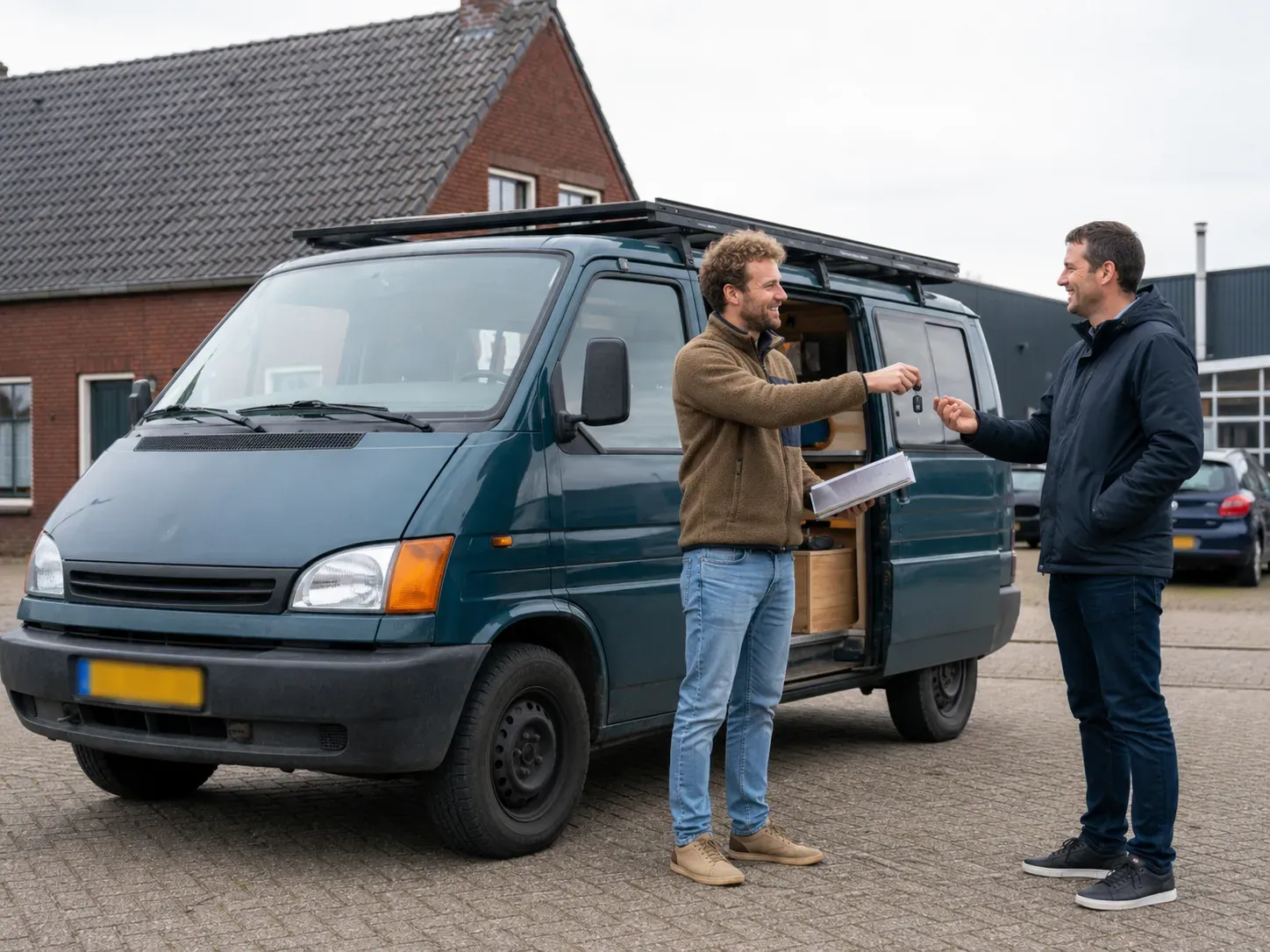
Buying a campervan or van abroad can seem very appealing. In Germany, you sometimes find more options. In the Netherlands, you often see neat vans. In France, Spain, or Italy, you might come across unique campervans. And every now and then, you see a vehicle and think: that's exactly what I'm looking for.
But bringing a foreign campervan or van to Belgium is more than just paying, getting in, and driving home.
You need to consider customs, VAT, E705, technical inspection, homologation, registration with DIV, insurance, road tax, and sometimes additional problems due to modifications or missing documents.
For vanlifers, this is especially important, as many vehicles are no longer ordinary standard vans. They have been converted, partially furnished, officially registered as motorhomes, light commercial vehicles, classic cars, or sometimes something in between. And that's where things can go wrong.
Why buy a foreign campervan or van?
There are good reasons to look outside Belgium.
The selection is often larger. Especially in Germany and the Netherlands, you'll find many vans, campervans, and half-finished projects. Sometimes the prices are more attractive. Sometimes the vehicle is better maintained. And sometimes you find a model, length, engine, or version that is hard to find in Belgium.
For vanlife, this can be appealing. An L2H2 van, an old bus with character, an ex-company vehicle with low mileage, or an already converted campervan can appear more quickly abroad.
But cheaper in the advertisement doesn't automatically mean cheaper in the end. Transport, inspection, homologation, missing documents, VAT, import duties, repairs, and Belgian registration can significantly change the real price.
First the most important question: EU or outside the EU?
The procedure depends heavily on where the vehicle comes from.
If you buy a campervan or van in another EU member state, such as the Netherlands, Germany, France, Spain, or Italy, you fall under the EU procedure. This mainly involves documents, fiscal regularization via E705, inspection, and registration.
If you buy a vehicle outside the EU, for example in Switzerland, Norway, the United States, or in certain cases the United Kingdom, it becomes more difficult. You then have to clear the vehicle through customs, and in many cases pay import duties and VAT. Individual approval may also be required.
For vanlifers, my advice is simple: preferably start with a vehicle from the EU, especially if you have no experience with import. Outside the EU can be interesting, but the chance of administrative and technical surprises is greater.
Never buy without the correct documents
Before you transfer money, you need to know which papers you will receive.
Ask for at least:
- the complete original foreign registration certificate
- all parts of the registration certificate if it consists of multiple parts
- purchase invoice, proof of purchase, or sales agreement
- mileage
- date of first registration
- chassis number
- make, type, model, and fuel
- foreign inspection certificate if available
- Certificate of Conformity or COC if available
- conversion or homologation documents if it is a campervan
- certificates for gas, LPG, tow bar, seats, or other installations if applicable
Pay particular attention to the registration certificate. In some countries, it consists of multiple parts. You need those parts. If a part is missing, registration in Belgium can become difficult or impossible.
I would personally never buy a foreign campervan with the message “papers will come later”. That's asking for trouble.
Check if the vehicle has European type approval
For vehicles from the EU, European type approval is important. The foreign registration certificate may contain a European type approval number, often in section K or K1.
If the vehicle has European type approval and was correctly registered in another EU member state, the procedure is usually simpler. You then get to the second-hand inspection and Belgian registration faster.
If the vehicle does not have European type approval, or if there is only a national approval number, a validation procedure may be necessary.
If the vehicle has been modified after registration, for example from a van to a campervan, Belgium may require individual approval. This is especially important for self-built campervans or foreign conversions.
Foreign campervan: pay attention to conversion papers
A vehicle registered as a campervan in Germany, the Netherlands, or France is not automatically accepted in Belgium without discussion.
Belgium looks at the documents, approvals, and technical data. If the campervan conversion is official and well-documented, that is of course much better. But with self-builds, old conversions, or vehicles with missing certificates, it can be more difficult.
Pay extra attention to:
- extra seats
- seat belts and anchor points
- side benches
- swivel plates
- windows and roof hatches
- pop-top or sleeping roof
- gas or LPG
- diesel heater
- solar panels and heavy electrical installation
- changed MTM or axle loads
- conversion from light commercial vehicle to motorhome
- vehicles without COC
A beautiful wooden interior says nothing about Belgian acceptability. You must be able to demonstrate what the vehicle officially is.
E705: getting fiscally in order
If you have bought a vehicle abroad and want to register it in your name in Belgium, it must be fiscally in order.
For this, the E705 exists. This is no longer a paper sticker as before, but an electronic signal that DIV can use to check whether the vehicle is legally on Belgian territory.
You can request the E705 via MyMinfin or via a customs assistance office. VAT taxpayers must apply digitally. Individuals can also do this digitally.
Without E705, you will not get through the registration process. So do not see it as a formality for later, but as a real step in the process.
When do you pay VAT when purchasing in the EU?
When purchasing in another EU member state, customs distinguishes between new and non-new vehicles.
A vehicle is considered new by customs if it has not traveled more than 6,000 km, or if delivery takes place within 6 months of first use.
This is important. A five-month-old campervan with 20,000 km can still be new for customs due to the 6-month period. A vehicle with 3,000 km can also be new due to the mileage limit.
For a new vehicle, Belgian VAT may be due. For a non-new vehicle, it is different, depending on whether you buy from a private individual or a professional seller.
Because VAT quickly becomes expensive, you must check this before purchase. Especially with almost new campervans, this can make a difference of thousands of euros.
Outside the EU: customs clearance, import duties, and VAT
If you buy a vehicle outside the EU, you must clear it through customs. This means you declare it to customs and in most cases pay import duties and VAT.
Flanders states for vehicles, especially for passenger transport of less than 10 people, a rate of 10 percent import duties and 21 percent VAT. The VAT is calculated on the total sum of the purchase value, import duties, and costs up to the place of destination.
The latter is often underestimated. Transport, insurance, and shipping can be included in the calculation.
For classic cars, different rates may apply if the vehicle is considered a collector's item and is sufficiently original. But that is not a free pass. An old converted bus is not automatically a fiscally advantageous classic car.
Importing outside the EU can therefore quickly become complex. When in doubt, a customs representative is not an unnecessary luxury.
The United Kingdom requires extra caution
Since Brexit, the United Kingdom is no longer an ordinary EU purchase. For vehicles from the UK, you need to pay extra attention to European approval, date of last registration, customs clearance, and technical acceptance.
Flanders distinguishes, among other things, between vehicles from the UK with a date of last registration from January 1, 1973, to December 31, 2020, and vehicles from before 1973 or from 2021. Depending on the situation, a validation procedure or individual approval may be necessary.
Practically, the UK is not always ideal for Belgian vanlife either. Think of right-hand drive, headlights, mileometer, parts, emission standards, and resale value.
A British campervan can seem charming and cheap, but double-check everything before you buy.
How do you get the vehicle to Belgium?
You cannot just drive to Belgium with any plates.
You need valid insurance for the journey. You can have the vehicle transported on a trailer or by a transport company. You can also use temporary license plates or transit plates from the country where you buy the vehicle.
Do not just use the license plates of your old vehicle. That is not a correct solution.
Arrange this practically beforehand. The moment you are with the seller is not the time to figure out if you are insured, if the plates are valid, and if you are allowed to drive through Germany, the Netherlands, or France.
Technical inspection before registration
All vehicles you bring to Belgium and want to use on public roads must be technically inspected before registration.
For vehicles from the EU with European type approval, this usually involves a second-hand inspection. If the last foreign inspection was in the name of the holder and less than 2 months old, a visual inspection may suffice in certain cases. In other cases, a second-hand inspection is required.
For vehicles without European approval or with a national individual approval certificate, a validation procedure may be necessary. The inspection center can then send technical data to the Homologation unit of the Department of Mobility and Public Works.
For motorhomes, there is also the inspection after registration, with administrative inspection and weighing before commissioning.
Motorhome after registration: administrative inspection and weighing
A motorhome must undergo an administrative inspection and weighing before commissioning after each new registration following the second-hand inspection.
Afterwards, you will receive a new identification report. For a first registration, the first periodic inspection is also carried out.
For imported vehicles from another EU member state, a COC is not always mandatory, unless the vehicle was modified after registration. This is important for campervans, as many converted vehicles have indeed been modified.
Practically, this means: always bring as many original documents as possible. Original papers are more important here than screenshots, photos, or copies.
Registration with DIV
After E705, inspection, and insurance comes registration with DIV.
Usually, you go to your insurer or broker with the pink form. They can often register the vehicle online. If that doesn't work via WebDIV, the file must be sent to DIV, by post or by appointment at a DIV counter.
For imported vehicles, there may be reasons why online registration does not work, for example, because technical data is missing or the vehicle has not been correctly pre-registered.
Make sure your file is complete. Think of:
- pink registration form
- proof of insurance
- complete original foreign registration certificate
- proof of purchase or invoice
- E705
- inspection documents
- any validation or individual approval
- COC if available or necessary
The more complete your file, the less back and forth.
Insurance: discuss it before registration
Your insurer plays a key role. Without third-party liability insurance, the vehicle cannot be used on public roads.
But with a campervan or self-built van, you need to discuss more than just the mandatory third-party liability.
Clearly state:
- whether the vehicle is a light commercial vehicle or a motorhome
- whether it is a foreign import
- whether it is a self-built or factory campervan
- how many official seats there are
- what conversion is present
- whether there are solar panels, battery, gas, LPG, or diesel heater
- what the estimated value of the campervan interior is
- whether you want to travel abroad with it
- whether you use the vehicle professionally or only privately
A foreign campervan with an expensive interior requires more clarity than an ordinary van. You don't want to hear after damage that the insurer didn't know the vehicle was completely converted.
Taxes after registration
After registration, you will also have to deal with road tax and possibly registration tax.
For motorhomes in Flanders, there is a separate arrangement for the annual road tax based on the maximum permissible mass. Motorhomes do not pay registration tax.
Different rules apply to light commercial vehicles. For passenger cars, the BIV is calculated according to other criteria, such as age and environmental characteristics.
Therefore, you need to know beforehand what the vehicle will officially become in Belgium: light commercial vehicle, motorhome, passenger car, classic car, or something else.
The fiscal cost depends not only on the purchase price, but also on registration, category, MTM, age, fuel, and environmental characteristics.
Pitfall: foreign inspection is not automatically Belgian inspection
A foreign inspection certificate can be useful, especially if it is recent. But it does not automatically replace the Belgian procedure.
Belgium must be able to register the vehicle, technically accept it, and process it fiscally correctly.
A campervan that had a valid TÜV in Germany can still raise questions in Belgium regarding registration, type approval, conversion, seats, gas installation, or documents.
So use a foreign inspection certificate as an extra document, not as a guarantee that everything will be fine in Belgium automatically.
Pitfall: converted abroad, but not documented
This is perhaps the biggest pitfall for vanlifers.
You find a beautiful self-built campervan abroad. Nice wood, good bed, solar panel, heater, cozy lighting. But the seller has no clear homologation, no conversion certificates, no documents for seats, no gas certificate, and no proof of what was officially changed.
Then you might not be buying a dream campervan, but an administrative problem.
So always ask: what is officially stated on the papers? Van? Light commercial vehicle? Motorhome? Number of seats? MTM? Fuel? Date of first registration? Has the conversion been officially inspected?
If the papers do not match reality, I would be very careful.
Pitfall: missing COC
The Certificate of Conformity, or COC, proves that the vehicle complies with European type approval.
For imported vehicles from another EU member state, the COC is not always mandatory for the inspection after registration, unless the vehicle was modified after registration. But in practice, the COC is often extremely useful.
Without a COC, pre-registration, technical control, or registration can become more difficult. Sometimes you have to request it from the manufacturer or representative. That costs time and money.
If you buy a vehicle without a COC, know beforehand what that means. Ask about it before you decide.
Pitfall: chassis number, papers, and identity
Always check that the chassis number on the vehicle matches the documents.
Also check:
- seller's name
- chassis number
- date of first registration
- mileage
- make and type
- vehicle category
- number of seats
- MTM
- registration certificate
- any export documents
- any damage history
When in doubt: do not buy. Especially not with campervans where the price seems too good to be true.
Checklist before purchase
Before you buy a foreign campervan or van, it's best to check:
- does the vehicle come from the EU or outside the EU?
- does it have European type approval?
- is there a complete original foreign registration certificate?
- does the registration certificate consist of multiple parts?
- is there a COC?
- is there a recent foreign inspection certificate?
- is the chassis number correct?
- what is the official vehicle category?
- is it a light commercial vehicle, motorhome, or passenger car?
- how many official seats are there?
- is the conversion officially documented?
- are there certificates for gas, LPG, tow bar, or seats?
- what is the MTM and payload?
- is VAT due in Belgium?
- are import duties due?
- can the vehicle be insured?
- can the vehicle be technically inspected in Belgium?
- what does transport or transit cost?
- what Belgian tax will apply?
- is the total cost still interesting?
That seems like a lot, but importing a vehicle is precisely one of those topics where it's better to be too strict beforehand than to be stuck afterwards with a bus that can't get Belgian plates.
Practical order
A logical order is usually:
1. Check papers and type approval before purchase.
2. Check if the campervan conversion is officially correct.
3. Calculate VAT, import duties, transport, and Belgian costs.
4. Arrange proof of purchase or invoice with all details.
5. Arrange transport, insurance, or transit plates.
6. Bring the vehicle to Belgium.
7. Request E705 via MyMinfin or customs.
8. Have the vehicle technically inspected.
9. Arrange any validation or individual approval.
10. Take out insurance.
11. Register the vehicle with DIV.
12. For a motorhome, go for administrative inspection and weighing after registration.
13. Pay the due road tax.
Not every situation follows exactly the same order, but this gives a good overview of the process.
Conclusion
Importing a foreign campervan or van into Belgium can certainly be interesting. The selection is larger, the choice is wider, and sometimes you find that one vehicle that is hardly available in Belgium.
But for vanlifers, the risk lies mainly in the details. Is the vehicle officially a motorhome or just a van with furniture? Does it have European type approval? Are the conversion, seats, gas installation, MTM, and documents in order? Is there an E705? Must VAT or import duty be paid? Will the vehicle pass Belgian inspection and registration?
My advice: don't just buy with your heart. A beautiful bus only remains beautiful if you can actually get Belgian plates for it. So first check papers, type approval, conversion, and total cost. Only then dream about routes, wood, curtains, and the first ride with Grephar in the passenger seat.
Source: https://fin.belgium.be/nl/particulieren/internationaal/voertuig-importeren
Source: https://www.autoveiligheid.be/autokeuring/kampeerwagen/keuring-na-inschrijving