Vintage van or vintage camper: interesting or risky for vanlife?
An old bus has something special. More character, less plastic, more story. You immediately picture it: an old Volkswagen, Mercedes, Ford, Renault, or Fiat with some wood inside, a relaxed pace, and no rush.
By Laurens De Leeuw · 24 June 2026
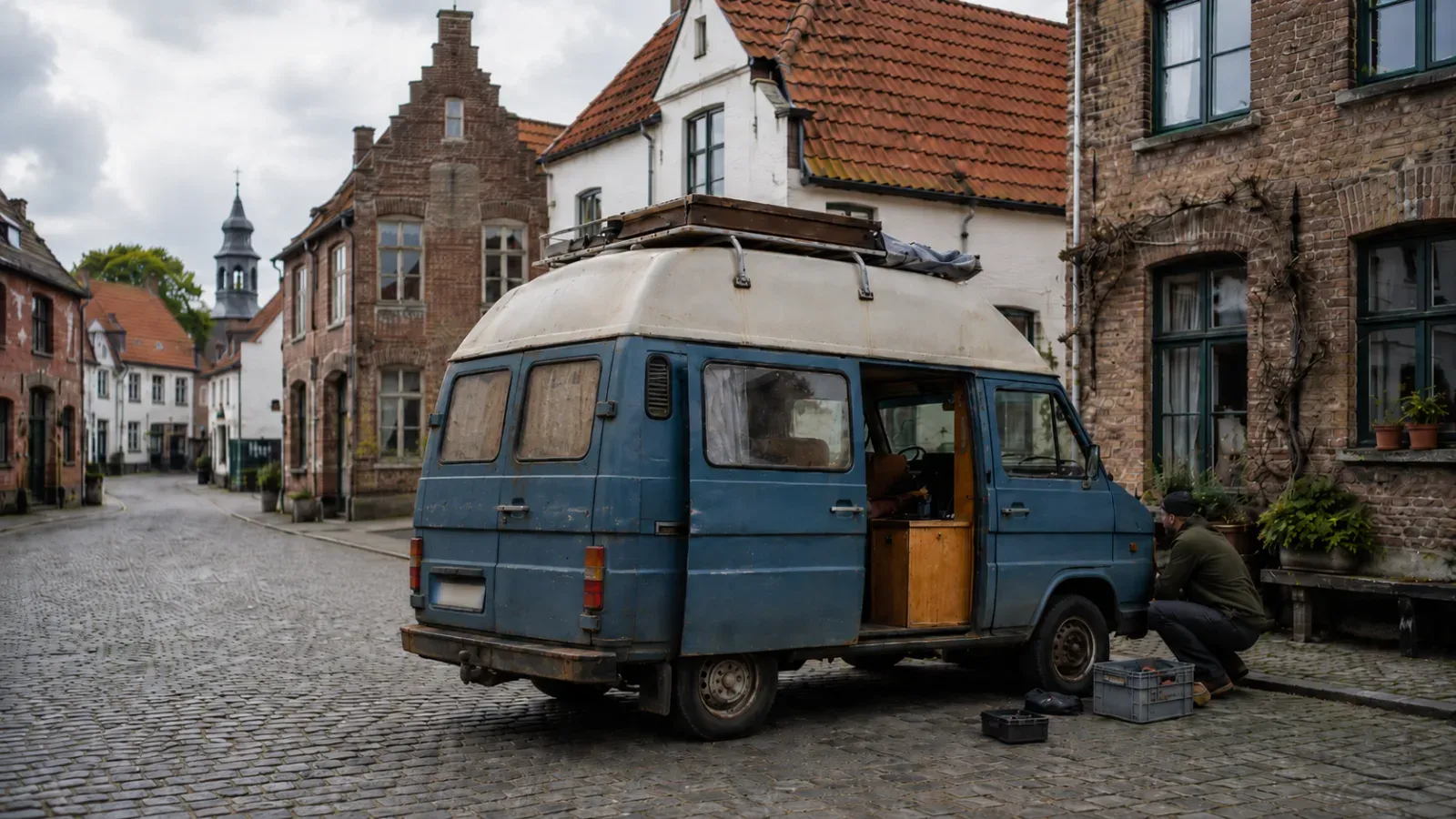
An old bus has something special. More character, less plastic, more story. You immediately picture it: an old Volkswagen, Mercedes, Ford, Renault, or Fiat with some wood inside, a relaxed pace, and no rush.
For vanlife, that sounds great. But as soon as you look beyond the charm, an important question arises: is a vintage van or vintage camper really interesting, or rather risky?
The answer is not black and white. A vintage vehicle can be fiscally attractive and have a lot of atmosphere. But for daily use, long journeys, full-time vanlife, low emission zones, maintenance, and insurance, it can quickly become more complicated than you think.
What is a vintage vehicle?
In Flanders, for road taxes, vehicles that were first put into circulation at least 30 years ago are considered. These are taxed at a flat rate. Important: for this, the date of first registration counts, not just the year of manufacture.
A vehicle that is more than 30 years old and registered with an O license plate is considered a vintage vehicle. Such an O plate offers certain advantages, but also clear usage restrictions.
This distinction is important. A vehicle can fall under the vintage vehicle regime for tax purposes due to its age, while driving with an O plate entails separate rules and restrictions.
O plate: cheaper, but not freely usable
A vintage vehicle with an O plate may not be used for just anything.
Vehicles with an O plate may not be used for:
- commercial and professional use
- commuting or school commuting
- paid transport
- free transport equated with paid transport
- use as a tool or working instrument
- intervention assignments
For a hobby vehicle or weekend camper, this may not be a problem. But for vanlife, it can be an issue.
If you only use your bus for leisure, travel, and outings, an O plate can be interesting. But if you also use the bus to drive to work, visit clients, transport materials for your side job, or as a daily vehicle, you need to be very careful.
For me, that is immediately the biggest risk. Vanlife feels like freedom, but with an O plate, that freedom is not unlimited.
Vintage vanlife is not the same as full-time vanlife
A vintage camper can perfectly suit quiet weekend trips, vintage vehicle meetings, short holidays, and nostalgic rides.
But for full-time vanlife, it's a different story.
If you live full-time in your bus, that bus often becomes more than a hobby vehicle. You drive it to shops, appointments, work, family, garages, campsites, nature spots, and perhaps even assignments. Then you have to honestly ask yourself if an O plate fits that use.
The rules do not literally forbid traveling with a vintage vehicle. But they do restrict professional use and commuting. As soon as your bus becomes your only vehicle and you do everything with it, the gray area grows.
Road tax: fiscally attractive
An important advantage of vintage vehicles is the road tax.
For vehicles that were first put into circulation at least 30 years ago, a flat-rate road tax applies in Flanders. At the time of writing, this amounts to 105.42 euros since July 1, 2025. From July 1, 2026, it will be 109.73 euros. This amount is indexed annually.
The tax on registration is also a flat rate. From July 1, 2025, it will be 55.88 euros. From July 1, 2026, it will be 58.16 euros.
This can be interesting, especially when compared to some younger vehicles. But taxes are only one part of the overall picture. A cheap road tax helps little if your bus requires a lot of maintenance, is unreliable, or does not suit your actual use.
Vintage vehicle inspection: less frequent, but not without control
Vintage vehicles with an O plate have a periodic vintage vehicle inspection.
For vehicles aged 30 to 49 years, a biennial inspection applies. Vehicles aged 50 years and older must undergo inspection every five years. For vehicles aged 25 to 29 years, an annual inspection applies, but for new vintage vehicle registrations, the 30-year limit is currently the most important.
For a vehicle you want to register with an O plate, a first vintage vehicle inspection is also required before registration.
Note: the period can be shortened by specific inspections, for example, for LPG, CNG, or a coupling device. A vintage camper with LPG or a tow bar may therefore require extra attention.
What about conversion to a camper?
An old delivery van is not automatically a camper just because you put a bed in it. If you want to officially register it as a motorhome, the interior and administration must be correct.
Camper conversion involves, among other things:
- fixed sleeping accommodation
- table and seating
- cooking facilities
- storage space
- secure fastening
- weight
- seats and seat belts
- gas or electricity
- any windows, roof hatches, or structural modifications
With a vintage vehicle, the vehicle is older and sometimes has less clear documentation. Chassis number, papers, previous modifications, engine changes, seating, and technical condition can all become important.
Converting an old bus can sound romantic, but administratively it can be more difficult than with a more recent delivery van.
LEZ: vintage vehicles can sometimes enter, but always check beforehand
Low emission zones are an important point for old diesels and petrol vehicles.
In Flanders, vintage vehicles older than 30 years may be allowed into LEZ areas such as Antwerp and Ghent after registration. Belgian vehicles must, among other things, be older than 30 years, be registered as a vintage vehicle, and have an O plate, 1 O plate, or personalized plate according to the rules.
This registration must be done with the local authority, free of charge in Antwerp or Ghent, and at the latest the day after you entered the LEZ.
In Brussels, there is also an exemption for vintage vehicles older than 30 years that meet the conditions. For Belgian vintage vehicles, this exemption can be automatic if the vehicle meets the conditions.
But don't blindly trust this. LEZ rules differ per city, per region, and certainly per country. Abroad, vintage vehicles may have different rules, stickers, day passes, or restrictions.
For vanlife, this is important. You don't just drive in your own municipality. You pass cities, parking lots, ports, campsites, and foreign zones. An old diesel can sometimes unexpectedly become problematic there.
Maintenance: character costs money
A vintage van has charm, but also age.
Think of:
- rust
- old rubbers
- leaking windows
- worn suspension
- older brakes
- less efficient engine
- more difficult parts
- less comfort
- less sound insulation
- fewer safety systems
- higher chance of breakdown
- fewer garages that know the model well
An old bus can be technically simple. That's an advantage if you're handy. But simple doesn't mean maintenance-free.
For someone who likes to tinker, a vintage vehicle can be fantastic. For someone who mainly wants to travel carefree, it can quickly become frustrating.
I fully understand the charm of an old van. But I also know myself that on the road, I'd rather arrive somewhere calmly with Grephar than have to crawl under the bus in a parking lot because something has "character" again.
Safety: old vehicles are different
A vintage vehicle drives differently than a modern delivery van.
Many old buses have less active and passive safety. Think of weaker brakes, no ABS, no airbags, less crumple zone, less good lighting, less stable handling, and less comfort on highways.
That doesn't mean you can't drive safely with it. But you have to adjust your driving style.
Driving slower, keeping more distance, braking earlier, and properly maintaining your vehicle are essential. Especially if you are driving a fully equipped camper, with extra weight, water, gas, furniture, and luggage.
Weight and payload remain important
A vintage camper also has an MTM (Maximum Authorized Mass) and payload.
Old delivery vans are sometimes built lighter, but that doesn't automatically mean they have a large safe margin. A wooden camper interior, water tank, gas bottle, refrigerator, battery, solar panels, and luggage can quickly make an old bus heavy.
So pay attention to:
- maximum authorized mass
- unladen weight
- payload
- axle loads
- braking capacity
- tires with the correct load index
- tow bar and trailer weight
An old bus that seems charming and light when empty can become surprisingly heavy after conversion. And old technology doesn't always react well to too much weight.
Insurance: vintage vehicle insurance is not always vanlife insurance
Vintage vehicle insurances are often attractively priced. But they usually have conditions.
Think of restrictions around:
- annual mileage
- recreational use
- storage
- daily use
- commuting
- professional use
- drivers
- foreign travel
- value of conversion
- use as a camper
A self-built vintage camper is not just a standard vintage vehicle. You have a vehicle, but also a camper interior, possibly solar panels, battery, gas installation, diesel heater, refrigerator, roof rack, or other accessories.
So clearly inform your insurer what the vehicle is, how it is registered, how you use it, and what is built in. Also ask if the conversion and accessories are insured.
A cheap policy is only interesting if it truly suits your use.
Parts and repairs on the road
With a more modern bus, you can often find parts faster. With a vintage vehicle, that strongly depends on the brand, model, and popularity.
An old Volkswagen or Mercedes often has an active community and parts market. A rarer delivery van can be much more difficult.
For vanlife, this is important. You don't want to wait three weeks for a brake cylinder while you're somewhere in France, Spain, or Sweden.
Check before purchase:
- are parts still available?
- are there specialists in Belgium or Europe?
- is there a community?
- are technical manuals available?
- is the engine reliable?
- are rust parts available?
- can your garage handle it?
Buying a vintage vehicle without researching parts is asking for surprises.
Vintage vehicle as an investment?
Some vintage vehicles increase in value. That can seem attractive.
But with a self-built camper, it's less simple. An original vintage vehicle can have collector's value. A heavily modified vintage vehicle can be less interesting for collectors.
Tastes also differ. What you find a beautiful conversion, a next buyer might find too specific. And if the conversion is not perfectly documented or inspected, that can depress the value.
So don't buy a vintage camper purely because you think it will always be worth more. Buy it because you really want to use it and understand what's involved.
When is a vintage van interesting?
A vintage van or camper can be interesting if:
- you mainly drive recreationally
- you don't need it for commuting
- you like to travel at a relaxed pace
- you are technically handy
- you don't mind maintenance
- parts are available
- you find correct insurance
- your vehicle's administration is correct
- you are not dependent on daily reliability
- you value charm more than modern comfort
For weekend vanlife, vintage vehicle meetings, short trips, and quiet holidays, it can be a great choice.
When is it risky?
A vintage vehicle becomes riskier if:
- you want to use it daily
- you want to drive it to work
- you want to live full-time in your bus
- you have little technical knowledge
- you have little budget left for maintenance
- the bus has rust problems
- parts are difficult to obtain
- the conversion is not documented
- you often visit LEZ areas or foreign cities
- you expect modern reliability
- you want to install heavy equipment
- your insurer does not clearly cover the use
Then a slightly more modern delivery van might ultimately be smarter, even if it has less character.
Common mistakes
A first mistake is thinking that vintage automatically means cheap. Taxes can be low, but maintenance and repairs can be high.
A second mistake is getting an O plate without understanding the usage restrictions.
A third mistake is buying an old bus for full-time vanlife without considering reliability and parts.
A fourth mistake is doing a camper conversion without checking if the papers, seats, seat belts, and interior are correct.
A fifth mistake is ignoring LEZ rules, especially in Belgium and abroad.
A sixth mistake is taking out vintage vehicle insurance without reporting that the vehicle is used as a camper.
A seventh mistake is falling in love with the look and underestimating rust, technology, or weight.
Practical checklist before purchase
Check before you buy a vintage van or camper:
- what is the date of first registration?
- has the vehicle been in circulation for at least 30 years?
- does it have an O plate or a regular plate?
- does your use fit within the restrictions of an O plate?
- is there a valid inspection certificate?
- when is the next vintage vehicle inspection due?
- is there a vintage vehicle report?
- does the chassis number match the documents?
- is the camper conversion officially in order?
- how many official seats are there?
- are seat belts and seats correct?
- what is the MTM and payload?
- is there rust on the chassis, sills, wheel arches, or roof edges?
- are parts available?
- is there documentation of maintenance?
- are you allowed to drive it in LEZ zones where you want to go?
- does the insurance cover camper use?
- is the value of the conversion insured?
This checklist may be less romantic than a photo of an old van at sunset, but it can save you a lot of trouble.
Conclusion
A vintage van or vintage camper can be fantastic for vanlife, but especially if you use it for what it's good at: quiet rides, recreational trips, characterful journeys, and a bit of nostalgia.
Fiscally, a vintage vehicle can be interesting. Road tax and BIV are flat rates. With an O plate, you also have a clear vintage vehicle status. But that O plate also brings restrictions, especially regarding professional use and commuting.
For full-time vanlife, daily use, or long, worry-free journeys, a vintage vehicle is not always the smartest choice. Then maintenance, reliability, LEZ rules, insurance, and parts availability can outweigh the charm.
My advice: don't buy a vintage bus because it seems cheap. Only buy it if you consciously choose the whole package: character, maintenance, limitations, slower travel, and administrative attention. Then it can be beautiful. But if you mainly want to set off carefree, a more modern bus is often the wiser choice.
Source: https://www.vlaanderen.be/periodieke-oldtimerkeuring
Source: https://www.vlaanderen.be/mobiliteit-en-openbare-werken/duurzame-mobiliteit/lage-emissiezones-lez