Road Tax for Motorhomes in Flanders
A motorhome sometimes sounds fiscally as if it automatically becomes expensive. A large bus, heavy weight, lots of space, perhaps a diesel engine and a robust conversion. You quickly think: that will surely cost a lot annually. But in Flanders, the road tax for motorhomes is often more favorable than many people expect.
By Laurens De Leeuw · 24 June 2026
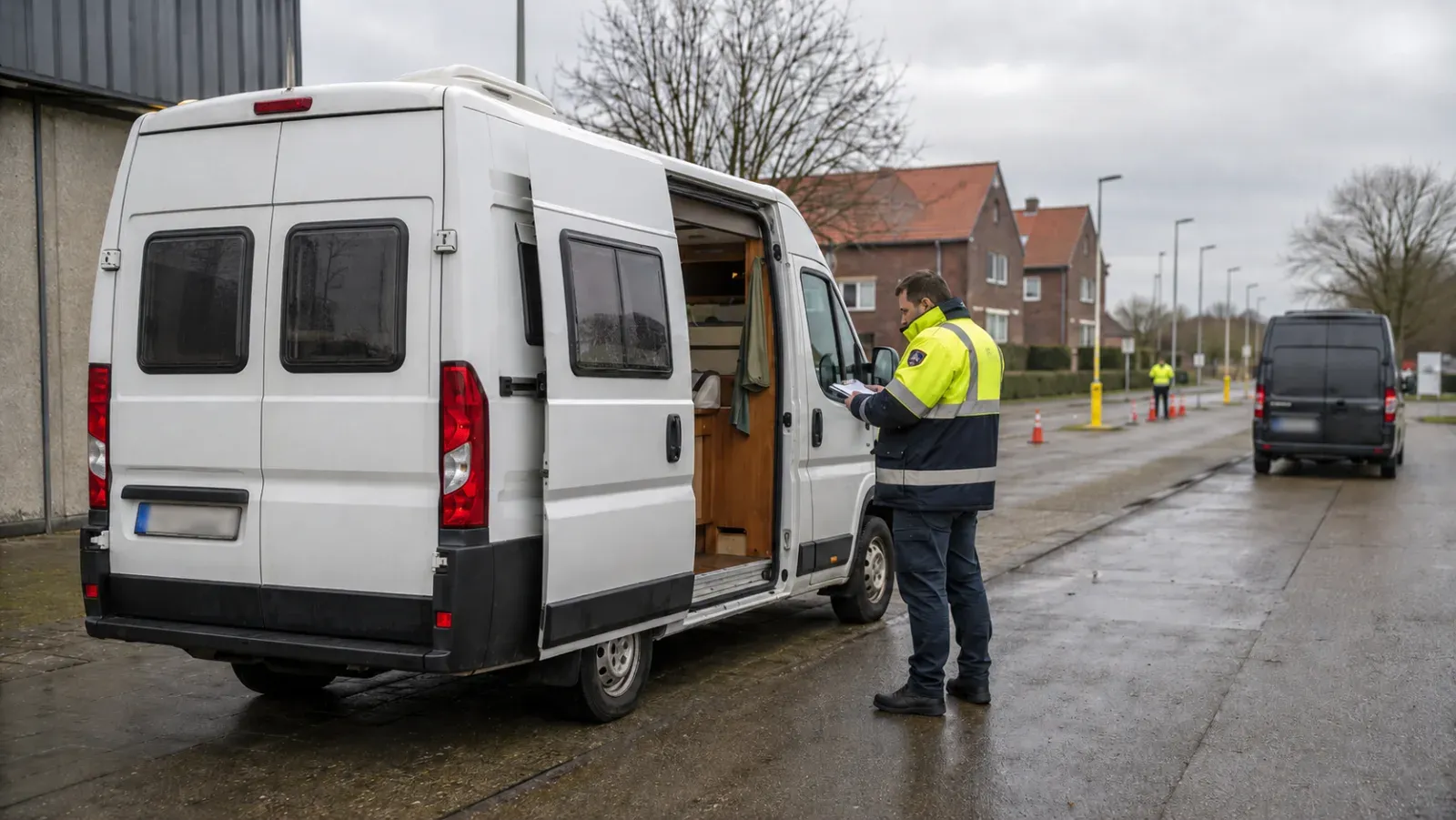
A motorhome sometimes sounds fiscally as if it automatically becomes expensive. A large bus, heavy weight, lots of space, perhaps a diesel engine and a robust conversion. You quickly think: that will surely cost a lot annually.
But in Flanders, the road tax for motorhomes is often more favorable than many people expect. Especially when compared to passenger cars, where the calculation takes into account factors such as power, fuel, CO2, and environmental characteristics much more.
For motorhomes, the Flemish Tax Service primarily looks at one important figure: the maximum permissible mass, or MTM.
And that immediately links to vanlife. Because anyone converting a van into a motorhome not only has to think about a bed, kitchen, and homologation, but also about what that official registration means for taxes.
What is a motorhome according to Flanders?
A motorhome or campervan is a vehicle for the transport of passengers whose construction includes living accommodation.
Think of:
- seating
- table
- sleeping accommodation
- cooking facilities
- storage space
This aligns with what we previously saw with homologation. A bus does not automatically become a motorhome just because you put a mattress in it. It concerns a vehicle that is officially equipped and registered as a motorhome.
For road tax, this official registration is important. The tax is not calculated based on what you call your bus, but on how the vehicle is administratively registered.
Annual Road Tax: Calculated on MTM
For motorhomes, the Flemish Tax Service looks at the maximum permissible mass of the vehicle.
MTM stands for maximum permissible mass. This is the maximum weight your vehicle is officially allowed to weigh when fully loaded.
So not just the empty weight of the bus, but the maximum on paper. For road tax, it doesn't matter how much your bus actually weighs today at the weighbridge, but in which MTM class it officially falls.
This is important when choosing your base vehicle. A motorhome with an MTM of 3,500 kg falls into a different class than a vehicle of, for example, 4,250 kg MTM.
Rates for Motorhomes in Flanders
According to Flanders, these rates apply to the annual road tax for motorhomes, including additional centimes:
| MTM | Annual Road Tax |
| --- | --- |
| 0 to 1,500 kg | 92.40 euros |
| 1,500 to 3,500 kg | 132.00 euros |
| 3,501 to 7,999 kg | 145.20 euros |
| 8,000 to 10,999 kg | 184.80 euros |
| 11,000 kg and more | 290.40 euros |
For most Belgian vanlifers, the bus falls into the 1,500 to 3,500 kg class. This is logical, as many self-built campers deliberately stay below 3,500 kg so that they can be driven with a B driving license.
In that case, the annual road tax for a motorhome is 132.00 euros.
This amount can, of course, change later. Always check the current rates with Flanders or via the simulation tool of the Flemish Tax Service.
No Registration Tax for Motorhomes
An important advantage: for motorhomes, you do not have to pay registration tax in Flanders.
This is the one-time tax you normally pay when a vehicle is put into circulation for the first time or again. For passenger cars, this BIV (Belasting op Inverkeerstelling - Registration Tax) can sometimes be quite high, depending on the vehicle.
This does not apply to motorhomes. Flanders explicitly states that motorhomes do not have to pay registration tax.
For those who want to convert a bus, this is an important difference compared to a regular passenger car. But beware: this does not mean that you have no costs at all. You still have annual road tax, insurance, inspection, possible homologation costs, registration, maintenance, and of course the conversion itself.
Motorhome or Light Commercial Vehicle: Fiscal Difference
Many vanlifers hesitate between remaining a light commercial vehicle or officially becoming a motorhome.
Fiscally, these are two different worlds.
For a light commercial vehicle, the annual road tax is calculated differently. For certain light commercial vehicles, factors such as maximum permissible mass, Euro norm, and the presence of a particulate filter are taken into account.
For a motorhome, Flanders looks at the MTM class of the motorhome for the annual road tax.
For a self-build project, you should therefore not only look at what seems fiscally advantageous, but especially at what is consistent with your vehicle and its use. If your bus actually has a permanent camper interior and you want to use it as a motorhome, then the registration, inspection, and insurance must match that.
I personally would not build around “how do I pay the least tax?” but around “how does my bus best align technically and administratively?” The fiscal aspect is important, but it should not be the only reason to have your vehicle incorrectly registered on paper.
Why 3,500 kg is Important Again
The 3,500 kg limit constantly reappears in vanlife.
It is important for:
- driving license B
- payload
- inspection
- insurance
- traffic rules
- tolls and restrictions abroad
- sometimes also fiscal comparison
For the road tax of motorhomes, the Flemish tariff limit is also at 3,500 kg. A motorhome from 1,500 to 3,500 kg pays 132.00 euros per year. A motorhome from 3,501 to 7,999 kg pays 145.20 euros per year.
The difference in road tax between just under and just over 3,500 kg is therefore not enormous. But for your driving license and practical use, that limit is very important.
A bus above 3,500 kg can provide more payload, but then you might end up with a C1 driving license, other practical limitations, and a different type of use. Road tax is therefore only one piece of the puzzle.
What if you have a Heavy Camper?
For heavier motorhomes, the annual road tax increases, but the rates in Flanders remain relatively manageable.
A motorhome from 3,501 to 7,999 kg falls into the 145.20 euro tariff class. Only from 8,000 kg do you enter the next class. From 11,000 kg, a higher rate applies again.
For the average self-build vanlifer, primarily the first two or three classes are relevant. Most buses are under 3,500 kg, or sometimes just above that for larger campers or vehicles with more payload.
But don't forget: a higher MTM might be fiscally favorable, but often requires a different driving license and can have consequences in use. Think of C1, toll roads, speed limits, tonnage restrictions, parking, and resale value.
Leasing Companies: Different Regulations
Separate rules apply to leasing companies.
If a leased motorhome has an MTM of no more than 3,500 kg, the leasing company pays the rate for a light commercial vehicle.
If the leased motorhome has an MTM of more than 3,500 kg, a separate table applies to leased motorhomes.
For most private vanlifers, this is less relevant, but it is good to know. Anyone working through leasing or a company should not simply assume that the same table applies as for a private registration.
When Do You Start Paying Road Tax?
Road tax is linked to the registration of the vehicle.
As soon as the vehicle is registered and used on public roads, road tax may be due according to the type of vehicle and the rules applicable to it.
In a conversion project, timing can therefore be important. A bus can first be registered as a light commercial vehicle and later, after homologation and inspection, as a motorhome. From the moment the administrative status changes, the fiscal treatment can also change.
If in doubt, inquire with the Flemish Tax Service or use the official simulation tool. Especially for re-registration, import, leasing, company vehicles, or heavy vehicles, it is better not to guess.
Road Tax is Not the Same as Inspection or Insurance
Sometimes all annual costs are lumped together, but road tax is only one component.
In addition to road tax, you also have:
- insurance
- technical inspection
- maintenance
- possible breakdown assistance
- possible tolls or environmental zones
- fuel
- parking or storage
- repairs
- conversion costs
The road tax for a motorhome may therefore seem relatively low, but that does not mean that a camper is cheap in overall use.
For me, this is especially important to be honest with people who want to start vanlife. A bus is freedom, but not free freedom. You have fewer fixed costs than a house, but you get other fixed costs in return.
Use the Simulation Tool for Your Situation
The rates provide a good overview, but for your own vehicle, it is best to use the simulation tool of the Flemish Tax Service.
This is certainly useful when:
- you are in doubt between a light commercial vehicle and a motorhome
- you want to import a vehicle
- you work through leasing
- your vehicle is above 3,500 kg
- you use a company
- you are unsure of the MTM
- your vehicle is electric, hybrid, or specially registered
- you are re-registering an existing vehicle
The simulation is indicative, but provides a better picture than isolated amounts from an online discussion.
Common Misunderstandings
A first misunderstanding is that a motorhome is automatically extremely expensive in road tax. In Flanders, this is often not the case for many motorhomes, especially in the class up to 3,500 kg.
A second misunderstanding is that the tax is calculated on the actual weight. For motorhomes, Flanders looks at the maximum permissible mass, i.e., the MTM on paper.
A third misunderstanding is that you have to pay BIV for a motorhome. Flanders states that motorhomes do not have to pay registration tax.
A fourth misunderstanding is that light commercial vehicles and motorhomes are treated the same fiscally. That is not correct. The calculation differs.
A fifth misunderstanding is that you can simply choose the cheapest fiscal option, regardless of the interior. Your vehicle must administratively match what it is and how you use it.
Practical Checklist
Before buying or converting a bus, check:
- what is the current registration?
- is the vehicle a light commercial vehicle, passenger car, or motorhome?
- what is the MTM?
- will the vehicle remain under 3,500 kg?
- do you want to officially become a motorhome?
- do you need to homologate?
- what will the annual road tax be?
- is BIV due?
- will the tax change after re-registration?
- does the insurance match the new status?
- have you used the simulation tool?
These are not exciting questions, but they can prevent many surprises.
Conclusion
The road tax for motorhomes in Flanders is calculated based on the maximum permissible mass of the vehicle. For most vanlifers with a motorhome between 1,500 and 3,500 kg MTM, this amounts to 132.00 euros in annual road tax according to the current Flemish table.
An important advantage is that motorhomes do not have to pay registration tax.
However, road tax should not be viewed in isolation from the rest. The choice between a light commercial vehicle and a motorhome has consequences for homologation, inspection, insurance, driving license, and use. The cheapest option is not always the right option.
My advice: first make sure your bus is correct on paper. Then look at the costs. A well-built and correctly registered van provides much more peace of mind than a bus that only seems fiscally interesting but is administratively problematic.