Insuring a self-built campervan: what does your insurer need to know?
A self-built campervan is not just any vehicle. It's a van, a construction project, a small home on wheels, and often a serious investment. You put time, money, and energy into it. Sometimes more than you dare admit beforehand. But on paper, everything still starts with one basic rule: as soon as you drive a motor vehicle on public roads in Belgium, you need a third-party liability (BA) car insurance.
By Laurens De Leeuw · 24 June 2026
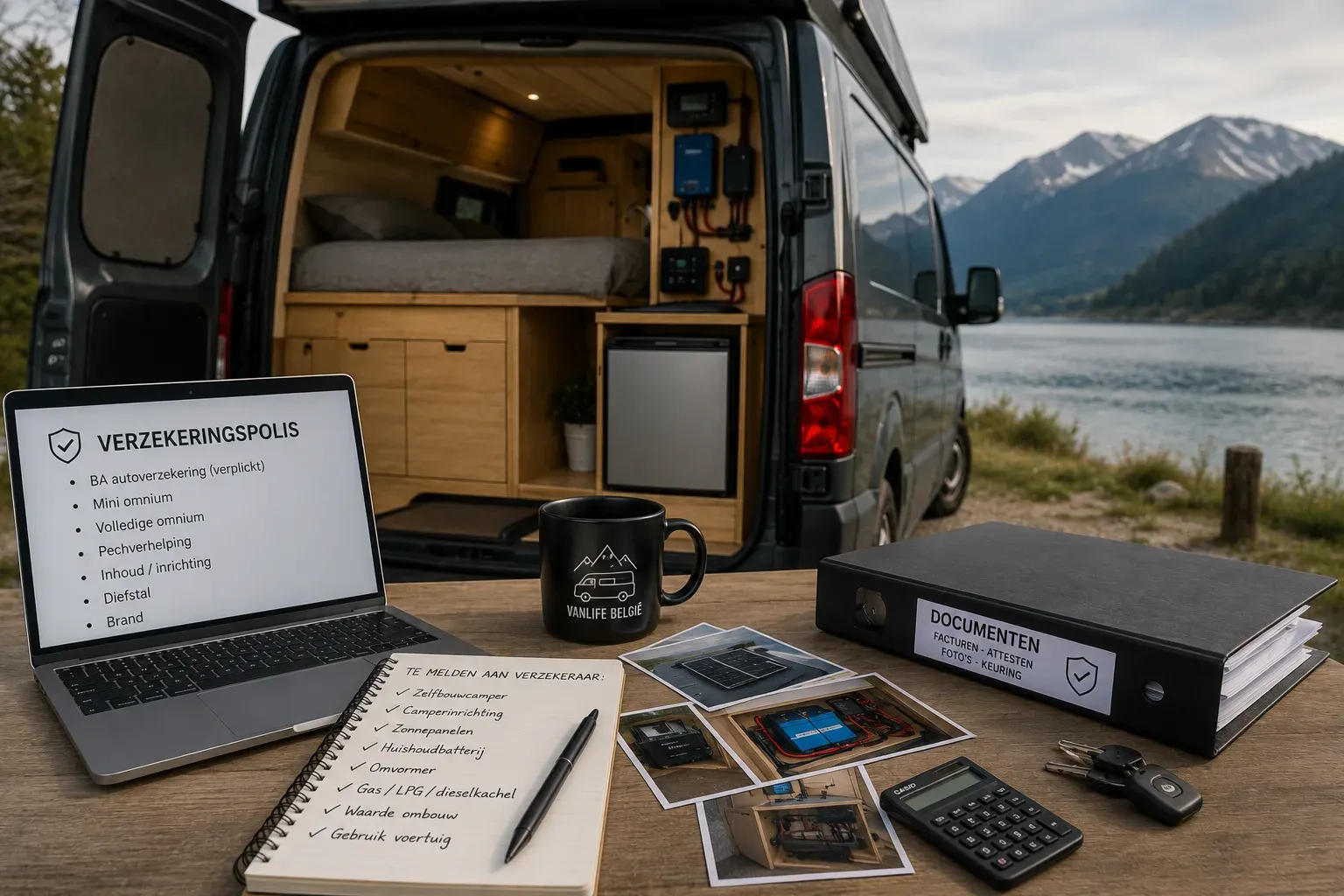
A self-built campervan is not just any vehicle. It's a van, a construction project, a small home on wheels, and often a serious investment. You put time, money, and energy into it. Sometimes more than you dare admit beforehand.
But on paper, everything still starts with one basic rule: as soon as you drive a motor vehicle on public roads in Belgium, you need a third-party liability (BA) car insurance.
That mandatory BA insurance is the basis. But with a self-built campervan, the real question is bigger: does your insurer actually know what you've done with that van?
Third-party liability (BA) car insurance: mandatory, but limited
Third-party liability (BA) car insurance, fully civil liability car, is mandatory for motor vehicles driving on public roads. It covers damage you cause to others with your vehicle.
Think of personal injury, material damage to another vehicle, damage to a building, pole, bicycle, trailer, or other road user.
But BA insurance normally does not cover damage to your own vehicle if you are at fault. It also does not automatically cover your expensive self-built interior, leisure battery, solar panels, inverter, refrigerator, or camper furniture as if all that is standard with the van.
That's the most important point for self-builders: BA is mandatory, but not enough to properly protect your own investment.
Why a self-built campervan is different from a regular van
A regular van usually has a fairly clear value. Make, model, age, mileage, engine, trim, and condition largely determine its worth.
With a self-built campervan, it's different.
You can buy a van for, say, 18,000 euros and then invest thousands more euros in:
- insulation
- floor and wall covering
- bed construction
- furniture
- refrigerator
- cooking facilities
- water installation
- solar panels
- leisure battery
- inverter
- diesel heater
- skylight
- fan
- windows
- tow bar
- bike rack
- security
- sound insulation
- professionally installed components
On paper, the vehicle may still look like a regular van, while in reality, it has become a fitted campervan. If your insurer doesn't know this, it can cause problems in case of damage or theft.
What must your insurer definitely know?
Your insurer must have a correct picture of the vehicle as it is actually used and equipped.
Report at least:
- that it is a self-built campervan or converted van
- whether the vehicle remains a light commercial vehicle or officially becomes a motorhome
- how many official seats there are
- whether a fixed camper interior is present
- which major installations are built-in
- whether gas, LPG, or diesel heating is present
- whether there are solar panels and a leisure battery
- whether there is an inverter or 230V installation
- whether expensive accessories are on or attached to the vehicle
- whether the conversion was done professionally or by yourself
- what the estimated value of the conversion is
- how the vehicle is used
The latter is important. Do you use the van daily for commuting? Only for travel? For a side job? For rental? For professional equipment? For long trips outside Belgium? All of this can influence the policy.
Light commercial vehicle or motorhome: state what it officially is
With a self-built campervan, the difference between a light commercial vehicle and a motorhome is important.
If your vehicle officially remains a light commercial vehicle, but you use it in practice as a campervan, your insurer must know that. If your vehicle is officially registered as a motorhome, the insurance must also be aligned with that.
Problems arise when the documents, actual use, and insurance do not tell the same story.
Example: your vehicle is insured as a regular light commercial vehicle, but has a fixed camper interior with a bed, kitchen, leisure battery, gas installation, and solar panels. In case of damage, there may be a discussion about value, use, and undeclared modifications.
My advice: don't try to be smarter than the paperwork. Make sure your registration, inspection, conversion, and insurance tell as much of the same story as possible.
Reporting self-build during the construction phase
Many people only think about insurance when the campervan is finished. Actually, that's too late.
Something can also happen during the construction phase:
- fire due to grinding, welding, or electricity
- theft of materials
- damage due to storm or water
- accident while the van is still half-finished
- damage to expensive parts that are already ready
- damage during test drives
So ask your insurer how your vehicle is insured during the conversion. A van that is not yet officially registered as a motorhome can already contain thousands of euros worth of parts.
Especially if you build for a long time, this is important. A conversion often takes months, sometimes longer. During that period, the value of your vehicle changes step by step.
The value of your self-built interior
One of the biggest insurance questions is: how much is your self-built interior worth?
That's not always simple. You have material costs, parts, appliances, and perhaps professional installation. But insurers often don't simply count your own hours as market value.
That's why documentation is important.
Keep:
- purchase invoices
- quotes
- proof of payment
- photos of the build
- photos of finished parts
- technical specifications
- certificates of professional installation
- inspection documents
- homologation documents
- list of built-in parts with estimated value
The better you can demonstrate what is in the vehicle, the stronger your position in case of fire, theft, or total loss.
Also take photos before everything is closed up. A neat wooden wall looks nice, but doesn't show what cables, insulation, fastenings, or technical installations are behind it.
BA, mini omnium, full omnium: what's the difference?
Third-party liability (BA) car insurance is mandatory and covers damage to third parties. That is the legal basis.
A mini omnium or small omnium is supplementary insurance. Depending on the policy, it can cover damage caused by, for example, fire, theft, glass breakage, natural forces, or collision with animals.
A full omnium goes further and can also cover damage to your own vehicle, even if you are at fault or if no opposing party is known.
For a self-built campervan, omnium can be important, but only if it is clear what is insured. An omnium based on the basic value of a van is not the same as an omnium that also correctly includes your camper conversion and accessories.
So don't just ask: “do I have omnium?” Especially ask: “what value is insured and are my conversion, solar panels, battery, interior, and accessories included?”
Accessories and fixed parts
With a self-built campervan, accessories can be very valuable.
Think of:
- solar panels
- roof rack
- awning
- skylight
- fan
- leisure battery
- inverter
- charge booster
- refrigerator
- diesel heater
- fixed hob
- water pump
- boiler
- bike rack
- tow bar
- extra windows
- security system
- reversing camera
- MaxxFan or other roof fan
Some parts are fixed in or on the vehicle. Others are loose or semi-loose. This difference can be important for insurance.
A laptop, camera, drone, or power station, for example, may not automatically fall under the same coverage as a permanently installed inverter. So explicitly ask what is insured as a vehicle part, what counts as contents or luggage, and what may need to be insured separately.
Always report gas, LPG, and diesel heater
You must definitely report gas, LPG, and diesel heating.
Not only because they have value, but also because they entail risks. Fire, leaks, carbon monoxide, and explosion hazards are not small details for an insurer.
For LPG installations in vehicles, specific inspections apply in addition to the regular technical inspection. After installation, modification, or repair, a separate LPG inspection may be mandatory. If you have such an installation, the insurance must know that it is present and correctly inspected.
It is also best to report a diesel heater. Especially if it is permanently installed and has fuel lines, exhaust, and electrical connection.
This is not the time to think: “they don't ask about it, so I won't say anything.” In case of fire damage, you don't want to have to explain that there was an unreported heater or gas installation in the van.
Report electrical installation
You should also report a leisure battery, solar panels, and inverter.
They increase the value of your vehicle and can pose a fire risk if poorly installed. A large lithium battery, 230V installation, shore power connection, or powerful inverter is relevant information for an insurer.
Ask specifically:
- are solar panels covered?
- is the leisure battery covered?
- is the inverter covered?
- is damage due to short circuit covered?
- is fire due to electrical installation covered?
- must the installation be professionally installed?
- do I need photos or invoices?
- is theft of parts covered?
For me, this is a point where I prefer to report too much rather than too little. As a web developer, I like systems that are clear. Insurance that doesn't know what's in your van is not a clear system.
Seats and passengers
The number of seats on paper must match what your insurer thinks the vehicle is.
If your vehicle officially has two seats, but you transport people in the back on a homemade bench, you are wrong. Not only technically and legally, but possibly also from an insurance perspective.
Passengers may only ride in official seats that are approved for that purpose. Seat belts, headrests, and anchor points must be correct.
So also report changes to seats, swivel bases, seat belts, or benches. Especially if you want to transport extra passengers.
Rental or sharing with others
Do you use your self-built campervan only yourself, or do you want to rent it out or lend it?
That makes a big difference.
Many standard insurances are not intended for rental. If you rent out your campervan via a platform or lend it privately for a fee, your insurer must know that. Regularly lending it to friends or family can also raise questions, depending on the policy.
If you ever want to rent it out, discuss it before you start. Not after there is damage.
Use abroad
Vanlife doesn't stop at the Belgian border. You might drive to France, Spain, Portugal, Scandinavia, the Alps, or the Balkans.
Therefore, check:
- in which countries your BA is valid
- what is stated on your insurance certificate
- whether breakdown assistance abroad is included
- whether repatriation of vehicle and persons is included
- whether your camper conversion remains covered abroad
- what happens in case of theft or total loss abroad
- whether trailers need to be mentioned separately
For long trips, assistance is sometimes as important as the insurance itself. A broken-down van in Belgium is annoying. A broken-down self-built campervan in Southern Spain is another story.
Breakdown assistance: pay attention to height, weight, and vehicle type
Breakdown assistance seems simple, but with campervans and converted vans, you need to be careful.
Some assistance formulas have limitations on:
- maximum authorized mass
- height
- length
- vehicle type
- use as a campervan
- trailer
- abroad
- number of travel days
- repatriation
- replacement vehicle
A tall van weighing 3,500 kg is not the same as a regular passenger car. So explicitly ask if your vehicle is covered by the assistance.
Especially if you have a large van with a roof rack, solar panels, raised roof, or trailer, you want to know this beforehand.
What about theft?
Self-built campervans can be attractive to thieves. Not only the vehicle itself, but also what's inside.
Theft can involve:
- the entire van
- solar panels
- battery
- inverter
- bicycle or bike rack
- tools
- laptop
- camera
- personal belongings
- loose camping equipment
- navigation or electronics
Ask what items are covered and under what conditions. Some policies differentiate between permanently mounted parts, loose luggage, and valuable items.
Also check if there are conditions regarding security, locked vehicle, visible items, or overnight parking.
What about fire?
Fire is one of the biggest risks with a self-built campervan.
Possible causes include:
- electrical short circuit
- poor connections
- overheated inverter
- incorrectly placed fuses
- gas leak
- cooking appliance
- diesel heater
- battery problem
- external fire
- arson
A mini omnium can cover fire, but the conditions are important. If the fire is caused by an unreported or poorly installed system, it can lead to discussion.
That's why photos, invoices, diagrams, and professional certificates are so useful. They show that you didn't just lay some cables and gas lines without thinking.
What about total loss?
In case of total loss, you want to know what value will be paid out.
Is it the market value of a regular van? The value as a motorhome? The insured value according to an estimate? The invoice value? The agreed value? The current value? The daily value?
For a self-built campervan, that difference can be enormous.
Therefore, ask before you have damage:
- what value is insured?
- is the conversion included?
- how do I prove the value?
- is an expert appraisal or valuation needed?
- is own labor included?
- how is depreciation applied?
- what happens in case of total loss?
This may be boring, but it can make thousands of euros difference.
Should you have an expert look at it?
For an expensive or extensive self-build, an expert appraisal can be useful. An expert can estimate the value of the vehicle and the conversion. Some insurers request this themselves, others let it depend on the value or coverage.
An appraisal can be useful if you want to establish a clear insured value. Especially with a beautifully finished self-built campervan that has a lot of money invested in it, this can be stronger than just a folder of receipts.
Ask your insurer if an appraisal is necessary or useful.
Common mistakes
A first mistake is only taking BA and thinking that your own camper conversion is well insured with it.
A second mistake is not reporting the conversion because the vehicle is still registered as a light commercial vehicle.
A third mistake is not keeping invoices or photos of parts and installation.
A fourth mistake is not mentioning expensive accessories separately.
A fifth mistake is not reporting gas, LPG, diesel heater, or electrical installation.
A sixth mistake is transporting passengers in unofficial seats.
A seventh mistake is taking out breakdown assistance without checking if a tall or heavy van is covered.
An eighth mistake is renting out without adapted insurance.
A ninth mistake is not knowing what value is used in case of total loss.
Practical questions for your insurer
Ask your insurer or broker these very specific questions:
- Is my vehicle insured as a light commercial vehicle or a motorhome?
- May I use the vehicle as a self-built campervan?
- Are fixed camper furniture insured?
- Are solar panels insured?
- Is the leisure battery insured?
- Is my inverter and electrical installation insured?
- Is damage due to short circuit covered?
- Is fire due to gas, diesel heater, or electricity covered?
- Must gas, LPG, or diesel heating be mentioned separately?
- Are loose items, laptop, camera, or tools covered?
- Is theft of built-in parts covered?
- What value is used in case of total loss?
- Do I need to provide invoices or photos?
- Is an expert appraisal needed?
- Am I covered abroad?
- Is breakdown assistance included for my height, weight, and vehicle type?
- May I rent out or lend the vehicle?
Preferably have important answers confirmed in writing. Not because you should be distrustful, but because clarity afterwards prevents a lot of misery.
Conclusion
Third-party liability (BA) car insurance is mandatory for motor vehicles on the road, but for a self-built campervan, that's just the basis.
Your insurer needs to know what your vehicle really is: a light commercial vehicle, motorhome, or converted van with a camper interior. Also report valuable and risky components, such as solar panels, leisure battery, inverter, gas installation, LPG, diesel heater, extra windows, roof rack, bike rack, and fixed furniture.
Keep invoices, photos, certificates, and diagrams. Ask clearly what value is insured and what happens in case of fire, theft, accident, or total loss.
Building a self-built campervan is about freedom, but insurance is about honesty and clarity. If your van on paper matches what it is in reality, you will set off with much more peace of mind.
Source: https://www.fsma.be/nl/autoverzekering
Source: https://www.assuralia.be/nl/thema/mobiliteit/omniumverzekering
Source: https://www.autoveiligheid.be/autokeuring/kampeerwagen/keuring-na-inschrijving