Solar panels, house battery and electricity: what do you need to report to insurance or inspection?
A modern van without electricity quickly feels limited. You want to charge your phone, use your laptop, run your fridge, have lighting, maybe connect a water pump, and ideally be able to go off-grid for a few days. That's why many vanlifers install solar panels, a house battery, an inverter, a charge booster, and 230V outlets in their van.
By Laurens De Leeuw · 24 June 2026
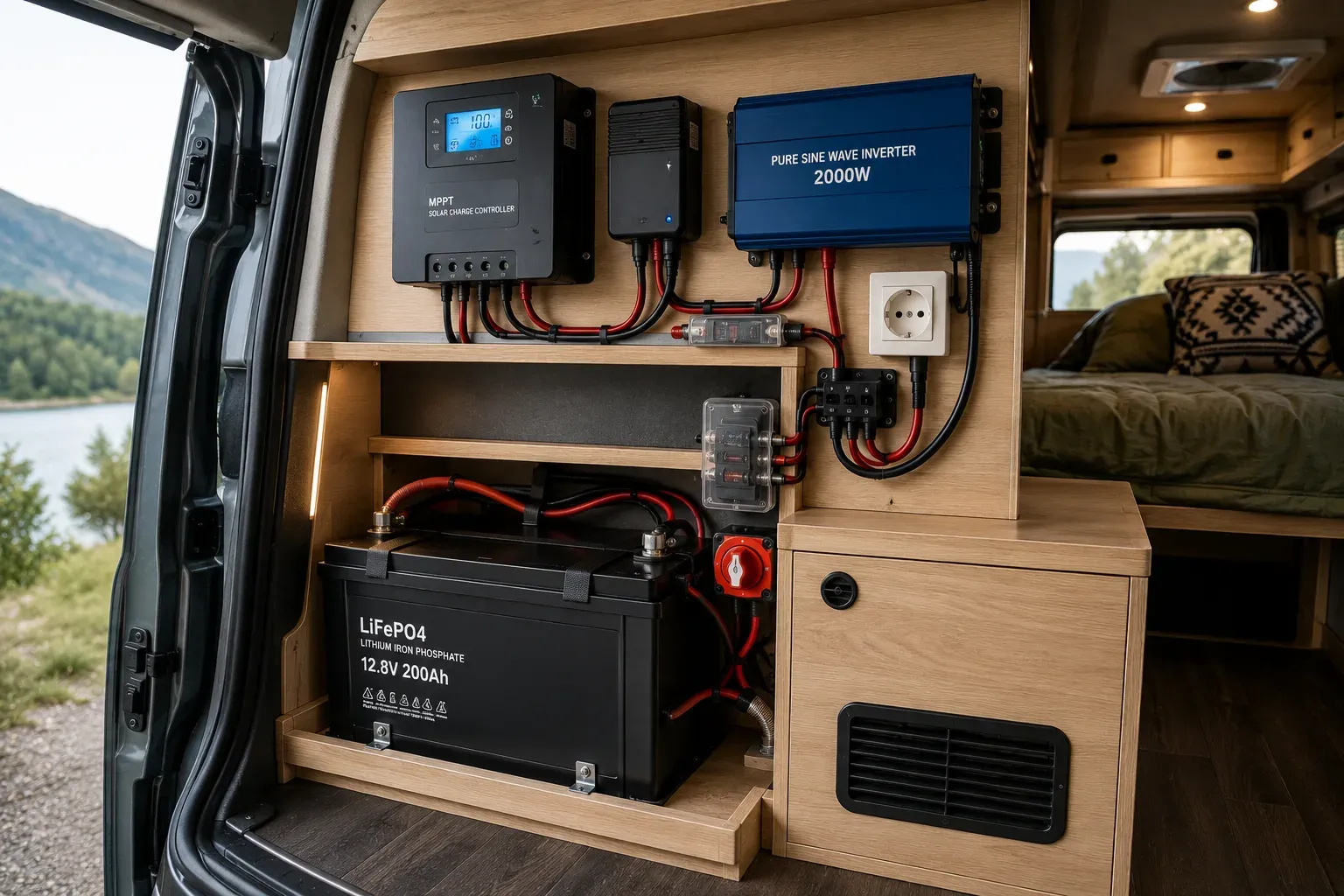
A modern van without electricity quickly feels limited. You want to charge your phone, use your laptop, run your fridge, have lighting, maybe connect a water pump, and ideally be able to go off-grid for a few days. That's why many vanlifers install solar panels, a house battery, an inverter, a charge booster, and 230V outlets in their van.
But as soon as you start with electricity, a less pleasant question arises: do you have to report it to your insurance or for inspection?
Short answer: it's best to report everything that changes the value, risk, or use of your vehicle to your insurer. For inspection, it depends on whether your installation is part of an official conversion to a campervan, whether it technically modifies the vehicle, and whether everything is safely, solidly, and correctly installed.
Electricity seems clean and quiet, but a poorly placed battery or incorrectly connected inverter can indeed pose a fire hazard. This is not a topic to quickly "tinker" with between two cabinets.
Why electricity in a van is different from at home
At home, your electrical installation is fixed to a building. In a van, everything moves. You drive over speed bumps, cobblestones, potholes, dirt roads, and sometimes just really bad Belgian concrete roads.
This means that cables, fuses, batteries, and appliances must not only be electrically safe but also mechanically well secured.
A cable that stays neatly in place at home can chafe in a van. A battery that sits in a technical room at home can become a projectile in a van during an emergency stop. An inverter that hangs in a dry garage might be near condensation, dust, vibrations, or wood dust in a van.
That's why an electrical installation in a camper conversion is not just "pulling a few wires." It must be designed for movement, vibrations, heat, weight, and safety.
What do we mean by house battery?
A house battery is a separate battery for your living area. It is separate from your starter battery, or at least electrically arranged so that your starter battery is not drained by your fridge, lighting, or laptop.
Such a house battery can be used for, for example:
- lighting
- refrigerator
- water pump
- USB chargers
- laptop chargers
- fan
- diesel heater
- inverter to 230V
- small appliances
- induction cooking if the installation is powerful enough
Many DIY builders today choose lithium, often LiFePO4. This is lighter and more practical than older lead-acid batteries, but it does require correct battery protection, a suitable charger, and good installation.
So, a house battery is not just "an extra battery." It is the heart of your electrical system.
What about solar panels on your van?
Solar panels on the roof are convenient, but they do change something about your vehicle.
They add weight, are exposed to wind, rain, and vibrations on the roof, and must be securely fastened. The cable entry through the roof must also be watertight and safe.
In a conversion to a campervan, solar panels can be part of your complete conversion file. Solar panels themselves are not always the most difficult part, but they do count towards weight, roof load, height, and value.
Pay particular attention to:
- sturdy fastening
- no sharp edges or protruding parts
- correct cable entry
- watertight sealing
- proper fuses
- correct charge controller
- weight on the roof
- impact on the total height of the vehicle
For a stealth van, it can also play a practical role. Solar panels make your van less inconspicuous. That's not an inspection point, but it is something many vanlifers consciously consider.
Do you have to report solar panels for inspection?
There is no simple general rule that says: every solar panel on every van must be reported separately for technical inspection.
But that doesn't mean it's never relevant.
If your vehicle is officially converted into a campervan, the entire conversion is reviewed in the context of homologation, approval, and inspection. Anything that is permanently installed and can affect safety, weight, dimensions, or construction can be relevant.
Solar panels can therefore play a role as a fixed part of your conversion, especially if they are mounted on the roof, have cable entries, make the vehicle higher, or are on a roof rack.
My advice: mention them in your conversion file if they are permanently installed. Photos, technical specifications, and clear installation information are not a luxury. It is much easier to be transparent than to have to explain afterwards what is on the roof.
Do you have to report a house battery for inspection?
Here too, the answer is nuanced.
A house battery in itself is not the same as an LPG installation with a separate LPG inspection. But in a camper conversion, the electrical installation can be part of the assessment of the conversion.
Especially with a fixed installation with a large battery, inverter, 230V outlets, solar panels, charge booster, and cables throughout the vehicle, you want to be able to demonstrate that everything is safely and properly installed.
The inspection or technical service can primarily look at general safety, installation, fastening, risk of short circuits, presence of dangerous loose parts, and whether the installation logically fits within the conversion.
A battery that is loose under a bed, without a fuse close to the positive terminal and with cables running along sharp edges, is simply asking for trouble. Even if no one literally asks about every cable.
12V, 230V and inverters
Many camper installations combine 12V and 230V.
12V is often used for lighting, water pump, refrigerator, fan, USB chargers, and diesel heater.
230V is added via an inverter or shore power connection. This allows you to use regular outlets, charge laptops, connect some appliances, or possibly cook electrically.
As soon as you install 230V, it becomes more serious. 230V can be dangerous if incorrectly connected, poorly grounded, exposed to moisture, or if cables are damaged. A 2000W or 3000W inverter can also draw enormous currents on the 12V side. This requires thick cables, correct fuses, and good connections.
Have this checked by someone who truly understands what they are doing. A camper is no place for guesswork with high currents.
Shore power: extra attention
Shore power means you can connect your van to an external 230V connection, for example, at a campsite.
This is convenient, but here too, everything must be done correctly. Consider:
- suitable external inlet
- correct protection
- differential protection where necessary
- fuses
- suitable cables
- proper grounding
- clear separation between 12V and 230V
- safe placement of outlets
- protection against moisture
A loose extension cord through a window is not the same as a safe fixed shore power installation.
If you often use campsites or want a neat 230V installation, have it professionally checked or installed. It might cost a bit more, but electricity and fire safety are not minor details.
What do you need to report to your insurance?
It's best to report everything that changes the value, risk, or use of your vehicle to your insurer.
In a camper conversion, this means not only the base van but also what you have built in and on it.
Consider:
- solar panels
- house battery
- lithium battery
- inverter
- charge booster
- shore power installation
- fixed refrigerator
- electric hob
- diesel heater
- expensive camper interior
- roof rack
- roof fan
- permanently installed accessories
Why? Because you want the insurer to know what actually needs to be insured. A standard commercial vehicle insurance does not automatically cover every expensive DIY installation as you might think it does.
If you install thousands of euros worth of batteries, panels, electronics, and interior, you don't want a discussion about "unreported modifications" in case of fire, theft, or an accident.
Insurance looks not only at value but also at risk
Solar panels and house batteries increase the value of your vehicle. But they can also change the risk.
An electrical installation can cause a fire if it is poorly installed. A roof panel can come loose if it is poorly secured. A large lithium battery can cause damage if it is incorrectly charged, poorly protected, or damaged.
This does not mean that insurers automatically make things difficult about solar panels or batteries. But they often want to know what is present, how it was installed, and whether the vehicle still matches the description in the policy.
For me, this is quite simple: if I build something expensive or important into my van, I want it in writing. Not because I like paperwork, but because I don't want a discussion when something goes wrong.
Keep invoices, photos, and technical specifications
Documentation is important for insurance and inspection.
Keep at least:
- invoices for solar panels
- invoices for battery and inverter
- technical specifications
- manuals
- quality marks or certificates of appliances
- photos of installation
- photos of cable routes before everything is built in
- diagram of your electrical installation
- proof of professional installation if applicable
- information about fuses and protections
Also take photos during construction. Not just afterwards when everything is neatly finished. If cables, fuses, and fastenings disappear behind panels later, you can hardly show them anymore.
A simple electrical diagram is also useful. Even if you are not an electrician, it helps to understand later what goes where.
Fire safety: fuses are not optional
One of the biggest mistakes in electrical installations is insufficient fusing.
Every cable must be protected against overload and short circuit. This is especially important with batteries, because a house battery can supply a lot of current.
Place fuses as close as possible to the power source, especially at the positive terminal of the battery. Use cable thicknesses that match the current strength and cable length. Protect cables against chafing, pinching, and sharp edges.
Also use proper connectors, cable lugs, and crimping tools. Loose connections can get hot. Heat can cause fire. That sounds dramatic, but this is exactly why neat electrical construction is important.
Ventilation and battery placement
Not every battery has the same requirements. Lead-acid, AGM, gel, and lithium have different properties. Some batteries can emit gases, others mainly need attention for temperature, charging profile, and battery management.
Lithium batteries, especially LiFePO4, are often chosen in campers because they are relatively safe and efficient. But they also need to be correctly charged, fused, and protected. Use a battery with BMS and chargers suitable for the battery type.
Don't just place a battery in a sealed cabinet without thinking about heat, accessibility, and fastening. A battery must be securely fixed and remain accessible for inspection or maintenance.
Weight: electricity also counts
Solar panels, batteries, inverters, cables, and mounting plates weigh more than you think.
A large electrical installation can add tens of kilograms. Batteries and inverters, in particular, are heavy items. Roof panels and roof racks also count towards total weight and roof load.
For a van with a maximum permissible mass of 3,500 kg, this can be important. Those who already have little payload must not only look at wood and water but also at electricity.
A robust off-grid setup is nice, but not free in terms of weight.
What about theft?
Solar panels, lithium batteries, and inverters are valuable. In case of theft, you want to be able to prove that they were present and what they were worth.
That's why invoices and photos are important. Report to your insurer what extra value is in your vehicle and explicitly ask if these components are covered.
Also, be careful with loose devices such as laptops, cameras, drones, power stations, or tools. These often fall under different conditions than permanently installed components.
So ask specifically: are my fixed camper installation, solar panels, house battery, and inverter covered in case of fire, theft, and accident?
Power station as an alternative
Some vanlifers opt for a portable power station instead of a fixed house battery.
This can be interesting for a light or temporary conversion. You need to install less fixed wiring, and you can take the system with you or remove it.
But here too, you need to think about safety. A power station must be securely fastened while driving. Charging cables should not hang loose. And if you use solar panels or 230V chargers, they must be connected correctly.
For an official campervan with a fixed installation, a power station may not always be the most logical solution. For a stealth or weekend van, it can be practical.
What if you expand later?
Many vanlifers start small and expand later. First a battery and a few lights. Then solar panels. Then a larger inverter. Then induction. Then maybe shore power.
This is understandable, but make sure your installation as a whole remains coherent. A cable that was large enough for your first setup may not be large enough after expansion. A fuse that was logical at first may no longer be correct. A charge controller can become too small. A battery can be incorrectly loaded.
Also report major expansions to your insurer, especially if the value or risk clearly changes.
Common mistakes
A first mistake is thinking that 12V is always harmless. 12V may be less likely to cause an electric shock, but with high currents, a short circuit can cause a fire.
A second mistake is using cables that are too thin. Especially between the battery and the inverter, enormous currents can flow.
A third mistake is not placing a fuse close to the battery.
A fourth mistake is running cables through metal without protection against chafing.
A fifth mistake is gluing or screwing solar panels to the roof without a proper mounting system and without taking wind load into account.
A sixth mistake is installing a large lithium battery without clear documentation, BMS, or a correct charger.
A seventh mistake is not informing the insurance company about expensive built-in components.
An eighth mistake is not keeping photos or a diagram of the installation.
Practical checklist for insurance and inspection
Before you leave or go for inspection, it's best to check:
- are solar panels securely fastened?
- is the roof penetration watertight?
- are cables protected against chafing?
- are cables correctly dimensioned?
- are fuses close to the battery?
- is the house battery securely fastened?
- is the battery suitable for the chargers used?
- is there a battery management system for lithium?
- is the inverter correctly connected?
- is 230V safely separated and protected?
- is shore power correctly installed if you use it?
- do you have photos of the installation?
- do you have an electrical diagram?
- do you have invoices and technical specifications?
- does your insurer know that this installation is present?
- is the extra value also insured?
- does the weight count towards your payload?
This checklist does not replace professional inspection, but it does help to ask the right questions.
Conclusion
Solar panels, house batteries, and electrical installations make vanlife much more comfortable. But they also bring responsibility.
For inspection, it mainly depends on your complete conversion, the way everything is permanently installed, and whether your vehicle is officially approved as a campervan. Fixed components such as solar panels, batteries, inverters, and shore power installations can be relevant for safety, weight, dimensions, and documentation.
For insurance, my advice is clearer: report everything that is valuable, permanently installed, or risky. Explicitly ask if solar panels, house battery, inverter, and DIY interior are covered in case of fire, theft, and accident.
A good electrical installation is not only convenient. It is safe, documented, securely fastened, and honestly reported. Then you can travel with more peace of mind, without having to worry about loose cables, fire risk, or discussions afterwards.
Source: https://www.autoveiligheid.be/autokeuring/kampeerwagen/keuring-na-inschrijving
Source: https://www.autoveiligheid.be/autokeuring/kampeerwagen/periodieke-keuring