Gas, LPG, and diesel heaters in your van: inspection and safety
Heat, cooking, and hot water truly make a van a livable space. Especially in Belgium, where "summer evening" sometimes just means you're sitting in your van in June wearing a sweater. But as soon as you work with gas, LPG, or a diesel heater, it's no longer just about comfort.
By Laurens De Leeuw · 24 June 2026
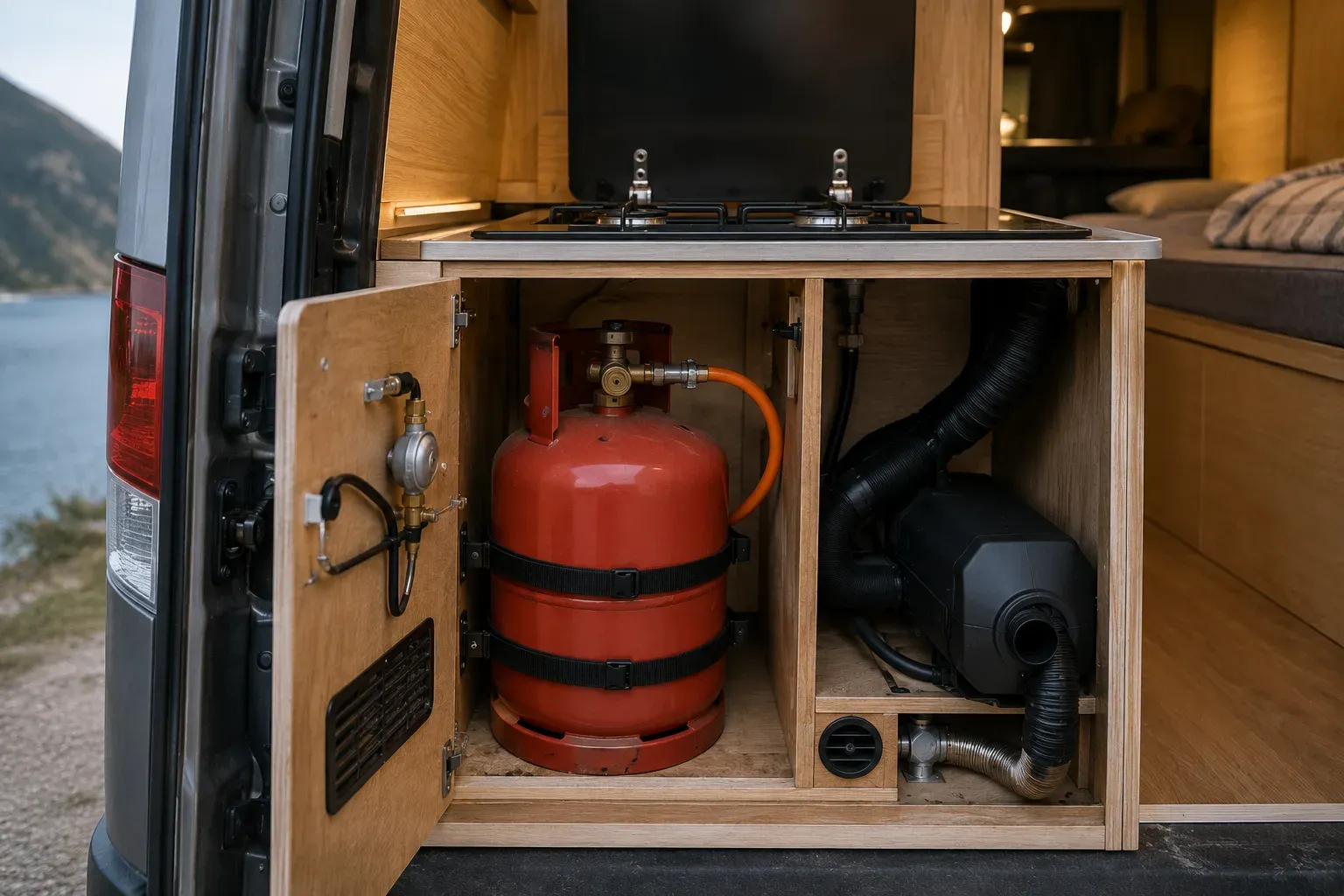
Heat, cooking, and hot water truly make a van a livable space. Especially in Belgium, where "summer evening" sometimes just means you're sitting in your van in June wearing a sweater.
But as soon as you work with gas, LPG, or a diesel heater, it's no longer just about comfort. It's also about safety, inspection, certificates, ventilation, correct installation, and common sense.
For vanlifers, this is a topic you shouldn't gamble on. A mistake with a cabinet can be annoying. A mistake with gas, combustion, or exhaust gases can be dangerous.
First, the difference: gas, LPG, and diesel heater
In camper conversions, these terms are sometimes used interchangeably, but they don't mean the same thing.
By "gas," many people mean loose gas cylinders or refillable gas cylinders used for cooking, heating, or making hot water. Usually, it's butane, propane, or a mixture.
LPG is also a gas mixture, but in a vehicle context, it can refer to different things. Some vehicles run on LPG as motor fuel. In campers, LPG is sometimes also used as a supply for household appliances, such as cooking or heating, via a fixed tank or refillable cylinder. This distinction is important, as an LPG installation in a vehicle may require additional inspections.
A diesel heater works differently. It burns diesel, often from the vehicle's fuel tank or a separate small diesel tank. The warm air enters the living space, while the combustion air and exhaust gases must be correctly vented outside.
All three can work perfectly in a van, but each requires its own approach.
Why this is important for a camper conversion
When converting to a camper van, one doesn't just look at the bed and cabinets. Anything permanently installed that affects safety can be relevant for homologation or inspection.
A gas installation, LPG tank, fixed cooking facility, or diesel heater is not a loose accessory like a camping chair. It is an installation that brings heat, fuel, pipes, ventilation, and sometimes combustion into or around your vehicle.
Therefore, when designing your conversion, you should already consider:
- where the gas cylinder or tank will be located
- how it will be secured
- where pipes will run
- how ventilation is regulated
- how appliances are vented
- where the exhaust of a diesel heater is located
- which certificates you need
- whether a recognized installer is required
- whether extra inspection is needed
That may sound daunting, but it's much better than having to break open a finished cabinet later because the installation isn't correct.
Loose gas cylinders: practical, but don't just put them anywhere
Many DIY builders start with a loose gas cylinder for a cooking appliance. That seems simple, but here too, you must work safely.
A gas cylinder must be securely fastened. It must not be able to fall over, shift, or be damaged while driving. The cylinder must remain accessible so you can shut it off. Pipes and connections must be suitable for gas use and remain in good condition.
Ventilation is also important. Gas can accumulate in low parts of your vehicle. Therefore, camper construction often involves a well-ventilated gas locker with an opening to the outside or downwards. The principle is simple: if there's a leak, gas must not collect in your living space.
For loose gas installations in campers, there isn't always the same separate mandatory inspection in Belgium as for an LPG installation for the vehicle, but that doesn't mean you can just do anything. For homologation or inspection, fixed installations, safety, and correct assembly can certainly play a role.
Propane or butane?
For vanlife, propane is usually more practical than butane, especially if you travel in cold periods. Butane works less well at low temperatures. Propane remains more usable when it gets colder.
This is not a purely administrative point, but a practical safety and comfort point. If you're in the Ardennes in winter, you don't want to discover that your gas cylinder is barely vaporizing anymore.
Always use pressure regulators, hoses, and connections that match your cylinder, appliance, and country of use. Do not creatively combine adapters without knowing what you are doing.
LPG in a vehicle: extra inspection on top of the regular inspection
LPG is the part where you need to pay extra attention.
A vehicle with an LPG installation is subject to a specific LPG inspection in addition to the periodic technical inspection. This specific LPG inspection is mandatory within 30 days after installation by a recognized installer, after modifications or repairs to the installation, and after certain interventions such as re-testing of the tank or replacement of the filler pipe.
During such an LPG inspection, among other things, the installation certificate, the installation plate, the condition and operation of the installation, and any leaks are checked. After a successful inspection, an LPG sticker is affixed.
Important: the installation must be installed, modified, or removed by a recognized installer when required. Just installing some pipes or a tank yourself and hoping for the best is not a good plan.
LPG as motor fuel or for domestic use
An LPG installation to run the engine on LPG is not the same as a domestic gas installation for cooking or heating.
However, confusion can arise because both involve LPG. For vehicles, the official LPG inspection mainly concerns the vehicle's LPG installation, with tank, pipes, filler valve, shut-off valves, pressure regulators, gas-tight housing, and other components.
If you use a fixed LPG tank or refillable LPG cylinder for domestic appliances in your camper, always check in advance which rules apply to your situation. The line between "camper gas supply" and "vehicle LPG installation" is not something you decide on a gut feeling.
When in doubt: ask a recognized installer, a recognized technical service, or the inspection station before installing anything.
Which documents can be important for LPG?
For LPG, these documents may be requested, among others:
- installation certificate from the recognized installer
- possibly a modification certificate
- possibly a removal certificate
- installation plate
- possibly an approval mark or sticker according to R115
- possibly a homologation certificate of the LPG tank
- original vehicle documents
The documents must be original. Copies, photos on your phone, or "I ordered it online" are not the same as a correct certificate.
Even during the regular technical inspection, additional documents may be requested if applicable, such as LPG or CNG documents.
Re-testing and replacement for LPG
LPG installations also have maintenance and inspection moments that go beyond just "it still works."
For older LPG installations, deadlines apply for re-testing of the tank and replacement of flexible high-pressure lines. For installations from July 1, 2001, deadlines also apply for re-testing of the tank and replacement of the LPG filler pipe. Depending on where the tank is installed, this can be every 6 or 10 years.
After such work, the recognized installer issues a certificate, and the vehicle must be presented for a full LPG inspection within 30 days.
This is precisely why second-hand campers or vans with an existing LPG installation deserve extra attention. Don't just ask if "the LPG works," but also when the tank, pipes, certificates, and inspections were last in order.
Removing LPG? That also needs to be done correctly
Removing an LPG installation is not just "take out the tank and done."
The removal must be done by a recognized installer. Before you use the vehicle again, it must go to the inspection station within 30 days for a re-inspection with a removal certificate from the recognized installer.
This applies mainly to vehicles that are officially registered or inspected with an LPG installation. You don't want to keep driving around with papers that no longer match the vehicle.
The same principle applies here: make sure the reality of your van matches the documents.
Diesel heater: popular, but install them correctly
Diesel heaters are popular in camper conversions. They are economical, work well in cold weather, and you don't have to carry a large gas supply if you only heat with diesel.
But a diesel heater burns fuel. This means you are working with combustion air, exhaust gases, heat, fuel lines, and electricity.
The warm air may enter the living space. The combustion gases absolutely not. The exhaust must be correctly vented outside, away from windows, doors, ventilation openings, and places where exhaust gases can re-enter.
A wrongly placed exhaust, poor sealing, or a leaking combustion chamber can be dangerous. Carbon monoxide is invisible and odorless. Therefore, every van with a combustion appliance should have a good carbon monoxide detector.
Inspection and diesel heater
For a diesel heater, the official Belgian information is less neatly summarized than for LPG. This makes it even more important not to just guess.
For a camper conversion, fixed appliances, electrical connections, fuel lines, openings in the floor or bodywork, exhaust system, and installation can be relevant for the approval of the conversion. For recent vehicles, the assessment of conversions is done via a recognized technical service.
So, don't buy a random heater without looking at approvals, installation instructions, and documents. When in doubt, check in advance whether the appliance and installation are acceptable for your vehicle and your conversion file.
In practice, a professionally installed diesel heater with clear documentation, correct installation, and a certificate is much easier to defend than a cheap heater without clear papers.
Gas leaks, carbon monoxide, and ventilation
With gas and heaters, three risks are important: gas leaks, fire, and carbon monoxide.
A gas leak can occur due to poor connections, old hoses, damaged pipes, or poorly secured cylinders. Gas can accumulate and cause fire or explosion upon ignition.
Carbon monoxide is produced by incomplete combustion. It is dangerous because you cannot see or smell it. Symptoms can resemble fatigue, headache, nausea, or dizziness. In a small space like a van, you absolutely want to avoid this risk.
Therefore, ensure at least:
- correct ventilation
- a well-placed carbon monoxide detector
- a gas detector if you use gas
- regular inspection of pipes and connections
- a suitable fire extinguisher
- no loose fuel or gas cylinders in the living space
- no heater exhaust close to openings
- no DIY with unknown parts
I like to be handy myself, and I understand the temptation to want to solve things yourself. But with gas and combustion, "it'll be fine" is really not enough.
Cooking with gas or electric?
More and more vanlifers are choosing electric cooking, for example, with induction. This avoids gas cylinders and gas lines but shifts the problem to electricity, battery capacity, inverter, wiring, and weight.
Gas is compact and powerful but requires good ventilation and safe storage. Electric cooking can be clean and simple but requires a strong electrical installation. Diesel heating can limit gas consumption but requires correct installation of fuel and exhaust.
So, there is no one-size-fits-all solution. The right choice depends on your van, your travel style, your budget, your technical knowledge, and your willingness to have installations correctly fitted.
Fixed installation or loose camping solution?
A loose camping stove that you use outside is different from a fixed cooking facility in your camper. A loose gas heater in a small van, on the other hand, is something you should be particularly careful with and in many cases, better avoid, especially with appliances without proper ventilation.
The more fixed and permanent your installation becomes, the more important documentation, installation, and inspection become. A fixed hob, built-in LPG tank, diesel heater with exhaust through the floor, or fixed gas lines belong in a well-thought-out conversion plan.
For official camper homologation, your vehicle must have a cooking facility. But that doesn't mean you have to take the cheapest or fastest solution. Choose something that is safely, controllably, and logically built-in.
Buying a second-hand van? Check this extra
If you buy a converted van or camper that already has gas, LPG, or a heater, check more than just whether everything works.
Ask for:
- certificates of LPG installation
- inspection certificates and LPG sticker
- date of installation
- date of tank re-testing
- date of replacement of filler pipe or high-pressure lines
- documentation of diesel heater
- installation certificate if present
- brand and type of appliances
- age of gas lines and pressure regulator
- presence of gas detector and CO detector
- correct ventilation and exhaust placement
A neat wooden conversion can hide a lot. So, also look behind cabinets, under benches, and in technical compartments.
Common mistakes
A first mistake is thinking that LPG is simply the same as a loose gas cylinder. A vehicle LPG installation involves specific inspections, certificates, and recognized installers.
A second mistake is working on LPG lines or tanks yourself without knowing which rules apply. This can be dangerous and cause problems during inspection.
A third mistake is installing a diesel heater without paying attention to exhaust gases, combustion air, and sealing.
A fourth mistake is not installing a carbon monoxide detector. In a small living space with combustion appliances, that is simply unwise.
A fifth mistake is placing gas cylinders loosely in a cabinet without secure fastening or ventilation.
A sixth mistake is trusting second-hand installations without certificates or maintenance history.
A seventh mistake is thinking that "it works" is the same as "it is safe and inspectable."
Practical checklist for gas, LPG, and diesel heater
Before you set off with gas, LPG, or diesel heating, it's best to check:
- do I know exactly which system I am using?
- is the installation professionally or demonstrably correctly installed?
- are original certificates available where necessary?
- was a recognized installer needed?
- has the LPG inspection been carried out if mandatory?
- has the tank or line been re-tested or replaced in time?
- are gas cylinders securely fastened?
- is there sufficient ventilation?
- is the diesel heater exhaust correctly vented outside?
- are fuel lines safely laid?
- are there no leaks or damaged hoses?
- do I have a CO detector?
- do I have a gas detector?
- do I have a suitable fire extinguisher?
- does the installation comply with my homologation or inspection?
That seems like a lot, but these are precisely the things you want to know before you're stuck somewhere cold or driving to the inspection.
Conclusion
Gas, LPG, and diesel heaters can make your van much more comfortable, but they demand respect. They are not ordinary camper gadgets. They work with fuel, pressure, combustion, heat, and sometimes exhaust gases.
LPG installations in vehicles have specific inspections in addition to the regular technical inspection. After installation, modification, repair, or certain interventions, you must go for an LPG inspection within 30 days. Certificates, installation plate, condition of the installation, leak check, and possibly tank documents are important here.
Loose gas cylinders and fixed gas installations primarily require safe storage, ventilation, correct components, and common sense. A diesel heater is a strong solution for vanlife, but only if it is correctly installed and exhaust gases can never enter the living space.
My advice: feel free to do electrical and wooden things yourself if you are handy, but be humble with gas, LPG, and combustion. Ask for advice, use approved parts, keep certificates, and have doubtful cases checked. Being warm is nice. Being safely warm is better.
Source: https://www.autoveiligheid.be/autokeuring/kampeerwagen/lpg-liquified-petrol-gas
Source: https://www.gocavlaanderen.be/detail-page/lpg-keuring
Source: https://www.autoveiligheid.be/autokeuring/kampeerwagen/keuring-na-inschrijving
Source: https://www.gocavlaanderen.be/detail-page/verplichte-documenten