Seatbelts and seats in a converted van: what's allowed with passengers?
Converting a van is one thing. Safely and legally transporting passengers is another. Many DIY builders primarily focus on the bed, cabinets, kitchen, and electricity. But as soon as someone wants to ride in the back, you enter a whole different story.
By Laurens De Leeuw · 23 June 2026
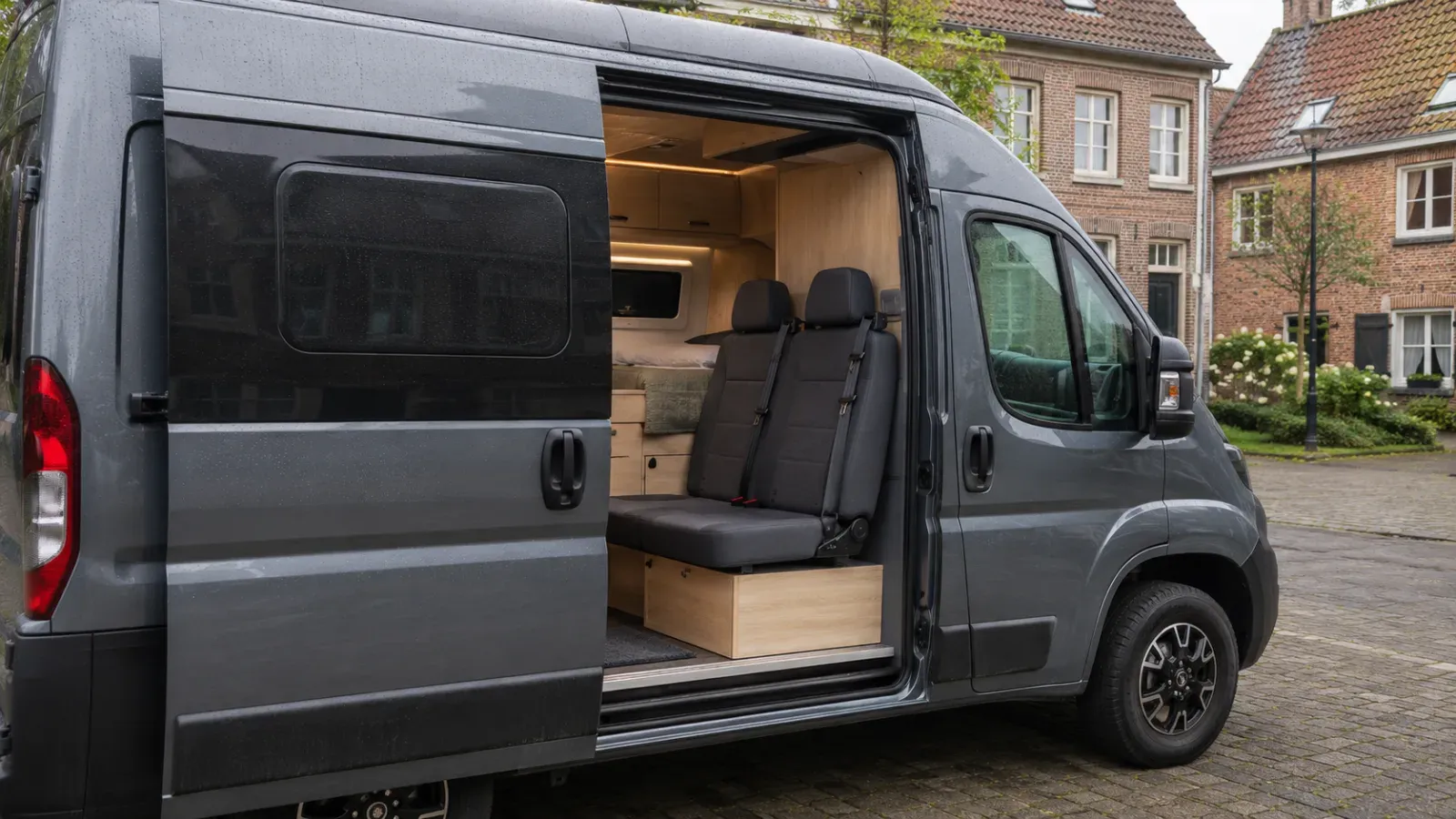
Converting a van is one thing. Safely and legally transporting passengers is another.
Many DIY builders primarily focus on the bed, cabinets, kitchen, and electricity. But as soon as someone wants to ride in the back, you enter a whole different story. Then it's no longer about comfort when stationary, but about official seating, seatbelts, headrests, anchor points, inspection, and homologation.
And Belgium is quite clear on this: a bench in your camper is not automatically a seat for travel.
The most important distinction: sitting while driving or sitting when stationary
In a converted van, you can perfectly build a bench, dinette, sofa bed, or wooden seating area to use when parked. You sit on it to eat, work, rest, or drink coffee.
But that doesn't make that spot an official seat while driving.
A seat for travel must be properly approved. This means that not only the seat itself counts, but also the backrest, headrest, seatbelt, and the points with which everything is attached to the vehicle.
For vanlifers, this is perhaps the most important thing to remember: a cozy bench is interior. An approved seat is vehicle technology.
How many passengers can you carry?
You cannot simply carry more people than the vehicle officially allows.
For this, refer to your registration certificate, certificate of conformity, inspection certificate, or identification report. These documents state how many official seats the vehicle has.
If your van has two or three seats in the front, these are normally the seats that may be used while driving. If you want to transport extra passengers in the back, those seats must be officially approved and included in the vehicle data.
A wooden bench in the living area therefore does not count, unless it has been approved as an official seat.
Seatbelt present? Then it must be used
According to the highway code, drivers and passengers in cars must wear seatbelts in the places equipped with them.
That sounds simple, but it also means that a seatbelt is not just decoration. If there is an approved seatbelt position, it must be used.
Stricter rules apply to children. Children shorter than 135 cm must be transported in a suitable child restraint system. This is especially important for families traveling in a converted van. Letting a child "just sit on the back bench" because it's only a short ride is not a good idea and can also simply be prohibited.
What about passengers in the back of a motorhome?
In a motorhome, there can be seats in the living area, but these must meet technical requirements.
For rear seats in the living area, rules apply regarding seatbelts, headrests, anchor points, and European approvals, among others. Flanders states that seats, headrests, seatbelts, and anchor points must have the necessary European approvals.
Since March 31, 2003, seats in the living area must be equipped with type Ar 4m seatbelts, except for side-facing seats. For rear-facing seats, a type B seatbelt is sufficient. The seat must be at least 400 mm wide and always have a backrest.
These are not details you can quickly fix afterwards. If you want to carry passengers in the back, you must include this from the beginning of your design.
Side-facing seats: nice in photos, usually not usable while driving
Side-facing benches are often seen in campers and DIY vans. They are handy for sitting at a table, putting on shoes, or hanging out with multiple people inside when you are stationary.
But as an official seat while driving, they are problematic.
Flanders states that side-facing seats have not been allowed to be used while driving since October 20, 2007, and are therefore no longer recognized as official seats.
This is logical from a safety perspective. In an accident, a side-facing seating position works very differently from a forward or rear-facing seat with a correct seatbelt and anchoring.
So yes, you can build a side bench for use at a campsite, parking lot, or on the road when you are stationary. But don't count on someone being able to legally and safely ride in it.
A bed is not a seat
This seems obvious, but it must be said: a bed is not a seat for travel.
Not even if there are cushions on it. Not even if it's a sofa bed. Not even if someone "just" lies down in the back while driving.
While driving, passengers should sit in official seats. A bed, mattress, wooden box, unapproved folding bench, or loose camping chair does not count.
For me, this is one of those topics where it's better not to try to be creative. Vanlife may feel free, but in an emergency stop or accident, you really don't want someone loose in the back of the bus.
Adding extra seats: is that allowed just like that?
Adding extra seats is not allowed just like that. As soon as you add seats that are used while driving, you affect vehicle safety.
Then you have to deal with:
- the approval of the seat itself
- the strength of the attachment
- the anchor points in the vehicle
- the seatbelt
- the headrest
- the direction of the seat
- the location in the vehicle
- the documentation for homologation and inspection
So, simply transferring a loose bus seat from another vehicle is not automatically sufficient. Even if that seat seems sturdy, the combination in your vehicle must be correctly approved and demonstrably safe.
When in doubt: check this with an accredited technical service before construction. Not afterwards when your floor, insulation, and furniture are already fixed.
Swivel bases: handy, but pay attention to approval
Swivel bases are popular in camper conversions. They make the driver's seat or passenger seat part of your living space. Practically, that's smart, especially in a compact van.
But technically, it's sensitive.
Flanders states that if original seats are modified by equipping them with a swivel system, the original partial approval of the seat's strength lapses. You then need to demonstrate with a new partial approval or test report that the combination of seat and swivel system complies.
In other words: don't just buy a swivel base because it says online "fits Sprinter/Ducato/Transit". For inspection and homologation, what counts is whether the system is correctly approved for your application.
DIY bench with seatbelts? Be very careful
Some DIY builders think: I'll build a strong wooden bench and mount seatbelts on it. That sounds logical, but it doesn't work that way.
A seatbelt must be able to withstand enormous forces in an accident. These forces are transferred via the seatbelt to the anchor points and the vehicle structure. A wooden furniture construction is normally not designed for this.
Even a metal frame is not automatically approved. It must demonstrably meet the correct standards and be correctly attached to suitable points in the vehicle.
So, a bench with seatbelts is not a furniture project. It is a vehicle technical intervention.
What about children in a converted van?
For children, the general rules regarding child restraint systems apply.
Children shorter than 135 cm must be transported in a suitable child restraint system. This means you need a correct official seat, with a seatbelt or suitable attachment system, depending on the child seat.
In a DIY van, this practically means you need to think in advance about where a child can sit safely and legally correctly. Not every camper bench is suitable for a child seat. Not every seatbelt position is ideal. And rear-facing or side-facing seats can have limitations.
Those traveling with children should therefore not solve this at the end. It is part of the basic design of your vehicle.
Light commercial vehicle: pay extra attention to rear seats
With light commercial vehicles, the story is even more sensitive.
A light commercial vehicle is, on paper, intended for goods transport. The cargo area must meet the conditions for light commercial vehicles. Extra seats, benches, or seatbelt anchor points in the cargo area can affect that status.
If your vehicle remains a light commercial vehicle, pay close attention to the number of official seats. Often, these are only the front seats. If you want to transport people in the back, you are no longer in the simple story of a cargo area with some camping gear.
A light commercial vehicle with a camper conversion can be possible in certain cases, but as soon as you want to carry passengers in the living area, everything must be administratively and technically correct. Otherwise, you can encounter problems with inspection, control, or insurance.
Motorhome: passengers can, but only in approved seats
In an official motorhome, it is more logical that there is a living area. But even there, that doesn't mean everyone can just sit anywhere while driving.
Passengers may only occupy official seats that are approved for this purpose. These seats must be included in the vehicle's documents.
A motorhome with four official seats can therefore transport four people, including the driver, if those seats are correctly listed and equipped. A camper with two official seats and a large living area remains a two-person vehicle while driving.
Insurance: tell them what you actually built
Seats and seatbelts are not just an inspection issue. They can also be important for your insurance.
If your vehicle officially has two seats, but you transport people in the back on a homemade bench, this can become particularly unpleasant in an accident.
It is best to report modifications such as swivel bases, extra seats, seatbelts, sofa beds, or altered anchor points to your insurer. Especially with a DIY camper, you want to avoid discussions afterwards about unreported changes.
My rule here remains the same as with weight and homologation: make sure your papers match reality. That's less exciting than building, but much better for your peace of mind.
What is checked during inspection or homologation?
During a conversion to a motorhome, seats can be one of the most important control points.
They may check:
- number of official seats
- direction of the seats
- width and backrest
- headrests
- seatbelts
- type of seatbelt
- E marking or European approval
- anchor points
- swivel bases
- documentation and test reports
- conformity with vehicle category and registration
If you want to have extra seats recognized, you must therefore be able to demonstrate that everything is correct. A verbal explanation or "it feels sturdy" is not sufficient.
Common mistakes
A first mistake is thinking that a bench is automatically a seat. That is not the case. Only official seats count while driving.
A second mistake is building side-facing benches and expecting passengers to be allowed to ride in them. Side-facing seats are no longer recognized as official seats for travel.
A third mistake is mounting seatbelts to furniture. A seatbelt belongs to approved anchor points, not just to wood or a homemade frame.
A fourth mistake is installing a swivel base without checking if the system is correctly approved.
A fifth mistake is not checking the number of seats on paper. Your vehicle documents determine how many people can ride along.
A sixth mistake is transporting children in the back without a correct official seat and suitable child restraint system.
Practical checklist before taking passengers
Before letting anyone ride along, check:
- how many seats are officially on the documents?
- are all passenger seats equipped as required?
- are seatbelts and seats approved?
- are headrests present where necessary?
- are anchor points correct?
- are any swivel bases approved?
- are children shorter than 135 cm in a suitable child restraint system?
- does your insurance match the actual setup?
- are loose items securely fastened?
That last one is also important. Even if everyone is correctly secured, loose cargo can become dangerous in an emergency stop.
Conclusion
Passengers may only be carried in a converted van in official, approved seats. A wooden bench, bed, box, or loose chair does not count as a seat while driving.
In a motorhome, seats can be in the living area, but then the seat, backrest, headrest, seatbelt, and anchor points must be correctly approved. Side-facing seats have not been allowed to be used while driving since October 20, 2007, and are no longer recognized as official seats.
For light commercial vehicles, you need to pay extra attention, because the vehicle is, on paper, intended for goods transport and extra seats can affect the vehicle's status.
The safest approach is simple: design your conversion around the number of people you really want to transport, check the official seats on your documents, and have technical modifications checked beforehand. Vanlife is about freedom, but while driving, everyone simply needs to be safely and legally secured.