GVW and Payload: Why Your Van Is Heavier Than You Think
In vanlife, a lot of attention goes to the fun stuff: which bed, which cabinets, which fridge, which battery, which floor, which route. But one of the most important numbers isn't in your interior plan. It's on your papers. The maximum permissible mass, or GVW.
By Laurens De Leeuw · 23 June 2026
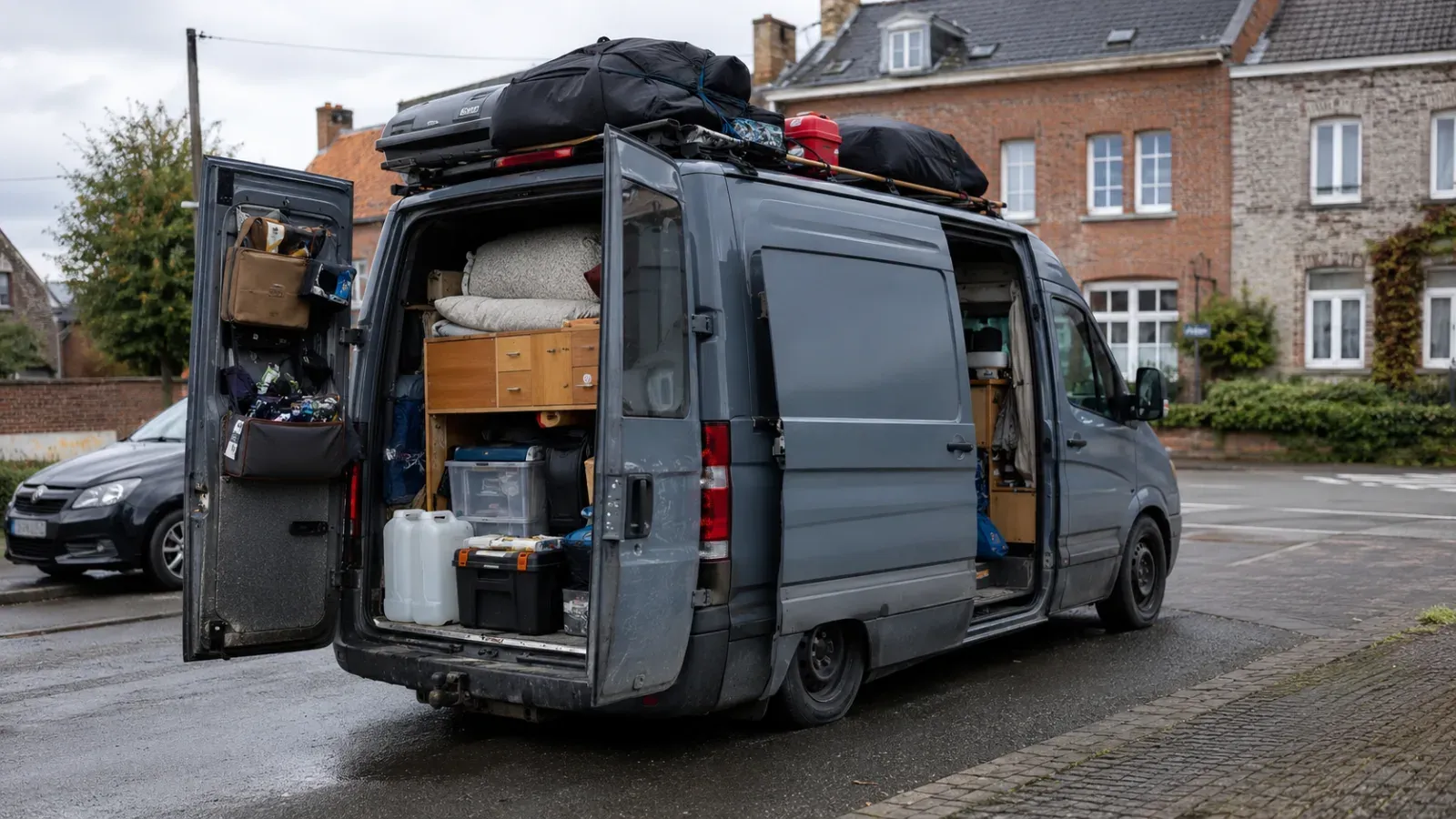
In vanlife, a lot of attention goes to the fun stuff: which bed, which cabinets, which fridge, which battery, which floor, which route. But one of the most important numbers isn't in your interior plan. It's on your papers.
The maximum permissible mass, or GVW.
For many Belgian vanlifers, the 3,500 kg limit is particularly important. That's the limit where a B driving license usually stops. But even if your van officially stays below that limit, in practice, you can be overweight faster than you think.
And honestly: weight isn't the most exciting topic of a camper conversion. Until you're at the inspection, on a weighbridge, or get pulled over on the road. Then it suddenly becomes very real.
What does GVW mean?
GVW stands for Gross Vehicle Weight. This is the maximum weight your vehicle is officially allowed to weigh when fully loaded.
So, not just the van itself, but everything combined:
- vehicle
- driver
- passengers
- fuel
- water
- gas
- furniture
- batteries
- solar panels
- clothing
- food
- dog
- bicycles
- tools
- luggage
Everything counts.
If your van has a GVW of 3,500 kg, then when fully loaded, it must not weigh more than 3,500 kg. Not even for a short trip. Not even because it's temporary. Not even because you're almost home.
GVW is not the same as what your van weighs today
A common mistake is thinking that GVW is the same as the actual weight. That's not correct.
GVW is the official upper limit. The actual weight is what your van effectively weighs at that moment.
Example:
Your van has a GVW of 3,500 kg.
Empty, it weighs 2,550 kg.
Then, on paper, you have 950 kg of space left.
That sounds like a lot, until you start building.
If, after your conversion, with full tanks, luggage, driver, and passengers, you end up at 3,650 kg, you are overloaded. Even if the van might technically be strong enough to carry more. The official limit remains the GVW on your documents.
What is payload?
Payload is simply how much weight you are allowed to add to your empty vehicle.
In theory:
GVW minus unladen weight = payload
But in practice, you need to be careful about which unladen weight you use. Sometimes a ready-to-drive weight is stated, sometimes an unladen mass, sometimes the vehicle is already partially equipped, sometimes not.
With a second-hand van, there might also be all sorts of things already installed: paneling, racks, a tow bar, a double cab, a tailgate, floor panels, or other equipment. That weight isn't always clearly visible, but it does count.
Why 3,500 kg is so important
For most Belgian vanlifers, a B driving license is standard. With a B driving license, you can drive a vehicle with a GVW of up to 3,500 kg, with a maximum of eight passengers in addition to the driver.
That's why many vans, campers, and self-build projects are built around that limit.
A 3,500 kg GVW van is attractive because you can drive it with a normal B driving license. But that limit also creates a pitfall: large vans seem spacious, but sometimes have less payload than you think.
A long, high van can be quite heavy when empty. Especially with a heavy engine, automatic transmission, tow bar, double cab, extra options, or 4x4 version. Then there's less margin left for your conversion.
A camper conversion quickly becomes heavy
During construction, each component separately feels logical. A bit of wood here, a battery there, some insulation, a floor, a cabinet, a drawer, a tank. But together, it quickly adds up.
Some typical weights:
- plywood sheets and wood constructions
- insulation and wall cladding
- floor panel and floor finish
- bed frame and mattress
- kitchen cabinet and countertop
- refrigerator
- leisure battery
- inverter
- solar panels and roof racks
- water tank
- grey water tank
- gas bottle or gas tank
- skylight or fan
- awning
- tow bar
- bike rack
- spare wheel
- tools
And then you haven't even packed anything for the trip itself.
That's why a light, smart build is often better than a build that mainly looks good in photos. Especially with self-builds, it's tempting to build robustly "so it definitely won't come loose," but robust quickly becomes heavy.
Water is heavier than you think
Water is one of the biggest stealth weights in a camper.
1 liter of water weighs approximately 1 kg.
A 100-liter water tank therefore means approximately 100 kg of extra weight when full. Add a grey water tank, pipes, pump, boiler, or extra jerry cans, and you quickly reach a serious weight.
That doesn't mean you shouldn't carry water. But you do have to count it. Many people think of wood and batteries, but forget that full tanks on the road simply count on the weighbridge.
Batteries and electricity also count
An electrical installation can become surprisingly heavy.
A leisure battery, inverter, charge booster, solar panels, cabling, fuses, mounting plates, and fastening materials together weigh more than you think. Especially with larger battery systems or older lead-acid batteries, this can seriously add up.
Lithium batteries are often lighter than lead-acid batteries, but even there, weight remains important. Those who want to stay off-grid for a long time quickly opt for more capacity. More capacity usually also means more weight and more loss of space.
For me, this is a typical point where I should also restrain myself. As a web developer and gadget person, "providing some extra power" is very tempting. But in a van, every kilo is a real kilo.
Roof load and high weight
Not only the total weight counts. Where that weight is located also matters.
Solar panels, roof racks, roof boxes, spare wheels, surfboards, and awnings are high up on the vehicle. This raises the center of gravity. Your van can therefore become more susceptible to crosswinds, turns, and emergency maneuvers.
You also need to consider the permitted roof load of your vehicle and how everything is attached. A roof full of gear looks adventurous, but it must remain safe.
Weight at the rear and on the axles
A van can remain below the GVW overall and still have an axle load problem.
This means that the total weight is still within the limit, but too much weight rests on one axle. In camper conversions, this often happens at the rear, because that's where the bed, garage, water, batteries, bike rack, and luggage end up.
Therefore, it's smart to consciously distribute heavy components. Don't put everything behind the rear axle. Batteries, water, and tools are best placed as low and as centrally as possible.
Good weight distribution not only drives better but is also safer.
Weight after homologation or inspection
During a conversion to a campervan, your vehicle is weighed. This weighing determines the tare weight of the converted vehicle.
For a campervan, the tare weight is determined with liquids, fuel, drinking water, and gas according to official conditions. This means you can't just drive to the inspection with an almost empty van and think that everything is solved.
The inspection looks at the vehicle as it is officially determined. If your conversion turns out to be heavy, it will become apparent.
Even after approval, you need to be careful. You can be perfectly approved and still depart overloaded later due to extra luggage, bicycles, water, tools, or passengers.
Driving overloaded is not without consequences
Driving overloaded is not a minor detail. It can have consequences for safety, fines, insurance, and liability.
An overweight vehicle brakes less effectively, steers differently, puts more strain on tires and suspension, and can become more dangerous during evasive maneuvers. Especially with a high van, you quickly feel extra weight in turns, in wind, and on bad roads.
During checks, overloading can also be financially painful. Flanders publishes separate fine tables for road freight transport. The amounts depend on the type of vehicle, the excess, and the circumstances.
But apart from fines, there's an even more important point: in the event of an accident, you don't want to have to argue about a vehicle that was actually overloaded.
The difference between a driving license problem and an overloading problem
There are two different problems that are often confused.
The first problem is driving with the wrong driving license. This concerns the GVW of the vehicle. If your vehicle has a GVW above 3,500 kg, a B driving license is usually not enough.
The second problem is driving overloaded. This concerns the actual weight. Your vehicle can have a GVW of 3,500 kg and thus be suitable for a B driving license, but still be overloaded if it actually weighs 3,650 kg.
So, for vanlifers, you need to check both:
- can I drive this vehicle with my driving license?
- does my vehicle, when loaded, weigh no more than permitted?
How do you know how much margin you have?
Start with your documents.
Look at:
- GVW
- mass in running order or unladen weight
- number of seats
- permitted axle loads
- possibly towing weight
- data on the certificate of conformity
- data on the registration certificate
- identification report after inspection
Then you need to calculate realistically.
If your van has a payload of 900 kg on paper, that doesn't mean you can build 900 kg of furniture. The driver, passengers, water, fuel, gas, dog, clothes, food, and travel luggage also need to be added to that.
A good rule of thumb: always keep a margin. Don't build down to the last kilo.
Have your van weighed in between
The best way to be sure is to weigh it.
Don't estimate. Don't guess. Don't think "it'll be fine." Just weigh it.
You can have your vehicle weighed at some inspection stations, weighbridges, recycling parks, agricultural businesses, or companies with weighing equipment. Check in advance if you can go there as a private individual.
Ideally, you weigh at multiple moments:
- before the conversion
- after insulation and basic floor
- after furniture
- after electricity and water installation
- fully ready for travel with full tanks, driver, passengers, and luggage
If you want to be really accurate, also have the axle loads measured. Then you'll know not only your total weight but also how the weight is distributed.
Tips to save weight
Saving weight starts with design choices.
Don't automatically choose the thickest wood. Only use heavy materials where they are truly needed. Work with smart constructions, lighter panels, aluminum profiles, or lighter furniture construction where possible.
Think carefully about what you really need. A large fixed water tank, enormous battery, heavy awning, thick wooden cabinets, and a bike rack with two electric bikes can all seem logical, but together they can eat up your margin.
Items also count. Many vanlifers build light and then depart with too much gear. Spare clothes, tools, camping tables, chairs, food, books, cables, parts, and "just in case" items quickly make your van heavier.
Minimalism here is not just a lifestyle, but also a technical necessity.
Common weight mistakes
A common mistake is buying a large van because it has a lot of space, without looking at the unladen weight and payload.
A second mistake is building with overly heavy materials. Especially solid wood, thick panels, and oversized constructions quickly make a conversion heavy.
A third mistake is underestimating water and batteries. A large off-grid setup is handy, but it has a weight.
A fourth mistake is placing everything at the rear. This can overload the rear axle, even if the total weight still seems acceptable.
A fifth mistake is departing with full tanks, bikes, dog, passengers, and luggage without ever actually having weighed it.
A sixth mistake is thinking that inspection or homologation automatically means you can never be overloaded. You remain responsible for how heavily your vehicle is actually loaded.
What if you have too little payload?
If you notice during or after construction that you have too little margin, there are only a few options.
You can save weight by replacing or omitting components. Think lighter furniture, a smaller water tank, a less heavy battery, less fixed equipment, or less luggage.
You can look more critically at what you really need. Not everything has to be permanently installed. Some things can be made smaller, simpler, or removable.
In some cases, a vehicle can be technically upgraded or re-registered, but that's not a simple DIY solution. It depends on the vehicle, technical possibilities, homologation, inspection, driving license, and administrative rules. So don't just assume that.
If you want to go above 3,500 kg, you'll also need a different driving license, such as C1. That can be a solution for some people, but it also brings extra practical consequences.
Practical checklist for your conversion
Before you start building, it's best to check this:
- What is the GVW of my van?
- What is the actual unladen weight?
- How much payload remains?
- Approximately how much will my planned conversion weigh?
- How much water do I want to carry?
- How heavy will my electrical installation be?
- Where will the heavy components be placed?
- How many passengers will be traveling?
- Am I taking bikes, a dog, tools, or sports equipment?
- Will everything together stay under 3,500 kg?
- Will the axle loads also remain within the limit?
These questions may be less pleasant than choosing your wood color, but they will save you a lot of misery later on.
Conclusion
GVW and payload seem like dry terms, but for vanlife, they are crucial.
A van is heavier than you think faster. Not because one component is extremely heavy, but because everything adds up. Wood, water, batteries, furniture, luggage, passengers, and daily items accumulate.
For Belgian vanlifers, the 3,500 kg limit is particularly important. Below that limit, you usually stay within a B driving license. But that doesn't automatically mean you have enough payload for every conversion.
The smartest approach is simple: start by weighing, build consciously light, distribute your weight well, and check your fully loaded van. Then you'll not only depart more beautifully, but above all, more safely and correctly.
Source: https://mobilit.belgium.be/nl/weg/rijden/rijbewijzen/belgisch-rijbewijs/personenwagen-categorie-b
Source: https://www.vlaanderen.be/belastingen-en-begroting/vlaamse-belastingen/boetes-massa-wegvervoer
Source: https://www.gocavlaanderen.be/detail-page/data-en-frequentie