Driving license B, B96, BE and C1: which van can you drive?
For many vanlifers, a B driving license seems obvious. You have a van, you convert it, you stay under 3,500 kg, and you're done. Right? Usually, but that 3,500 kg MTM limit is more important than many people think.
By Laurens De Leeuw · 23 June 2026
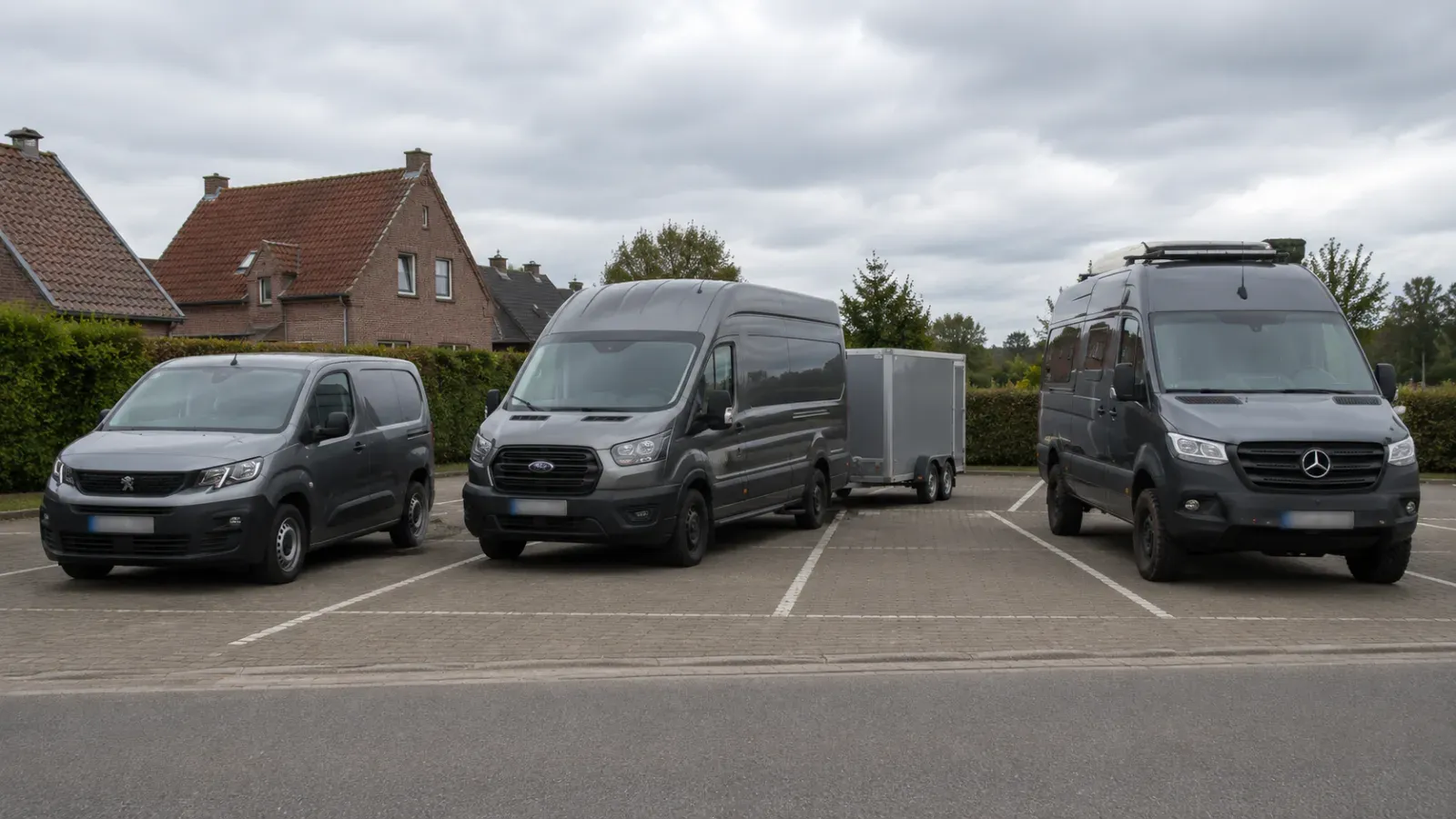
For many vanlifers, a B driving license seems obvious. You have a van, you convert it, you stay under 3,500 kg, and you're done. Right?
Usually, but that 3,500 kg MTM limit is more important than many people think. Especially with larger vans, heavy camper conversions, trailers, motorcycle trailers, bike racks, water tanks, and extra batteries, it can quickly become more complicated.
In this article, we'll look at the difference between driving license B, B with code 96, BE, and C1. Not from dry theory, but from the question that truly matters to vanlifers: which van can you drive and when do you need a different driving license?
First, this: what does MTM mean?
MTM stands for maximum authorized mass. This is the maximum weight that a vehicle or trailer is officially allowed to weigh when fully loaded.
This is therefore not the same as what your vehicle actually weighs at that moment.
For example, a van can weigh 2,600 kg empty but have an MTM of 3,500 kg. For your driving license, that MTM counts. Not just the weight on the weighbridge at that moment.
That's an important nuance. So you can't say: my bus only weighs 3,200 kg today, so I'm fine. If the MTM of the vehicle exceeds the limit of your driving license, you have a problem.
Driving license B: the standard for most vanlifers
With a B driving license, you can drive a car, van, or motorhome in Belgium with a maximum authorized mass of up to 3,500 kg. The vehicle may be designed for a maximum of eight passengers, not including the driver.
For most self-built campers and vans, this is the normal category.
Think of:
- a compact van such as a Volkswagen Transporter, Ford Transit Custom, or Renault Trafic
- a larger van such as a Fiat Ducato, Peugeot Boxer, Citroën Jumper, Ford Transit, Mercedes Sprinter, or Volkswagen Crafter
- a campervan or motorhome with an MTM of up to 3,500 kg
As long as the MTM is a maximum of 3,500 kg, you are generally fine with a B driving license.
The 3,500 kg limit is not a detail
In vanlife, 3,500 kg is the magic limit. Not because everyone likes to talk about it, but because that limit determines whether you can drive with a B driving license.
Many larger vans are sold with an MTM of 3,500 kg, precisely because they can then still be driven with a B driving license. But after a conversion, the actual weight can quickly increase.
Think of:
- wooden interior
- insulation
- floor and wall covering
- bed construction
- kitchen cabinet
- refrigerator
- solar panels
- household battery
- inverter
- water tank
- gas tank or gas bottles
- bike rack
- spare parts
- tools
- clothing, food, and camping equipment
And then you get in yourself. Maybe with a passenger, dog, bikes, or surfboard.
With me, Grephar would just get in as if he weighed nothing, but on the weighbridge, he counts just as much, of course.
Overloading is different from the wrong driving license
There are actually two separate problems that people sometimes confuse.
The first problem is driving overloaded. In that case, your vehicle is suitable for a B driving license on paper, for example with an MTM of 3,500 kg, but in reality, it weighs more than 3,500 kg. Then you are overloaded.
The second problem is driving a vehicle for which your driving license is insufficient. This happens when the MTM of the vehicle is higher than what your driving license allows.
Example: you are driving a camper with an MTM of 4,250 kg, but you only have a B driving license. Even if that camper is loaded lighter at that moment, you are not allowed to drive it with a B driving license.
For vanlifers, it is therefore important to check both: the official MTM and the actual weight when you depart.
Driving license B with a trailer
With a B driving license, you can also tow a trailer, but there are limits.
With a B driving license, you can tow a trailer with an MTM of up to 750 kg.
With a B driving license, you can also tow a trailer with an MTM of more than 750 kg, but then the MTM of the entire combination must not exceed 3,500 kg.
That combination is therefore the towing vehicle plus the trailer together.
Example:
Your van has an MTM of 2,800 kg.
Your trailer has an MTM of 700 kg.
That is possible with a B driving license.
Your van has an MTM of 2,500 kg.
Your trailer has an MTM of 1,000 kg.
Together that is 3,500 kg. That is also possible with a B driving license.
Your van has an MTM of 3,000 kg.
Your trailer has an MTM of 1,000 kg.
Together that is 4,000 kg. Then a regular B driving license is not enough.
B with code 96: useful for light trailers above the B limit
B with code 96 is between driving license B and BE.
With B code 96, you can drive a category B vehicle with a trailer of more than 750 kg, provided that the MTM of the entire combination is more than 3,500 kg but a maximum of 4,250 kg.
This can be interesting for vanlifers who want to tow a small caravan, luggage trailer, motorcycle trailer, or material trailer, but do not immediately need a full BE driving license.
Example:
Your bus has an MTM of 3,000 kg.
Your trailer has an MTM of 1,000 kg.
Together that is 4,000 kg.
With a regular B driving license, this is not allowed, but with B code 96, it is.
B code 96 is therefore especially useful when you just exceed the 3,500 kg combination, but stay under 4,250 kg.
Driving license BE: for heavier trailers behind a B vehicle
Driving license BE is intended for those who want to tow a heavier trailer with a category B vehicle.
According to the FPS Mobility, BE falls under the situation where the trailer has an MTM of more than 750 kg and the MTM of the combination is more than 3,500 kg and a maximum of 7,000 kg.
This does not mean that your towing vehicle itself may be heavier than 3,500 kg. The towing vehicle remains a category B vehicle. The extra space is in the trailer combination.
Example:
Your van has an MTM of 3,500 kg.
Your trailer has an MTM of 2,000 kg.
Together that is 5,500 kg.
For that, you need a BE driving license.
For vanlifers, BE can be interesting if you want to tow, for example, a boat, motorcycle trailer, small trailer with conversion material, extra luggage, or off-road equipment.
Note: in addition to your driving license, your vehicle must also be technically suitable for towing that trailer. So always check the permitted towing weight of your vehicle and the inspection of your tow bar.
Old BE driving licenses: pay attention to the exceptions
There are exceptions for older driving licenses.
Anyone who obtained a B driving license before January 1, 1989, also has BE with it.
Anyone who has a BE driving license from before May 1, 2013, can, under certain conditions, tow a heavier trailer than with the current standard rules. The code 79.06 can be important here.
This is one of those points where it's better not to gamble. Check your driving license for the categories and codes on it, and if in doubt, ask your municipality, driving school, or official body for an explanation.
Driving license C1: for campers and vans above 3,500 kg
Driving license C1 is the category for vehicles with an MTM of more than 3,500 kg up to and including 7,500 kg.
For vanlifers, C1 becomes particularly relevant for larger campers, heavy expedition vehicles, or vans that are deliberately homologated above 3,500 kg.
Think of:
- a large camper with an MTM of 4,250 kg
- a heavy converted bus with an MTM of 5,000 kg
- a larger 4x4 camper with an MTM above 3,500 kg
- a light commercial vehicle or truck base used as a camper
With C1, you can also tow a trailer with an MTM of up to 750 kg.
If you want to tow a trailer of more than 750 kg with a C1 vehicle, you will need C1E.
C1 is not just a larger driving license
C1 sounds attractive if you want to build a heavy camper. More payload means less stress about weight. You can build heavier, carry more water, install larger batteries, and travel more comfortably.
But C1 also has disadvantages.
A vehicle above 3,500 kg can have consequences for:
- driving license and medical fitness
- technical inspection
- traffic rules
- speed
- toll roads abroad
- traffic signs with tonnage restrictions
- parking
- insurance
- resale value
For a big dream camper, C1 can be logical. But for many Belgian vanlifers, a bus under 3,500 kg remains more practical, especially if you drive a lot in villages, cities, or on small roads.
What about electric vans above 3,500 kg?
There are specific rules and pilot projects concerning certain zero-emission vans with an MTM above 3,500 kg that can still be driven with a B driving license. These rules are mainly aimed at professional logistics and have strict conditions.
For the average vanlifer, this is usually not the basic rule you should count on.
If you want to convert an electric van or camper and the MTM exceeds 3,500 kg, check very carefully which rules apply to your situation. Do not simply assume that electric automatically allows more with a B driving license.
Trailers: light or heavy?
In addition to your driving license, the trailer itself also plays a role.
A light trailer has an MTM of up to 750 kg. This is normally covered by the third-party liability insurance of the towing vehicle, but you must inform your insurer that you are towing a trailer.
A heavy trailer has an MTM of more than 750 kg. This requires brakes, separate insurance, its own registration with the DIV, a separate license plate, technical inspection, and annual road tax.
For vanlifers, this is especially important for trailers for motorcycles, bicycles, boats, equipment, small caravans, or extra storage. Just because your bus technically has a tow bar does not mean you are administratively allowed to tow anything.
Tow bar and towing weight
A driving license only states what you, as the driver, are allowed to drive. It does not automatically state what your vehicle is technically allowed to tow.
For that, you need to look at:
- the registration certificate
- the certificate of conformity
- the maximum braked towing weight
- the maximum unbraked towing weight
- the nose weight
- the inspection of the tow bar
The tow bar must be inspected and must not be loaded heavier than permitted. With a braked trailer, the emergency breakaway cable must be correctly attached to the towing vehicle. With an unbraked trailer, there must be an auxiliary coupling.
These are not details. In case of inspection or accident, all of this can play a role.
Which combination suits vanlife?
For most vanlifers, a B driving license is sufficient, as long as the van or campervan has an MTM of up to 3,500 kg and you are not using a heavy trailer combination.
B code 96 becomes interesting if you are driving with a trailer above the regular B limit and the combination exceeds 3,500 kg, but not 4,250 kg.
BE is interesting if you regularly want to tow a heavier trailer behind a category B vehicle.
C1 becomes relevant if your vehicle itself has an MTM above 3,500 kg, for example, with a heavy camper or large conversion.
C1E becomes relevant if you also want to tow a trailer of more than 750 kg with such a C1 vehicle.
Simple examples
Small stealth van without a trailer
You drive a compact van with an MTM of 2,900 kg.
Driving license B is sufficient.
Large self-built camper under 3,500 kg
You drive a converted Ducato, Boxer, Jumper, Transit, Sprinter, or Crafter with an MTM of 3,500 kg.
Driving license B is sufficient, as long as you don't overload.
3,500 kg van with a light trailer
Your van has an MTM of 3,500 kg.
Your trailer has an MTM of 750 kg.
Driving license B is sufficient for the driving license category, but always check if your vehicle is technically allowed to tow that trailer.
Van with a heavier trailer
Your van has an MTM of 3,000 kg.
Your trailer has an MTM of 1,000 kg.
Together that is 4,000 kg.
Driving license B is not enough. B code 96 may be sufficient, as the combination is a maximum of 4,250 kg.
Van with a heavy trailer
Your van has an MTM of 3,500 kg.
Your trailer has an MTM of 2,000 kg.
Together that is 5,500 kg.
Then you need a BE driving license.
Heavy camper above 3,500 kg
Your camper has an MTM of 4,500 kg and no trailer.
Then you need a C1 driving license.
Heavy camper with a trailer
Your camper has an MTM of 5,000 kg.
Your trailer has an MTM of 1,200 kg.
Then you need not only C1, but C1E.
Common mistakes
A common mistake is thinking that the actual weight always counts. For your driving license, you look at MTM. For overloading, you look at the actual weight.
A second mistake is thinking that a B driving license is always enough as long as you stay under 3,500 kg with the van itself. As soon as you tow a trailer, you also have to look at the MTM of the combination.
A third mistake is only looking at the driving license and not at the technical towing weight of the vehicle. You may be able to tow a heavy trailer with BE, but your van must also be technically allowed to do so.
A fourth mistake is buying a van with too little payload. Many campers at 3,500 kg are B driving license friendly on paper, but in practice, they have little margin once loaded.
A fifth mistake is forgetting that foreign countries sometimes have other practical limitations. Your Belgian driving license remains valid, but tolls, speed limits, environmental zones, and tonnage restrictions can vary by country.
My advice for those looking for a van
Don't just look at the brand, length, engine, and interior. First, look at the specifications on paper.
Check at least:
- MTM of the vehicle
- unladen weight
- useful payload
- number of seats
- maximum braked towing weight
- maximum unbraked towing weight
- whether there is already a tow bar
- whether the tow bar has been inspected
- which driving license you have
- whether you ever want to tow a trailer
For me, this is typically a topic where it's better to start boring and sober. First papers, weight, and driving license. Only then dream about wood, bed, kitchen, and routes. Because a bus that is beautiful but not allowed with your driving license is of little use on the road.
Conclusion
For most Belgian vanlifers, a B driving license is sufficient, as long as the van or campervan has an MTM of up to 3,500 kg and you are not using a heavy trailer combination.
B code 96 is useful if you are driving with a trailer above the regular B limit, but stay under 4,250 kg combination.
BE is the right direction if you want to tow a heavier trailer with a category B vehicle.
C1 is needed as soon as your vehicle itself exceeds 3,500 kg MTM, up to a maximum of 7,500 kg. If you also want to tow a heavier trailer behind that C1 vehicle, you will need C1E.
The most important rule for vanlifers remains simple: look at the MTM, not just what you think your bus weighs. And always check the complete picture: vehicle, trailer, towing weight, inspection, and driving license.
Source: https://www.vlaanderen.be/mobiliteit-en-openbare-werken/auto-en-motor/aanhangwagens
Source: https://www.gocavlaanderen.be/detail-page/categorie-be-b96