Light commercial vehicle or campervan: what's the difference for vanlifers?
Anyone converting a van into a travel bus will sooner or later face the same question: do you keep the vehicle registered as a light commercial vehicle, or do you officially register it as a campervan?
By Laurens De Leeuw · 23 June 2026
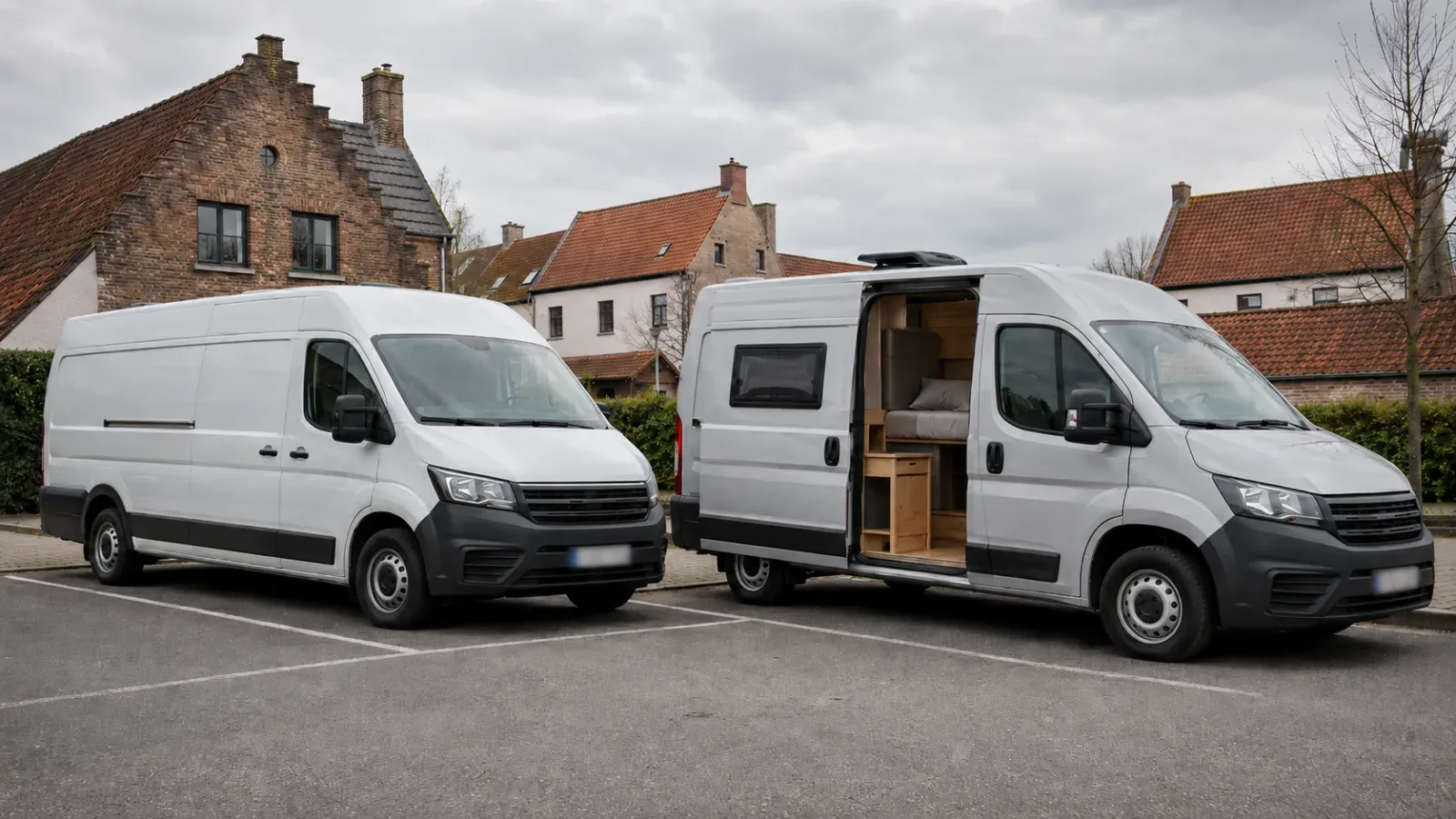
Anyone converting a van into a travel bus will sooner or later face the same question: do you keep the vehicle registered as a light commercial vehicle, or do you officially register it as a campervan?
At first glance, this might seem like mere paperwork. In practice, this choice affects your interior, homologation, inspection, road tax, insurance, and even what you can and cannot expect during roadside checks.
For vanlifers, this is not a minor detail. It determines how far you can go with your conversion and how correctly your van is registered on paper.
What is a light commercial vehicle?
A light commercial vehicle is a motor vehicle intended for goods transport with a maximum authorized mass of 3,500 kg or less.
To be registered as a light commercial vehicle, the vehicle must meet several conditions. The cargo area must be at least 50 percent of the length of the wheelbase. The cargo area must consist of a fixed or permanently attached horizontal loading floor and may not have anchoring points for extra benches, seats, or seat belts. The cargo area must also be completely separated from the cabin by a partition wall.
This last point is important for vanlifers. A van that officially remains a light commercial vehicle is still, on paper, a vehicle for goods transport. You cannot simply turn it into a living space as if it were a campervan, without the registration and interior still being correct.
What is a campervan?
A campervan is a category M vehicle with a living area. This living area must at least be equipped with:
- a table and chairs
- sleeping accommodation
- cooking facilities
- storage options
This equipment must be permanently fixed in the living area. The table may be designed so that it can be easily removed.
A campervan is, therefore, officially intended for travel and stay. This naturally aligns better with what many vanlifers actually do: sleeping, cooking, storing belongings, and living on the road.
The big difference: goods transport or accommodation
The main difference lies in the official purpose of the vehicle.
A light commercial vehicle is intended for goods transport. A campervan is intended for passenger transport with living accommodation.
That sounds theoretical, but it becomes very practical as soon as you start building. With a light commercial vehicle, the cargo area remains a cargo area. With a campervan, that same space officially becomes a living area.
Therefore, a converted van is not automatically a campervan. A mattress, loose boxes, and a camping stove do not suddenly make your van officially a camper. But if you build a fixed interior with a bed, cooking area, table, chairs, and storage space, and you want to officially register that vehicle as a campervan, then you enter the realm of homologation.
Can a light commercial vehicle still have a camper interior?
Yes, in certain cases, a commercial vehicle such as a light commercial vehicle can be equipped with a camper interior.
Flanders states that some commercial vehicles of category N1, N2, or N3 can be equipped with a camping interior. A light commercial vehicle with a partition wall between the driver's compartment and the living area AND with the required camping equipment can be registered as a light commercial vehicle or as a campervan M1.
If you choose registration as a campervan M1, it involves a change of category and type. In that case, new homologation is required.
Without a partition wall, it becomes stricter. A light commercial vehicle without a partition wall between the driver's compartment and the living area, but with the required camping equipment, can, according to Flanders, be registered as a campervan M1. In that case, too, new homologation is necessary.
In short: remaining a light commercial vehicle is sometimes possible, but your interior must still fit within what is administratively permitted. You cannot simply want to retain all the benefits of a light commercial vehicle and at the same time pretend that the vehicle is officially a campervan.
Why do some vanlifers choose a light commercial vehicle?
The choice for a light commercial vehicle often stems from simplicity, cost, or the fact that the vehicle was originally registered as such.
For some people, a light commercial vehicle is interesting because they only use the van for sleeping to a limited extent. Think of someone who installs a simple removable sleeping box, takes loose camping gear, and also uses the van for work or transport.
From a tax perspective, a light commercial vehicle can also be interesting. Light commercial vehicles do not pay registration tax. The annual road tax is calculated according to different rules than for regular passenger cars and depends, among other things, on the maximum authorized mass, Euro standard, and possibly a particulate filter.
But you should not be blinded by potential advantages. If your interior no longer complies with the requirements for a light commercial vehicle, this can cause problems during inspection, checks, insurance, or taxation.
Why do some vanlifers choose a campervan?
An official campervan is a better fit for a permanent camper conversion. If your vehicle is built for sleeping, cooking, and living, then the registration also matches its actual use.
That provides peace of mind. You don't have to explain why your cargo area is actually a bedroom. Your vehicle is officially what it is in practice: a campervan.
A campervan must meet the basic requirements. Think of fixed equipment, correct seating, secure fastening, emergency exit, glass with European marking, correct documentation, and possibly approval from the base manufacturer. For a conversion, you usually need an individual approval certificate.
From a tax perspective, a campervan in Flanders is also regulated separately. For campervans, the Flemish Tax Service looks at the maximum authorized mass for the annual road tax. For campervans, no registration tax is due.
Inspection: is there a difference?
For many vanlifers, the inspection is one of the most important practical differences. However, the difference here is smaller than people sometimes think.
According to GOCA Flanders, campervans must be inspected after re-registration and then annually. Light commercial vehicles up to and including 3,500 kg must also be inspected after re-registration and then annually.
The difference is not only in how often you have to go for inspection, but mainly in what is checked and which papers must be correct.
For a light commercial vehicle, they look, among other things, at the conditions for light commercial vehicles, such as cargo area, partition wall, and technical condition. For a campervan, the living interior plays a role, along with the approval of the conversion, the weighing, the identification report, and the specific requirements for campervans.
Road tax and BIV
There are also tax differences, although you should always be careful with general statements. Taxes depend on your vehicle, registration, date, mass, fuel, Euro standard, and sometimes other factors.
For light commercial vehicles, they do not have to pay registration tax. The annual road tax is calculated based on the rate for light commercial vehicles, with corrections depending on, among other things, the Euro standard and particulate filter.
For campervans, there is a separate regulation in Flanders. The annual road tax for campervans is calculated based on the maximum authorized mass. Campervans also do not have to pay registration tax.
For those who want to know exactly what their van will cost, the simulation tool of the Flemish Tax Service is the safest choice. Especially with conversions or re-registrations, you don't want to guess amounts you've read somewhere in a Facebook group.
Insurance: always state what you actually do
Insurance may not be the most exciting topic, but it is important.
If your vehicle is a light commercial vehicle on paper, but in practice is used entirely as a camper, you must ensure that your insurance company knows how the vehicle is used and equipped. The same applies to expensive built-in components such as solar panels, household battery, inverter, furniture, skylight, or pop-top roof.
With an official campervan, the use is usually clearer. Your insurer then knows that it is a camper or motorhome. But even then, you must indicate what is in the vehicle and whether the conversion is professional or DIY.
My personal rule would be: better to be too honest with the insurer than to have a dispute afterwards after damage or theft. Building a van already costs enough. You don't want to discover that your coverage is incorrect when it's too late.
What about seating?
Seating is an important point of difference.
With a light commercial vehicle, the cargo area is primarily for goods transport. The cargo area may not have anchoring points for extra benches, seats, or seat belts if you want to remain under the conditions for a light commercial vehicle.
With a campervan, there can be seats in the living area, but these must be correctly approved if they are used while driving. Seats, headrests, seat belts, and anchoring points must have the necessary European approvals.
Side-facing seats may no longer be used while driving since October 20, 2007. Swivel plates can also affect the approval of the seat.
In other words: a bench to sit on when you are stationary is not the same as an approved seat for on the road.
What about the partition wall?
The partition wall is one of the biggest practical differences between a light commercial vehicle and a campervan.
For a light commercial vehicle, a full partition wall between the cabin and the cargo area is one of the conditions. This wall ensures that the cargo area remains clearly separated from the cabin.
With a campervan, it's different. There, it's about a living area. If people are transported in the living area, under certain conditions, a passage must be provided between the driver's compartment and the living area for visual contact with the driver.
This does not mean that every camper must have the same layout, but it does mean that your partition wall, seats, and use must be consistent. A full partition wall can be useful if you want to remain a light commercial vehicle, but can be limiting if you want to transport passengers in the living area.
What best suits your situation?
There is no single choice that is right for everyone.
A light commercial vehicle can be logical if your van primarily remains a commercial vehicle, your interior is limited or removable, you don't want to make an official campervan, and you want to retain the cargo function.
A campervan is more logical if you create a permanent camper conversion, primarily use your vehicle for travel and stay, and want the paperwork to match the actual use.
For me, that's actually the core of this whole story: make your paperwork match your reality. If your van is practically your small home on wheels, then an official campervan often feels more logical. If your van primarily remains a light commercial vehicle with an occasional sleeping setup, then a light commercial vehicle may suffice.
Common misconceptions
A first misconception is that every van with a bed automatically becomes a campervan. That is not true. Loose or temporary items do not automatically make an official camper.
A second misconception is that you can always keep your light commercial vehicle status as long as the vehicle was once registered as such. That is also too simplistic. The interior must continue to meet the conditions.
A third misconception is that a campervan is always much more expensive. That depends on your vehicle and situation. For campervans in Flanders, there is a separate road tax based on the maximum authorized mass, and there is no registration tax.
A fourth misconception is that the inspection only looks at brakes, lights, and tires. For a converted van, the interior, documents, weight, seats, and approval also count.
Practical conclusion
Light commercial vehicle and campervan are not just two names for the same vehicle.
A light commercial vehicle is, on paper, a vehicle for goods transport. A campervan is, on paper, a vehicle with living accommodation. For vanlifers, this difference is important because your vehicle must not only work practically but also be administratively correct.
Do you want a simple, temporary sleeping setup and does your van primarily remain a commercial vehicle? Then a light commercial vehicle can be logical.
Do you want a permanent camper conversion with a bed, cooking area, storage space, and a real living function? Then a campervan is often the cleanest choice, but then you have to take homologation and the correct inspection into account.
The best choice is therefore not made based on what someone says online, but based on your vehicle, your conversion, your use, and your official papers.
Source: https://www.gocavlaanderen.be/detail-page/data-en-frequentie