Municipal police regulations: why the rules can differ per municipality
“Can you sleep in your van in Belgium?” That seems like a simple question, but in practice, the answer is rarely simple. Belgium has national traffic rules, regional rules, local police regulations, parking signs, nature rules, and sometimes separate rules per zone, square, parking lot, or coastal municipality. That's why “it's allowed in Belgium” is often too simplistic.
By Laurens De Leeuw · 23 June 2026
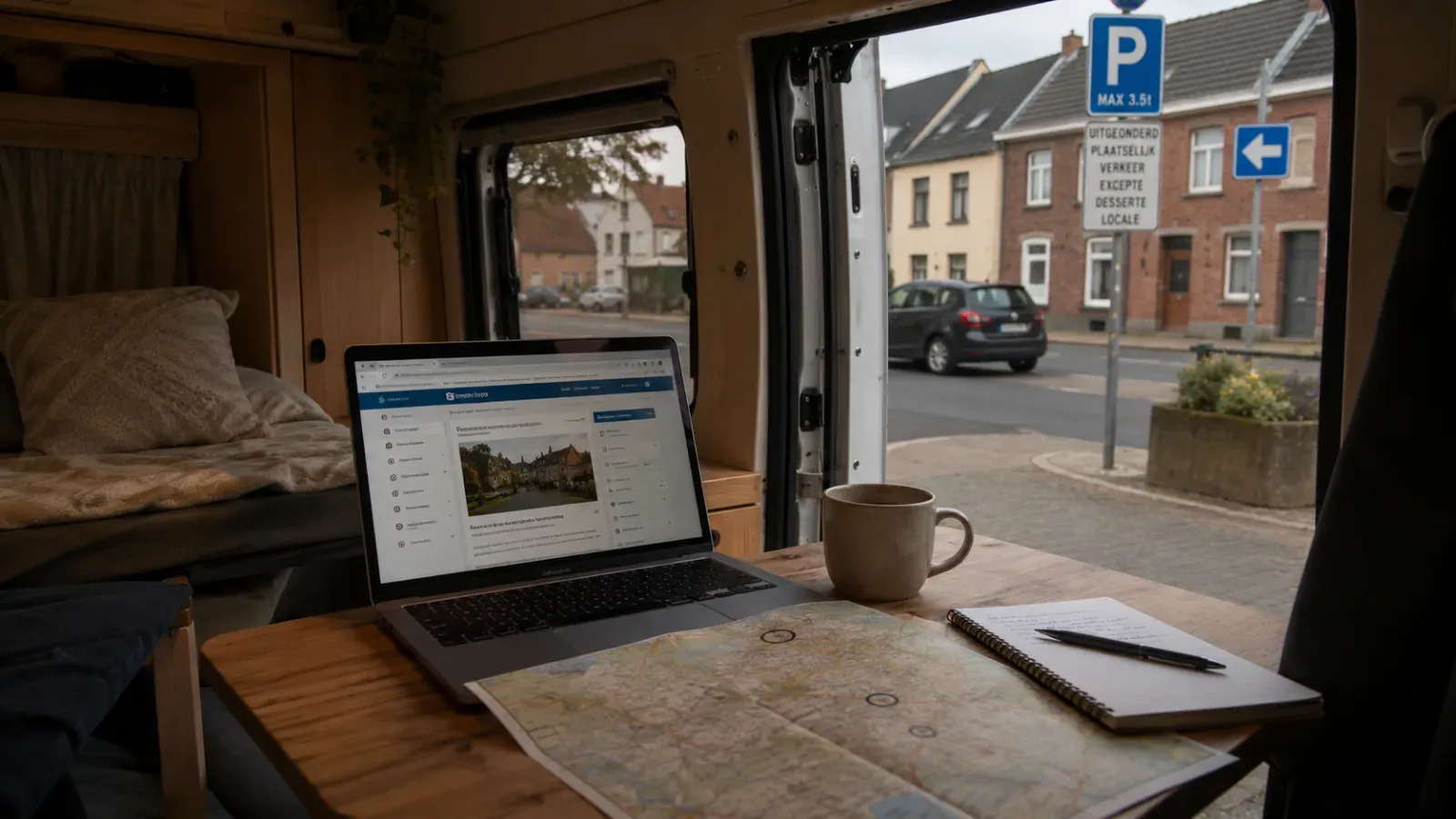
Can you sleep in your van in Belgium?
That seems like a simple question, but in practice, the answer is rarely simple. Belgium has national traffic rules, regional rules, local police regulations, parking signs, nature rules, and sometimes separate rules per zone, square, parking lot, or coastal municipality.
That's why “it's allowed in Belgium” is often too simplistic.
What seems to be no problem in one municipality can be forbidden a few kilometers further. Not because Belgium is arbitrary, but because municipalities have the authority to regulate local problems. And with vanlife, it's often about local situations: parking, night rest, nuisance, tourism, public space, beach, dunes, nature, market squares, residential streets, and parking lots.
Belgium has general rules, but municipalities have local powers
The Belgian Highway Code applies throughout Belgium. Among other things, it defines what parking and stopping mean, which traffic signs apply, and how drivers should behave on public roads.
But that doesn't mean that all parking spaces in Belgium can be used in the same way. Municipalities have powers within their own borders for matters that serve the local interest. They can draw up their own decisions and regulations for this.
This is important for vanlifers. The basic rules regarding traffic are general, but the specific rules regarding a square, parking lot, beach zone, village center, or night rest can differ locally.
What is a municipal police regulation?
A municipal police regulation is a local regulation in which a city or municipality lays down rules regarding public order, safety, peace, cleanliness, and liveability.
Think of rules about night noise, waste, dog poop, fireworks, begging, terraces, events, use of public domain, parking, camping, or overnight stays in certain places.
The mayor also plays an important role in this. The mayor is responsible for administrative policing within the municipality's territory and is involved in the implementation of police ordinances and police decisions.
For you as a vanlifer, this means: the municipality may have local rules that are in addition to the general traffic rules. Even if you are parked correctly according to the Highway Code, a local police regulation can still stipulate that overnight stays, camping, or certain uses of public space are not allowed there.
Why does this differ per municipality?
Every municipality has different problems and priorities.
A coastal municipality experiences much more pressure from tourism, motorhomes, beach parking lots, dunes, and second homes. A rural municipality might focus more on agricultural roads, forest parking lots, and quiet village centers. A city, on the other hand, pays more attention to resident parking, night noise, market zones, event zones, and busy public parking lots.
That's why municipalities make different choices. One municipality provides a camper pitch with clear conditions. Another municipality prohibits overnight stays on public domain. Yet another municipality allows parking during the day, but not at night.
This is not always convenient for travelers, but it is how local regulations work.
Parking is sometimes allowed, overnight stays are not
This is one of the biggest pitfalls.
A sign or municipal page may state that you can park a motorhome or larger vehicle somewhere. But that does not automatically mean that you can also stay overnight there.
Ostend, for example, states that overnight stays in a motorhome on public domain are not permitted. This is only possible at an official campsite.
Blankenberge makes the same kind of distinction. During the day, motorhomes and caravans can park on the Moysonpad, but overnight stays are not permitted there. At night, you have to move to a campsite.
Koksijde, on the other hand, provides a specific motorhome pitch in Koksijde-Dorp, free of charge, with 15 spots and a maximum duration of 16 hours.
Bredene and De Haan show yet another approach. The local police state that overnight stays in campervans, motorhomes, and the like are prohibited on public roads, in the forest, in the dunes, and on the beach.
These are all Belgian coastal municipalities, but the practical rules are not identical.
Traffic signs and supplementary signs remain decisive
In addition to police regulations, traffic signs also play a major role.
A municipality can regulate local traffic situations through supplementary traffic regulations. On the street, you see this reflected in parking signs, supplementary signs, time restrictions, blue zones, resident parking, height restrictions, prohibitions for certain vehicles, or specific indications for campervans and motorhomes.
For vanlifers, this means: not only looking if there is a parking space available, but also reading exactly what is on the signs and supplementary signs.
Pay particular attention to words such as:
- no overnight stays
- no campervans
- passenger cars only
- resident permit
- max 2 hours
- max 24 hours
- parking closed between certain hours
- blue zone
- paid parking
- prohibited on beach, dunes, or nature reserve
Sometimes it doesn't literally say “vanlife prohibited,” but there is a rule that in practice means you can't stay there overnight.
“Didn't see a sign” is not a watertight argument
Many people think: “If there's no sign, it's allowed.”
That's too simplistic.
Sometimes there is indeed a clear sign: no campervans, no overnight stays, parking closed between certain hours, passenger cars only, resident permit required, or maximum duration.
But some rules are not always on a large sign next to your parking space. They can also be in the municipal police regulations, on the municipality's website, in a parking regulation, or in a general rule for public domain.
That doesn't mean that as a traveler you can know everything perfectly. But it does mean that if in doubt, it's best to check, especially in sensitive places such as coastal municipalities, nature parking lots, village squares, towpaths, beach zones, dunes, city centers, and residential areas.
GAS fines and local enforcement
Municipalities can punish certain offenses with municipal administrative sanctions, better known as GAS fines.
A GAS fine is an administrative sanction for nuisance or offenses that are regulated locally. Municipalities can determine through their police regulations which behaviors they want to address, as long as it fits within the legal rules.
For vanlifers, the message is simple: local rules are not just advice. In some cases, violation can actually lead to a fine or other intervention.
Why “I'm just sleeping” doesn't always help
Vanlifers often distinguish between camping and sleeping. This distinction is important, but it doesn't solve everything.
You can correctly argue that you don't put chairs outside, don't open an awning, and don't exhibit camping behavior. Nevertheless, a municipality may have rules that not only prohibit camping but also overnight stays in vehicles on public domain.
That is an important difference.
If a rule says “camping prohibited,” it often refers to camping behavior: tents, chairs, tables, awning, outdoor cooking, and staying in public space.
If a rule says “overnight stays in vehicles prohibited,” then discreetly sleeping in your van can also fall under that rule.
Therefore, you should always look at the exact wording.
How do you check a municipality's rules?
The fastest way is to search the website of the municipality where you want to stay. Use keywords such as:
- motorhome
- camper
- campervan
- overnight stay
- parking
- police regulations
- public domain
- camping
- GAS
- large vehicles
In coastal municipalities, you often find separate pages about motorhomes or large vehicles. In other municipalities, it may be in the general police regulations. Sometimes you can also find the information on the website of the local police zone.
Also pay attention to the date and context. A forum reaction or app review from three years ago is less reliable than the municipal website or a current sign on site.
Apps are useful, but not decisive
Vanlife apps and camper apps can be useful for finding places. They provide experiences from other travelers, photos, coordinates, and sometimes information about facilities.
But they are not legislation.
A place may be in an app because someone slept there once without problems. That doesn't mean it's allowed. Maybe it was never checked. Maybe the regulation has changed. Maybe the rule only applies in summer. Maybe it's only addressed after complaints.
So use apps as inspiration, not as permission.
Practical checklist for vanlifers
Before you stay overnight somewhere, ask yourself these questions:
1. Am I allowed to park here according to the signs?
2. Is there anything about overnight stays, camping, motorhomes, or large vehicles?
3. Is this a regular parking lot or an official camper pitch?
4. Is this public domain, private property, or a nature reserve?
5. Does the municipality have separate rules on its website?
6. Is there a maximum duration or a night ban?
7. Am I in a coastal municipality, tourist zone, or sensitive nature zone?
8. Am I not putting anything outside and not giving a camping impression?
9. Can I leave calmly if someone addresses me?
10. Is there a clear legal alternative nearby?
If in doubt, it is safer to use an official camper pitch, campsite, or private spot with permission.
Why this is important for the community
If vanlifers continue to act as if “it's allowed in Belgium” is enough, complaints, checks, and new prohibition signs will arise more quickly.
Municipalities usually react to concrete problems: waste, noise, vehicles staying too long, parking lots filling up, residents complaining, nature being damaged, or people using regular parking lots as campsites.
That's why local respect is so important. Not every municipality is against vanlife. But every municipality wants to keep its own public space liveable.
Those who respect local rules help to keep the image of vanlife positive. Those who think “I'll just do what I want” make it more difficult for the next person.
Conclusion
The question “can you sleep in your van in Belgium?” is too simplistic if you only look at Belgium as a whole.
General traffic rules apply everywhere, but municipalities can have their own police regulations, parking rules, and restrictions. The mayor and municipal council play an important role in local public order, liveability, and enforcement. As a result, the rules can truly differ per municipality.
Therefore, the best approach for vanlifers is: don't just look at the national basis, but always check the local context. Read the signs. Look up the municipal website. Avoid camping behavior in regular parking lots. Respect nature, residents, and public space.
Belgium is small, busy, and locally regulated. Those who understand this travel more calmly and avoid problems.
Source: https://www.politie.be/5450/vragen/parkeren/mag-ik-met-een-motorhome-parkeren-bredenede-haan
Source: https://koksijde.be/nl/met-de-mobilhome
Source: https://www.visit-blankenberge.be/parkeren
Source: https://www.blankenberge.be/grote-voertuigen
Source: https://www.oostende.be/speciale-voertuigen
Source: https://www.oostende.be/mobiliteit-veelgestelde-vragen
Source: https://www.besafe.be/nl/gemeentelijke-administratieve-sancties-gas/administratieve-procedure-gas
Source: https://www.belgium.be/nl/justitie/veiligheid/gemeentelijke_administratieve_sanctie_gas
Source: https://www.wegcode.be/nl/regelgeving/2024005817~0mocswfbry
Source: https://codex.vlaanderen.be/PrintDocument.ashx?datum=&geannoteerd=true&id=1029017
Source: https://www.vlaanderen.be/lokaal-bestuur/organisatie-en-werking/burgemeester/bevoegdheden