Sleeping on the Belgian coast: why you need to be extra careful
The Belgian coast seems ideal for vanlife on paper. You drive to the sea, park somewhere quiet, take a walk on the beach, and then crawl into your van. Simple, right? In practice, it's a lot more sensitive at the coast.
By Laurens De Leeuw · 23 June 2026
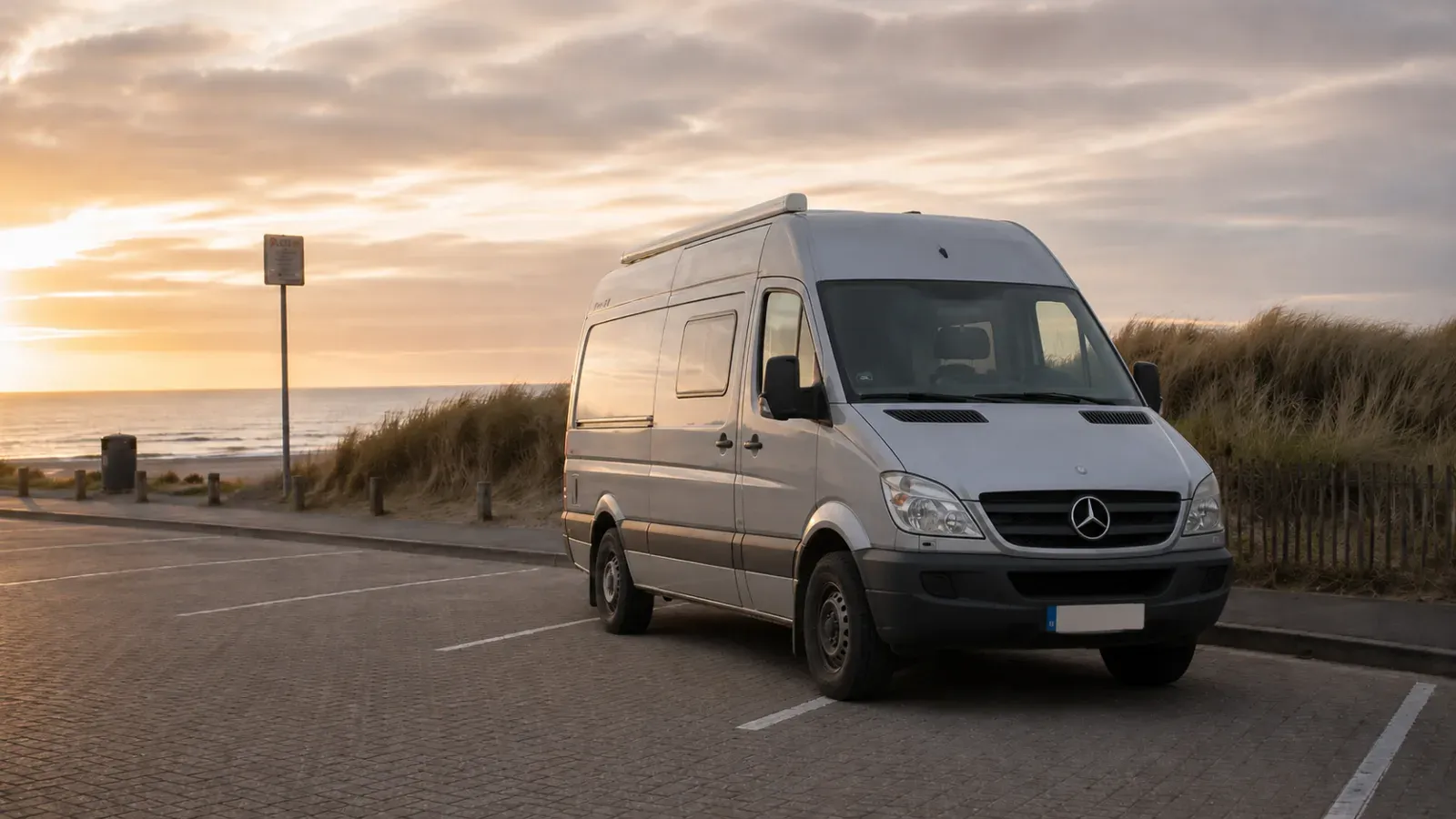
The Belgian coast seems ideal for vanlife on paper. You drive to the sea, park somewhere quiet, take a walk on the beach, and then crawl into your van. Simple, right?
In practice, it's a lot more sensitive at the coast.
Coastal municipalities often have stricter rules regarding campers, motorhomes, parking, and overnight stays. This is due to the crowds, the limited number of parking spaces, the vulnerable dunes, the many second homes, tourist nuisance, and the fact that one wrongly parked camper or van is quickly visible.
So, anyone wanting to sleep by the sea in a van needs to be extra careful. Not because vanlife is impossible there, but because parking at the coast does not automatically mean you are allowed to stay overnight.
Parking is not the same as staying overnight
According to the Belgian road code, a vehicle is parked as soon as it remains stationary longer than necessary for people to get in or out, or to load and unload. That is the general traffic basis. But that definition does not yet mean that you can sleep everywhere you are allowed to park. Municipalities can impose restrictions via local rules or signage for certain vehicles, parking spaces, periods, or forms of overnight stays.
For vanlifers, this distinction is important. A car park by the sea may be perfectly intended during the day for leaving your vehicle while you go for a walk or have a drink. But the same car park may be prohibited for overnight stays in campers, motorhomes, or vehicles used as sleeping accommodation at night.
That sometimes feels contradictory, but at the coast, it's quite normal.
Coastal municipalities enforce more strictly
Many things come together at the coast: many visitors in a small space, narrow streets, busy car parks, sensitive nature, residents who want peace and quiet, and tourist zones where every meter counts. As a result, municipalities often act more strictly against vehicles that remain parked as if they were at a camper site or campsite.
Especially during peak season, weekends, holidays, and events, you need to be extra vigilant. A spot that seems quiet on a regular weekday evening can suddenly be in a strictly controlled parking zone in the summer.
Therefore, “no one else is here” is not a reliable rule. “There was no sign I saw” is also not always enough. At the coast, you must actively look for signs, local rules, and official camper sites.
Examples on the coast
Ostend is very clear: there are a number of parking spaces for motorhomes, including in Mercatorlaan and at the car park near Diksmuidestraat, but overnight stays in a motorhome on public land are prohibited. The city refers to official campsites for overnight stays.
Blankenberge also makes a clear distinction between parking and sleeping. Motorhomes and caravans may park during the day on the Moysonpad, but overnight stays are not permitted there. At night, you must move your motorhome or caravan to a campsite.
In Bredene and De Haan, the local police state that overnight stays in camping vehicles, motorhomes, and the like are prohibited on public roads, in the forest, in the dunes, and on the beach. According to that police zone, there are also no public overnight sites specifically for motorhomes there.
Koksijde, on the other hand, has a specific motorhome pitch in Koksijde-Dorp, with a maximum duration of 16 hours. This clearly shows how local and specific the rules can be: one municipality can provide a separate place, but at the same time attach clear time restrictions to it.
The lesson is simple: every coastal municipality has its own approach. What is allowed in one municipality may be prohibited a few kilometers further.
Beach, dunes, and nature: almost always be careful
Sleeping on or near the beach sounds nice, but legally and practically, it's usually not a good idea. Beaches and dunes are not ordinary car parks. They are sensitive, heavily used, and often strictly regulated.
In Flanders, Natuur en Bos states that wild camping or simply pitching a tent in nature is not allowed. There are official bivouac zones, but these are intended for those who come on foot or by bicycle, not for vans that remain at the edge of a nature reserve.
At the coast, it is also important to note that dunes are protected and vulnerable. Therefore, never park on dune land, grass verges, beach access points, emergency routes, or places where you could obstruct passage for emergency services, beach services, or residents.
Even if you “only want to stay one night,” that is precisely what municipalities want to avoid in such places.
An official camper site is not a license for camping behavior
Even if you find an official camper site, you must read the local rules. A camper site is not always the same as a campsite.
Some camper sites only allow parking and overnight stays. Others allow limited camping activities. Still others are actually day car parks, where you can park your motorhome but not sleep. Toerisme Vlaanderen describes camper sites within site-bound accommodation as places where tourists sleep in their camper, and also indicates that camper sites must meet specific conditions.
This does not mean that every car park with a few wide bays is automatically a camper site. So always check what is indicated on site: maximum duration, paid or not, overnight stays allowed or not, discharge possible or not, and whether camping behavior is allowed.
Note the difference between a van and a motorhome
Many vanlifers do not drive a large white motorhome, but a regular delivery van, minibus, or self-converted van. This might make you think: “I'm less conspicuous, so it'll probably be fine.”
But local rules often refer to camping vehicles, motorhomes, and the like. A self-converted van in which you sleep can therefore perfectly fall under the same intention, especially if your vehicle is clearly used as a sleeping vehicle.
Stealth camping also does not solve this legally. The fact that you are less visible does not automatically mean it is allowed. It can help to avoid causing nuisance, but it does not change the local rules.
Signs are extra important at the coast
At the sea, you really need to get into the habit of reading every sign. Not just the large parking sign, but also the small sub-signs.
Pay particular attention to indications such as:
no overnight stays
no camping vehicles
passenger cars only
resident permit
blue zone
paid parking
max 2 hours, max 4 hours or max 24 hours
car park closed between certain hours
no access for vehicles above a certain height or length
prohibited on beach, dike, dunes or nature reserve
Sometimes it doesn't literally say “vanlife prohibited,” but there is a rule that in practice means you cannot stay there overnight.
Avoid camping behavior in regular car parks
At the coast, the line between parking and camping is extra sensitive. Even if you are allowed to park somewhere, you quickly give the wrong impression if you start setting up your spot.
Chairs outside, table outside, awning open, cooking equipment next to the van, shoes outside, wet towels on the doors, blocks under the wheels, or discharging wastewater: that is no longer just parking. In a regular coastal car park, that is precisely the behavior that leads to complaints and stricter signs.
If you want to rest discreetly somewhere, keep everything inside. No setup, no patio, no noise, and no traces.
What is the safest approach then?
The safest approach at the coast is simple: use official campsites, official camper sites, or private grounds with clear permission. Especially if you really want to stay overnight and not just rest for a while.
If you still want to park on public land, first check the rules of the municipality itself. Search the city or municipality's website for “motorhome,” “camper,” “camping vehicle,” “parking,” and “overnight stay.” Don't blindly trust apps, as information may be outdated or users may indicate a spot where overnight stays are actually not allowed.
A vanlife app can be useful for finding ideas, but the local rule remains more important than a review from someone who “slept here without problems.”
Practical checklist for the Belgian coast
Before you stay overnight somewhere on the coast, ask yourself these questions:
Am I allowed to park my vehicle here?
Is there a parking duration, blue zone, paid zone, or resident scheme?
Is there anything about camping vehicles, motorhomes, or overnight stays?
Is this public land, private property, beach, dune, forest, or nature reserve?
Are overnight stays in a vehicle allowed in this municipality?
Am I at an official camper site, or just in a regular car park?
Am I taking up more space than my vehicle itself?
Can I leave without anyone noticing I slept here?
Is there an official campsite or camper site nearby as an alternative?
Would I be okay with this behavior if a hundred other vans did the same?
If you are in doubt about multiple questions, it's better to find another spot.
Why this is important for the community
The Belgian coast is small and busy. If vanlifers massively stay overnight in places where it is not intended, there will only be more prohibitions, height barriers, and controls.
This is not only annoying for large motorhomes. It also affects small vans, minibuses, and people who just want to travel neatly.
That is why responsible behavior at the coast is extra important. No making camp in car parks. No lingering in places where it is not allowed. No leaving behind rubbish. No discharging toilet water. No arguing if you are approached. Just stay friendly and leave if necessary.
Every neat vanlifer helps to improve the image of vanlife in Belgium.
Conclusion
Sleeping on the Belgian coast is possible, but you need to be much more careful than in many other places. Coastal municipalities often have stricter rules regarding campers, motorhomes, parking, and overnight stays. Sometimes you can park during the day, but not stay overnight. Sometimes there are specific camper sites with time restrictions. Sometimes overnight stays on public land are completely prohibited.
The best rule is therefore: never assume at the coast that parking also means staying overnight.
Read the signs. Check the municipal website. Avoid beaches, dunes, and nature zones. Use official places when you can. And keep it discreet, clean, and respectful.
This way, the coast remains enjoyable for residents, visitors, and vanlifers.
Source: https://toerismevlaanderen.be/nl/logies/uitbatingsnormen-camperterrein
Source: https://toerismevlaanderen.be/nl/logies/uitbatingsnormen-terreingebonden-logies
Source: https://natuurenbos.be/activiteiten/bivakzone
Source: https://natuurenbos.vlaanderen.be/faq/mag-ik-kamperen-een-bos-natuurgebied
Source: https://www.politie.be/5450/vragen/parkeren/mag-ik-met-een-motorhome-parkeren-bredenede-haan
Source: https://koksijde.be/nl/met-de-mobilhome
Source: https://www.oostende.be/speciale-voertuigen https://www.blankenberge.be/grote-voertuigen
Source: https://www.oostende.be/mobiliteit-veelgestelde-vragen
Source: https://www.wegcode.be/nl/regelgeving/1975120109~hra8v386pu