Overnight stays on private land: is it allowed with the owner's permission?
For vanlifers, private land often sounds like the perfect solution. No busy parking, no doubt about traffic signs, no angry neighbors, and no hassle with “am I allowed to park here?”. Just ask a farmer, friend, family member, company, or private individual if you can sleep on their property for one night.
By Laurens De Leeuw · 23 June 2026
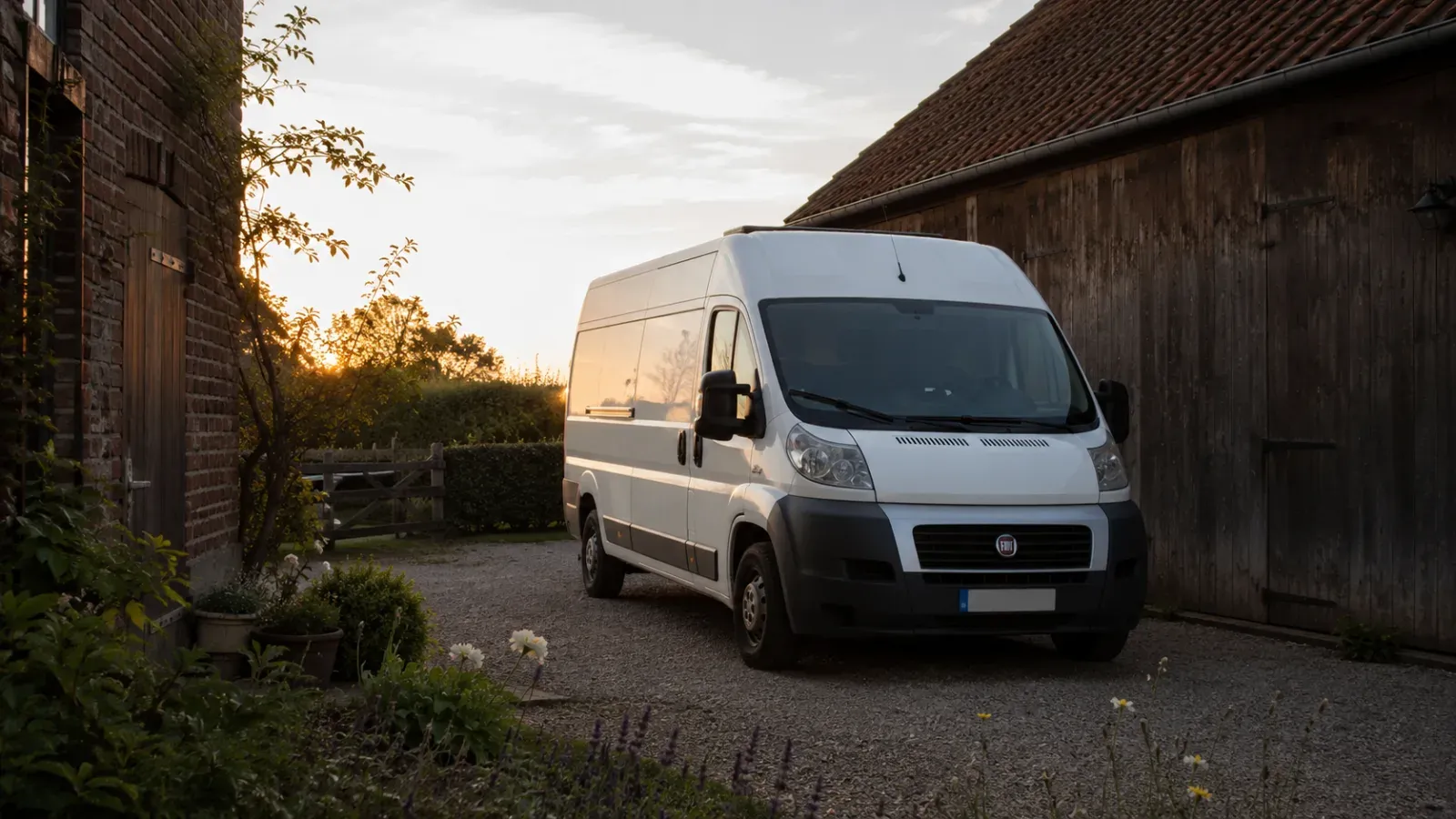
For vanlifers, private land often sounds like the perfect solution. No busy parking, no doubt about traffic signs, no angry neighbors, and no hassle with “am I allowed to park here?”. Just ask a farmer, friend, family member, company, or private individual if you can sleep on their property for one night.
But here too, the answer is nuanced.
Yes, the owner's permission makes a big difference. But no, permission alone does not automatically mean everything is allowed.
It depends on the situation. Is it about one discreet overnight stay in a driveway? Or a meadow where vans, campers, and tents are received every week? Is payment involved? Is it publicly offered? Is the land actually a parking lot, agricultural land, business premises, or residential plot? And are there local rules or urban planning restrictions?
For vanlifers, this is an important article, because private spots can be fantastic. But they must be used correctly.
Permission is the first condition
Parking on someone's property without permission is, of course, not a good idea. A field, forest edge, driveway, company parking lot, or farmyard is not free to use just because it seems quiet or empty.
Private land means someone is the owner, tenant, operator, or manager of that place. So you need permission from the person who has the authority to decide. With a friend, that's simple. For business premises, it must be someone who is actually authorized to give permission. For agricultural land, it's the owner or user of the plot.
With permission, you are in a much stronger position than in a random public parking lot. But that permission doesn't automatically resolve all other rules.
One night with friends or family
The simplest situation is usually: you stay one night in the driveway of friends or family, for free, with their permission, without camping behavior and without causing nuisance.
That also feels logical. You are not operating a campsite. No tourist activity is being organized. You are using the place as a guest of someone you know.
In Flanders, free accommodation and rental to family and friends do not fall under the rules of the Accommodation Decree. This is important, as this decree mainly concerns tourist accommodation offered on the market. Vlaanderen.be also states that anyone who provides paid accommodation must register their accommodation with Toerisme Vlaanderen and meet basic standards.
Nevertheless, common sense is still needed. Don't open an awning on a narrow driveway. Don't leave any waste behind. Don't make noise. Don't block a sidewalk or public road. And don't stay for weeks as if you live there.
A driveway is not a second home
An important nuance: using a van as a sleeping place for one night is not the same as living somewhere.
In Flanders, information regarding environmental permits states that a permit is often required for placing caravans, campers, or tents, unless specific exemption conditions are met. One of these conditions for a movable facility such as a mobile home, camper van, or tent is that it is not actually inhabited and that it is not visible from the public road. The page also clearly states that local rules can be stricter and that you should always inquire with the municipality.
For vanlife, this means: sleeping at someone's place once is different from setting up your van in a driveway for months and actually living there. The longer and more structural it becomes, the faster you move towards living, storage, placing a structure, or a permit application.
At a farmer's yard or in the meadow
A farmer saying “just park there for one night” can be a wonderful solution. You're out of the way, you're not bothering anyone, and you have permission. Especially if it's free and occasional, in practice, it's often a much calmer choice than wild camping somewhere.
But agricultural land is not automatically a camper pitch. As soon as a farmer regularly starts receiving campers or vans, especially for a fee, it becomes a different story. Then it can move towards tourist accommodation, a camper site, a campsite, recreational use, or an urban planning issue.
Toerisme Vlaanderen makes it clear that anyone who allows tourists to stay overnight for a fee must register their accommodation and meet certain conditions. For site-bound accommodation, this includes places where tourists sleep in tents, campers, caravans, or mobile homes.
So: sleeping on a farmyard once with permission is not the same as a farmer offering his meadow as a mini camper site every summer.
Business premises and parking lots
Business premises can also be interesting. Think of a garage, outdoor store, brewery, workshop, riding school, small business, or other company that says you can park in their lot for one night.
Here too, ask for permission from the right person. Not from “someone who happens to work there,” but from the owner, manager, administrator, or person in charge.
With business premises, additional factors sometimes play a role. Is the site fenced? Is there CCTV? Are there trucks leaving early? Is there a risk of fire, construction activity, or heavy traffic? Are you allowed to park there outside opening hours? And what if something happens?
For you as a vanlifer, the best approach is simple: park where you are told you can, stay inside your vehicle, leave nothing behind, and depart at the agreed time.
Paid or publicly offered? Then it gets more serious
The biggest difference is usually with money and repetition.
A friend saying “just park your van here tonight” is one thing. A private individual offering a spot online for €10 a night is another. A farmer occasionally letting someone stay for free is one thing. A site where multiple campers come to stay overnight for a fee every week quickly starts to resemble a tourist operation.
In Flanders, accommodation offered for a fee, even if only temporarily or occasionally, must be registered with Toerisme Vlaanderen. According to Toerisme Vlaanderen, this also applies if you rent out for only one or more nights a year via a platform such as Airbnb, Booking.com, or another booking platform.
For camper pitches, there are also separate conditions when you operate a camper site or use that protected designation. Toerisme Vlaanderen states that the conditions for camper sites are in addition to the general standards for site-bound accommodation, and that you must also meet the basic standards and general conditions even without official recognition.
In short: as soon as you, as an owner or operator, systematically offer overnight stays, especially for a fee, you need to be much more careful.
Free is simpler, but not always free of rules
Allowing free overnight stays is usually simpler than offering paid ones. Vlaanderen.be states that the rules of the Accommodation Decree do not apply to free accommodation.
But free doesn't mean everything is automatically allowed. There can still be local police regulations, urban planning rules, nature rules, fire safety rules, long-term lease conditions, rental agreements, neighbor complaints, or insurance issues involved.
So, a free overnight stay with friends in a driveway is different from a site that is offered for free but publicly and structurally as a vanlife spot.
There are also rules in Wallonia and Brussels
Because Vanlife Belgium covers all of Belgium, it is important to know that the rules differ per region.
In Wallonia, anyone wishing to create or manage tourist accommodation must take into account registration and, in certain cases, urban planning permits. Wallonia states that since 2023, an urban planning permit via the municipality may be required for certain tourist accommodation.
The Brussels rules are again different. Brussels states that the operation of tourist accommodation must be registered and meet conditions regarding safety and urban planning, among other things.
For one discreet private overnight stay at someone's home, this is usually not the problem. For those who want to offer places to travelers, especially for a fee, it is important not to simply apply Flemish rules to Wallonia or Brussels.
What should you, as a vanlifer, do?
Always ask for permission beforehand. Clearly agree on where you can park. Ask if you can only park or also stay overnight. Keep it to one night, unless something else has been clearly agreed upon. Don't put anything outside if it's not explicitly allowed. Don't use an awning, table, chairs, or cooking equipment in places that are not campsites. Don't leave any waste, dishwater, or toilet water behind. Don't make noise. Don't block any passage. And depart at the agreed time.
It also helps to be honest. Don't say “I'm just parking here for a bit” if you actually want to sleep. Just ask: “Can I park my van here tonight and sleep inside? I won't put anything outside and I'll leave again tomorrow.”
That's clear, respectful, and prevents misunderstandings.
What should you, as an owner or farmer, know?
As an owner, farmer, or company, do you want to occasionally let someone stay overnight? Then the safest basis is: keep it occasional, small-scale, clearly agreed upon, and without camping behavior.
Do you want to make it a recurring system, offer it publicly, charge money, provide multiple spots, or advertise it as a camper pitch? Then you are in a different category. Then you need to check what is allowed according to your municipality, the Accommodation Decree, spatial planning, fire safety, insurance, and possibly environmental rules.
Especially the latter is often underestimated. A field is not automatically a permitted camping spot just because the owner approves it.
Practical checklist
For the vanlifer:
Have I obtained permission from the right person?
Is it clearly agreed that I can stay overnight, not just park?
Will I remain discreet and without items outside?
Will I not block anything?
Will I not leave any waste, toilet water, or traces behind?
Will I only stay for a short time?
Do I know where to go if someone approaches me?
For the owner:
Is this truly occasional and private?
Is it free or paid?
Is it offered publicly?
Is it one vehicle or multiple?
Is the site suitable and safe?
Are there neighbors who might experience nuisance?
Do I need to inquire about this with the municipality or Toerisme Vlaanderen?
Am I insured if something happens?
Conclusion
Overnight stays on private land are often allowed if you have permission from the owner or manager. For one night in a driveway, yard, business premises, or private spot, it is usually much simpler and calmer than wild camping somewhere.
But permission is not a free pass. As soon as it becomes structural, publicly offered, for a fee, or attracts multiple vehicles, rules regarding tourist accommodation, camper sites, urban planning, fire safety, and local regulations may come into play.
For vanlifers, the best rule is simple: ask politely, be clear, be discreet, and leave nothing behind. For owners, the best rule is just as simple: helping someone once is different from operating a camper site.
This way, private spots remain something beautiful: personal, hospitable, and without hassle.
Source: https://www.wallonie.be/fr/demarches/creer-et-gerer-un-hebergement-touristique
Source: https://www.vlaanderen.be/omgevingsvergunning/stedenbouwkundige-handelingen/opslag
Source: https://toerismevlaanderen.be/nl/logies/uitbatingsnormen-camperterrein
Source: https://toerismevlaanderen.be/nl/logies/uitbatingsnormen-terreingebonden-logies
Source: https://toerismevlaanderen.be/nl/logies/basisnormen
Source: https://toerismevlaanderen.be/nl/logies/aanmelding
Source: https://toerismevlaanderen.be/nl/logies
Source: https://www.vlaanderen.be/aanmelding-en-erkenning-van-een-toeristisch-logies